

How Digital Agencies Earn Cashback on Client Ad Spend
Executive Summary
Digital agencies earn 1% unlimited cashback on client ad spend by routing client-funded budgets through a dedicated charge card — with no financial exposure to the agency.
Generic business cards (Brex, Amex Platinum, Chase Sapphire) cap rewards, pay points instead of cash, or exclude ad spend from bonus categories — costing agencies tens of thousands in uncaptured cashback every year.
The math is direct: $200K/month in managed spend generates $24,000/year in cashback — from spend the agency is already running.
Opal's Client-Funded Card model is the structural unlock: the client funds the ad budget, the agency runs spend through the card, and the cashback accrues to the agency — zero capital at risk.
Digital agencies earn cashback on client ad spend by running client advertising budgets through a dedicated agency charge card that returns a percentage of every dollar spent as cash rewards. With the right card, every dollar a client allocates to Google Ads, Meta, or any other platform generates a direct cashback return for the agency, not the client.
The key mechanism is the Client-Funded Card model: the client transfers their ad budget to the agency, the agency charges that spend to the card, and the cashback accrues to the agency. The agency never uses its own capital. There is no financial exposure. The client's money funds the spend, but the rewards belong to the agency.
At 1% unlimited cashback on $200,000 in monthly managed ad spend, an agency earns $2,000 per month, or $24,000 per year, in pure cashback revenue. No new clients. No extra hours. No margin negotiation. Just revenue that was always there, going uncaptured.
Most agencies aren't doing this yet. Here's why that's about to change.
Why Most Agencies Are Leaving Thousands Per Month on the Table
The average digital agency manages somewhere between $100,000 and $1,000,000 in client ad spend every month. That volume runs through some combination of credit cards, bank transfers, and ad platform billing accounts. Very few agencies are earning meaningful cashback on any of it.
This isn't because cashback on ad spend is impossible. It's because the cards most agencies use were never designed for them.
The Generic Card Problem
Most business cards treat ad spend as an afterthought. The rewards structure is built around travel, dining, and office supplies, not the thing agencies actually spend the most money on. The result is one of three failure modes:
-
Caps on rewards: Many cards limit cashback to a fixed annual amount ($50,000 in spend, for example), after which the rate drops to near zero. An agency running $500K/month hits that ceiling in the first month.
-
Points instead of cash: Points programs create a conversion layer between spending and value. A point might be worth $0.01 under one redemption and $0.015 under another. Cash is cash. Points are a discount program.
-
Ad spend excluded from bonus categories: Some cards offer elevated rewards on specific categories but explicitly exclude advertising or digital media purchases. The category that represents the majority of agency spend gets the worst rate.
The agencies that recognize this problem often switch to a "better" business card. But as the next section shows, even the cards with the best reputations fall short for agencies specifically.
How Traditional Business Cards Fail Agencies on Ad Spend
Let's be specific. These are the cards agencies most commonly use and exactly where they break down for ad spend at scale.
Card |
Ad Spend Reward Rate |
Key Limitation |
|---|---|---|
Brex (corporate card) |
1x points |
No multiplier on ad spend; points, not cash |
Amex Platinum |
~0.6% as statement credit |
Membership Rewards points, not direct cashback; poor value for ad spend |
Chase Sapphire Preferred/Reserve |
1-2% effective value |
Caps apply; ad spend earns base rate, not travel category multiplier |
Generic business cards |
1-1.5% |
Low flat rates, often with annual spend caps |
The pattern is consistent: these cards were built for corporate travelers and general business purchasers. Ad spend is not a priority category. Agencies using them are earning, at best, half the cashback rate available on a card designed specifically for this use case.
The Real Cost of Using the Wrong Card
The difference between 0% and 1% cashback doesn't sound dramatic. On a per-transaction basis, it isn't. But at agency scale, that gap compounds fast.
-
$200K/month in managed spend: 0% = $0/month. 1% = $2,000/month. Gap: $2,000/month, $24,000/year.
-
$500K/month in managed spend: 0% = $0/month. 1% = $5,000/month. Gap: $5,000/month, $60,000/year.
That $60,000 annual gap is the cost of using the wrong card. It's not a rounding error. It's a full-time employee, a meaningful growth investment, or pure margin improvement sitting uncaptured.
The Cashback Math: What 1% on Client Ad Spend Actually Looks Like
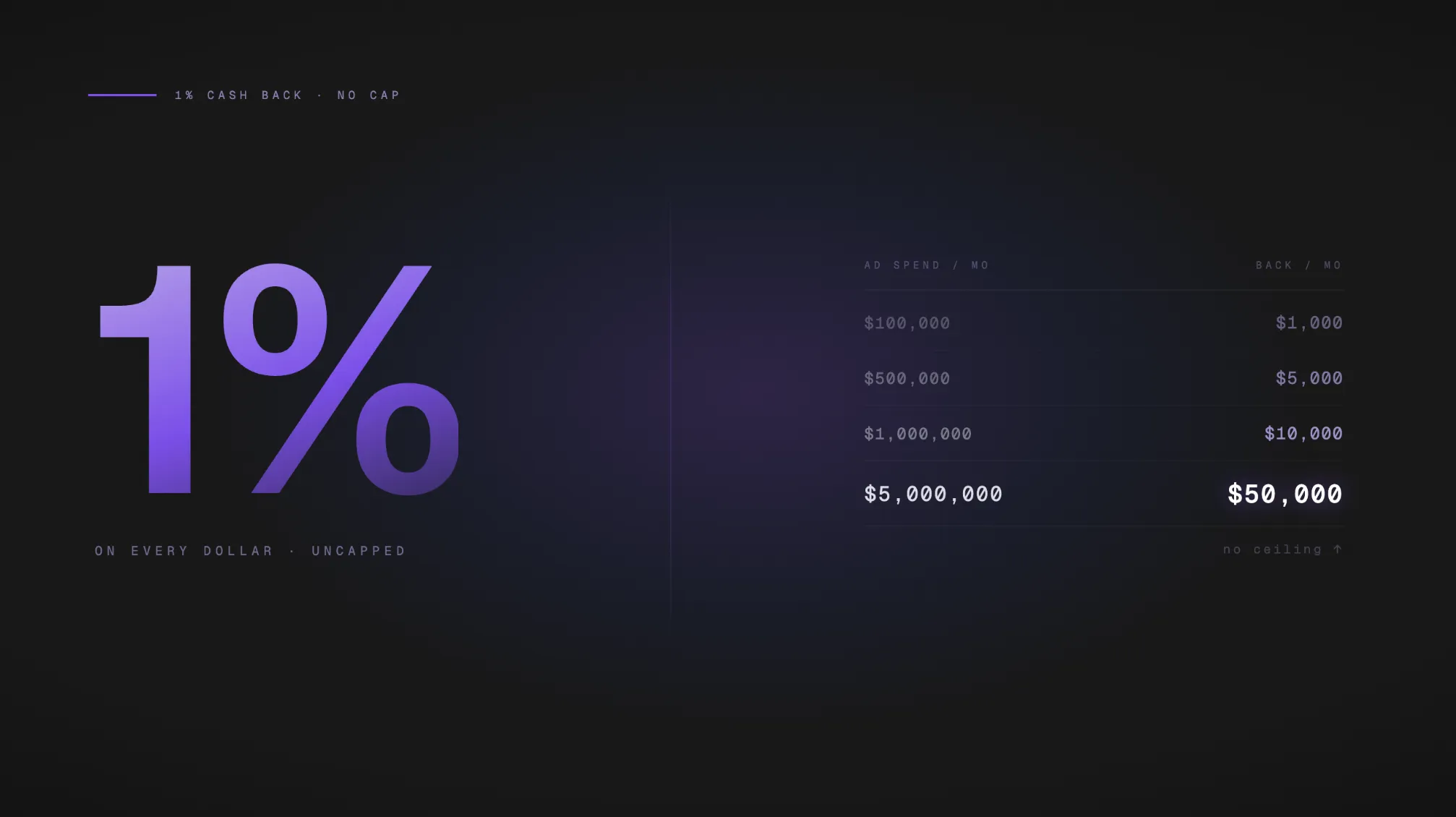
Here is the full picture across common agency spend levels, at 1% unlimited cashback with no caps.
Monthly Managed Ad Spend |
Monthly Cashback |
Annual Cashback |
|---|---|---|
$100,000 |
$1,000 |
$12,000 |
$200,000 |
$2,000 |
$24,000 |
$300,000 |
$3,000 |
$36,000 |
$500,000 |
$5,000 |
$60,000 |
$1,000,000 |
$10,000 |
$120,000 |
These are not projections or best-case scenarios. They are the direct result of applying a 1% cashback rate to spend that agencies are already running for clients.
No New Revenue Required
The critical point here is that this cashback does not require the agency to win new clients, expand retainers, or increase headcount. The spend already exists. The clients are already paying. The only variable is whether the card the agency uses converts that spend into cashback or lets it pass through as zero-return transactions.
Every month an agency spends without a 1% cashback card is a month of cashback revenue permanently forfeited. It doesn't roll over. It doesn't accumulate in the background. It's gone.
The Annual Compounding Effect
At $200K/month in managed spend, an agency that switches to a 1% cashback card in January will have earned $24,000 by December. An agency that waits until July earns $12,000. The six-month delay costs $12,000 with no way to recover it. That's the compounding pressure: every month of inaction has a real, permanent dollar cost.
The Client-Funded Card Model: Earning Cashback Without Financial Risk
This is the structural piece that most agencies miss when they first think about cashback on ad spend.
A standard business card earns rewards on the cardholder's own spending. If an agency uses its own capital to front client ad budgets and then gets reimbursed, the cashback accrues to the agency, but the agency carries the float. That's financial exposure. For agencies managing $500K or more in monthly ad spend, fronting that capital creates real cash flow strain and credit risk.
The Client-Funded Card model works differently.
How It Works
The client transfers their ad budget directly to the agency (or the agency invoices for it upfront, as most already do).
The agency loads those client funds onto a dedicated card.
The agency runs all ad spend through that card across Google, Meta, TikTok, LinkedIn, and any other platform.
Cashback accrues to the agency on every dollar spent.
The agency never uses its own capital. The card is funded by client money.
The agency earns the reward. The client funds the spend. There is no financial exposure because the agency is not fronting anything.
Why This Changes the Math
Traditional cashback thinking assumes the cardholder is spending their own money and earning a small rebate. The Client-Funded Card model inverts this. The agency is spending client money at scale, and the cashback is a direct margin improvement on every managed account.
An agency with 10 clients each spending $30,000/month in ad budget is managing $300,000/month in client funds. At 1% cashback, that's $3,000/month in agency revenue generated entirely by client activity. The agency's own operating capital is untouched.
How Agencies Can Use Cashback Strategically
Cashback revenue is unrestricted cash. How an agency uses it determines how much strategic leverage it creates.
Offset Operational Costs
The most immediate application is using cashback to absorb overhead. Software subscriptions, contractor costs, platform fees, and tools that currently come out of margin can be partially or fully covered by cashback income. An agency earning $2,000/month in cashback can eliminate $24,000 in annual overhead costs without touching retainer revenue.
Improve Net Margin on Retainer Accounts
Most agency retainers are priced on a fixed monthly fee. The agency's margin on each account is the retainer minus the cost to service it. Cashback adds a passive margin layer to every account that generates ad spend, without renegotiating pricing or reducing service quality.
"Opal has transformed how we manage finances. The cashback alone has become a significant revenue stream. We're more profitable, more efficient, and our clients love the transparency." — Operations Lead, Outsmart Labs
Reinvest Into Growth
Agencies that treat cashback as a growth fund can use it to hire, invest in tooling, or fund business development activities that would otherwise require taking margin from existing accounts. At $500K/month in managed spend, $5,000/month in cashback is a meaningful growth budget.
Use as a Competitive Differentiator When Pitching
This one is underused. An agency that earns 1% cashback on client ad spend can legitimately offer clients more value per dollar because the agency's cost structure is better. Some agencies use this to price more competitively, absorb platform fees, or offer enhanced reporting at no additional cost. The cashback subsidizes the client relationship.
The agencies winning on margin in 2026 are not just billing more. They are building passive revenue into the operational model.
For Agency Finance Leads: How Cashback Shows Up in Reporting
If you're the person responsible for the agency's books, here is exactly what you need to know about how cashback from ad spend integrates into financial reporting.
How Cashback Is Categorized
Cashback earned on business card spend is typically recorded as other income or a reduction in advertising expense, depending on your accounting preference. Neither approach is wrong. The key is consistency across periods so the income shows up cleanly in P&L reporting.
-
Other income treatment: Cashback appears as a separate line item in income, making it easy to track as a distinct revenue stream and report to agency ownership.
-
Expense offset treatment: Cashback reduces the net cost of advertising operations, which improves gross margin on managed accounts and is useful for per-client profitability reporting.
QuickBooks Integration
Opal integrates directly with QuickBooks, which means cashback transactions and card spend are automatically reconciled without manual entry. For agencies managing spend across multiple clients and campaigns, this eliminates the bookkeeping overhead that makes high-volume card programs operationally painful.
The integration also means monthly cashback income is visible in real time, not discovered during a quarterly close. Finance leads can report on it as an active KPI rather than a periodic surprise.
Presenting Cashback to Agency Ownership
If you're making the case internally for switching to a cashback-optimized card, the framing is straightforward:
-
Current state: The agency is running $X/month in client ad spend and earning $0 (or near zero) in cashback.
-
Opportunity: At 1% on that same spend, the agency would generate $Y/month in cashback revenue with no operational changes.
-
Annual impact: $Y x 12 = $Z in additional annual income, which flows directly to the bottom line.
-
Risk: None. The Client-Funded Card model means no capital exposure. Clients continue to fund their own budgets.
Key takeaway for finance leads: Cashback from client ad spend is not a perk. It is a predictable, recurring income stream that improves agency margin on every account. At scale, it is material enough to report as a standalone revenue line.
This is a margin improvement that requires no new sales, no new hires, and no client conversations. It is a structural change to how the agency processes spend it is already managing.
Real-World Proof: How Outsmart Labs Turned Cashback Into a Revenue Stream
Outsmart Labs is a digital marketing agency that started earning cashback on client ad spend through Opal. What began as a 1% cashback rate became, in their own words, a significant new monthly revenue stream.
The operations lead at Outsmart Labs described the impact directly: the cashback alone changed the agency's profitability profile. Not marginally. Meaningfully enough to call out as a standalone outcome alongside efficiency improvements and client transparency gains.
This is the proof-of-concept that matters for skeptical agency owners. Cashback on client ad spend is not theoretical. It is already generating real monthly income for agencies that have made the structural change. The only question is whether your agency is one of them.
Start Earning Cashback on Client Ad Spend
The math is straightforward. The mechanism is proven. The only thing standing between your agency and thousands of dollars in monthly cashback is the card you're currently using to run client ad spend.
Opal is a charge card built exclusively for digital marketing agencies. It offers 1% unlimited cashback on all ad spend, no caps, no platform fees, no annual fee, and a Client-Funded Card model that means your capital is never at risk.
Calculate your agency's potential cashback:
Take your total monthly managed ad spend across all clients.
Multiply by 0.01.
That is your monthly cashback at 1%. Multiply by 12 for the annual figure.
If that number is larger than zero and you're not currently earning it, you are leaving money on the table every single month.
Visit opalspend.com to see how much your agency could be earning.
Frequently Asked Questions
Q: How do digital agencies earn cashback on client ad spend?
Agencies earn cashback by routing client-funded advertising budgets through a dedicated charge card that rewards every dollar spent. The client pre-funds the ad spend, the agency runs media through the card, and cashback accrues to the agency. With Opal, this structure is built in so agencies earn 1% back on every dollar of client ad spend, with no caps and no exclusions.
Q: How much cashback can my agency earn?
At 1% unlimited cashback, the numbers scale directly with managed spend. An agency running $100,000/month earns $12,000/year. At $500,000/month, that's $60,000/year. These figures assume no caps and no exclusions — which is exactly what separates a purpose-built agency card, like Opal's, from a generic business card.
Q: Why don't generic business cards work well for agency ad spend?
Generic cards were designed for corporate travel and office purchasing, not high-volume media buying. The three most common failure modes for agencies are reward caps, points instead of cash, and ad spend exclusions. This is exactly the gap Opal was built to solve
Q: How should a finance lead record cashback from client ad spend?
Cashback can be recorded as either other income or a reduction in advertising expense. Both are acceptable; the priority is consistency across reporting periods so the income appears cleanly in P&L. Agencies using Opal benefit from direct QuickBooks integration, which automatically reconciles card transactions and cashback without manual entry.
Q: How do I switch my agency to Opal?
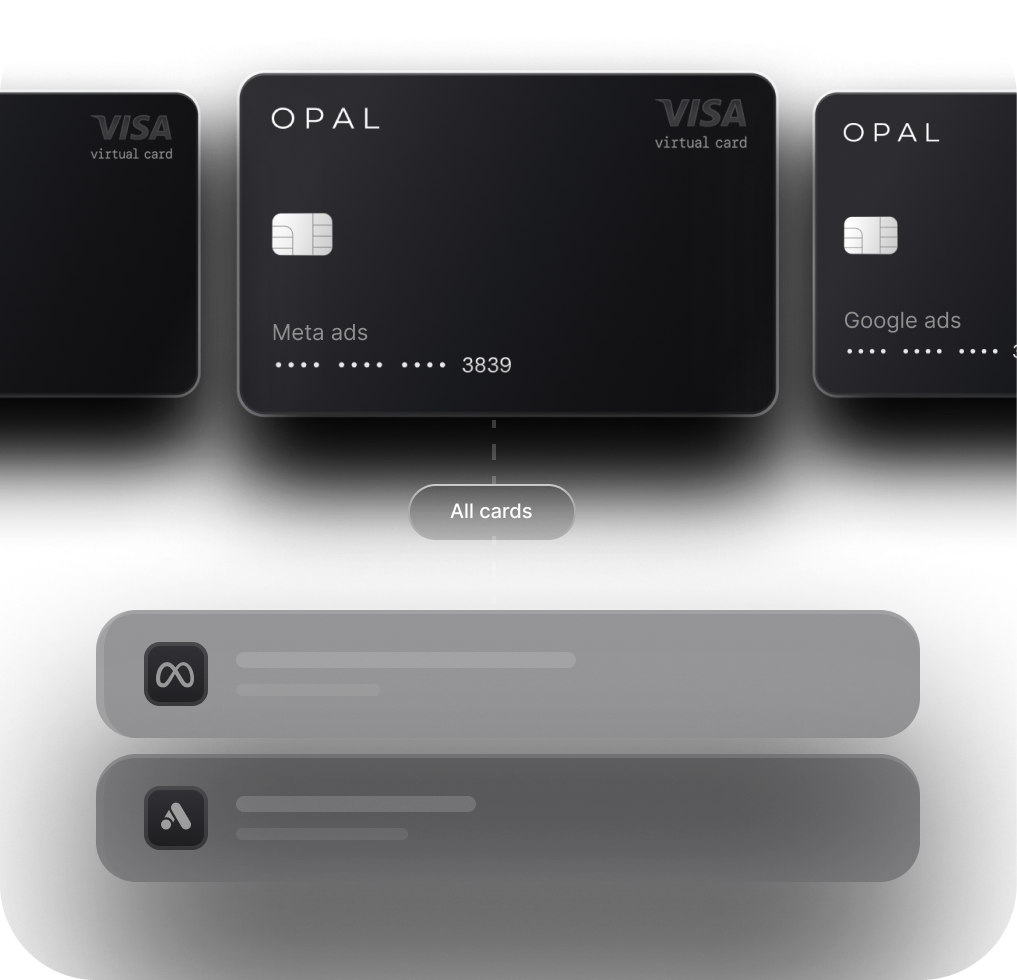
Switching is straightforward. You sign up at opalspend.com, get approved for the card, and set up virtual cards for each client account. From there, you update your ad platform billing details to the Opal card and start running client spend through it. Most agencies are live within a few days.