

How to Eliminate Ad Spend Disputes With Clients Before They Happen

TL;DR
Ad spend disputes between agencies and clients are almost always caused by a structural problem: co-mingled spend on shared cards, no real-time client visibility, and end-of-month reconciliation as the only source of truth.
The most effective way to prevent billing conflicts is to issue each client a dedicated virtual card with a spending limit tied to their approved monthly budget, so charges are always attributable and overruns are structurally impossible.
Under a Client-Funded Card model, each client's money sits in a separate balance and never co-mingles with another client's budget, eliminating the root cause of unattributable charges.
Agencies using Opal Spend can onboard a new client with a dedicated virtual card in under 10 minutes, with automatic budget enforcement, real-time spend visibility, and QuickBooks sync included at no additional cost.
Executive Summary
Agencies lose clients not because campaigns underperform, but because the client doesn't understand what was spent, where, and why. The dispute usually starts with a charge they didn't recognize or a budget they thought wasn't hit. By the time the invoice arrives, the trust has already eroded.
The fix isn't a better report. It's a structural change to how agency spend is organized. When each client has their own dedicated card, their own balance, and real-time access to what's been charged against their budget, there is nothing to dispute. The conversation moves from billing to performance, which is where it should have been all along.
The Dispute That Costs More Than It Looks
A client sends an email. They don't recognize a charge on last month's invoice. Maybe it's $4,200 in Meta spend they thought was closer to $3,800. Maybe it's a line item they can't map to a campaign they approved.
You know the charge is correct. But now you have to prove it.
You pull the Meta Ads Manager report. You cross-reference it against your agency card statement. You build a reconciliation spreadsheet that maps each charge to a campaign, a date, and an approved budget. Two hours later, you send a response with supporting exports. The client accepts it. The invoice gets paid late.
That three-hour reconciliation exercise is not an anomaly. For most agencies, it happens every month, with multiple clients, indefinitely.
The downstream consequences compound fast:
-
Eroded trust. The client now questions whether your numbers are right, even when they are.
-
Delayed payment. Disputed invoices sit in limbo while you gather evidence.
-
Client churn. Billing friction is one of the most common reasons clients switch agencies, even when campaign performance is strong.
-
Internal hours burned. At an agency billing $150/hour, a three-hour reconciliation costs $450 in labor, per dispute, per month.
The problem isn't that your team made a mistake. The problem is that the client had no way to see the truth in real time, so by the time the invoice arrived, the numbers felt foreign.
The Root Causes of Ad Spend Disputes
Most billing disputes between agencies and clients trace back to the same four structural problems. None of them are fixed by sending a better report.
Co-mingled spend on shared cards
Most agencies run all client ad spend through one or two shared business cards. When a Meta statement arrives with $47,000 in charges across 12 clients, there is no native way to attribute each charge to a specific client without manual reconciliation. A single card statement is not a client-level record. It is an aggregated ledger that requires significant labor to decode.
No real-time client visibility into spend
Clients approve a monthly budget at the start of the month. They then have no visibility into what's being spent until the invoice arrives. If spend runs high mid-month due to a campaign adjustment, the client finds out weeks later. By then, the charge feels like a surprise rather than a decision they were part of.
End-of-month reconciliation as the only source of truth
When the invoice is the first time a client sees the actual spend numbers, every discrepancy becomes a dispute. Reconciliation after the fact is reactive by definition. It cannot prevent a disagreement; it can only try to resolve one that has already started.
Budget overruns that go unnoticed until the invoice arrives
On shared cards with no per-client spending limits, a campaign that runs over budget has nothing to stop it. The overrun shows up on the invoice. The client, who approved a specific budget, now sees a number they didn't authorize. The conversation that follows is adversarial before it even begins.
What Agencies Currently Do, and Why It Fails
Agencies have developed workarounds for this problem. None of them solve it.
Current Approach |
Why It Fails |
|---|---|
Monthly spend reports emailed after the fact |
Reactive, not preventive. The dispute has already started by the time the report arrives. |
Screenshots from platform dashboards |
Not a financial record. Platform data and card statements don't always match due to timing differences and billing cycles. |
Manual reconciliation spreadsheets |
Labor-intensive, error-prone, and still after the fact. A spreadsheet explains a dispute; it doesn't prevent one. |
Separate tracking sheets per client |
Creates a parallel recordkeeping system that diverges from the actual card statement the client is questioning. |
The common thread: all of these are reactive fixes applied to a structural problem.
They treat the symptom (the client doesn't believe the number) without addressing the cause (the client had no way to see the number forming in real time). As long as the agency's spend is organized around shared cards and end-of-month reporting, disputes will keep happening. The volume may vary, but the structure guarantees the friction.
The Structural Fix: One Card Per Client
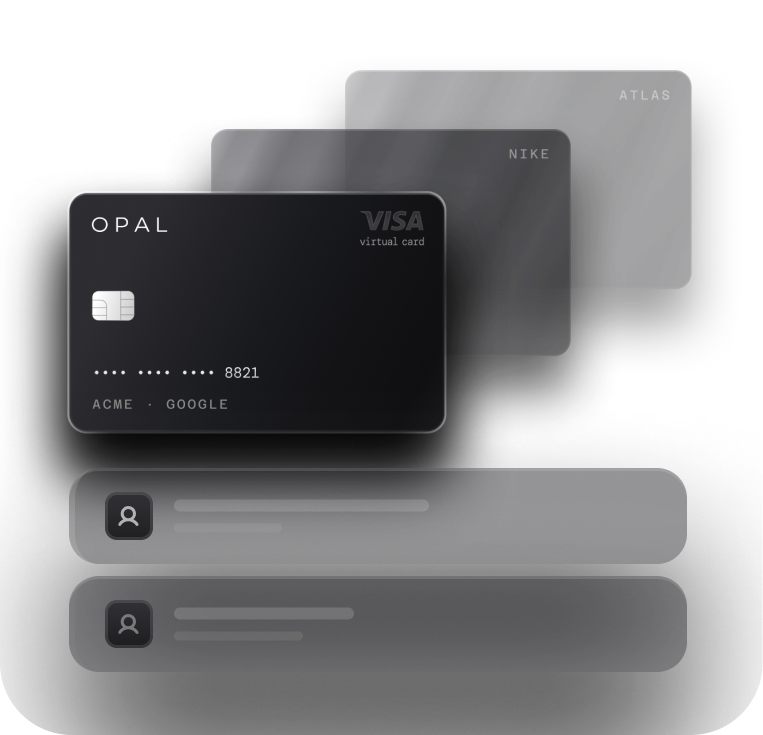
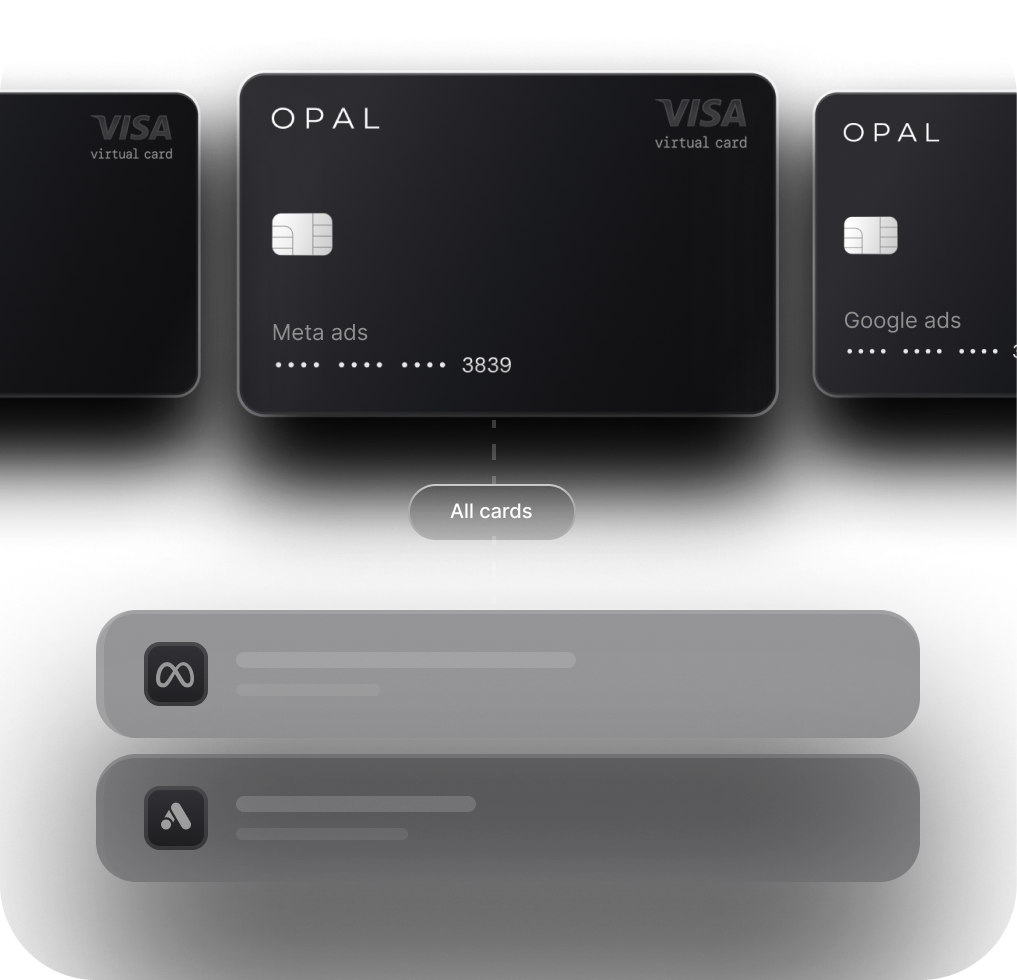
The only way to permanently eliminate ad spend disputes is to reorganize how spend is structured at the card level. Specifically: every client gets their own dedicated virtual card, with a spending limit set to their approved monthly budget, drawing from their own pre-funded balance.
This is not a reporting improvement. It is a structural change to how money moves.
How the Client-Funded Card model works
Under a Client-Funded Card model, the client's budget is loaded onto a dedicated card balance before any spend occurs. That card is the only card used for that client's ad platforms. The spending limit is set to the approved monthly budget. When the limit is reached, the card stops. There is no mechanism for an overrun to occur.
Because each client has their own card and their own balance, their money never co-mingles with another client's budget. Every charge on that card is attributable to that client and only that client. There is no reconciliation exercise to perform because there is nothing to reconcile. The card statement is the client record.
Why this eliminates disputes before they start
When a client's budget is enforced at the card level:
-
Unattributable charges become impossible. Every charge maps to one card, one client, one budget.
-
Budget overruns are structurally prevented. The card stops at the limit. No overrun, no surprise invoice line.
-
End-of-month reconciliation becomes a formality. The card statement already matches the invoice. There is nothing to cross-reference.
-
Client trust is built into the system. Transparency isn't a conversation you have. It's a fact the client can verify themselves, at any time.
How Real-Time Visibility Changes the Client Relationship
The billing dispute is really a trust problem wearing a math problem's clothes. When a client questions a charge, what they're actually saying is: "I don't have enough information to trust this number." Real-time visibility removes that gap entirely.
When a client can log in and see exactly what has been spent against their budget at any point during the month, the dynamic shifts. They're not waiting for an invoice to tell them what happened. They're watching it happen. A mid-month campaign adjustment that increases spend becomes a conversation you initiate, not a surprise they discover.
The conversation stops being "prove this charge to me" and starts being "let's talk about performance." That is a fundamentally different client relationship, and it's built on a structural foundation, not a communication strategy.
How QuickBooks integration keeps the agency's books clean
Real-time visibility for the client is only half the equation. The agency's internal books need to reflect the same reality. With QuickBooks integration, every transaction on every client card syncs automatically to the agency's accounting records. There is no manual data entry, no end-of-month export, and no risk of a discrepancy between what the card statement shows and what the books say.
When the client's card statement, the agency's QuickBooks records, and the invoice all show the same number, there is no surface area for a dispute to form. The data is consistent across every system that touches it.
What This Looks Like in Practice: Setting Up With Opal
Opal Spend is a charge card and spend management platform built for businesses running high-volume ad spend — digital marketing agencies, brands, and in-house media teams. Here is exactly what the operational setup looks like.
Onboarding a new client in under 10 minutes
-
Issue a virtual card for the new client directly from the Opal dashboard. Cards are unlimited and free.
-
Set the spending limit to match the client's approved monthly ad budget.
-
Label the card by client name so every transaction is immediately identifiable.
-
Connect the card to the client's ad platforms. Opal auto-syncs with Google Ads, Meta, TikTok, Snapchat, LinkedIn, Amazon Advertising, and The Trade Desk. This prevents re-verification prompts and campaign interruptions when card details change.
-
Load the client's budget onto their dedicated card balance under the Client-Funded Card model.
The entire process takes under 10 minutes per client. After that, budget enforcement is automatic. The card stops at the limit. Reconciliation maps directly to invoices because the card statement is the client record.
Key platform facts
-
Credit limit: Up to $10 million, with no personal guarantee required.
-
Cashback: up to 2% cashback on ad spend, with no category restrictions.
-
Virtual cards: Unlimited, free to issue.
-
Ad platform integrations: Google Ads, Meta, TikTok, Snapchat, LinkedIn, Amazon Ads.
-
Accounting integration: QuickBooks, with automatic transaction sync.
-
Application: 2 to 3 minutes, no hard credit check, no annual fee.
The structure does the work. Once each client has their own card with their own limit and their own balance, the conditions that create billing disputes no longer exist.
Frequently Asked Questions
How do agencies handle client disputes over ad spend?
Most agencies handle ad spend disputes reactively: they pull platform reports, build reconciliation spreadsheets, and send documentation after the client has already raised a concern. The more effective approach is structural prevention. Agencies that issue each client a dedicated virtual card with a set spending limit eliminate the conditions that create disputes, because every charge is attributable to one client and budget overruns are blocked at the card level before they occur.
How do I give clients real-time visibility into their ad budget?
The most reliable method is to issue each client a dedicated virtual card and grant them read access to that card's transaction feed. When the card is the only payment method used for that client's ad platforms, the card balance is an accurate, real-time record of what has been spent and what remains. This eliminates the need for manual reports and gives the client a live view of their budget at any point during the month.
How do I prevent billing conflicts with advertising clients?
Billing conflicts are prevented by closing the information gap before the invoice arrives. The two most effective structural controls are: (1) dedicated per-client virtual cards that make every charge attributable, and (2) spending limits set to the approved monthly budget so overruns cannot occur. When the client's card statement, the agency's accounting records, and the invoice all reflect the same data, there is no factual basis for a billing conflict.
Can clients see their ad spend in real time?
Yes, when agencies use a dedicated virtual card per client, the client can be given access to their card's transaction history at any time. Platforms like Opal Spend provide a dashboard where both the agency and the client can see live spend against the approved budget, with no lag and no need to pull platform-level reports. This transparency is the single most effective way to prevent disputes from forming.
What is a Client-Funded Card model and how does it prevent disputes?
A Client-Funded Card model means the client's budget is loaded onto a dedicated card balance before any ad spend occurs, rather than being drawn from a shared agency credit line after the fact. Because the client's money sits in a separate balance and is spent only from their card, it never co-mingles with another client's budget. This makes every charge fully attributable, eliminates the possibility of one client's spend being billed to another, and ensures the card statement is a clean, client-specific financial record.
Why do ad spend reconciliation spreadsheets fail to prevent disputes?
Reconciliation spreadsheets are a reactive tool, not a preventive one. They explain what happened after the invoice has already been sent and the client has already raised a question. More critically, they are a manual process applied to a structural problem: as long as multiple clients' spend runs through a single shared card, no spreadsheet can make that statement self-explanatory to a client. The spreadsheet becomes the agency's argument, and arguments are not the same as transparent records.
How long does it take to set up a client with a dedicated ad spend card?
With Opal Spend, issuing a dedicated virtual card for a new client takes under 10 minutes from start to finish. The process involves issuing the card, setting the spending limit to match the approved budget, labeling it by client name, and connecting it to the relevant ad platforms. Opal auto-syncs with Google Ads, Meta, TikTok, Snapchat, LinkedIn, Amazon Advertising, and The Trade Desk, so no manual re-verification is required on the platform side.
Ad spend disputes are not inevitable. They are the predictable output of a system where multiple clients' money runs through shared cards and nobody can see what's happening until the invoice arrives.
The fix isn't a better process. It's a better structure. And it takes 10 minutes per client to set up.
Apply for Opal Spend at opalspend.com and issue your first client card today. No personal guarantee. No annual fee. No hard credit check.