

How to Structure Ad Spend for Multiple Clients Without Card Chaos
Executive Summary
Managing ad spend across multiple clients with shared cards creates three compounding problems: reconciliation chaos at month-end, campaign interruptions when a shared card hits its limit, and client billing disputes from misattributed charges. The fix is structural, not procedural. Agencies that solve this problem issue one virtual card per unit of accountability, whether that unit is a client, a platform, or a campaign. Opal is a charge card built for exactly this use case: unlimited virtual cards issued in seconds, auto-sync with every major ad platform, client-funded balances, spend limits at the card level, and QuickBooks integration that eliminates end-of-month reconciliation entirely.
Picture this: your agency runs five clients. You have two corporate cards. One card is attached to Google Ads, the other to Meta. Both are used for everything.
Month-end arrives. Your finance lead opens the statement and sees 47 line items. Some say "Google Ads." Some say "Meta." None of them say which client. She spends the next four hours cross-referencing screenshots, Slack messages, and campaign dashboards trying to figure out which $8,400 charge belongs to Client C's Q2 retargeting push and which belongs to Client A's brand awareness test.
That is not a process problem. That is a card structure problem.
And reconciliation is only part of it. When a shared card hits its limit mid-month, every client tied to that card goes dark at once. A campaign for Client B gets paused because Client D ran over budget. You find out when a client calls asking why their impressions dropped. The downstream consequences are real:
-
Reconciliation time: 3 to 5 hours per month manually mapping charges to clients and campaigns
-
Misattributed spend: Client billing errors that erode trust and require credit memos
-
Billing disputes: Clients questioning invoices because the numbers don't match what they approved
-
Campaign interruptions: One client's overage kills another client's live campaign
There is a better way to set this up. Here is the framework.
TL;DR: Agencies managing multiple clients should structure virtual cards using one of three models: card-per-client, card-per-platform, or card-per-campaign. The right model depends on your client count, platform mix, and how granular your budget enforcement needs to be.
The Three Ways to Structure Virtual Cards for Multiple Clients
Agencies that have solved this problem all arrive at the same answer: one card per unit of accountability. The unit varies by agency size and operational complexity.
Model |
Best For |
Card Count (5 clients, 4 platforms) |
|---|---|---|
Card per client |
Agencies with 2+ clients, any platform mix |
5 cards |
Card per platform |
Agencies running one client across multiple channels |
20 cards (5 clients x 4 platforms) |
Card per campaign |
High-volume agencies needing hard budget caps |
One card per active campaign |
Each model is a step up in granularity. Most agencies start at card-per-client and move to card-per-platform as they scale. Card-per-campaign is for shops running dozens of active campaigns simultaneously and need budget enforcement baked into the infrastructure itself.
Model 1: Card Per Client (The Baseline Every Agency Needs)
If your agency manages more than two clients and you are not running a dedicated card for each one, you are creating reconciliation work every single month.
The card-per-client model is simple: issue one virtual card per client and use that card exclusively for all ad spend on that client's behalf. Every charge on that card belongs to that client. No exceptions.
What this eliminates immediately:
Month-end spend attribution is automatic. The card statement is the client ledger.
A limit breach on Client D's card does not touch Client A's campaigns. Each client's budget is ring-fenced.
Invoicing maps directly to card spend. No reconciliation spreadsheet required.
If a client churns, you close the card. There is no untangling of shared charges.
This is the minimum viable structure for any agency running more than two clients. It does not require sophisticated tooling. It just requires that each client gets their own card and that card is never used for anything else.
Model 2: Card Per Platform (For Multi-Channel Client Management)
Say your agency runs three clients, and each client is active on Google Ads, Meta, TikTok, and LinkedIn simultaneously. That is 12 active ad platform relationships, all billing at different intervals, with different charge patterns.
A single card per client handles the attribution problem. But it does not give you platform-level visibility. If Client B's card shows $22,000 in charges this month, you still have to dig into each platform's dashboard to know the breakdown.
The card-per-platform model solves that. You issue one card per ad platform per client.
Example setup for three clients across four platforms:
Client A: Google card, Meta card, TikTok card, LinkedIn card
Client B: Google card, Meta card, TikTok card, LinkedIn card
Client C: Google card, Meta card, TikTok card, LinkedIn card
That is 12 cards total. Each one maps to a single client-platform combination. When you pull Client B's Meta card statement, you see exactly what Meta billed for Client B. No math required.
There is a second benefit that gets overlooked: fraud prevention. Ad platforms have different billing behaviors. Google Ads charges in threshold increments. Meta charges daily. TikTok's billing cadence differs again. When all three run through one card, the mix of charge patterns can trigger fraud flags at the card issuer, causing declines mid-campaign. Separate cards eliminate that risk entirely because each card's charge history reflects a single platform's normal billing pattern.
Model 3: Card Per Campaign (For High-Volume Budget Enforcement)
This model is for agencies running a high volume of campaigns simultaneously and need hard budget caps that do not rely on anyone remembering to check a dashboard.
The logic is straightforward: issue one virtual card per active campaign and set a spend limit at issuance equal to that campaign's approved budget. When the card hits its limit, the campaign stops spending. Automatically. No manual monitoring required.
Why this matters at scale:
A campaign with a $5,000 monthly budget gets a card with a $5,000 limit. It cannot overspend, regardless of what happens inside the platform's bidding algorithm.
Your team does not need to audit campaigns daily to catch budget overruns. The card enforces the budget.
If a campaign is paused or cancelled, you close the card. There is no risk of residual charges.
The card-per-campaign model requires a platform that makes card issuance fast and frictionless. If issuing a new card takes a phone call or a 24-hour approval process, the model falls apart operationally. It only works when new cards can be created in seconds.
What This Looks Like in Practice with Opal
Opal is a charge card built for businesses running high-volume client ad spend — agencies, brands, and in-house media teams. The product is designed around exactly the card structures described above.
Here is what the operational reality looks like:
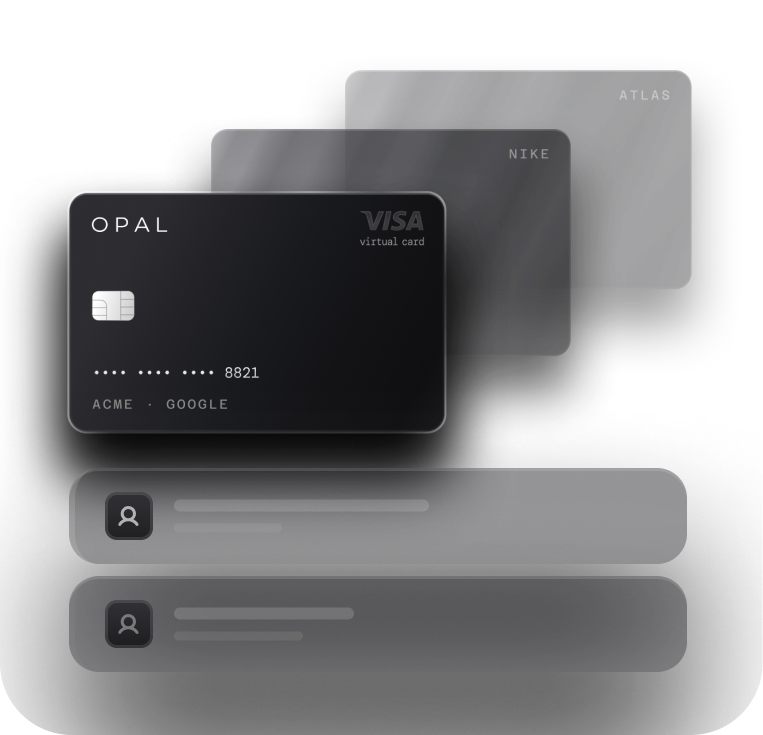
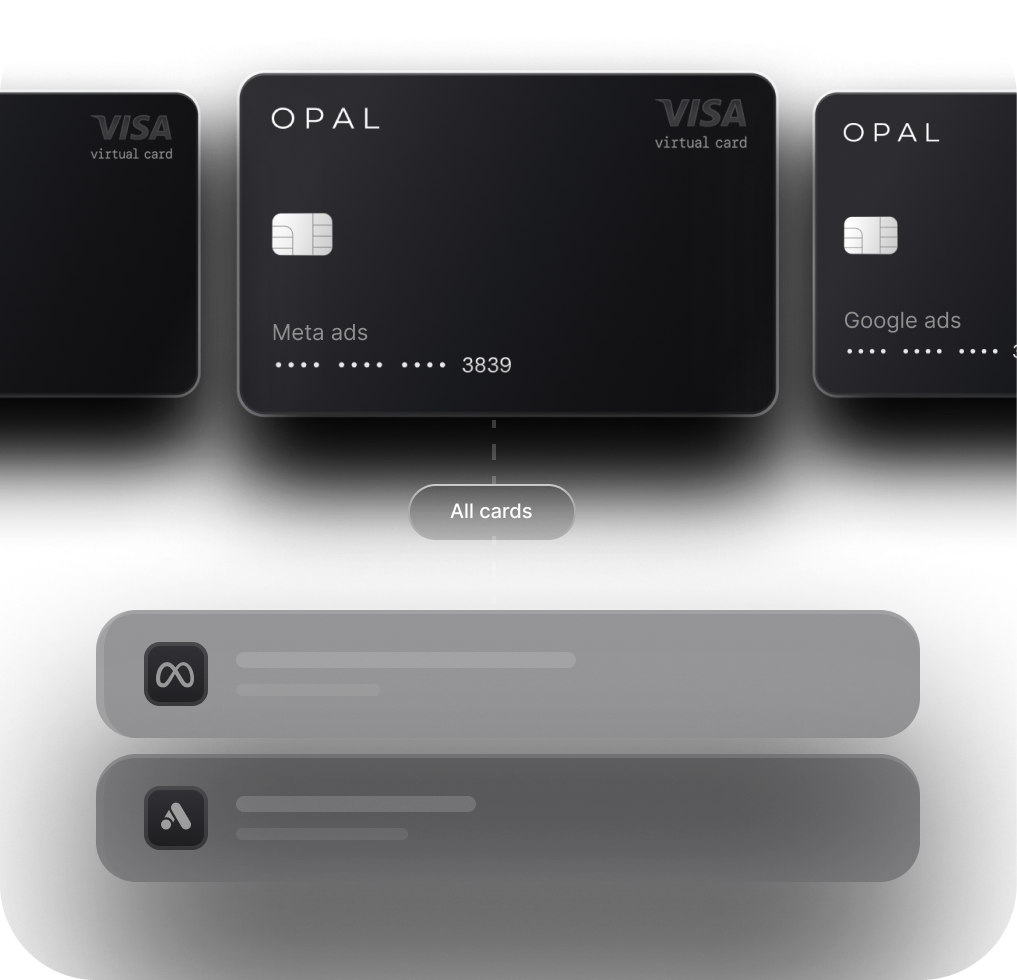
Card issuance: Issuing a new virtual card in Opal takes seconds. You name the card (e.g., "Client A - Meta," "Client B - Google Ads - Brand Campaign"), set a spend limit, and it is ready to use. There is no approval queue, no waiting period.
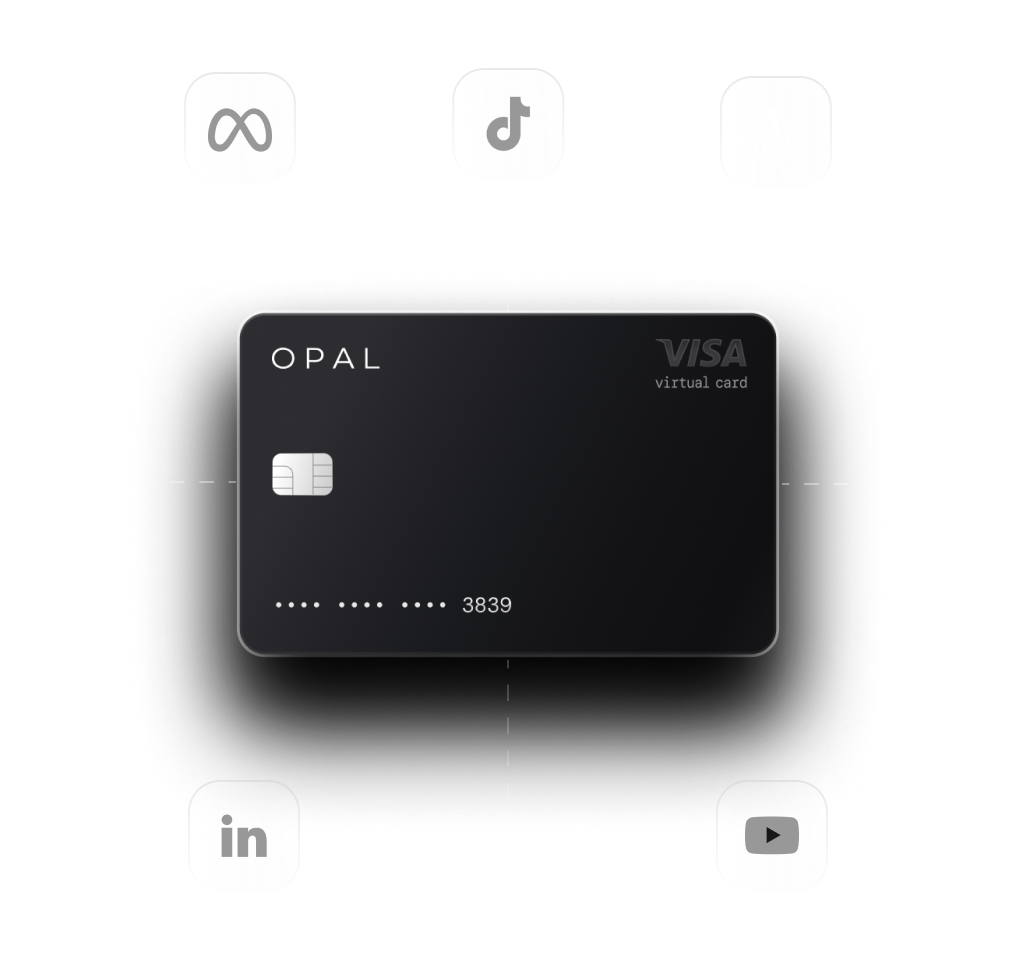
Platform integrations: Opal auto-syncs with Google Ads, Meta, TikTok, Snapchat, LinkedIn, Amazon, and The Trade Desk. This prevents ad platforms from triggering re-verification when a new card is added, which means no campaign interruptions when you swap or add a card.
Client-Funded Card model: Opal supports a client-funded structure where clients pre-fund their own card balance. The agency is not fronting the spend from its own credit line. This is a meaningful operational distinction: the card's balance belongs to the client, which makes reconciliation cleaner and removes the agency's cash flow risk on large ad budgets.
Spend limits: Limits are set at the card level during issuance. You do not need a separate budgeting tool to enforce campaign caps. The card does it.
QuickBooks integration: Spend data flows directly from Opal into QuickBooks. There is no end-of-month export, no manual entry, no spreadsheet reconciliation. The books update as charges occur.
Credit and fees: Opal offers credit limits up to $10M, up to 2% cashback on ad spend, no annual fee, no personal guarantee, and no hard credit check. The application takes 2 to 3 minutes.
Outsmart Labs, an Opal customer, reported saving over 15 hours per week in administrative work after restructuring their card setup around per-client virtual cards.
Why General-Purpose Cards Cannot Replicate This
General-purpose corporate cards were built for companies spending their own money. Co-mingling spend is not a flaw in the design — it just means the design was never meant for agencies spending on behalf of clients.
Some platforms can issue virtual cards. But there are two structural problems that make them a poor fit for agency ad spend:
Problem 1: It is the agency's credit line, not the client's balance. When an agency issues virtual cards from a general-purpose corporate card, every card draws from the same pool of the agency's own credit. A client with a $500,000 monthly ad budget is consuming $500,000 of the agency's credit limit. That constrains the agency's own financial flexibility and creates cash flow exposure that should not exist.
Problem 2: The infrastructure was not built for ad platforms. General-purpose cards do not auto-sync with Google Ads, Meta, or TikTok. Every time you add a card to an ad platform, you risk triggering a re-verification process that can pause campaigns for hours or days. For agencies managing live campaigns, that is an unacceptable operational risk.
The card-per-client, card-per-platform, and card-per-campaign models described above are only operationally viable when the card infrastructure is purpose-built for the use case. Unlimited virtual card issuance, instant setup, platform integrations, client-funded balances, and spend limits at the card level are features that general-purpose cards were never designed to offer agencies.
Get Set Up in Minutes
Every month you run multiple clients through shared cards, the reconciliation problem gets harder to unwind. The fix is not a new process. It is issuing cards differently.
Opal's application takes 2 to 3 minutes, requires no personal guarantee, and involves no hard credit check. Once approved, you can issue virtual cards immediately, label them by client or platform, set spend limits, and connect to your ad platforms and QuickBooks.
Apply at opalspend.com and get your card infrastructure set up before the next billing cycle.