

Opal vs. Brex for Agencies: Which Card Actually Works for Ad Spend?
Executive Summary
Opal offers 1% unlimited cash-back on ad spend; Brex earns 1x points on ad purchases with no bonus multiplier.
Opal's credit limits go up to $10M, built for agencies whose client budgets routinely outpace their own balance sheet.
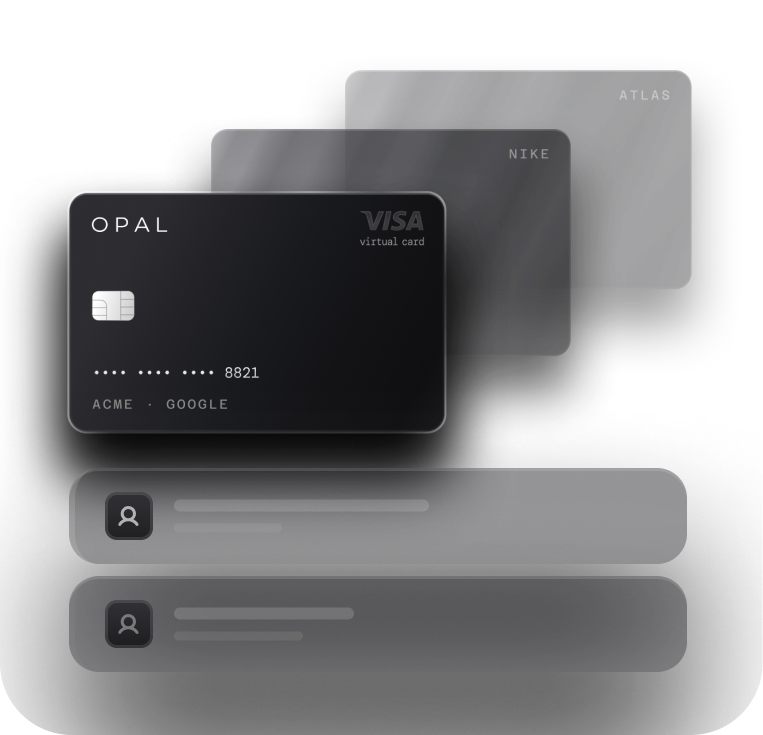
Unlimited free virtual cards let you isolate spend by client, campaign, or platform, so reconciliation is clean, co-mingled charges are eliminated, and month-end closes faster.
Opal is the purpose-built choice for agencies where ad spend is the core business. Brex is a capable generalist, but make unfavourable trade-offs for agencies running paid media.
If you run a paid media agency, you already know the card problem. You're pushing real volume across Google, Meta, TikTok, and a handful of other platforms every month. Your clients expect clean invoicing, your bookkeeper expects clean records, and your finance lead expects the credit line to actually keep up with campaign spend.
Most business cards weren't designed for that reality. They were designed for a company that buys office supplies, takes client dinners, and books the occasional flight. That's not you.
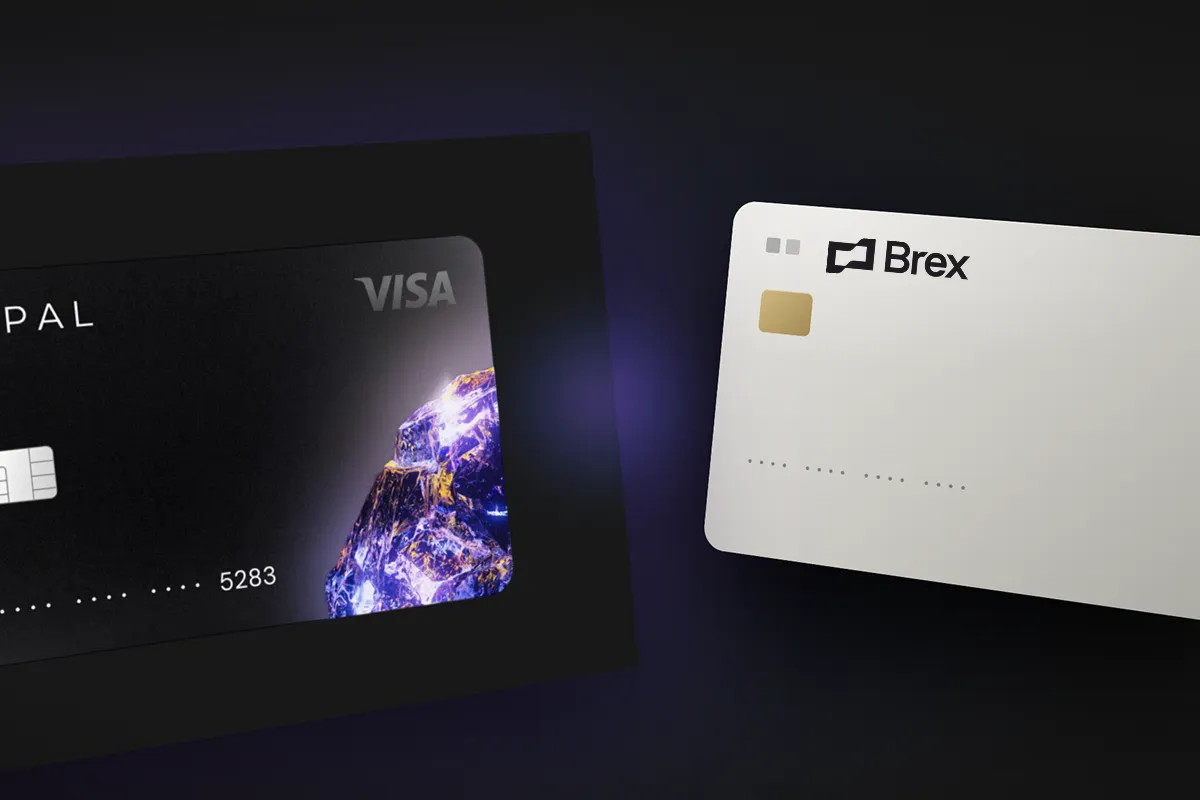
Brex and Opal both get mentioned in the same breath when agencies go looking for a better card. They share some surface-level similarities: no annual fee, virtual cards, accounting integrations. But the moment you go one layer deeper, the differences become significant.
The short version: Brex is a well-built product for startups and growing companies with diverse spending needs. Opal is built specifically for agencies running ad spend, and that focus shows in every feature that actually matters for your workflow.
Here's the full breakdown.
Opal vs. Brex at a Glance
Before getting into the nuances, here's how the two products stack up on the features that matter most to agency finance teams.
Feature |
Opal |
Brex |
|---|---|---|
|
Annual fee |
$0 |
$0 |
|
Cash-back on ad spend |
1% unlimited |
1x points (no ad-spend multiplier) |
|
Rewards structure |
Flat cash-back on all spend |
Points-based, with multipliers on travel, dining, software |
|
Credit limit |
Up to $10M |
Based on cash flow; typically high for funded companies |
|
Extra cards |
Unlimited, free |
Unlimited virtual cards |
|
Bookkeeping automation |
Yes, built for agency workflows |
Yes, via QuickBooks/Xero integration |
|
Built for agencies |
Yes, core product focus |
No, broader startup/enterprise focus |
|
Personal guarantee |
Not required |
Not required |
|
Foreign transaction fees |
None |
None |
The table tells part of the story. The rest is in what those differences mean when you're actually running campaigns.
Where Opal Wins for Agencies Running Ad Spend
Cash-Back That's Actually Structured for Ad Spend
This is the most important difference, and it's worth being direct about it.
Brex's rewards program is points-based, with multipliers on rideshare (7x), travel (4x), restaurants (3x), and software (2x). Ad spend earns 1x points, the same as everything else. For a company spending heavily on SaaS and travel, that structure makes sense. For an agency routing $200K/month through Google and Meta, it doesn't.
Opal offers 1% unlimited cash-back on ad spend across platforms including Google, Facebook, Instagram, and more. That's actual cash returned to your business, not points you have to figure out how to redeem.
What this means in practice: An agency running $500K/month in managed ad spend earns up to $5,000/month back with Opal. With Brex, that same spend earns 1x points with no bonus multiplier on ad purchases. The gap compounds fast.
Credit Limits Built for Agency Scale
Agencies don't spend like startups. You're often carrying client budgets that dwarf your own revenue, and you need a card that can handle that without constant limit checks or declined transactions mid-campaign.
Opal offers credit limits up to $10M, specifically sized for agencies managing large client budgets. Brex's limits are dynamic and based on company cash flow, which works well for funded startups but can be unpredictable for agencies whose own balance sheet doesn't reflect the volume they're actually managing.
The practical risk with a generalist product: a campaign goes live, spend accelerates, and the card hits a ceiling at the worst possible moment.
Unlimited Free Cards for Every Client and Platform
Running paid media across multiple clients means you need card infrastructure that matches how your team actually operates. One card per client. One card per platform. Cards for individual media buyers on your team. Cards that can be spun up, capped, and shut down without a billing event.
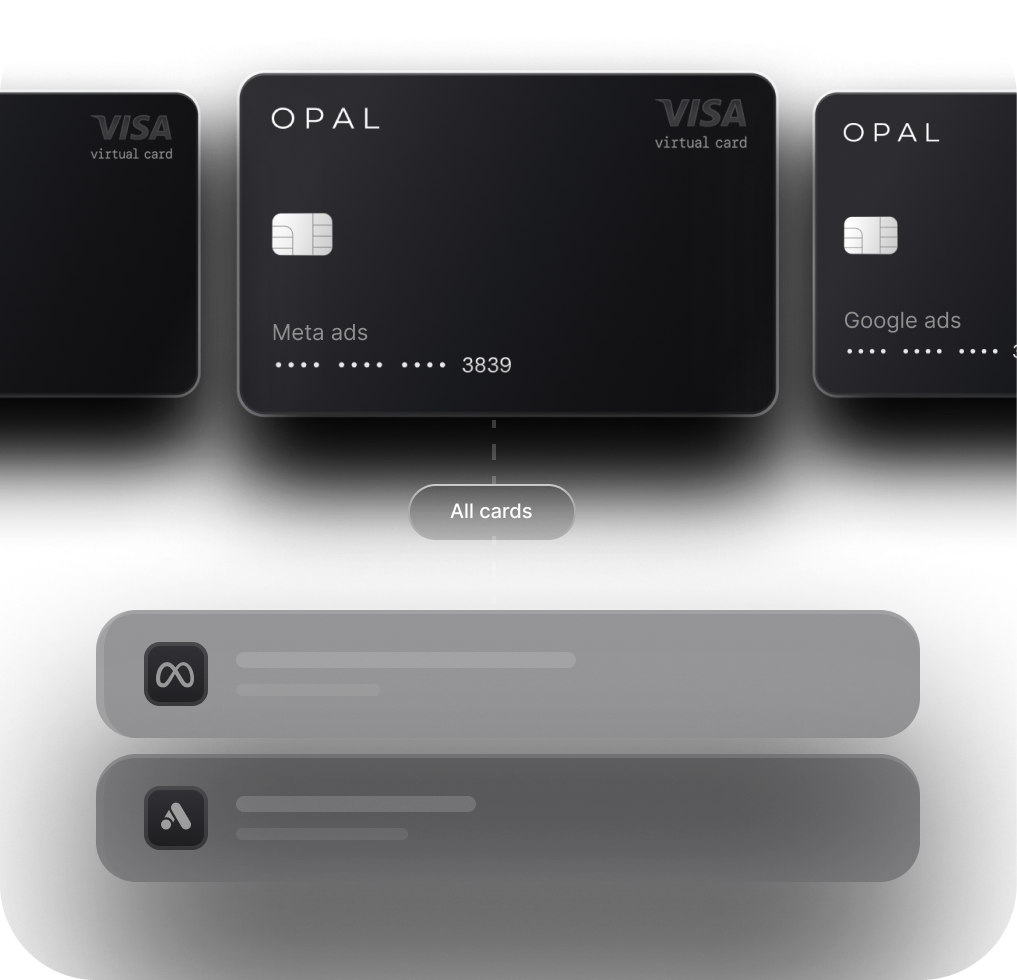
Opal provides unlimited free virtual cards designed for exactly this workflow. You can isolate spend by client, campaign, or platform, making reconciliation straightforward and reducing the risk of co-mingled charges across accounts.
Brex also offers unlimited virtual cards, so this isn't a hard differentiator. But the key distinction is how the product is designed to use them. Opal's card infrastructure is built around the agency model, where client-level separation is the default expectation, not a workaround.
Bookkeeping Automation That Understands Agency Workflows
Reconciling ad spend across clients is one of the most time-consuming back-office tasks at any agency. Every platform, every client, every campaign generates transactions that need to be categorized, matched, and reported.
Opal's bookkeeping automation is built with that workflow in mind. Transactions are automatically categorized in a way that maps to how agencies track spend by client and campaign, reducing the manual cleanup that typically happens at month-end.
Brex integrates with QuickBooks and Xero and offers receipt matching and expense categorization. It's solid for a general business. But it's designed for a company with diverse spend categories, not one where 80%+ of transactions are ad platform charges that need to be mapped to specific client accounts.
The bottom line on bookkeeping: Opal's automation reduces the reconciliation burden specific to agency ad spend. Brex reduces the reconciliation burden for general business expenses. If ad spend is your dominant expense category, that distinction matters.
Where Brex May Still Appeal
Brex is a genuinely capable product, and it would be intellectually dishonest to pretend otherwise. There are specific situations where it could be a reasonable fit, even for teams with meaningful ad spend.
-
You're a diversified agency. If your business model includes significant non-ad spend, like travel, events, SaaS tools, or production costs, Brex's multiplier structure starts to add up. The 7x on rideshare and 4x on travel are real if you're actually spending there.
-
You want a broader financial platform. Brex has invested heavily in building a full-stack finance product: bill pay, expense management, travel booking, and more. If you want one platform to manage the whole business, not just the card, that breadth is a genuine advantage.
-
You're a funded startup running ads. Brex's underwriting model is built around company cash flow and funding, which means funded startups often get generous limits quickly. If your agency is structured more like a startup than a traditional services firm, that model may work in your favor.
The honest framing: Brex is excellent at being a generalist. The question is whether you need a generalist.
The Recommendation for Agency Teams
If your agency's primary expense category is paid media, the choice is straightforward.
Brex was built for startups that happen to run ads. Opal was built for agencies that run ads as their core business. That difference in design intent shows up everywhere: in the rewards structure, in the credit limit model, in the card infrastructure, and in how bookkeeping automation handles your transaction volume.
The cash-back alone is a compelling argument. At 1% uncapped cash-back on ad spend, Opal pays for itself many times over at any meaningful volume. But the deeper value is the workflow fit. A product designed around your use case will always outperform a product that accommodates your use case.
Who should use Opal:
Agencies routing $50K+ per month in client ad spend
Teams managing multiple clients across Google, Meta, TikTok, and other platforms
Finance leads tired of manual reconciliation at month-end
Operators who need high credit limits that scale with managed spend, not just their own revenue
Who might stick with Brex:
Agencies with heavy non-ad spend looking for a full-stack finance platform
Funded startups where Brex's underwriting model gives them favorable terms
Teams that already use Brex for the broader platform and aren't primarily ad-spend-driven
If you're running a paid media agency and you're still on a generalist card, you're leaving money on the table every single month. See how Opal works for agencies like yours or read the Outsmart Labs case study to see what the switch looks like in practice.
FAQ
How quickly can my agency get set up on Opal?
Fast. The onboarding form takes 2 to 3 minutes to complete, and virtual cards are typically issued within 24 to 48 hours. There are no calls required, no lengthy underwriting process, and no need to switch banks. Opal works with any US-based bank account.
Do I need a personal guarantee or credit check to get approved?
No on both counts. Opal does not require a personal guarantee or a credit check. Approval is based on your agency's ad spend activity, not your personal credit profile. That's a meaningful difference from most traditional card issuers.
What happens to my existing Brex account if I switch?
Nothing forces you to close it immediately. Most agencies run both for a short period while migrating client cards and reconciling any open spend.
Can I create separate cards for each client without paying extra?
Yes. Opal provides unlimited free virtual cards. The standard workflow is one dedicated card per client, per platform, or per campaign. Spend is isolated by default, which means cleaner reporting, faster reconciliation, and no co-mingled charges across client accounts.
Does Opal integrate with QuickBooks and Xero?
Yes. Opal integrates with QuickBooks and Xero to make reconciliation and month-end bookkeeping easier. For agencies managing high volumes of ad spend, that matters because transactions need to be categorized cleanly across clients, campaigns, and platforms, not just logged as general business expenses.
Does Opal integrate with the ad platforms we already use?
Yes. Opal works with Google Ads, Meta, TikTok, Snapchat, Amazon Ads, The Trade Desk, LinkedIn, and more. Cards update automatically on connected platforms, so there's no manual payment method management when cards are refreshed or replaced.