



Opal vs. Ramp for Marketing Agencies: Which One Actually Handles Ad Spend?

The Short Answer
Quick answer: Ramp is an excellent general-purpose corporate spend platform built for companies across all industries. Opal is a vertical fintech platform built exclusively for digital marketing agencies managing client ad budgets. For agencies running high-volume paid media across Google, Meta, TikTok, and other platforms, the two products are not interchangeable. Opal offers credit limits up to $10M, up to 2% cashback on ad spend, a Client-Funded Card model that eliminates the need to front client money, and direct ad platform integrations that prevent campaign interruptions. Ramp offers none of these agency-specific features. If your primary use case is managing employee expenses across a company, Ramp is a strong choice. If your primary use case is running client ad spend, Opal was built for that problem and Ramp was not.
Key Takeaways
Ramp is a strong general-purpose spend platform. Opal is built exclusively for agencies running client ad spend.
Opal offers credit limits up to $10M. Ramp starts at $10,000 and scales based on your own cash balance.
Opal's cashback is up to 2% on ad spend. Ramp's rate is variable — anywhere from 0% to 1.5% — and you won't know your rate until after approval.
Opal auto-syncs with Google Ads, Meta, TikTok, Snapchat, LinkedIn, Amazon, and The Trade Desk. Ramp has no ad platform integrations.
Opal's Client-Funded Card model lets clients fund their own spend directly. Ramp has no equivalent.
Neither platform requires a personal guarantee or hard credit check.
Marketing agencies evaluating spend management tools face a version of this question constantly: does it matter that a platform was built specifically for agencies, or does a good general-purpose tool do the job just as well?
The honest answer is that it depends on what you need the tool to do. For internal company expense management, travel, and procurement, Ramp is genuinely excellent. For the specific infrastructure agencies need — high credit limits, per-client card separation, ad platform auto-sync, client-funded spend models — the gap between a general-purpose platform and a purpose-built one is significant.
This comparison covers both platforms accurately, including where Ramp outperforms Opal, so you can make the right call for your agency's situation.
Who Each Platform Is Built For
Understanding what each platform was designed to solve is the most important context for this comparison.
Ramp: General-Purpose Corporate Spend Management
Ramp is an all-in-one spend management platform serving 50,000+ companies across virtually every industry. Its core product combines corporate cards, expense management, accounts payable, travel booking, procurement, and accounting automation into a single system. Ramp's value proposition centers on reducing out-of-policy spend, automating expense reporting, and giving finance teams visibility across all company expenditures.
Ramp is genuinely excellent at what it was designed for. Its AI-powered policy enforcement, receipt matching, and ERP integrations are among the best in the corporate card category. The platform is built around the assumption that the primary challenge is managing employee spending across a company — controlling what employees buy, where they buy it, and how those transactions get reconciled.
That assumption does not map cleanly onto agency ad spend.
Opal: Vertical Fintech Built for Agency Ad Spend
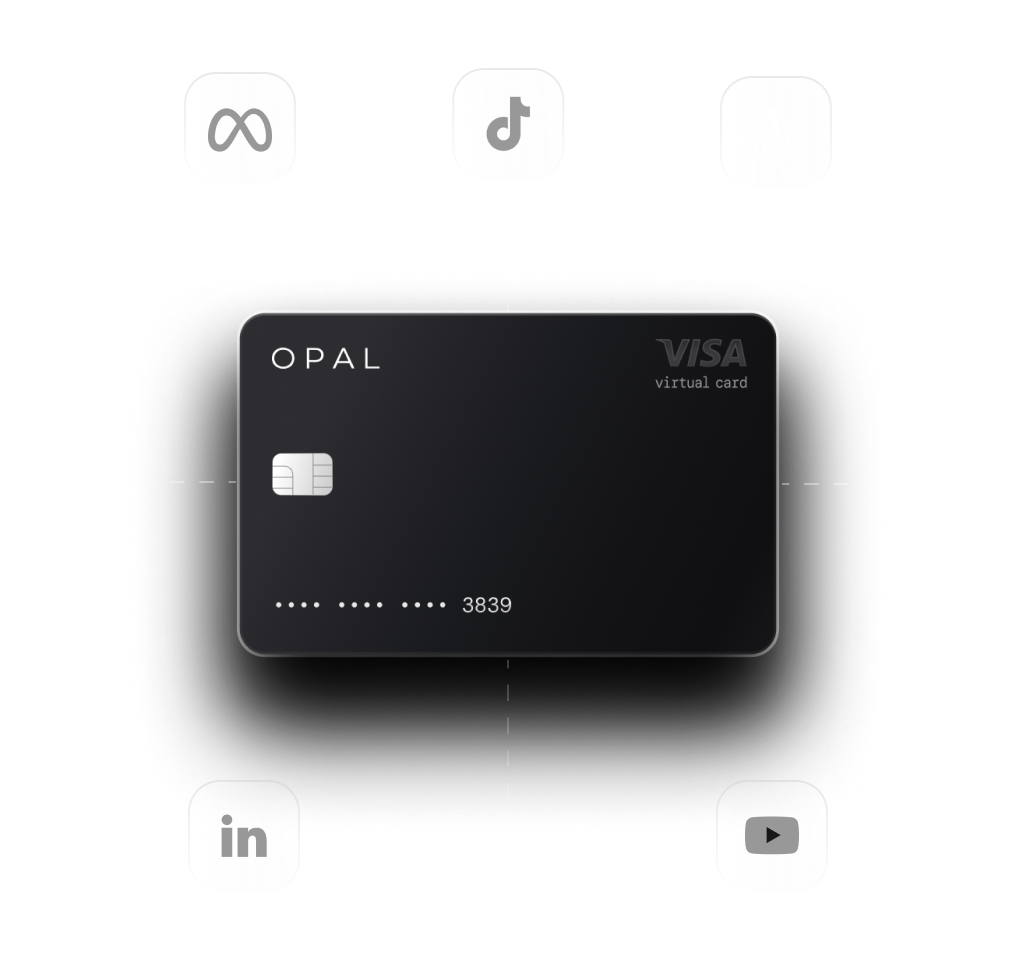
Opal is a charge card and spend management platform built exclusively for digital marketing agencies and brands managing client advertising budgets. Every feature in the product was designed around a specific agency problem: running large volumes of paid media spend across multiple clients, platforms, and campaigns simultaneously.
The target customer is an agency spending $250,000 to tens of millions per month across Google Ads, Meta, TikTok, Snapchat, LinkedIn, Amazon, and The Trade Desk. Every product decision Opal has made — credit limits up to $10M, unlimited free virtual cards, ad platform auto-sync, the Client-Funded Card model — traces back to a problem agencies face that general-purpose platforms were never designed to solve.
Head-to-Head: The Criteria That Matter for Agencies
Credit Limits for High Ad Spend
Credit limits are not a minor detail for agencies. An agency managing $1M per month in client ad spend needs a card that can actually hold that volume. This is where the structural difference between the two platforms becomes immediately concrete.
Ramp starts new cardholders at a $10,000 initial credit limit. That limit scales based on your linked business bank balance — up to 30x higher than traditional cards, according to Ramp's own documentation. For a company with strong cash reserves, that can mean meaningful limits. But Ramp's limit methodology is based on your agency's own financial profile, not the client budgets you're managing.
Opal offers credit limits up to $10M, sized to the actual volume of client ad spend an agency manages. The underwriting model is built around the agency context: you're spending on behalf of clients, not out of your own operating budget.
The real-world implication: An agency managing $500,000/month in client ad spend with modest cash reserves will hit Ramp's ceiling. They won't hit Opal's.
Cashback Structure
Opal |
Ramp |
|
|---|---|---|
Rate |
Up to 2% on ad spend |
0%–1.5% (variable, determined post-application) |
Cap |
None |
None |
Category |
Ad spend specific |
All purchases |
Rate guarantee |
Fixed rate on ad spend |
Variable — set by Ramp based on creditworthiness |
Ramp changed its cashback structure in May 2024, moving from a flat 1.5% to a variable rate ranging from 0% to 1.5%, as confirmed by NerdWallet's 2026 Ramp Card review. Your actual rate is determined by Ramp's internal assessment of your business's financial health after you apply — you will not know your rate before approval.
Opal's cashback rate of up to 2% applies to ad spend. For an agency running $500,000/month in client media, the difference between a variable rate that could drop to 0% and 2% is up to $10,000 per month, or $120,000 per year. That is not a rounding error.
Virtual Card Functionality
Both platforms offer unlimited virtual cards. The difference is in what those cards are designed to do.
Ramp's virtual cards are built for internal expense control: locking cards to specific vendors, setting category restrictions, and enforcing employee spending policies. This is genuinely useful for managing internal team expenses.
Opal's virtual cards are built for client and campaign isolation. The model is one card per client, per platform, or per campaign — each with its own spend limit and budget tracking. This separation keeps client budgets clean, prevents cross-contamination between accounts, and creates the reporting structure agencies need to invoice clients accurately.
Ad Platform Integrations and Re-Verification Prevention
This is the sharpest functional difference between the two platforms.
Ramp does not have native integrations with ad platforms. It is a spend management tool, not an ad payment infrastructure tool. When a card number changes on Ramp, someone on your team has to manually update the payment method in each ad account — Google Ads, Meta Business Manager, TikTok Ads Manager, and so on. If that update is missed or delayed, campaigns pause.
Opal auto-syncs card information directly with Google Ads, Meta, TikTok, Snapchat, LinkedIn, Amazon, and The Trade Desk. When a card is updated or replaced, Opal pushes the new details to every connected ad account automatically. Campaigns keep running. No manual updates, no missed platforms.
Why this matters: A declined or expired card on a major ad platform can pause campaigns within minutes. For an agency running client media, a paused campaign is not a minor inconvenience — it is a client relationship problem, a performance problem, and sometimes a contract problem.
Reconciliation and Accounting
Ramp has strong accounting automation. It integrates with QuickBooks, NetSuite, Xero, Sage, and other ERPs. Its AI-powered receipt matching, GL coding, and expense categorization are genuinely best-in-class for general corporate expense management. Finance teams that need to close books quickly across many expense types will find Ramp's tooling excellent.
Opal integrates with QuickBooks and is built specifically for the agency reconciliation workflow: matching spend by client, campaign, and platform, then tying that spend back to invoices. The reconciliation model is designed around client billing rather than internal cost center accounting.
For agencies, the relevant question is not "how good is the accounting automation in general?" but "does the reconciliation output map to how I invoice clients?" Opal's model is built around that output. Ramp's is built around internal expense reporting.
Personal Guarantee and Application Requirements
Neither platform requires a personal guarantee or runs a hard credit check, which is a meaningful shared advantage over traditional business cards.
Ramp requires a minimum of $25,000 in a U.S. business bank account to qualify — down from the $75,000 required as recently as March 2024. Only corporations, LLCs, and limited partnerships are eligible — sole proprietors cannot apply.
Opal requires no hard credit check, no personal guarantee, and the application takes 2–3 minutes. Approval is designed around the agency's ad spend volume rather than its cash reserves.
Pricing and Fees
Opal |
Ramp |
|
|---|---|---|
Annual fee |
$0 |
$0 (core tier) |
Virtual card fees |
$0, unlimited |
$0, unlimited |
Foreign transaction fee |
$0 |
$0 |
Personal guarantee |
No |
No |
Hard credit check |
No |
No |
Advanced tiers |
N/A |
Ramp Plus and Enterprise (paid) |
Ramp's core platform is free, but the company has introduced paid tiers — Ramp Plus and Ramp Enterprise — for advanced features. Opal has no tiered pricing structure; the full product is available with no annual fee.
Where Ramp Wins
Ramp has genuine strengths that are worth stating clearly.
-
Expense management depth. Ramp's AI-powered policy enforcement, receipt matching, and duplicate subscription detection are among the best in the category. For agencies that also need to manage internal team expenses — travel, software, office spend — Ramp's tooling is more mature.
-
ERP integrations. Ramp connects to QuickBooks, NetSuite, Xero, Sage, and a broader set of accounting systems. For agencies running complex multi-entity accounting structures, Ramp's integration breadth is an advantage.
-
Broader platform ecosystem. With 200+ integrations, Ramp fits into more existing tech stacks. If your agency has already built workflows around Slack, NetSuite, or other enterprise tools, Ramp's integrations are more extensive.
-
Ramp Treasury. Ramp's 4.3% APY cash management feature lets businesses earn interest on idle cash. Opal does not offer an equivalent.
-
Partner discounts. Ramp offers over $350,000 in partner discounts across AWS, Amazon Business, UPS, and 100+ other vendors. For agencies with significant SaaS and infrastructure spend, this is real value.
-
Travel management. Ramp includes in-app travel booking with embedded policy controls. Opal does not have a travel product.
The honest summary: if your agency needs a comprehensive internal expense management platform and your ad spend volume is moderate enough that Ramp's credit limits are sufficient, Ramp is a capable tool. It is not the right tool for the ad spend infrastructure problem specifically.
Where Opal Wins
For agencies running client ad spend, Opal's advantages are structural, not cosmetic.
-
Credit limits built for agency volume. Up to $10M, sized to client ad budgets rather than the agency's own cash reserves.
-
Up to 2% cashback on ad spend. Built around ad spend rather than general purchases. On $1M/month in ad spend, that is up to $20,000/month in cashback.
-
Ad platform auto-sync. Direct integrations with Google Ads, Meta, TikTok, Snapchat, LinkedIn, Amazon, and The Trade Desk prevent re-verification events and campaign interruptions when card details change.
-
Client-Funded Card model. Opal's most structurally differentiated feature (covered in full detail in the next section).
-
Purpose-built reconciliation. Spend tracking organized by client, platform, and campaign — mapped to invoicing workflows rather than internal cost centers.
-
No personal guarantee, no hard credit check, 2–3 minute application. Faster to get started, with no personal liability exposure.
-
Built exclusively for agencies. Every product decision reflects the agency use case. There is no general-purpose compromise in the product design.
The Client-Funded Card Model: Opal's Core Structural Differentiator
Ramp has no equivalent to this feature, and it is the single most important structural difference between the two platforms for agencies.
What the Problem Is
Most agencies front client ad spend. The agency charges media to its own card, pays the bill at month end, and invoices the client afterward. At any given moment, the agency is carrying its clients' ad budgets on its own balance sheet — using its own cash and credit to fund spend that belongs to someone else.
At $100,000/month in client media, this is manageable. At $1M/month, it creates a cash flow problem. At $5M/month, it becomes a structural risk to the business. The agency is acting as a lender to its own clients — bill due before client payments arrive.
How the Client-Funded Card Model Works
Opal's Client-Funded Card model inverts this structure. Instead of the agency fronting spend and invoicing afterward, clients fund their own card directly. The client's budget sits on a dedicated virtual card before media spend begins. The agency never carries client money on its own balance sheet.
The practical result:
-
No cash flow gap. The agency does not need to front client money and wait for reimbursement.
-
Clean client separation. Each client's budget is isolated to their own card, making reconciliation and invoicing straightforward.
-
Scalable without capital constraints. An agency can grow its managed spend without needing to grow its own credit line proportionally.
-
Reduced financial risk. If a client relationship ends or payment is delayed, the agency is not left holding the bill for media that has already run.
Outsmart Labs, an Opal customer, eliminated fronting costs entirely after implementing the Client-Funded Card model — saving 15+ hours of administrative work per week and converting what was previously a cash flow liability into a net-positive revenue stream through cashback on client spend.
Ramp does not have a mechanism for this model. Its card structure is built around company-owned spend, not client-funded spend. This is not a criticism of Ramp — it was not designed for this use case. But for agencies where fronting client media is a real operational and financial burden, the absence of this feature is a meaningful gap.
Who Should Choose Ramp vs. Who Should Choose Opal
Choose Ramp if:
Your primary need is managing internal employee expenses — travel, software, team spend — across a company of any industry
Your ad spend volume is low enough that Ramp's credit limits (based on your cash balance) are sufficient
You need deep ERP integrations beyond QuickBooks, such as NetSuite or Sage
You want a cash management feature (Ramp Treasury at 4.3% APY) alongside your corporate card
You need travel booking with embedded policy controls
Your team needs a comprehensive, all-in-one platform that consolidates expenses, AP, procurement, and travel in one place
Choose Opal if:
You are a digital marketing agency managing client ad budgets across Google, Meta, TikTok, or other platforms
Your monthly managed ad spend is $100,000 or more — and especially if it is $500,000 or more
You are currently fronting client ad spend and want to eliminate that cash flow exposure
You need a credit limit that scales to your client budgets, not your own cash reserves
Campaign continuity is critical — you cannot afford paused campaigns from payment re-verification events
You want guaranteed, uncapped cashback on ad spend without post-approval rate variability
You need per-client and per-campaign card separation that maps directly to your invoicing workflow
The Bottom Line
Ramp and Opal are not competing for the same customer. Ramp is a strong general-purpose spend management platform for companies managing internal expenses. Opal is a purpose-built platform for agencies managing client ad spend. The question is not which platform is better in the abstract — it is which one was designed for your specific problem.
If your problem is agency ad spend, Opal was built for it. Ramp was not.
Get Started with Opal
Opal's application takes 2–3 minutes, requires no hard credit check, and involves no personal guarantee. Credit limits up to $10M are available for qualifying agencies.
If you are managing client ad spend and want a card built specifically for that problem — with up to 2% cashback, ad platform auto-sync, unlimited free virtual cards, and the Client-Funded Card model — visit opalspend.com to apply.