



How to Match Ad Spend to Revenue Without Waiting for Month-End Reports
Introduction: The Hidden Cost of Month-End Reporting
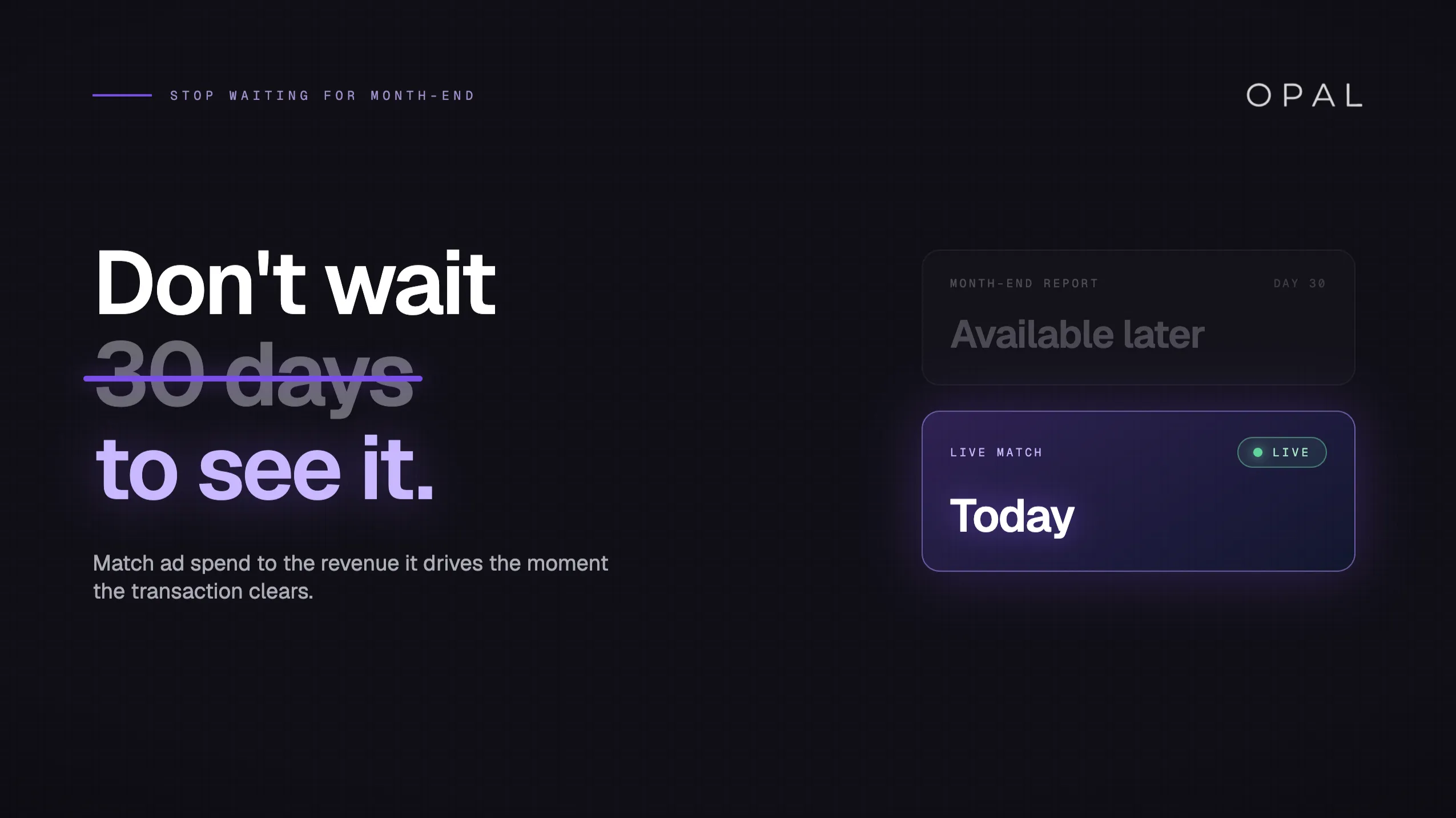
If you're running paid media across Meta, Google, TikTok, or Amazon, you already know the problem: by the time your month-end report lands, the damage is done. Campaigns that should have been paused kept running. Budgets that should have scaled sat flat. And the finance team is reconciling numbers that marketing stopped caring about two weeks ago.
This post is for finance leads, founders, ecommerce operators, and growth teams who want to close that gap. It covers how to track ad spend against revenue on a weekly or daily basis, which inputs actually matter, how to reconcile marketing and finance data without overcomplicating it, and how to make faster budget decisions without waiting for the books to close.
TL;DR
Month-end reports are too slow for paid media decisions. By the time they close, inefficient spend has already run for weeks.
The fix is a simple mid-month tracking layer: pull platform spend daily or weekly, pair it with attributed and blended revenue, and use that to make budget calls before close.
The key inputs are platform spend, blended ROAS, contribution margin, CAC, and refunds or chargebacks. You don't need all of them on day one.
Keep mid-month reporting directional, not accounting-grade. The goal is faster decisions, not a second close.
Cleaner spend data from a centralized source makes reconciliation faster and reduces the gap between what marketing sees and what finance sees.
The Problem With Waiting Until Month-End
Most businesses running paid media across Meta, Google, TikTok, and Amazon are making budget decisions with a significant blind spot. They know roughly what they're spending. They have a vague sense of whether revenue is tracking up or down. But the precise picture, spend matched to revenue, attributed and blended, net of refunds and chargebacks, doesn't arrive until the books close.
That can be 15 to 30 days after the fact.
By then, the campaign that was burning budget at a 0.8x ROAS has already cost you three weeks of wasted spend. The channel that was quietly outperforming didn't get the budget it deserved. And the finance team is reconciling data that marketing stopped caring about weeks ago.
The core issue is structural. Month-end reporting is designed for accounting accuracy, not operational speed. It's built to be correct, not fast. That's appropriate for the books. It's the wrong tool for managing live ad spend.
The good news: you don't need to replace your accounting process. You need a parallel, lighter-weight layer that gives your team directional visibility before close.
Why the Lag Costs You More Than You Think
When spend and revenue data are out of sync, three specific problems compound quickly.
You can't catch inefficient spend in time
A campaign running at a poor return doesn't announce itself. It just keeps spending. If you're only reviewing performance at month-end, a bad campaign can run for 20 or more days before anyone adjusts it. At $5,000 per day, that's a $100,000 problem that a weekly check-in would have caught in the first week.
You miss the window to scale what's working
The flip side is just as costly. When a campaign is outperforming, the window to scale it is often short. Audiences saturate, competition increases, and seasonality shifts. If you're waiting for month-end data to confirm what's working, you're often scaling into a window that's already closing.
Budget decisions get made on gut, not numbers
Without mid-month visibility, budget reallocation becomes instinct-driven. Teams shift spend based on what feels like it's working rather than what the data shows. That's how you end up over-investing in channels that look busy but don't convert, and under-investing in the ones that do.
The real cost of the lag isn't just wasted spend. It's the compounding effect of slow decisions across an entire quarter.
The Key Inputs to Track Before Close
You don't need a perfect dashboard on day one. You need the right inputs, pulled consistently, so you can see the relationship between what you're spending and what you're earning.
Here's what actually matters for mid-month tracking:
Input |
What It Tells You |
Frequency |
|---|---|---|
|
Platform spend |
Total ad cost by channel (Meta, Google, TikTok, Amazon, etc.) |
Daily |
|
Attributed revenue |
Revenue the platforms claim is driven by your ads |
Daily |
|
Blended revenue |
Total store or account revenue across all sources |
Daily or weekly |
|
Blended ROAS |
Total revenue divided by total ad spend, all channels combined |
Weekly |
|
Contribution margin |
Revenue minus cost of goods and ad spend |
Weekly |
|
CAC |
Total ad spend divided by new customers acquired |
Weekly |
|
Refunds and chargebacks |
Revenue that's been reversed or disputed |
Weekly |
|
Payment timing |
When revenue actually hits your account vs. when it was recognized |
Weekly |
|
Inventory constraints |
Whether stock limits are capping revenue potential |
As needed |
Why blended ROAS matters more than platform ROAS
Every ad platform reports its own attributed revenue. Meta will claim credit for sales that Google also claims credit for. The numbers don't add up when you look at them side by side.
Blended ROAS, total revenue divided by total spend across all channels, cuts through the attribution noise. It's the number that tells you whether your paid media program is profitable as a whole, not just whether each platform's self-reported numbers look good.
Don't skip contribution margin
ROAS tells you the revenue ratio. Contribution margin tells you whether you're actually making money. A 3x ROAS on a product with 25% gross margin and high return rates can still be unprofitable. Tracking contribution margin mid-month keeps you anchored to what actually matters: cash left over after you've paid for the goods and the ads.
How to Match Ad Spend to Revenue Mid-Month
The goal here isn't to build a second accounting system. It's to create a simple, repeatable process that gives your team enough signal to make good budget calls between closes.
Set up a weekly spend-vs-revenue review
Pick one day per week, Monday or Friday works well, and pull the following for the prior 7 days:
Total platform spend by channel
Total blended revenue (from your store, not the platforms)
Blended ROAS (revenue divided by spend)
Estimated contribution margin
Any significant refunds or chargebacks that came through
This doesn't need to be a long meeting. A 30-minute review with your media buyer and a finance lead is enough to answer the question: are we on track, or do we need to adjust?
Use a simple pacing model
Divide your monthly budget by the number of days in the month to get your daily spend target. Then track cumulative spend against cumulative revenue week by week. If you're 40% through the month and have spent 55% of your budget, that's a signal worth investigating before it compounds.
A basic pacing model looks like this:
Monthly budget: $200,000
Daily spend target: ~$6,450
Week 2 cumulative spend: $60,000 (should be ~$45,000)
Week 2 cumulative blended revenue: $150,000
Blended ROAS to date: 2.5x
That's a clear picture. You're overpacing on spend, but if your target ROAS is 2.5x or above, you may want to let it run. If your target is 3x, you have a problem that's been running for two weeks.
Flag anomalies early, not at close
Build a short list of thresholds that trigger a review. For example:
Spend pacing more than 15% ahead of target
Blended ROAS dropping more than 0.5x week over week
CAC increasing more than 20% in a single week
Refund rate spiking above your baseline
These aren't accounting entries. They're operational flags. When one trips, you review and decide. Most of the time, you'll hold course. Occasionally, you'll catch something that saves real money.
How to Reconcile Marketing and Finance Data
The gap between what marketing reports and what finance records is one of the most persistent friction points in growth operations. Marketing sees platform spend and attributed revenue. Finance sees bank statements, invoices, and accruals. They're looking at the same activity through completely different lenses.
You don't need them to agree perfectly mid-month. You need them to be close enough to make decisions.
Separate directional reporting from accounting close
This is the most important mindset shift. Mid-month reporting is for decisions, not records. It doesn't need to be audit-ready. It needs to be accurate enough to tell you whether to increase, decrease, or hold your spend.
Final accounting happens at close. That's where you reconcile platform data against card statements, apply accruals, account for payment timing, and produce the numbers that go into the books. These are two different jobs with two different standards.
Trying to make mid-month reporting accounting-grade is what causes teams to give up on it entirely. Keep it simple and directional.
A practical reconciliation approach
Here's a lightweight process that works for most teams:
-
Weekly: Pull platform spend reports from each channel. Compare total spend to what's showing on your card or bank feed. Flag anything that doesn't match within a small tolerance (say, 2-3%).
-
Weekly: Pull blended revenue from your ecommerce platform or analytics tool. This is your ground truth, not the platform attribution numbers.
-
At close: Reconcile platform spend against card statements line by line. Account for any timing differences (spend that ran in one month but billed in the next). Apply refunds and chargebacks. That's your final number.
Where spend data quality makes a difference
One of the most common reconciliation headaches is fragmented spend data: multiple cards across multiple platforms, some managed by an agency, some in-house, with no single source that shows total spend cleanly.
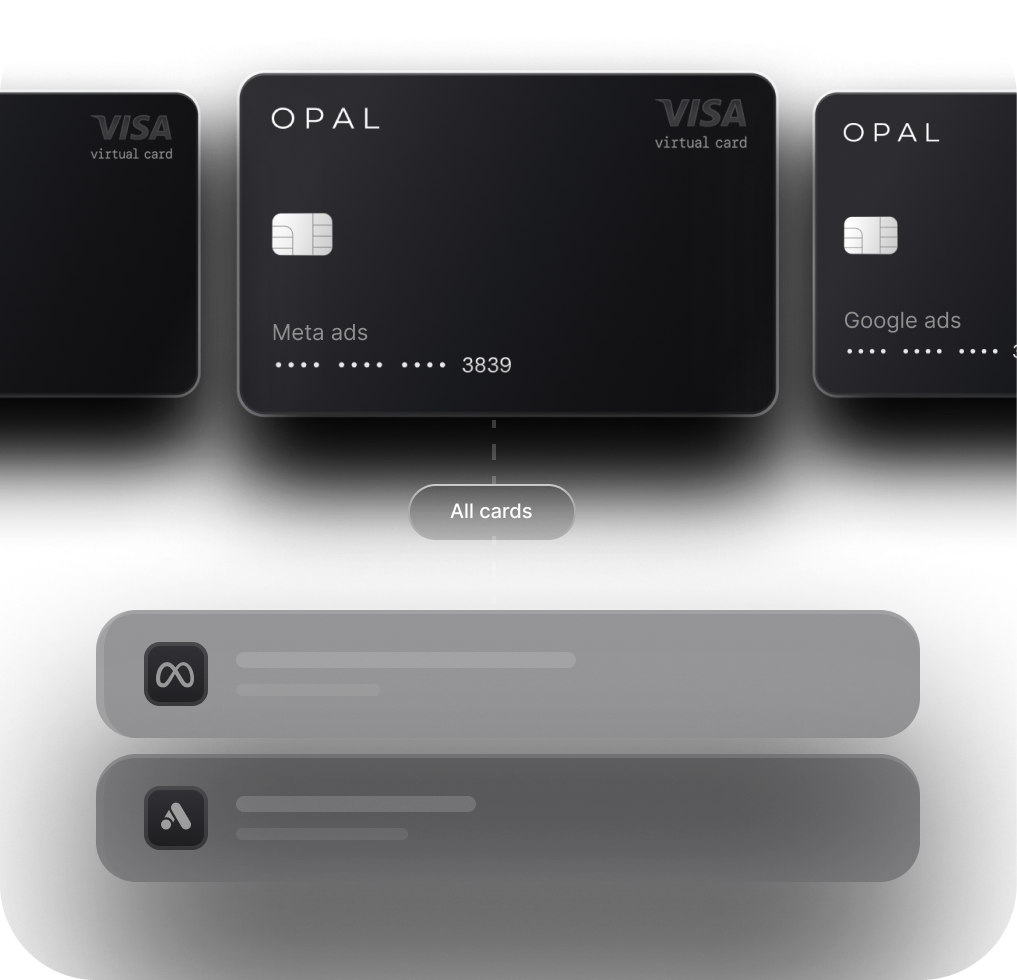
Teams using a dedicated ad spend card, like Opal, often find reconciliation easier because all platform charges flow through one place. Instead of hunting across three card statements to piece together what ran on Meta versus Google versus TikTok, the spend is already consolidated. That doesn't eliminate the reconciliation work, but it reduces the time it takes to get to a number you can trust.
How Real-Time Spend Visibility Improves Budget Decisions
When your team can see what's been spent today, not what was spent last month, the quality of budget decisions improves in ways that compound over time.
You shift from reactive to proactive
Without real-time spend data, budget decisions are reactive. You find out a campaign overspent after the fact and adjust next month. With daily or weekly visibility, you're making proactive calls: pausing a campaign before it burns through its allocation, reallocating budget to a channel that's performing ahead of pace, or flagging a spend spike before it hits your card.
Finance and marketing stay aligned
One of the most common sources of tension between finance and marketing is the end-of-month surprise. Marketing thinks they're on track. Finance closes the books and finds they overspent by 12%. Real-time spend data doesn't eliminate that tension entirely, but it gives both teams a shared number to look at throughout the month, not just at close.
You can make working capital decisions earlier
For operators managing significant ad budgets, spend visibility isn't just a reporting issue. It's a cash flow issue. Knowing where you stand on spend mid-month helps you plan payment timing, manage credit utilization, and avoid situations where you're scrambling to cover platform charges at the end of the billing cycle.
The teams that get this right treat spend data as an operational input, not a finance output. They look at it the same way they look at inventory levels or fulfillment rates: something to monitor continuously, not something to review once a month.
That shift in mindset is what separates operators who are always chasing last month's numbers from the ones who are making decisions based on what's happening right now.
FAQ
How often should we be tracking ad spend against revenue?
For most teams, weekly is the right cadence. It's frequent enough to catch problems before they compound, but not so frequent that it creates reporting fatigue. If you're running high-volume campaigns or managing a large budget, a daily spend check (even just a quick look at platform totals versus your pacing target) adds useful signal.
What's the difference between attributed revenue and blended revenue, and which should I use?
Attributed revenue is what the ad platforms report as driven by your ads. It's useful for understanding channel-level performance, but it's almost always inflated because platforms overlap in claiming credit for the same sale. Blended revenue is your total store or account revenue across all sources. For mid-month decision-making, use blended revenue as your ground truth and treat attributed revenue as directional context.
How do I account for refunds and chargebacks in mid-month reporting?
Pull your refund and chargeback data weekly from your payment processor or ecommerce platform. Subtract it from your gross revenue to get a net revenue figure. You don't need to reconcile this to the penny mid-month, but tracking the trend matters. A rising refund rate against flat revenue is a signal that your effective ROAS is worse than the raw numbers suggest.
Should mid-month reporting replace our month-end close process?
No. They serve different purposes. Mid-month reporting is directional: it helps you make faster budget decisions with the data you have. Month-end close is accounting-grade: it's the authoritative record of what happened, reconciled against statements and adjusted for timing. Treat them as two separate layers with two different standards of accuracy.
What's the simplest way to start if we have no mid-month tracking in place today?
Start with a single spreadsheet. Each week, pull total spend from each platform and total revenue from your store. Calculate blended ROAS. Compare it to your target. That's your baseline. You can add contribution margin, CAC, and refund tracking over time as the habit gets established. The goal is consistency, not complexity.
How do we handle timing differences between when spend runs and when it's billed?
Some platforms bill in arrears, meaning spend that runs in one period gets charged in the next. Keep a simple log of any known timing gaps: what ran, when it ran, and when it's expected to bill. This prevents surprises at close and makes reconciliation faster. If you're using a dedicated card for ad spend, your card statement is the clearest source of when charges actually hit.
The Bottom Line
Month-end reports will always have their place. They're how you close the books, satisfy finance, and produce the numbers that matter for accounting. But they're not the right tool for managing live ad spend across Meta, Google, TikTok, and Amazon.
The operators who consistently get more out of their paid media budgets aren't necessarily running smarter campaigns. They're reviewing performance more frequently, with cleaner data, and making adjustments before the month is over.
You don't need a sophisticated analytics stack to get started. A weekly review of blended ROAS, spend pacing, and contribution margin gets you most of the way there. The key is separating the goal of mid-month tracking, which is faster decisions, from the goal of month-end close, which is accurate records.
Build the habit first. Refine the process as you go. The gap between what you're spending and what you're earning doesn't have to wait until the books close to be visible.