




The Agency Owner’s Checklist for De-Risking Client Media Spend
Managing client ad budgets is one of the highest-leverage things an agency does. It's also one of the highest-risk. When you're running paid media across Meta, Google, TikTok, Amazon, and LinkedIn on behalf of a dozen clients, the operational and financial exposure compounds fast. A missed reimbursement, an unauthorized charge, a payment decline at the wrong moment: any one of these can damage a client relationship, disrupt campaign performance, or put your agency's cash flow in a difficult position.
The good news is that most of this risk is manageable. The agencies that handle it well aren't operating with more caution; they're operating with better structure. Clear ownership, documented processes, and the right financial controls make it possible to scale client spend without scaling your exposure alongside it.
This checklist covers the risks that matter most and what to do about each one.
TL;DR
-
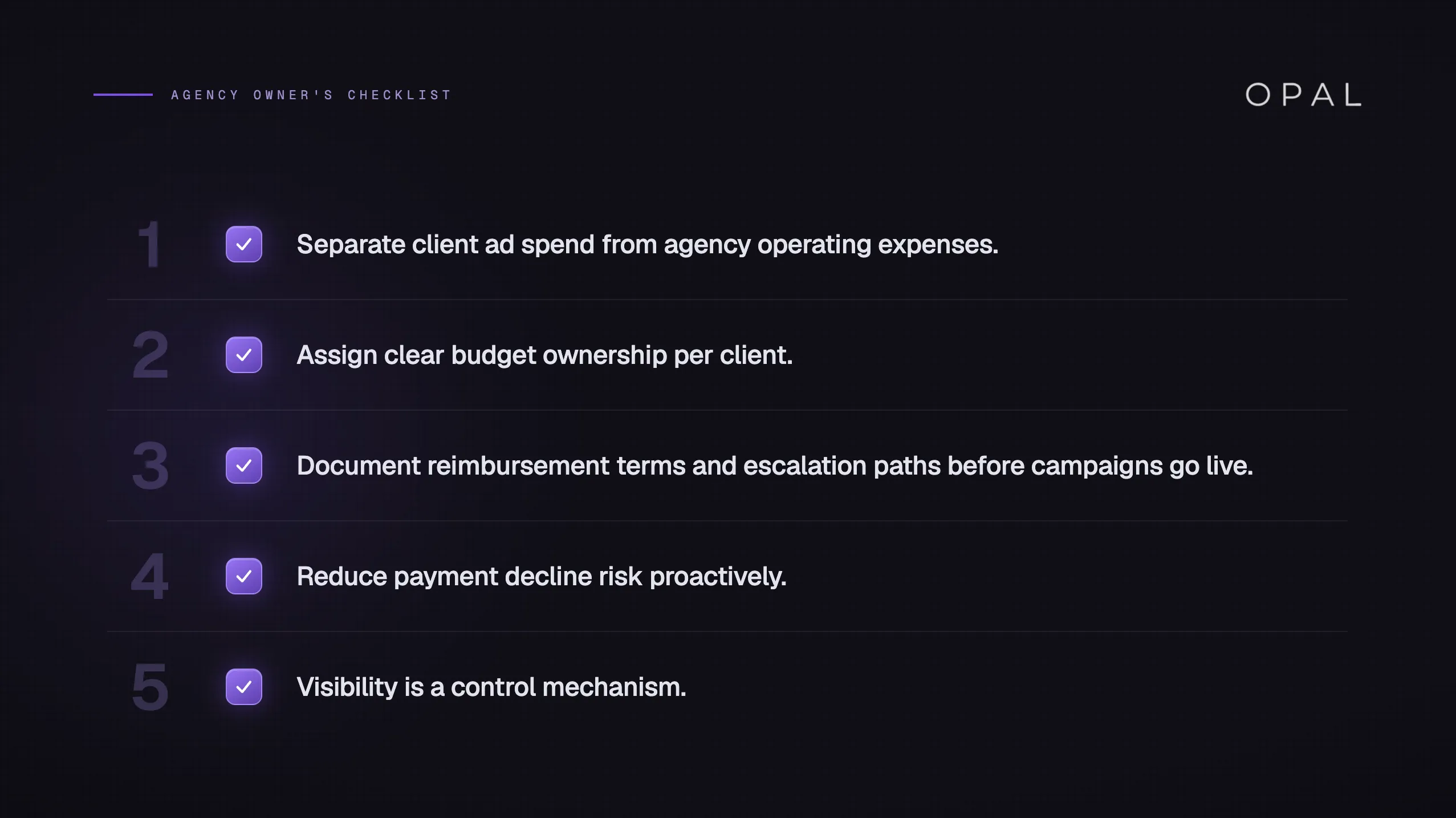
Separate client ad spend from agency operating expenses. Shared cards create reconciliation nightmares and accountability gaps.
-
Assign clear budget ownership per client. Every dollar of media spend should trace back to a named client, a named buyer, and an approved budget.
-
Document reimbursement terms and escalation paths before campaigns go live. Verbal agreements don't hold up when a client disputes a charge.
-
Reduce payment decline risk proactively. Declined cards pause campaigns and cost performance. High-limit, dedicated cards reduce this exposure significantly.
-
Visibility is a control mechanism. If you can't see who spent what, on which platform, for which client, in real time, you don't have control; you have hope.
Why Client Media Spend Creates Risk for Agency Owners
At small scale, managing client ad budgets feels straightforward. You load a card, run campaigns, get reimbursed, move on. But as your book of business grows, the mechanics that felt manageable at $50K per month become genuinely risky at $500K or $2M.
The core problem is that you're spending money that isn't yours, on platforms that don't care whose money it is.
Ad platforms charge the card on file. If the card is yours, the liability is yours. If a client is slow to reimburse, you're floating their spend. If a campaign runs over budget, the overage hits your statement before you've had a chance to flag it. If a media buyer makes an error, it shows up as your agency's financial problem first.
The Scale Problem
Risk doesn't grow linearly with budget. It compounds. Consider what happens when a single agency manages ten clients:
Ten different approved budgets to track
Multiple media buyers, each with their own platform access
Spend running simultaneously across Meta, Google, TikTok, Amazon, and LinkedIn
Different reimbursement timelines per client
Different billing contacts, approval chains, and dispute processes
At this scale, a single shared card or informal process isn't just inefficient. It's a liability. One missed reimbursement, one disputed charge, or one unauthorized overspend can create a cash flow gap that takes months to resolve.
Why Growing Agencies Feel This Most
The agencies most exposed to media spend risk are usually the ones growing fastest. New clients mean new payment setups, new approval workflows, and new media buyers who don't yet know your internal processes. Growth creates the exact conditions where financial controls tend to break down: speed, volume, and complexity arriving faster than your operations can absorb them.
The Main Risks to Watch For
Most of the financial and operational risk in client media spend falls into a handful of categories. Knowing what to watch for is the first step to managing it.
Fronting Client Spend
This is the most common and most costly risk. When your agency's card is the payment method on file, you're extending credit to your clients whether you intended to or not. Reimbursement cycles of 30, 45, or 60 days mean you could be carrying hundreds of thousands of dollars of client spend on your balance sheet at any given time.
At $1M per month in managed spend with a 45-day reimbursement cycle, you're floating roughly $1.5M of client money. That's not a cash flow inconvenience. That's a structural risk.
Missed or Delayed Reimbursements
Even with good clients, reimbursement delays happen. Invoice disputes, slow approvals, client-side billing errors, and payment processing delays all create gaps between when spend runs and when your agency gets paid back. Without clear documentation of reimbursement terms, those gaps can become disputes.
Unauthorized or Unplanned Spend
Media buyers with broad platform access can overspend budgets, launch unauthorized campaigns, or make changes that push spend beyond what was approved. Without per-client spend limits and approval workflows, there's no structural barrier between an approved budget and an overrun.
Payment Declines
A declined card doesn't just create an accounting problem. It pauses campaigns mid-flight, which can destroy performance metrics, waste retargeting audiences, and damage client trust. Standard business cards with low limits or conservative fraud detection are particularly prone to declines during high-spend periods.
Client Disputes and Unclear Accountability
When something goes wrong, whether it's an overspend, a billing error, or a campaign that underperformed, the question of who is responsible becomes critical. Without documented approval chains and clear records of who authorized what, disputes become difficult to resolve and easy to escalate.
Mixed Spend and Poor Visibility
Using the same card for client media spend and agency operating expenses makes reconciliation painful and audits nearly impossible. When a finance lead has to manually sort through 200 line items to figure out which charges belong to which client, errors are inevitable and time spent on reconciliation is time not spent on anything else.
The Agency Owner's Checklist for De-Risking Client Media Spend
This checklist is organized by risk category. Work through each area and identify where your current setup has gaps.
Financial Separation
Client ad spend is on a separate card or set of cards from agency operating expenses
Each client has a dedicated virtual card or payment method assigned to their campaigns
Spend limits are set per card to match approved client budgets
Agency operating expenses (software, payroll, contractors) cannot be charged to client media cards
Budget Ownership and Approvals
Every client has a documented, signed-off monthly budget before campaigns go live
Budget changes require written approval from the client, not just a verbal confirmation
Media buyers know their per-client spend limits and cannot exceed them without escalation
A named person at the agency is responsible for each client's budget compliance
Reimbursement Terms and Documentation
Reimbursement timelines are written into the client contract or SOW (not assumed)
Invoicing cadence is agreed upon in advance (weekly, monthly, per campaign)
There is a documented escalation path if a client misses a reimbursement deadline
Client responsibilities (approving invoices, processing payments) are explicitly listed
Payment Reliability
Cards used for media spend have limits high enough to cover peak spend periods without declines
You have a process for proactively increasing card limits ahead of high-spend periods (Q4, product launches)
Platform billing accounts are monitored for payment failures or account flags
A backup payment method exists for each platform in case the primary card is declined
Visibility and Accountability
You can see, in real time, which card is being used for which client and which platform
Spend is tagged or labeled by client so reconciliation doesn't require manual sorting
Media buyers' platform access is scoped to their assigned clients only
Monthly spend reports are reviewed against approved budgets before client invoices go out
Dispute Prevention
Campaign launch approvals are documented (email, Slack, signed brief)
Budget adjustments are logged with timestamps and client confirmation
Overspend incidents have a defined response process: who gets notified, in what timeframe, and what the resolution path looks like
How Better Controls Reduce Financial Exposure
The checklist above is process-driven. But process alone only goes so far if the underlying financial infrastructure isn't built for the way agencies actually operate.
Most agencies start with whatever card they have: a personal card, a standard business card, or a corporate card that wasn't designed for high-volume ad spend. These cards typically have limits in the $25K to $100K range, which sounds adequate until you're managing a few clients with aggressive Q4 budgets. They also tend to pool all spend into a single statement, making client-level reconciliation a manual, error-prone exercise every month.
The structural fix is to use financial infrastructure that matches how media spend actually works: per-client, per-platform, with limits tied to approved budgets.
This means:
-
Dedicated virtual cards per client. When each client has their own card with its own limit, overspend becomes structurally difficult rather than just a policy violation. The card stops when the budget is reached.
-
High credit limits that scale with managed spend. A card that can handle $500K in a month without triggering a decline is a campaign reliability tool, not just a payment method.
-
Spend visibility that doesn't require manual reconciliation. When transactions are automatically tagged by client and platform, your finance team spends time on analysis instead of data entry.
Agencies that have moved to this kind of setup report a meaningful reduction in reconciliation time and fewer client billing disputes, because the paper trail is clean from the moment spend runs rather than reconstructed at month end.
Tools like Opal are built specifically for this use case: high-limit charge cards for agencies, with unlimited virtual cards, per-card spend limits, and spend visibility organized by client. It's not a general-purpose corporate card that happens to work for ad spend. It's designed around how media buying agencies actually operate.
How to Keep Campaigns Moving Without Increasing Risk
One of the tensions agency owners face is that tighter controls can feel like they slow things down. Media buyers need to move fast. Campaigns need to launch. Budget adjustments happen mid-flight. The last thing you want is a rigid approval process that becomes a bottleneck.
The answer isn't to choose between speed and control. It's to build controls that are invisible to the day-to-day workflow but active when it counts.
Build Guardrails, Not Gates
A spend limit on a virtual card doesn't slow down a media buyer. They don't interact with it. But it does prevent an overspend from happening without anyone noticing. That's a guardrail: it's there when needed, invisible when not.
The same logic applies to approval workflows. A lightweight written confirmation (a Slack message, a signed brief, an email approval) adds almost no friction but creates a record that protects both the agency and the client if a dispute arises later.
Automate What You Can
Manual reconciliation is where risk accumulates. When your finance team has to manually match transactions to clients, match clients to invoices, and match invoices to reimbursements, errors happen. Automating the tagging and categorization of spend reduces that error surface significantly.
Ad platform integrations that sync transaction data automatically, combined with virtual cards that are labeled by client, mean your books are largely reconciled in real time rather than at month end under deadline pressure.
Maintain a Proactive Relationship with Your Credit Limit
Payment declines are almost always preventable. The most common cause isn't fraud or card errors. It's a credit limit that wasn't sized for peak spend. If you know Q4 is coming, or a client is about to launch a major campaign, proactively request a limit increase before spend ramps up. Most card providers will accommodate this with a few days' notice. Waiting until a campaign is mid-flight is too late.
Key takeaway: The agencies with the fewest campaign disruptions aren't the ones with the most conservative processes. They're the ones who anticipated their peak spend needs and built their financial infrastructure around them in advance.
FAQ
What's the biggest financial risk for agencies managing client ad budgets?
Fronting client spend is the most significant risk. When an agency's card is the payment method on file, the agency is effectively extending credit to the client. At scale, this creates cash flow exposure that can run into seven figures. The fix is a combination of clear reimbursement terms in contracts, high-limit cards sized for your managed spend volume, and per-client payment methods that keep each client's spend accountable and visible.
How should agencies handle reimbursement terms with clients?
Put them in writing before any campaign goes live. Specify the invoicing cadence, the payment timeline (net 15, net 30, etc.), what triggers an invoice, and what happens if a payment is late. A signed SOW or addendum is better than an email. Verbal agreements are the most common source of billing disputes.
What's the best way to prevent unauthorized spend by media buyers?
Use dedicated virtual cards with per-card spend limits set to the client's approved monthly budget. When a card has a hard limit, overspend becomes structurally prevented rather than just policy-prohibited. Pair this with scoped platform access: media buyers should only have access to the accounts and campaigns they're responsible for.
How do payment declines affect campaign performance?
A declined card pauses all active campaigns on that billing account immediately. Depending on the platform, reactivation can take hours and may require manual intervention. During that window, you lose impression share, retargeting continuity, and potentially conversion momentum. The downstream effect on performance metrics can be significant, especially for campaigns with tight attribution windows.
How can agencies improve spend visibility across multiple clients and platforms?
The most effective approach is dedicated virtual cards per client, labeled clearly, with transactions that can be filtered by client in your reporting. Paired with ad platform integrations that sync transaction data automatically, this eliminates the manual reconciliation step and makes client-level reporting straightforward. If you're still sorting through a combined statement at month end, that's the process to fix first.
Should agencies use a separate card for each client, or is one card per platform enough?
One card per client is the more defensible setup. It creates a clean separation of spend, makes reconciliation simple, and gives you a hard limit per client rather than a shared pool that any client's spend can draw from. One card per platform still mixes clients together, which means you're still doing manual reconciliation to figure out which charges belong to whom.
Conclusion
Managing client media spend at scale is a financial operations challenge as much as it is a marketing one. The agencies that handle it well have one thing in common: they treat spend management as infrastructure, not afterthought.
The risks covered in this post, from fronting spend to payment declines to unclear accountability, are all solvable. None of them require complex systems or expensive overhauls. They require clear contracts, dedicated payment methods, documented processes, and financial infrastructure that was built for the way media buying actually works.
Work through the checklist. Identify the gaps. Fix the process before the next client dispute, the next payment decline, or the next reconciliation headache forces your hand.
The agencies that grow without growing their financial exposure are the ones that built the controls before they needed them.