

The Real Cost of a Declined Ad Payment (And How to Prevent It)
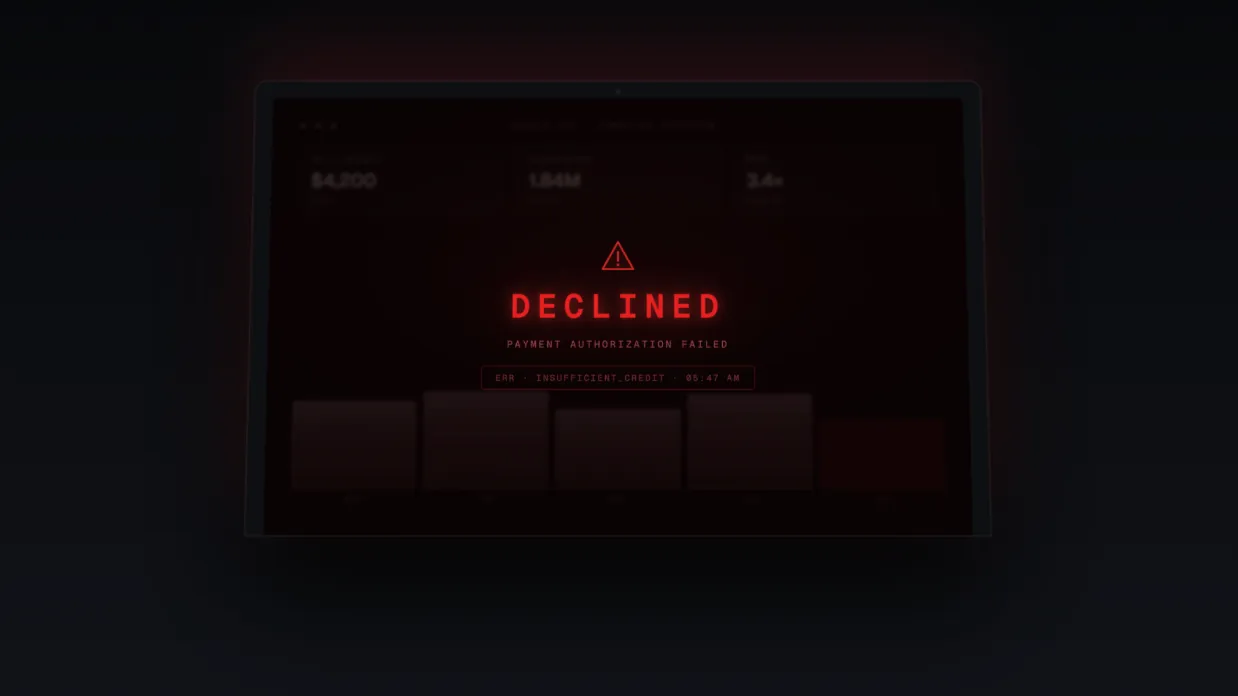
It's a Tuesday morning. Your client's product launch campaign has been live for 48 hours, momentum is building, and the algorithm is finally starting to deliver. Then your phone lights up:
"Hey, our ads stopped running."
You log in. Payment failed. The campaign is paused. The ad account is flagged. And that launch window, the one your client has been building toward for six weeks, is closing by the hour.
This isn't a hypothetical. It happens to agencies every week, on every major ad platform: Google Ads, Meta, TikTok, LinkedIn, Snapchat. And the real cost isn't just the missed impressions while the card is down. It's everything that happens after.
TL;DR: A single declined ad payment can cost an agency $500 to $12,000+ in wasted spend, re-entry CPM premiums, and internal hours. That figure doesn't include client relationship damage. The root cause is almost always structural: general-purpose cards were never built for multi-client, multi-platform ad spend. This post covers what it costs, why it happens, and the infrastructure fix that stops it permanently.
What a Declined Ad Payment Actually Costs
Most people think about the obvious loss: the impressions you didn't serve while the payment was down. That's real, but it's the smallest part of the bill.
Here's the full cost breakdown agencies rarely see coming:
Lost impressions and auction position. The moment your campaign pauses, you exit the auction entirely. Competitors absorb your share of voice. For time-sensitive campaigns like product launches, seasonal promotions, and event-driven spend, those impressions don't come back.
Re-entry CPM and CPA premiums. When a Meta campaign restarts after a payment failure, the algorithm treats it like a new campaign. It re-enters the learning phase, which means you're paying premium CPMs to re-teach the system who to target. According to Meta's own delivery data, conversion campaigns can run 25% to 60% above their stable CPA during the recovery window — a window that lasts 7 to 21 days. Advantage+ Shopping campaigns can see costs run 30% to 70% above stable ROAS for up to four weeks.
Internal firefighting hours. Someone has to diagnose the failure, contact the card issuer, update payment methods across platforms, and monitor the restart. For an agency managing multiple client accounts across multiple platforms, that's easily 4 to 8 hours of billable time burned on a payment problem.
Client relationship damage. This is the cost that doesn't show up on a spreadsheet. Explaining to a client why their campaign went dark — especially during a launch or a high-spend period — erodes trust in ways that are hard to quantify and harder to repair.
The math on a single incident: A 4-day Meta account disablement from a payment failure can cost $8,000 or more in excess spend during learning phase recovery alone. That number doesn't count lost impressions or internal hours. A 6-day disablement can push that figure above $12,000.
Why Ad Payments Get Declined: The Structural Causes
Payment failures aren't random. For agencies, they almost always trace back to the same handful of structural problems — problems that generic business cards were never designed to solve.
Shared cards hitting limits across multiple clients
Most agencies run multiple clients through the same card. When Client A's campaign spikes on a high-spend day and pushes the card toward its limit, Client B's campaign gets caught in the crossfire. The card declines. Both campaigns pause. Neither client knows why.
General-purpose cards flagged by fraud detection
Ad platforms run aggressive fraud detection on payment activity. When they see the same card charging across multiple ad accounts — each with different business names, industries, and spending patterns — it triggers automated flags. The card looks like it's being used fraudulently, even when it isn't. Google Ads triggers re-verification any time there are significant changes to a payments profile. A flagged card qualifies as one of those changes.
Credit ceilings hit mid-month during high-spend days
Standard business cards carry credit limits that made sense for general business expenses. They weren't built for agencies running $200K/month in client ad spend. When a campaign scales aggressively — or when Q4 hits and every client is pushing budget — the ceiling gets hit mid-month, mid-campaign, mid-flight.
Re-verification loops that lock accounts
Once a payment failure triggers a verification request, the clock starts. Google gives advertisers up to 5 business days to complete verification — and in some cases up to 30 days for business operations review. During that window, ads are restricted or paused entirely. Miss the deadline and the account is suspended until verification is complete. There's no extension.
The Compounding Effect: One Failure Creates a Chain Reaction
Here's what most coverage of this topic misses: the decline itself isn't the worst part. It's the sequence of events that follows.
A single payment failure sets off a chain:
-
Campaign pauses. Delivery stops immediately. The platform stops charging, but the audience window keeps moving.
-
Ad account gets flagged. Repeated payment failures, or even a single significant one, can trigger an account-level review. The platform now treats your account as elevated risk.
-
Re-verification is triggered. Changing a payment method on a flagged account prompts identity or business verification. This can take 1 to 15 business days depending on the platform and the complexity of the review.
-
Learning phase resets. When the campaign restarts, the algorithm starts over. All the optimization data accumulated from previous delivery is discarded. You're paying to re-educate the system.
-
Budget compression on restart. To "catch up" on missed delivery, some agencies push spend aggressively when campaigns come back online. This spike in activity can trigger another round of fraud flags — restarting the entire cycle.
The critical threshold on Meta: If an account remains disabled for more than 7 days, Meta treats the interruption as a complete reset. All campaigns restart as new. No optimization history is retained. The platform documentation is explicit about it: treat reactivation as a new account launch.
One payment failure. Five downstream consequences. Weeks of degraded performance.
Why the Common Workarounds Don't Work
Agencies have been patching this problem for years. The workarounds are familiar. They're also broken in the same ways.
Workaround |
The Problem It Creates |
|---|---|
Multiple personal cards |
Personal liability on business spend; limits still too low for high-spend clients; cards still get flagged for multi-account activity |
Rotating credit lines |
Manual tracking overhead; gaps during card transitions trigger the same platform flags |
One card per platform |
Doesn't solve limit collisions; still triggers re-verification when cards are swapped |
Manual monitoring |
Reactive, not preventive; by the time someone catches the failure, the campaign is already dark |
Prepaid or debit cards |
No credit buffer; platforms flag debit cards at higher rates for suspicious activity |
The deeper problem: every one of these workarounds treats payment infrastructure as an afterthought. They're duct tape on a structural gap. The card products agencies are using were designed for general business expenses: office supplies, SaaS subscriptions, travel. They were never built to handle the specific demands of high-volume, multi-client, multi-platform ad spend.
That's not a card usage problem. It's a product category problem.
How to Actually Prevent Declined Ad Payments
Preventing payment failures at the agency level requires fixing the root causes — not managing the symptoms. The solution has four components.
Dedicated virtual cards per client
When every client has their own virtual card, a limit collision on one account can't take down another. Fraud detection stops triggering because each card maps to a single ad account with consistent spend patterns. The platform sees predictable, account-specific behavior instead of a single card charging across dozens of unrelated accounts.
Auto-sync to ad platforms
The re-verification loop is triggered when payment methods change on a platform account. The fix is a card that stays pre-verified with each platform — so that even when card details update, the platform doesn't see a change that requires review. This is the difference between a card that works with ad platforms and one that just processes payments on them.
A credit ceiling built for agency-scale spend
A standard business card with a $25K or $50K limit is a liability for an agency running $300K/month in client ad spend. The ceiling needs to match the spend, not the other way around. For agencies managing multiple high-spend clients, that means access to credit limits in the millions — not the tens of thousands.
Removing personal liability from the equation
When agency owners put client ad spend on personal cards or cards with personal guarantees, they're taking on financial risk that has nothing to do with their business operations. A client-funded model, where client budgets fund the card directly, removes that liability entirely and makes the financial structure of the agency cleaner for everyone.
What Happens When a Meta Ad Payment Fails?
When a payment fails on Meta, the platform doesn't just pause your campaign. It initiates a sequence that can take weeks to fully unwind.
Immediate: Delivery stops. The campaign exits the auction. Competitors absorb your impression share.
Within hours: Meta flags the payment method and may restrict the ad account. If the account has had prior payment issues, the flag escalates to a review.
Days 1-7: You update the payment method and attempt to reactivate. Meta may require identity or business verification before restoring delivery. During this window, campaigns remain paused.
Days 7+: If the account stays disabled past 7 days, Meta treats the restart as a completely new campaign launch. All historical optimization data is discarded. The algorithm re-enters the learning phase from zero.
On restart: Conversion campaigns typically run 25% to 60% above their stable CPA during recovery. Advantage+ Shopping campaigns can see costs run 30% to 70% above stable ROAS for up to four weeks.
The short answer: A Meta ad payment failure doesn't just pause your campaign. It can reset months of optimization work and inflate costs for weeks after the account comes back online.
How Long Does Google Ads Verification Take After a Payment Failure?
It depends on the type of review triggered, but the timelines are tighter than most agencies expect.
Google's advertiser verification policy distinguishes between identity verification, business operations review, and ad content review. A payment failure that triggers a flag can initiate any of these.
Here's what the timelines look like in practice:
Review Type |
Typical Timeline |
|---|---|
Identity verification |
Up to 5 business days |
Business operations review |
Up to 30 days |
Ad content review |
1-3 business days (per ad) |
Account-level suspension appeal |
Varies; often 5-15 business days |
The critical detail: Google gives advertisers up to 5 business days to complete verification once a request is triggered. Miss that window and the account is suspended until verification is complete. There is no extension.
For agencies managing multiple client accounts, a single payment failure on one account can trigger cascading verification requests across related accounts on the same payments profile.
The short answer: Google Ads verification after a payment failure takes 5 to 30 business days, depending on the review type. During that window, ads are restricted or paused entirely.
Opal is a charge card built specifically for this. It was designed around the exact failure modes described above:
-
Unlimited free virtual cards — one per client, per platform, per campaign if needed. No shared limits, no cross-contamination.
-
Auto-sync to Google Ads, Meta, TikTok, Snapchat, LinkedIn, Amazon, and The Trade Desk — pre-verified with each platform to prevent re-verification loops when payment details update.
-
Up to $10M credit limit — built for agencies running serious ad budgets, not general business expenses.
-
Client-Funded Card model — client budgets fund the card directly, removing personal liability from the agency's side of the equation.
-
Up to 2% unlimited cashback on all ad spend — with no caps, no category restrictions, and no annual fee.
The application takes 2 to 3 minutes. No hard credit check. No personal guarantee.
The Bottom Line
A declined ad payment isn't a billing inconvenience. It's a performance event with a cost that compounds for weeks. Lost impressions are just the entry fee. The real damage is the learning phase reset, the re-entry CPM premium, the hours of internal triage, and the client conversation nobody wants to have.
The agencies that stop having this problem aren't the ones with better manual monitoring. They're the ones who stopped using infrastructure that was never designed for what they do.
Ready to stop patching it? Apply to Opal in 2 to 3 minutes at opalspend.com — no hard credit check, no annual fee, no personal guarantee.