




How to Forecast Cash Flow When Paid Media Spend Changes Every Week
TL;DR
Static monthly ad budgets break down fast when campaign performance shifts week to week. Your forecast needs to match the pace your spend actually moves.
Build a rolling 4-6 week cash flow forecast that refreshes every week, not every month.
Track six core inputs: current cash on hand, expected receivables, planned media spend, ROAS or CAC trends, contribution margin, and payment terms.
Model three scenarios (base, upside, downside) so you know exactly how much cash you need before a scaling opportunity or pullback hits.
Separating media spend forecasts from operating expense forecasts gives you clearer visibility and faster decisions. Flexible working capital can cover the gap so you are not holding idle cash just to fund ad buys.
Most cash flow forecasts are built for a world where spending is predictable. You set a monthly budget, you stick to it, and your finance model holds.
Paid media does not work that way.
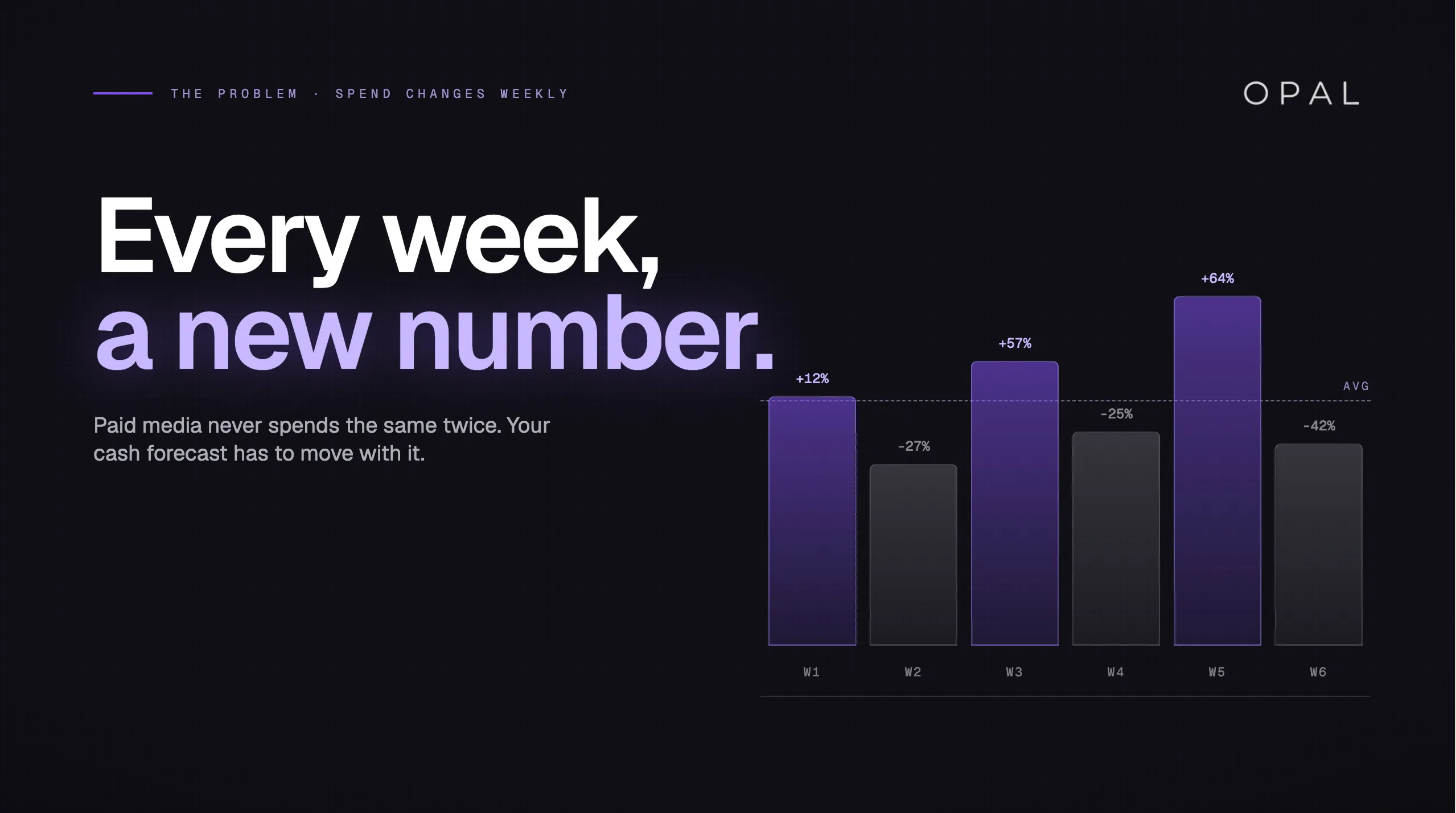
A campaign that converts at $18 CAC on Monday might shift to $34 by Thursday. A Meta creative that was burning through $5K a day gets paused. A Google Shopping campaign suddenly finds an audience and you want to pour fuel on it before the window closes. These are not edge cases. They are the normal operating rhythm of any team running performance marketing at scale.
The problem is that your cash flow forecast is probably still built around the old model. Monthly budget approvals, static spend assumptions, and a single cash position review at the end of the month. That gap between how fast ad spend moves and how slowly most forecasts update is where cash surprises happen.
This post walks through how to build a forecasting approach that actually keeps up.
Why Fluctuating Ad Spend Complicates Cash Flow Forecasting
Traditional cash flow forecasting assumes relatively stable outflows. Payroll hits on the same dates. Rent is fixed. Software subscriptions are predictable. You can model these with reasonable confidence a month or two out.
Paid media breaks that assumption in a few specific ways.
Ad platforms charge on their own schedule
Meta, Google, TikTok, and Amazon all bill differently. Some platforms charge daily once you hit a threshold. Others bill weekly or on a rolling 30-day cycle. If you are running across multiple platforms simultaneously, your actual cash outflows can vary by tens of thousands of dollars week to week, even if your total monthly budget looks the same on paper.
Performance changes force real-time budget decisions
When a campaign is working, the right move is usually to scale it immediately. When it stops working, you cut it. Both decisions happen faster than any monthly budget cycle can accommodate. The finance team often finds out after the fact, which means the cash forecast is already wrong before anyone updates it.
Seasonality creates predictable but steep swings
Q4 ecommerce spend, back-to-school windows, summer slowdowns: these are known events, but their cash impact is often underestimated. A brand that spends $150K per month in August might need $400K in October. The cash required to fund that ramp has to exist weeks before the revenue from those campaigns hits the bank.
Inventory timing adds another layer
For ecommerce operators, ad spend and inventory purchasing are linked. You do not run aggressive acquisition campaigns into a stockout. That means cash planning for media and cash planning for inventory have to happen together, not in separate spreadsheets.
The core issue: Most forecasts treat ad spend as a fixed line item. In practice, it is one of the most variable costs on the P&L, and it moves faster than any other budget category.
The Key Inputs to Track Weekly
Before you can build a useful forecast, you need to know which numbers actually drive your cash position. For teams running paid media, these are the inputs that matter most.
Input |
Why It Matters |
|---|---|
|
Current cash on hand |
Your starting point for every forecast. Pull this weekly, not monthly. |
|
Expected receivables |
When does revenue from recent campaigns actually land in your account? Account for platform payout delays and payment processor holds. |
|
Planned media spend |
What is the media team intending to spend this week and the next four? Get a number, even if it is a range. |
|
ROAS and CAC trends |
If your return on ad spend is declining, your spend efficiency is dropping. That changes how much you need to spend to hit the same revenue target. |
|
Contribution margin |
Revenue minus variable costs (COGS, fulfillment, returns). This tells you how much of each dollar of ad-driven revenue actually contributes to covering fixed costs and profit. |
|
Payment terms |
When do your ad platforms actually charge you? When do your suppliers expect payment? When do customers pay? These timing gaps are where cash crunches hide. |
|
Inventory position and reorder timing |
If you are an ecommerce operator, planned inventory purchases need to sit alongside your media spend forecast, not separate from it. |
The inputs most teams underweight
Two of these tend to get skipped in practice: payment terms and receivables timing.
A brand running $300K per month in Meta spend might assume that revenue from those campaigns lands within a week. In reality, if you are selling through a marketplace or using a payment processor with a rolling hold, that cash might not clear for 14 to 21 days. Meanwhile, Meta has already charged your card.
That gap is your actual cash requirement. Not your total monthly spend, but the float between when you pay the platform and when revenue clears.
How to Build a Rolling Forecast
A rolling forecast is not a new concept, but most teams apply it to revenue and not to ad spend. The fix is simple: treat your media budget as a dynamic variable in the same model, not a fixed assumption baked in once a month.
The structure
Build a 4-6 week rolling view that you update every Monday. The structure looks like this:
-
Week 0 (current week): Actual cash position, confirmed spend to date, confirmed receivables expected this week.
-
Weeks 1-2: Planned spend from the media team, expected revenue based on current ROAS, known payables (platform billing dates, supplier payments).
-
Weeks 3-6: Projected spend based on current campaign trajectory, revenue projections with a margin of variance, any large planned outflows (inventory orders, payroll, etc.).
The further out you go, the wider your confidence interval. That is expected and fine. The point is not precision at six weeks. The point is knowing whether you are likely to hit a cash constraint in the next two weeks, with enough lead time to do something about it.
Separate media spend from operating expenses
This is worth doing explicitly. Your media spend forecast and your opex forecast should live as separate line items, even if they feed into the same cash position model.
Why it matters: when you blend them together, a spike in ad spend looks the same as a spike in headcount costs. But they have very different implications. A media spend increase (if ROAS holds) generates revenue. A headcount increase is a fixed commitment. Keeping them separate lets you make faster, better-informed decisions about whether to scale or pull back.
A simple weekly cadence
-
Monday morning: Pull actual cash balance, update receivables, confirm week's planned spend with media team.
-
Wednesday: Mid-week check. Is spend tracking to plan? Any creative pauses or budget shifts?
-
Friday: Close out the week. Record actual spend, update the rolling model, flag any variances for next week's planning.
This does not need to be a complex system. A well-maintained spreadsheet with these inputs, updated three times a week, will outperform a sophisticated model that nobody updates.
Scenario Planning for Spikes or Pullbacks in Media Spend
A single-line forecast tells you what you expect to happen. Scenario planning tells you what you need to be ready for.
For paid media, three scenarios are enough to cover the realistic range of outcomes.
Base case
Your current campaign trajectory holds. ROAS stays within 10-15% of recent averages. Spend runs at the planned level. Revenue lands on the expected timeline. This is your operating assumption, not a guarantee.
Upside case
A campaign is outperforming. CAC drops, ROAS climbs, and the media team wants to scale spend by 30-50% to capture the window. Ask: do you have the cash to fund that increase before the revenue from it hits your account? If your receivables cycle is 14 days and the platform bills weekly, you need to cover roughly two weeks of elevated spend in advance.
Model the upside explicitly. Too many teams treat scaling opportunities as a cash emergency because they never planned for them. If your upside scenario shows you need an additional $80K in available cash to capitalize on a strong week, that is information you can act on before you need it.
Downside case
Campaigns underperform. ROAS drops, you pull back spend, revenue comes in below forecast. Now you have a different problem: lower cash inflows, but fixed costs (payroll, rent, software, inventory already ordered) that do not shrink with your ad budget.
The downside scenario should answer two questions:
How long can we operate at reduced revenue before hitting a cash constraint?
Which costs can we cut quickly, and which are locked in?
How to use scenarios practically
Do not treat these as three separate forecasts. Build them as sensitivity layers on top of your base case. A simple version: your base case has planned spend of $200K this week. Your upside scenario adds $80K. Your downside scenario removes $60K. Run the cash position math for all three and you immediately know your cash floor and ceiling for the next 4-6 weeks.
Key takeaway: If your downside scenario shows a cash shortfall and your upside scenario shows a scaling opportunity you cannot fund, those are not abstract risks. They are decisions you need to make now about working capital.
How Working Capital Can Support Faster Campaign Scaling
One of the less obvious costs of volatile ad spend is the cash reserve problem.
If your ad spend can swing by $100K in a week, the conservative approach is to keep $100K sitting in your operating account at all times as a buffer. That is rational. It is also expensive. Cash sitting idle is not earning a return, not funding inventory, and not being deployed anywhere productive.
The alternative is access to flexible working capital that can cover short-term media spend without requiring you to hoard reserves.
What this looks like in practice
When a campaign is scaling fast, the timing mismatch between ad spend (paid now) and revenue (received later) creates a temporary cash gap. That gap does not reflect a business problem. It reflects growth. But without a way to bridge it, the only options are to slow the campaign or drain your reserves.
A charge card with a high limit sized around your actual ad spend volume solves this cleanly. You run the campaign, the card covers the spend, revenue clears, and you pay the balance. The float is built into the structure rather than held in your bank account.
This is where tools like Opal fit into the working capital stack. Opal's credit limits are sized around ad spend volume rather than general business financials, which means the available credit scales with the opportunity, not just your balance sheet. For teams running $500K or more per month in paid media, that distinction matters.
The broader principle: working capital flexibility reduces the cash buffer you need to hold. If you have reliable access to credit for media buys, your minimum cash reserve requirement drops. That frees capital for other uses, including inventory, headcount, or simply staying out of a cash crunch during a slow revenue week.
What flexible working capital does not fix
It is worth being clear: access to credit is not a substitute for a good forecast. Running up a large balance on a campaign with deteriorating ROAS is not a working capital strategy. It is a way to accelerate a problem.
The forecast comes first. Working capital tools work best when you already know what your scenarios look like and you are using credit to fund a planned, profitable scaling opportunity, not to paper over a cash shortfall caused by a bad campaign.
FAQ
How often should we update our cash flow forecast when ad spend changes weekly?
At minimum, once a week. For teams running significant paid media budgets, a Monday-Wednesday-Friday cadence works well. Monday sets the week's plan, Wednesday catches mid-week shifts, and Friday closes the loop. The goal is to never be more than a few days behind actual spend.
What is the biggest mistake teams make when forecasting cash flow for paid media?
Treating ad spend as a fixed monthly number. When the media team scales a campaign mid-month, the finance model is already wrong. The fix is to get a weekly spend estimate from the media team every Monday and treat it as a live input, not a locked budget.
How do we account for the timing gap between when we pay ad platforms and when revenue clears?
Map your specific receivables cycle: how long does it take from a sale to cash in your account? For direct-to-consumer brands with Shopify Payments, it might be 2-3 business days. For marketplace sellers or brands using third-party processors, it can be 14-21 days. That number is your minimum float requirement. You need that much cash available at all times to cover the gap between spend and receipt.
Should media spend be its own line in the forecast, or lumped with other operating expenses?
Keep it separate. Media spend is variable and tied to revenue. Opex (payroll, rent, SaaS tools) is mostly fixed. When you blend them, a spike in ad spend looks the same as a cost problem, and a pullback looks like cost savings. Separating them gives you a cleaner read on whether your cash position is changing because of growth decisions or operational issues.
How do we model cash flow when we are scaling into a seasonal peak like Q4?
Start the model 6-8 weeks before the peak. Map the ramp: how much will spend increase week over week, and when does the corresponding revenue start clearing? Then calculate the maximum cash gap, the point where spend is highest and revenue from early campaigns is just starting to land. That is your peak working capital requirement. If your cash reserves do not cover it, you need a plan before the season starts, not during it.
When does it make sense to use a credit line for ad spend rather than cash reserves?
When the campaign economics are solid (ROAS is holding, CAC is within target) and the constraint is timing rather than performance. If you are confident the revenue will come in but it has not cleared yet, using a credit line to bridge that gap is a reasonable use of working capital. If the campaign is underperforming and you are hoping more spend will fix it, that is a different situation and credit will not help.
Conclusion
Forecasting cash flow when ad spend moves every week is not a finance problem. It is a coordination problem.
The media team is making real-time decisions about budgets. The finance team is working from a model that was built a month ago. The gap between those two realities is where cash surprises happen.
Closing that gap does not require sophisticated software. It requires a weekly cadence, a rolling model with live inputs, and a clear separation between media spend and operating expenses. Add scenario planning for the upside and downside cases, and you have a system that can keep up with how paid media actually works.
The goal is not a perfect forecast. It is a forecast that is close enough, updated often enough, that you are never more than a week away from knowing your real cash position.
That is what gives you the confidence to scale when a campaign is working, and the discipline to pull back when it is not.