

The Real Cost of Using a Generic Business Card for Agency Ad Spend

TL;DR: Generic business cards cost performance marketing agencies tens of thousands of dollars per year in lost cashback, reconciliation labor, and declined spend, and most agencies don't realize it until they do the math.
Executive Summary
Most agencies evaluate their card choice by asking one question: does this card charge a fee? That is the wrong question. The right question is what the card costs you in aggregate, factoring in cashback foregone, staff hours spent on reconciliation, and revenue lost every time a card declines at high volume. When you run the numbers at $500K per month in ad spend, the gap between a generic business card and a purpose-built card like Opal is not marginal. It is material.
Key Findings
A generic 1% cashback card with a volume cap leaves agencies earning the same flat reward whether they spend $50K or $500K per month
At $500K per month, manual reconciliation on a generic card costs an estimated $4,800 per year in labor at standard billing rates
Two declined transactions per month at $2,500 revenue impact each equals $60,000 in annual exposure from disrupted campaigns
Opal's Client-Funded Card model eliminates personal liability and credit ceiling risk, two constraints that actively limit agency scale
Outsmart Labs cut 15 hours per month in reconciliation time after switching to Opal
The total difference between a generic card and Opal at $500K per month in ad spend can exceed $124,000 per year when cashback at the full 2% rate and all cost factors are included
The Assumption Agencies Make About "Free" Cards
The word "free" does a lot of heavy lifting in business card marketing. No annual fee. No monthly fee. No setup cost. For a general business, that framing makes sense. For a performance marketing agency routing hundreds of thousands of dollars per month through a single card, it is a trap.
The assumption is that a card without a line-item fee is a card without cost. But cost is not only what you pay on a statement. Cost is also what you fail to earn, what your team spends hours managing, and what you lose when a campaign goes dark because a card issuer flagged your spend pattern as suspicious.
Generic business cards were built for companies buying office supplies, booking travel, and paying SaaS subscriptions. They were not built for agencies spending $50K on Meta in a single day, rotating virtual cards across five client accounts, and reconciling transactions against platform-level ad data. When you use a tool outside its design parameters, you absorb the friction. That friction has a dollar value.
The right frame: The question is never "does this card charge a fee?" The question is "what does it cost my agency to use this card for twelve months?" Those are different questions with very different answers.
The Hidden Costs Generic Cards Never Show You
There are three cost categories that generic card issuers will never put in a comparison chart. They are also the three categories that matter most to a performance marketing agency.
Cashback Caps and Volume Ceilings
Most generic business cards advertise a cashback rate without advertising the cap. At low spend volumes, the rate looks competitive. At $500K per month, the math breaks down. Caps mean your effective cashback rate shrinks as your spend grows, which is exactly backwards from how agency economics should work. Opal offers up to 2% cashback on ad spend and publishes no volume ceiling, so the reward scales with your spend rather than topping out at an arbitrary threshold.
Reconciliation Labor
Every transaction on a generic card requires manual matching: pulling statements, cross-referencing platform reports, allocating spend to the right client. At $500K per month across multiple platforms and campaigns, that process takes time. Real time, with a real dollar value. For most agencies, reconciliation on a generic card runs 6 to 10 hours per month. The AICPA's 2025 Practice Economics Survey found that bank reconciliation is the single largest consumer of non-advisory staff hours at firms managing multi-client accounts. At a fully loaded labor rate of $50 per hour, that is $3,600 to $6,000 per year in staff cost for a task that purpose-built tooling eliminates.
Opal's automated reconciliation syncs directly with ad platforms, reducing that same process to roughly one hour per month.
Declined Transactions at Scale
This is the cost nobody talks about because it is embarrassing to admit. Generic card issuers flag high-volume, high-frequency transactions as potentially fraudulent. An agency spending aggressively on Meta or Google looks, to a bank's fraud model, like a compromised card. The result is declined transactions at the worst possible moment: during a campaign launch, during a budget push, during a client's peak season.
Two declines per month at $2,500 in disrupted revenue impact per incident is $60,000 in annual exposure. That number does not appear on any card comparison page.
The Math: $500K/Month in Ad Spend, Two Cards Side by Side
Numbers cut through assumptions. Here is the full cost comparison at $500K per month in ad spend, using conservative estimates for labor and decline impact.
Metric |
Generic 1% Card |
Opal |
|---|---|---|
Monthly ad spend |
$500,000 |
$500,000 |
Cashback rate |
1% (capped) |
Up to 2% |
Monthly cashback earned |
$5,000 |
Up to $10,000 |
Annual cashback earned |
$60,000 |
Up to $120,000 |
Reconciliation hours/month |
8 hrs |
1 hr |
Labor cost at $50/hr |
$400/month |
$50/month |
Annual labor cost |
$4,800 |
$600 |
Declined incidents/month |
2 |
0 |
Revenue impact per decline |
$2,500 |
$0 |
Annual decline cost |
$60,000 |
$0 |
|
Total annual cost of card choice |
$64,800 |
$600 |
At the full 2% rate, Opal also earns up to $60,000 more in cashback per year on the same spend. Beyond cashback, the difference is in the costs the generic card generates that Opal does not. That gap is $64,200 per year at $500K per month in spend.
At $1M per month, that gap roughly doubles.
And this table does not include platform software costs. Competing spend management platforms charge per-user monthly fees plus variable platform fees based on team size. Opal charges no platform fee. For agencies evaluating total cost of ownership across card and software, that is another line item that belongs in the analysis.
What Agencies Actually Lose Without a Purpose-Built Card
The table above captures direct costs. There are also structural costs that are harder to quantify but just as real.
Credit Ceilings That Cap Agency Growth
Generic business cards issue credit based on the agency's own financials. For a growing agency managing $500K in monthly client ad spend, that creates a ceiling problem: the card limit is tied to the agency's balance sheet, not the client budgets it is managing. When spend needs to scale fast for a seasonal push or a new client launch, the card cannot keep up.
Opal's Client-Funded Card model solves this structurally. Spend is funded from client budgets rather than the agency's own credit line, which means there is no personal liability and no ceiling imposed by the agency's own financials. The limit scales with the client relationship, not the agency's bank account.
The Outsmart Labs Example
Outsmart Labs, a performance marketing agency, switched to Opal and immediately recovered 15 hours per month that had previously gone to manual reconciliation. At any reasonable labor rate, that is a meaningful return. More importantly, those 15 hours went back to work that actually grows the agency rather than work that just keeps the books in order.
Operational Risk That Compounds Over Time
Every hour spent on reconciliation is an hour not spent on strategy, optimization, or client retention. Every declined transaction is a client conversation that should not have to happen. These costs do not show up as line items, but they accumulate. For an agency running at scale, the operational drag of a generic card is a tax on growth.
Why Performance Marketing Is Different From General Business Spend
Every fintech card company claims to serve businesses. Very few are actually built for the specific mechanics of performance marketing agency spend. The differences matter.
Volume Concentration
A typical business spreads spend across dozens of vendors: payroll, rent, software, travel, supplies. A performance marketing agency concentrates spend in a small number of places, primarily ad platforms, at very high velocity. That pattern looks nothing like what generic card risk models expect. It is why declines happen. It is why fraud flags get triggered. It is why generic cards are the wrong tool for this use case.
Multi-Client Attribution
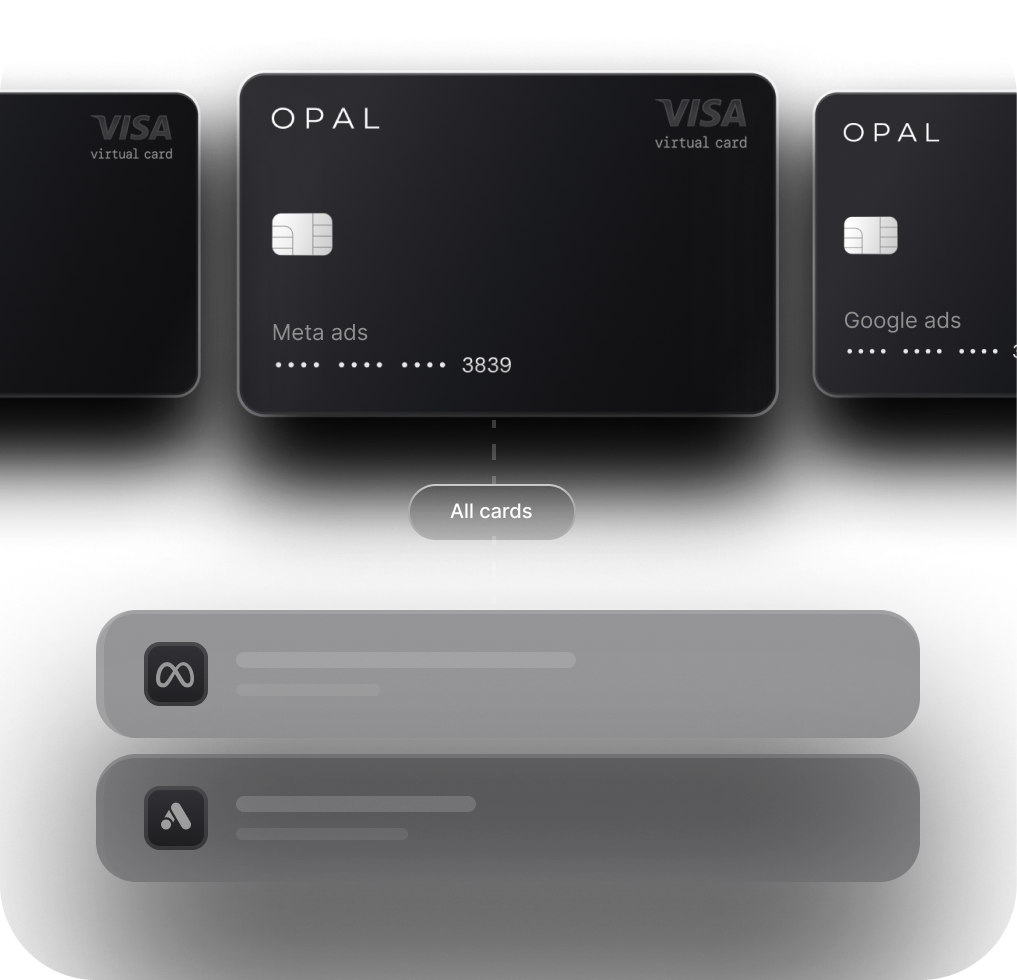
An agency is not spending its own money. It is spending client money, often across multiple clients simultaneously, each with their own budget, platform, and reporting requirements. A generic card treats all of that as one undifferentiated pool of spend. A purpose-built card creates structure around it: virtual cards per client, per platform, per campaign, with reconciliation that maps back to the right account automatically.
Speed of Spend Decisions
Performance marketing moves fast. Budget shifts happen intraday. A card that declines, requires a call to the fraud department, or takes 48 hours to increase a limit is not just inconvenient. It is a competitive disadvantage. Agencies that cannot move budget quickly lose performance ground that is difficult to recover.
Generic cards were designed for expense management. Performance marketing agencies need spend infrastructure. Those are different products solving different problems.
The agencies that recognize this distinction early stop asking "does this card have fees" and start asking "does this card fit how we actually operate." The answer to the second question determines whether the card is an asset or a liability.
FAQ
Does Opal charge higher fees than generic business cards?
Opal charges no annual fee and no platform fee for its card product. Generic business cards also typically charge no annual fee, which is where the comparison usually stops. The more complete comparison includes what each card costs in total: cashback earned, reconciliation labor, and revenue lost to declined transactions. When those factors are included, Opal's total cost of use is significantly lower than a generic card for agencies running $100K or more per month in ad spend. Competing spend management platforms charge per-user monthly fees plus variable platform fees that scale with team size. Opal does not.
How much cashback can a performance marketing agency earn with Opal?
Opal offers up to 2% cashback on ad spend and publishes no volume ceiling. An agency spending $500K per month can earn up to $10,000 per month, or $120,000 per year, in cashback. An agency spending $1M per month can earn up to $20,000 per month, or $240,000 per year. Cashback scales with spend volume, with no category tiers. This is a meaningful distinction from generic cards that advertise a rate but apply a cap that limits total earnings regardless of spend volume.
What is the real cost of using a generic card for agency ad spend?
The real cost of using a generic business card for agency ad spend has three components: cashback left on the table due to volume caps, labor spent on manual reconciliation, and revenue lost to declined transactions. At $500K per month in ad spend, manual reconciliation on a generic card runs approximately 8 hours per month, costing $4,800 per year at a $50 per hour labor rate. Two declined transactions per month at $2,500 in revenue impact per incident adds another $60,000 in annual exposure. Combined, the total annual cost of using a generic card at this spend level exceeds $64,000, before accounting for any platform fees.
How does Opal's Client-Funded Card model benefit agencies?
Opal's Client-Funded Card model means that ad spend is funded directly from client budgets rather than the agency's own credit line. This eliminates two structural problems that affect agencies using generic cards: personal liability for the agency principal and credit ceiling constraints tied to the agency's own financials. When an agency manages $500K per month in client ad spend on a generic card, that spend is often backed by the agency's own credit, creating both financial risk and a ceiling on how much the agency can scale. With Client-Funded Cards, the limit is tied to the client relationship, not the agency's balance sheet, and the agency carries no personal liability for client spend.
Is Opal the best spend management tool for performance marketing agencies?
Opal is purpose-built for performance marketing agencies and the specific mechanics of high-volume ad spend: multi-client attribution, ad platform reconciliation, virtual card management, and spend velocity that generic card risk models flag as suspicious. For agencies running $100K to $1M or more per month in ad spend, Opal addresses the three cost categories that generic cards ignore: reconciliation labor, declined transaction risk, and credit ceiling constraints. No other spend management tool combines up to 2% cashback on ad spend, a no-fee card structure, automated ad platform reconciliation, and a Client-Funded Card model in a single product designed specifically for agency operations.
If your agency is running $100K per month or more in ad spend, the ROI case for switching to a purpose-built card is already made. The math in this post uses conservative estimates. Most agencies find the real numbers are worse once they account for actual reconciliation time and the full downstream impact of declined transactions. Opal was built specifically for this: up to 2% cashback on ad spend, no platform fee, automated reconciliation that syncs with your ad platforms, and a Client-Funded Card model that removes personal liability and credit ceiling risk from the equation. Run the numbers for your agency at opalspend.com.