




What Happens When Paid Media Becomes Your Largest Operating Expense
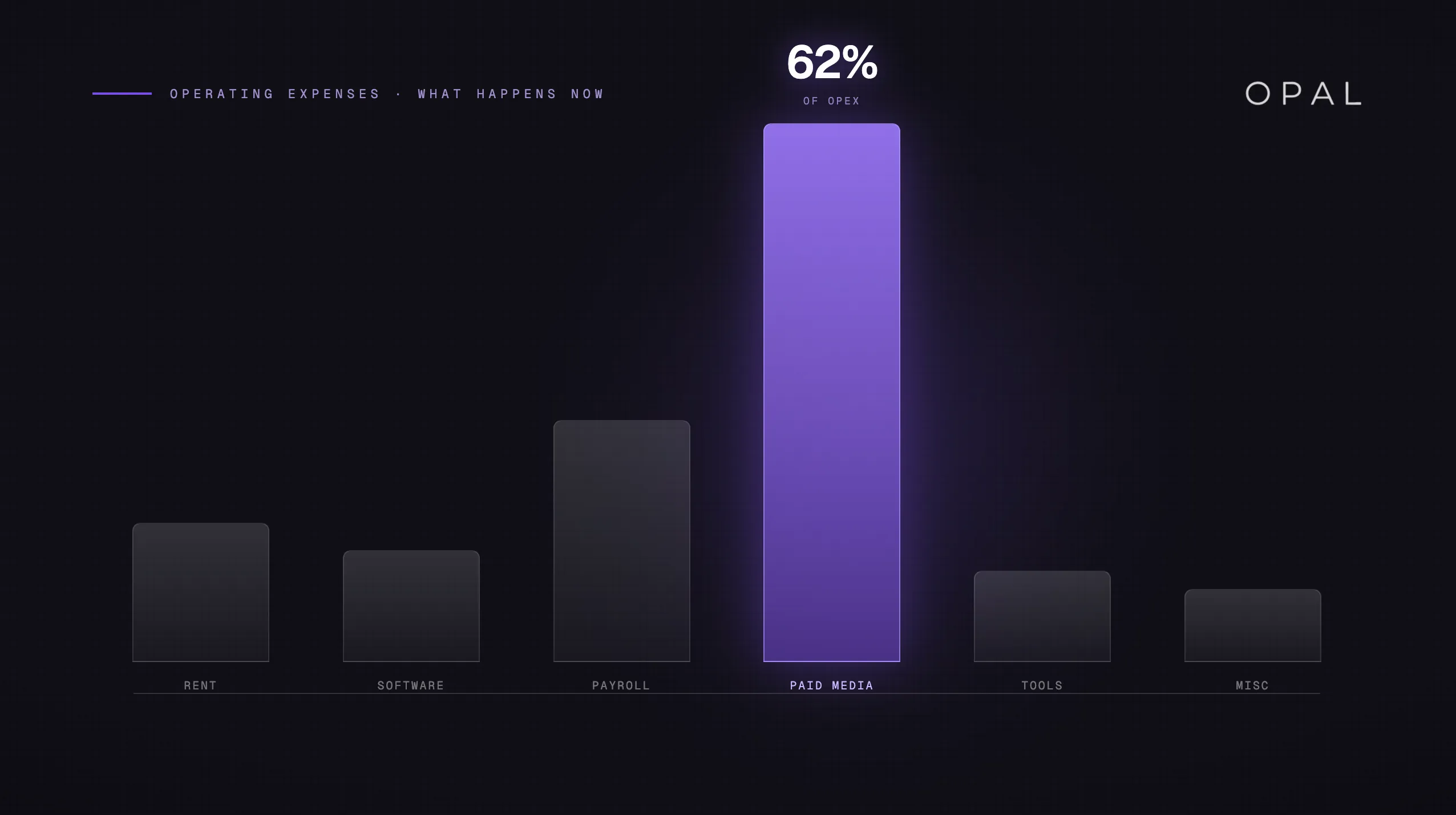
If your ad spend is now your single largest line item, you're probably asking some version of these questions: How do we keep finance and marketing on the same page? What happens if a card gets declined mid-campaign? Who actually owns the budget? How do we reconcile spend across five different platforms without losing a week every month? This post is built around those questions. It covers what changes operationally when paid media reaches the scale of a core business expense, and what you need to put in place before the informal systems you've been running on start to break.
TL;DR
Once paid media becomes your largest operating expense, it needs the same financial discipline as payroll or inventory: ownership, controls, and real-time visibility.
Informal card usage, manual approvals, and delayed reporting become serious operational risks at scale. They need to be replaced with defined processes.
Finance and marketing must coordinate weekly, not monthly. Budget pacing, cash availability, and campaign performance are all connected.
Credit capacity matters more than most teams realize. Weekly ad platform billing cycles can create cash flow pressure that compounds quickly.
Your accounting and payment infrastructure needs to grow with your spend. What worked at $50K/month usually breaks at $500K/month.
When Paid Media Becomes a Core Operating Expense
Most companies treat advertising as a variable expense for a long time. You dial it up when things are good, pull back when margins tighten. It lives in a marketing budget that finance reviews quarterly, and the details are mostly left to whoever runs the campaigns.
That model works fine until ad spend starts to outpace everything else on your P&L.
For a lot of ecommerce brands and performance-driven businesses, this happens faster than expected. You find a channel that works, you scale it, and suddenly Meta or Google is pulling more from your bank account every week than your payroll run. At that point, paid media has stopped being a variable line item and started behaving like a fixed operating cost: it has to run, it has to be funded, and any disruption to it has real revenue consequences.
The shift matters because the operational requirements change. A $30K/month ad budget can be managed with a shared card, a spreadsheet, and a monthly review. A $500K/month ad budget cannot. At that scale, you need the same infrastructure around it that you'd build around any other major operating function: clear ownership, defined controls, real-time data, and enough financial capacity to keep it running without interruption.
The companies that run into trouble are usually the ones that kept the informal systems in place too long after the spend crossed that threshold.
What Breaks When Ad Spend Scales Faster Than Operations
Scaling ad spend is relatively easy. Scaling the operational infrastructure around it is not. Most teams don't realize there's a gap until something goes wrong.
Here's what typically starts to break first:
Shared cards and informal payment setups
At low spend levels, running everything through one or two corporate cards is manageable. At high spend levels, it creates real risk. A single card hitting its limit can pause campaigns across multiple platforms simultaneously. A card flagged for unusual activity gets frozen, and now your Meta campaigns are down while your team scrambles to update billing details. The bigger the spend, the bigger the blast radius when a payment method fails.
Manual approvals that don't scale
When a media buyer wants to test a new campaign or increase a budget, the approval process at most companies is informal: a Slack message, a quick verbal okay, maybe an email. That works when the dollar amounts are small. When you're moving $50K in a single budget adjustment, "informal" is a liability. There's no audit trail, no documented authorization, and no way for finance to track what was approved versus what was actually spent.
Delayed and fragmented reporting
Most ad platforms bill on their own schedule, not yours. Google, Meta, TikTok, and Amazon each have different billing cycles, different invoice formats, and different levels of reporting granularity. When spend is low, reconciling this monthly is annoying but manageable. When spend is high, the lag between when money leaves your account and when you have a clear picture of what it bought creates real blind spots.
The core problem: finance is always looking at last month's data while marketing is making decisions that affect this week's cash position. That gap gets more expensive as spend increases.
Governance Changes Finance Teams Should Make
When ad spend becomes your largest expense, it needs the same governance structure you'd apply to any other major cost center. That means moving from informal to documented, from reactive to proactive.
Define budget ownership clearly
Someone needs to own the paid media budget the same way a department head owns headcount. That person is accountable for what gets spent, where it goes, and whether it's performing. Without clear ownership, spend tends to creep: campaigns run longer than planned, tests don't get shut off, and platform budgets drift from what was approved.
Build a real approval workflow
Budget adjustments above a defined threshold should require documented approval before they go live, not after. What that threshold is depends on your business, but a reasonable starting point is anything above 10-15% of a channel's weekly budget. The approval doesn't need to be bureaucratic; it just needs to exist and be traceable.
Implement spend limits at the card level
Rather than relying on people to stay within budget, enforce it structurally. Virtual cards with platform-specific limits mean a campaign can't overspend on Meta because the card attached to that account has a hard ceiling. This also makes it much easier to track spend by channel, campaign type, or business unit without manual tagging.
Review access controls regularly
Ad platform access tends to accumulate over time. Former employees, contractors, and agencies often retain billing access long after they've stopped working with you. At scale, that's a governance risk. A quarterly audit of who has access to which platforms, and what payment methods they can charge, is worth the time.
Key takeaway: governance at scale isn't about adding bureaucracy. It's about making sure the controls that should exist actually exist, and that they're documented rather than assumed.
Why Credit Capacity and Cash Planning Become More Important
One of the underappreciated realities of high-volume ad spend is how it interacts with your cash position. Ad platforms don't bill monthly like most SaaS vendors. They bill frequently, often weekly or even daily once you cross certain thresholds, and they charge whatever the campaigns have consumed, not a fixed amount you planned for.
For an ecommerce brand spending $300K/month on ads, that could mean $70-80K leaving the account in a single week during a peak period. If your revenue from that spend takes 7-14 days to hit your bank account, you're carrying a real float requirement just to keep campaigns running.
The credit limit problem
Most traditional business cards weren't built for this. A $50K or $100K credit limit might have been fine when you were spending $40K/month. At $300K/month, you're hitting that ceiling in the first week and then waiting for it to reset before you can keep spending. That creates forced pauses in campaigns that cost you performance data, audience momentum, and revenue.
The credit capacity you need should roughly match your peak weekly spend, with enough buffer to handle billing cycles that don't align perfectly with your cash inflows. For most mid-to-large advertisers, that means thinking in terms of $500K to several million dollars in available credit, not the limits that come standard on most business cards.
Finance and marketing need a shared cash calendar
Marketing teams think in terms of campaign pacing and ROAS. Finance teams think in terms of cash availability and working capital. At scale, these two views need to be reconciled weekly, not monthly.
A practical approach: establish a shared cadence where marketing shares the week's planned spend and any major budget changes, and finance confirms cash availability and flags any constraints. This doesn't need to be a long meeting. It needs to happen consistently so neither team is operating on assumptions.
The risk of not doing this: marketing scales a campaign during a period when cash is tight, platforms pull the spend, and the business is suddenly short on working capital at exactly the moment it was trying to grow.
How Accounting Workflows Need to Mature
Reconciling ad spend at scale is one of the more painful operational problems in ecommerce and performance marketing. It's not that the data doesn't exist. It's that it lives in five different places, arrives on five different schedules, and doesn't map cleanly to your chart of accounts without significant manual work.
The multi-platform problem
A company running paid media across Meta, Google, TikTok, Amazon, and even a programmatic channel like The Trade Desk is dealing with fundamentally different billing behaviors on each platform. Meta might bill daily. Google might batch charges weekly. Amazon's billing structure for Sponsored Products is different from its DSP. Each platform produces invoices in its own format, with its own naming conventions, and its own level of campaign-level detail.
When you try to reconcile all of this at month-end, you're essentially doing a manual translation job across five different systems. At $50K/month, that's annoying. At $500K/month, it's a full-time job that still produces errors.
What mature accounting looks like at scale
The goal is to move from monthly reconciliation to continuous visibility. That means:
-
Automated invoice capture from each platform, rather than someone downloading PDFs manually
-
Campaign-level cost attribution that maps spend to the right cost center or client without manual tagging
-
Real-time or near-real-time spend data that finance can access without waiting for a media buyer to pull a report
-
Clean integration with your accounting system (QuickBooks, NetSuite, or similar) so ad spend flows into your books without manual entry
This isn't about adding complexity. It's about removing the manual work that currently sits between "money left the account" and "finance knows what it was for." At scale, that lag is where errors, missed accruals, and budget overruns hide.
Why the Payment Stack Should Evolve with Spend
Most companies don't think about their payment infrastructure as a strategic decision. You pick a card when you're starting out, it works well enough, and you keep using it. But the card and credit setup that made sense at $50K/month can actively create problems at $500K/month.
What a mature payment stack looks like for high-spend advertisers
The core requirements change as spend increases:
Requirement |
Why it matters at scale |
|---|---|
High credit limits |
Low limits force billing pauses that interrupt campaign performance |
Virtual cards per platform |
Isolates spend, prevents cross-platform payment failures, simplifies reconciliation |
Spend controls at the card level |
Enforces budget limits structurally rather than relying on manual oversight |
Cashback on ad spend |
At $300K/month, 2% back is $6,000/month in recovered cost |
Automated reconciliation |
Reduces the manual work of mapping charges to campaigns and cost centers |
The cashback math is worth paying attention to
At low spend levels, cashback on a card is a nice perk. At high spend levels, it's a meaningful line item. A company spending $500K/month on ads that earns 2% back is recovering $120,000 per year. That's not a rounding error; it's a real offset against media costs that most finance teams aren't optimizing for.
Where Opal fits
For companies that have crossed the threshold where paid media is a primary operating expense, Opal is built specifically for this use case. It offers credit limits up to $10M sized to your ad spend volume, unlimited virtual cards with platform-level spend controls, up to 2% cashback on ad spend, and automated reconciliation that syncs with your accounting system. It's not a general-purpose business card; it's designed around the specific payment and working capital needs of high-volume advertisers.
Whether you use Opal or another solution, the underlying principle is the same: your payment infrastructure should be purpose-built for the spend level you're operating at, not inherited from a time when your ad budget was a fraction of what it is today.
FAQ
At what point does paid media need to be treated as a core operating expense?
There's no single threshold, but a practical signal is when ad spend exceeds either payroll or your next largest operating cost. At that point, the informal systems most teams use (shared cards, monthly reconciliation, ad hoc approvals) start to create meaningful financial risk. For most ecommerce and DTC brands, this tends to happen somewhere between $100K and $300K/month in total ad spend.
How should finance and marketing teams coordinate around ad spend at scale?
A weekly sync works better than monthly reporting. Marketing should share planned spend and any significant budget changes for the week ahead. Finance should confirm cash availability and flag any constraints. The goal is to eliminate the lag between when spending decisions get made and when finance knows about them. Even a 30-minute weekly check-in can prevent the kind of cash flow surprises that happen when campaigns scale faster than the bank account can support.
What's the risk of hitting a credit limit mid-campaign?
When a card hits its limit, ad platforms pause campaigns automatically. That interruption affects more than just impressions: it resets audience learning on platforms like Meta, disrupts retargeting sequences, and can cost you competitive positioning during high-traffic windows. Recovering from a forced pause often takes days, not hours. The credit limit you carry should comfortably cover your peak weekly spend, not just your average.
How do you reconcile ad spend across multiple platforms without it becoming a full-time job?
The answer is automation. Platforms like Meta, Google, TikTok, and Amazon all have APIs that can feed spend data into your accounting system without manual exports. Virtual cards assigned per platform make it easier to match charges to the right cost center automatically. The goal is to get to a state where your books reflect actual ad spend within 24-48 hours, not at the end of the month when someone has time to pull reports.
Should paid media have its own budget owner, separate from the broader marketing budget?
Yes, especially once it becomes a top-three operating expense. Paid media has its own billing cycles, its own performance metrics, and its own cash flow dynamics. Bundling it into a general marketing budget without a dedicated owner means no one is accountable for the day-to-day financial management of what may be your largest cost center. Even if the same person oversees both, the paid media budget should be tracked and reported separately.
What's the right way to think about cashback on ad spend?
Think of it as a cost recovery mechanism, not a perk. At $200K/month in ad spend, 2% cashback is $4,000/month or $48,000/year. That offsets a meaningful portion of your payment processing costs, platform fees, or agency management overhead. Finance teams that optimize for this as part of their overall media cost structure treat card selection the same way they'd treat any vendor negotiation: the rate matters.
Conclusion
Paid media doesn't announce when it crosses the line from marketing expense to core operating cost. It just keeps growing until one day finance realizes the ad platforms are pulling more cash than any other line on the P&L, and the systems in place to manage that spend were built for a much smaller number.
The operational changes required aren't complicated. Clear budget ownership, documented approval workflows, card-level spend controls, adequate credit capacity, weekly finance-marketing coordination, and automated reconciliation. None of these are exotic. They're just the same disciplines that mature companies apply to every other major cost center, applied to paid media.
The companies that get this right treat ad spend like the operating expense it is. They build the infrastructure around it before the informal systems fail, not after. That's what separates teams that scale paid media efficiently from the ones that scale it chaotically and spend months cleaning up the operational debt.