


Why Agency Owners Should Stop Using Personal Credit to Fund Client Ad Spend
If you're an agency owner running paid media for clients, you've probably used a personal card or a generic business card to float ad spend at some point. Maybe it was early days, maybe it was a client onboarding crunch, or maybe you just never stopped to question whether a better setup existed.
The short answer: no, you should not be using personal credit to fund client ad spend. Not because it never works, but because it creates compounding financial and operational risk that becomes harder to unwind the larger your agency grows.
Here's what you need to know.
TL;DR
-
Personal credit is not agency infrastructure. Using personal cards or credit lines to float client media budgets exposes your personal finances to business-level risk.
-
Rewards are not the same as risk. Earning points or cashback on client spend feels like a win until a late payment, a budget increase, or a client dispute leaves you holding the balance.
-
Cash flow pressure compounds fast. Fronting five or six figures in media spend per client, across multiple clients, creates a float problem that can outpace your agency's operating capital.
-
Mixing personal and client finances creates reporting chaos. Reconciliation, client billing, and accountability all get harder when ad spend runs through the same card as your operating expenses.
-
A professionalized payment setup is not complicated. Dedicated, high-limit credit designed for ad spend, with clean separation between clients and agency expenses, is the standard your agency should be operating at.
Why Agency Owners End Up Using Personal Credit
It usually starts with convenience, not carelessness.
A new client comes on board. The contract is signed, the budget is approved, and campaigns need to go live. The fastest path to getting ads running is the card already on file, which is often the owner's personal card or a general business card with a modest limit. Nobody planned to make this a permanent arrangement. It just became one.
There are a few common paths that lead here:
-
Early-stage speed. When you're building the agency, getting campaigns live matters more than getting the payment infrastructure right. Personal cards are available immediately.
-
Generic business card limits. Most standard business credit cards cap out at limits that don't scale with managed spend. A $25,000 limit doesn't cover a single mid-size client's monthly Meta budget.
-
Rewards optimization. Some owners deliberately route client spend through personal or travel cards to accumulate points. The logic makes sense on the surface: someone has to put the spend somewhere, so it might as well earn miles.
-
No better option was obvious. For many agency owners, a card purpose-built for high-volume media buying simply wasn't on their radar.
The problem is that what starts as a workaround tends to calcify into a system. And as the agency grows, the risks embedded in that system grow with it.
The Hidden Risks of Fronting Client Media Budgets
Earning rewards on client ad spend sounds like a smart move. And in isolation, it can be. But there is a meaningful difference between earning a return on spend and absorbing the risk of that spend.
When you front client media budgets on personal credit, you are the one liable for the balance, regardless of what happens on the client side.
Rewards vs. risk: not the same trade
Here is the scenario that breaks the rewards logic:
Your client approves a $150,000 monthly ad budget. You run the spend on your personal card or a personal line of credit. The client hits a cash flow issue and delays their invoice payment by 45 days. Your card statement is due in 30. You are now carrying $150,000 in personal debt, paying interest on it, and waiting on a client to make you whole.
The rewards you earned, maybe $1,500 in points at a 1% return, do not offset the interest charges, the liquidity pressure, or the personal credit utilization hit you just absorbed.
The math only works when timing is perfect. Timing is rarely perfect.
Budget increases make the exposure worse
Client budgets are not static. A client who starts at $50,000 a month might scale to $200,000 within a quarter if campaigns are performing. That growth is good news for the agency relationship, but it compounds the float problem directly.
If you are personally financing that spend, your exposure scales with their budget, not with your agency's cash reserves. At some point, you are running a financing operation inside your media agency, and that is not what you signed up to build.
How Personal Credit Creates Liability and Cash Flow Pressure
The cash flow pressure from fronting client media spend is real, but personal credit creates a second layer of risk that is easy to overlook: what it does to your personal financial profile.
Personal guarantees and hard credit checks
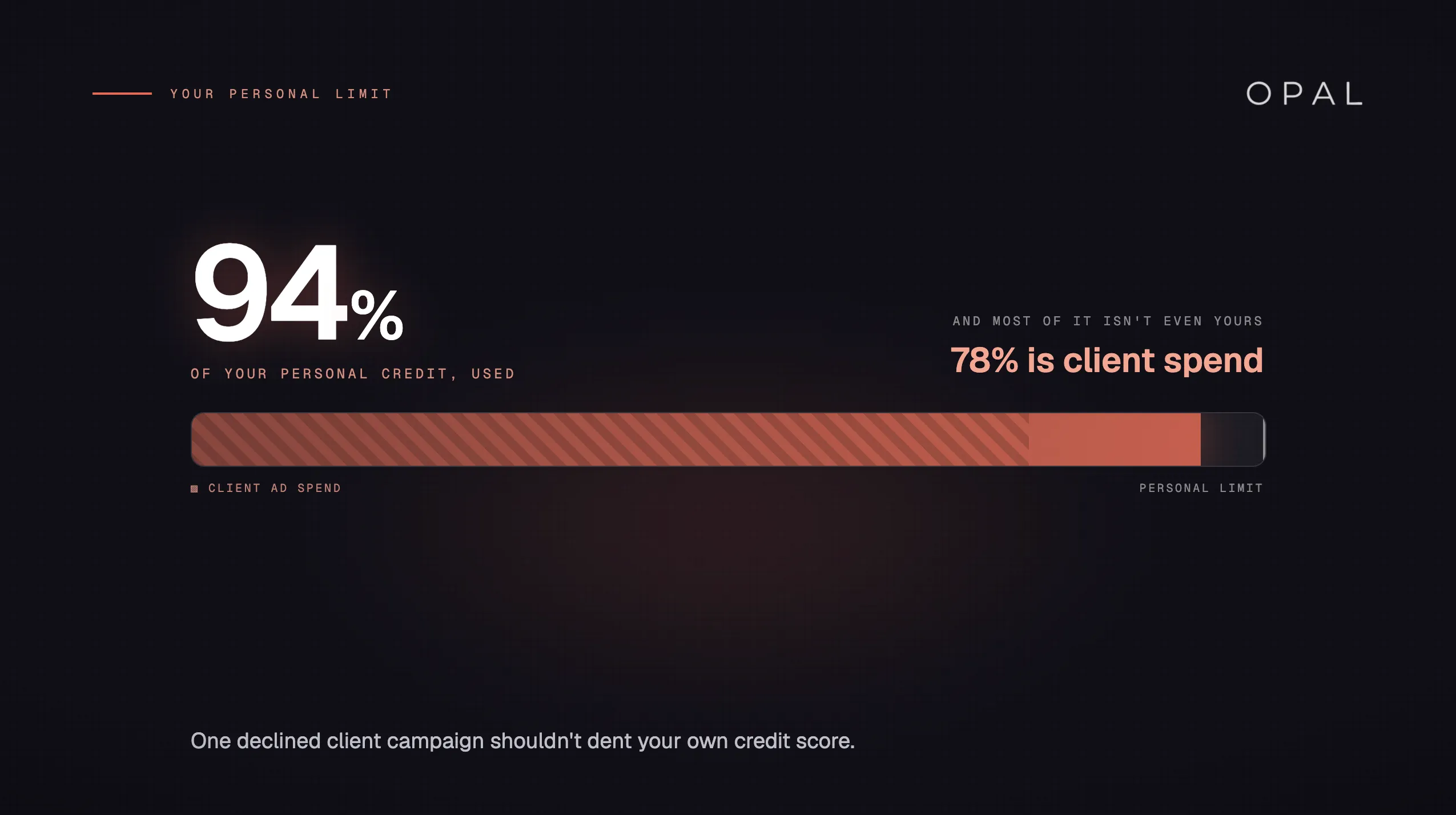
Most personal credit cards and personal lines of credit are tied directly to you as an individual. When you use them for business purposes, you are not just accessing funds; you are making yourself personally liable for the balance. If the agency hits a rough patch, a client disputes an invoice, or a major account churns, those balances do not disappear. They follow you personally.
The same applies to many generic business credit cards. A significant portion of small business cards require a personal guarantee, meaning the lender can pursue you personally if the business cannot pay. Getting that card also typically involves a hard credit inquiry, which affects your personal credit score.
This matters when you want to do anything personal that requires credit. Buying a home, refinancing, or accessing a personal line of credit for non-business purposes becomes harder when your personal credit profile shows high utilization or recent hard inquiries tied to business activity.
The multi-client float problem
Run the numbers across a real agency book of business:
Client |
Monthly Ad Spend |
Payment Terms |
|---|---|---|
Client A |
$80,000 |
Net 30 |
Client B |
$120,000 |
Net 45 |
Client C |
$60,000 |
Net 30 |
Client D |
$200,000 |
Net 45 |
|
Total float |
$460,000 |
At any given moment, you could be personally financing close to half a million dollars in client media spend while waiting on reimbursement. That is not a cash flow inconvenience. That is a structural risk that compounds every time you add a client or increase a budget.
Why Client Ad Spend Needs Cleaner Financial Separation
Beyond the liability question, there is an operational problem with mixing personal or general business credit with client media budgets: it makes your agency harder to run.
Reconciliation becomes a manual nightmare
When ad spend for five clients runs through the same card as your SaaS subscriptions, payroll tools, and travel expenses, every month-end becomes an exercise in forensic accounting. Someone on your team, or you, has to go line by line through statements and sort out which charges belong to which client.
That is time that could go toward growing the agency. Instead, it goes toward untangling a mess that a cleaner setup would have prevented.
Reporting and accountability get blurry
Clients expect accurate reporting on their media spend. When the payment infrastructure is not organized by client, even honest reporting takes more effort than it should. Errors creep in. Charges get misattributed. And if a client ever asks for a billing audit, producing a clean record from a shared card statement is not a good look.
Clean financial separation is also about professionalism. An agency that can produce clear, client-level spend data on demand operates at a different level than one that cannot.
Agency operating expenses get obscured
There is a flip side to this problem. When client ad spend runs through the same accounts as agency operating costs, your own P&L becomes harder to read. You lose visibility into what the agency actually costs to run, what margins look like by client, and where operating expenses are growing. That visibility matters for making good decisions about pricing, hiring, and growth.
Separation is not just a finance best practice. It is how you actually understand your own business.
What a Professionalized Ad Spend Payment Stack Should Include
The good news is that the right setup is not complicated. It just requires being intentional about the tools you use and how they are structured.
Here is what a mature agency payment infrastructure typically looks like:
-
Credit sized for media buying, not general business use. Generic business cards are built for office expenses and travel. Client media budgets on Meta, Google, TikTok, and Amazon can run into the hundreds of thousands per month. Your payment infrastructure needs limits that match that reality.
-
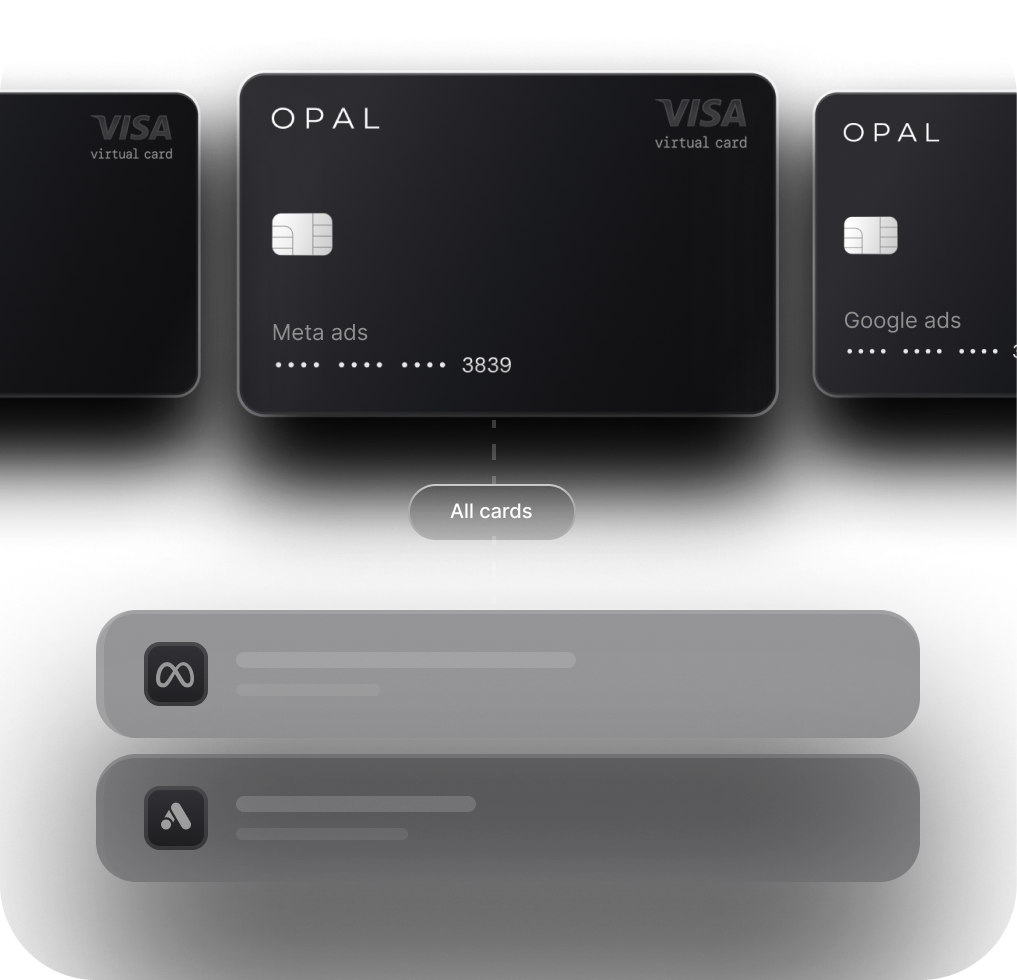
Dedicated virtual cards by client or platform. Issuing separate virtual cards for each client or ad platform eliminates the reconciliation problem at the source. Every charge is already attributed before the statement closes.
-
No personal guarantee. Credit extended based on your agency's managed spend volume, not your personal financial profile, keeps your personal credit separate from your business operations.
-
No hard credit check to get started. Hard inquiries affect your personal score. A setup that does not require one removes that friction entirely.
-
Clean separation between client ad spend and agency operating expenses. These should never live on the same card or account.
Where Opal fits
Opal is built specifically for agencies that manage client ad budgets at scale. It extends credit directly to the agency, with limits up to $10M sized based on managed spend volume rather than cash on hand or deposits. There is no personal guarantee and no hard credit check to get started.
The setup supports unlimited free virtual cards, so agencies can issue dedicated cards by client, by platform, or by campaign. That means clean separation by default, not something you have to manually reconstruct at month-end.
It is not a generic business card that happens to work for ad spend. It is infrastructure built around how media buying agencies actually operate.
FAQ
Is it ever acceptable to use a personal credit card for client ad spend?
In the very early stages of an agency, it may be unavoidable. But it should be treated as a temporary workaround, not a system. The moment you have more than one client or any meaningful budget to manage, the risks of personal credit outweigh the convenience.
What is the actual risk of using a personal card for client ad spend?
The primary risks are personal liability for the balance if a client pays late or disputes an invoice, high credit utilization on your personal profile, and the operational burden of reconciling mixed personal and business charges. As budgets grow, so does your personal exposure.
Can I earn rewards on client ad spend without using a personal card?
Yes. There are charge cards designed specifically for agency media buying that offer cashback on ad spend without requiring a personal guarantee or hard credit check. You can earn on the spend without tying it to your personal financial profile.
Why don't generic business cards work for agency media buying?
Most standard business cards have credit limits that are not sized for high-volume ad spend. A $20,000 or $30,000 limit does not support a client running $100,000 a month on Meta. They also lack features like unlimited virtual cards by client or platform, which creates reconciliation problems at scale.
Does using a personal card for ad spend affect my personal credit score?
It can, in two ways. First, high utilization on a personal card, even if you pay it off monthly, can temporarily lower your score. Second, if you applied for a personal card or credit line for this purpose, the hard inquiry affects your score. Both become more significant as the spend volumes increase.
When should an agency owner move to a dedicated ad spend payment setup?
Before you need to, not after. If you are managing more than $50,000 a month in client ad spend across multiple clients, the operational and financial risks of personal or generic business credit are already present. A dedicated setup is worth building before the complexity forces you into it.
The Bottom Line
Using personal credit to fund client ad spend is a workaround that most agency owners adopt by default and abandon only after it causes a problem. The rewards feel real. The risks feel abstract, until a client pays late, a budget spikes, or a hard credit inquiry shows up at the wrong moment.
The agencies that scale cleanly are the ones that treat payment infrastructure as seriously as they treat campaign infrastructure. That means credit sized for media buying, clean separation between client spend and agency expenses, and no personal liability attached to what is fundamentally a business operation.
You built the agency. Your personal credit should not be the thing holding it together.