


How to Give Clients Real-Time Ad Spend Visibility (And Why It Wins You More Business)
TL;DR
Agencies that give clients real-time visibility into their ad spend don't just build trust, they win more business and keep it longer.
Reporting is one of the most underrated growth levers in agency life. Most agencies treat it as an obligation: something to get done at the end of the month before the client asks. But the agencies pulling ahead right now are treating it differently. They've made transparency a product feature, something they can sell in a pitch, reference in a renewal conversation, and use to justify every dollar they manage.
This post covers what real-time ad spend visibility actually looks like in practice, where the typical agency setup falls short, and how automating the whole process turns a back-office task into a front-office advantage.
Key Takeaways
Most agencies share lagging reports. Clients want live access to where their budget is going.
Manual reporting creates reconciliation errors that erode trust, often at the worst possible moment.
Real-time visibility means clients can see spend data as it happens, not three weeks after the fact.
Automation eliminates the spreadsheet work that consumes hours of account manager time each month.
Outsmart Labs saved 15 hours per month on reconciliation after switching to a real-time spend model.
Agencies with a transparency story close new business faster because most competitors still can't offer it.
Why Client Visibility Is a Business Development Asset, Not Just a Finance Task
Ask most agency owners what their biggest retention risk is, and they'll say performance. A bad month, a campaign that didn't convert, a CPL that crept up. But dig into the actual churn conversations, and a different pattern shows up: clients don't just leave because results slipped. They leave because they felt like they were in the dark.
When a client can't see where their budget went until the end of the month, every unexplained charge becomes a question. Every delayed report becomes a reason to wonder. And when a competitor agency walks into that same client's office and says "we give you live access to your spend data at any time," the incumbent agency has a problem that no amount of performance improvement can fix.
Transparency is not a reporting nicety. It is a retention mechanism.
The agencies that understand this have stopped thinking about client visibility as a finance task and started treating it as a product decision. What do we want our clients to experience when they think about their budget? What do we want them to be able to say about us to their CFO? Those are business development questions, not accounting ones.
The practical implication is straightforward: if your reporting workflow makes the client feel informed, in control, and confident in your stewardship of their budget, you are significantly harder to replace. If it makes them feel like they have to ask for basic information, you are one bad month away from a review.
What Agencies Typically Share vs. What Clients Actually Want to See
Here is what the standard agency reporting workflow looks like: the month ends, someone pulls platform exports from Google Ads, Meta, and TikTok, pastes them into a spreadsheet, reconciles the numbers against the invoice, catches a few discrepancies, fixes them manually, and sends a PDF or a dashboard screenshot to the client around the 10th of the following month.
That is the best-case version. In reality, reconciliation takes longer, the numbers sometimes don't match, and the client gets their report two or three weeks after the spend actually happened.
What clients are actually asking for is different:
Real-time or near-real-time access to where their budget is being deployed
Confidence that every dollar charged to them maps to a specific campaign or platform
The ability to check spend themselves without having to email their account manager
No surprises at invoice time
The gap between what agencies deliver and what clients want is not a technology gap. It is a workflow gap. Most agencies are still running a manual process that was designed for a world where clients asked fewer questions and had fewer alternatives. That world is gone.
The reconciliation problem is where trust breaks down. When a client sees a charge on their statement that doesn't match the number in the report, even by a small amount, it triggers a conversation that is disproportionately damaging to the relationship. The agency has to explain the discrepancy, the client has to decide whether to accept the explanation, and both sides leave the conversation with slightly less goodwill than before.
Real-time visibility doesn't just make reporting faster. It makes those conversations unnecessary.
What Real-Time Ad Spend Visibility Actually Looks Like
Real-time visibility is not a fancier dashboard. It is a structural change in how spend data flows from the platform to the client.
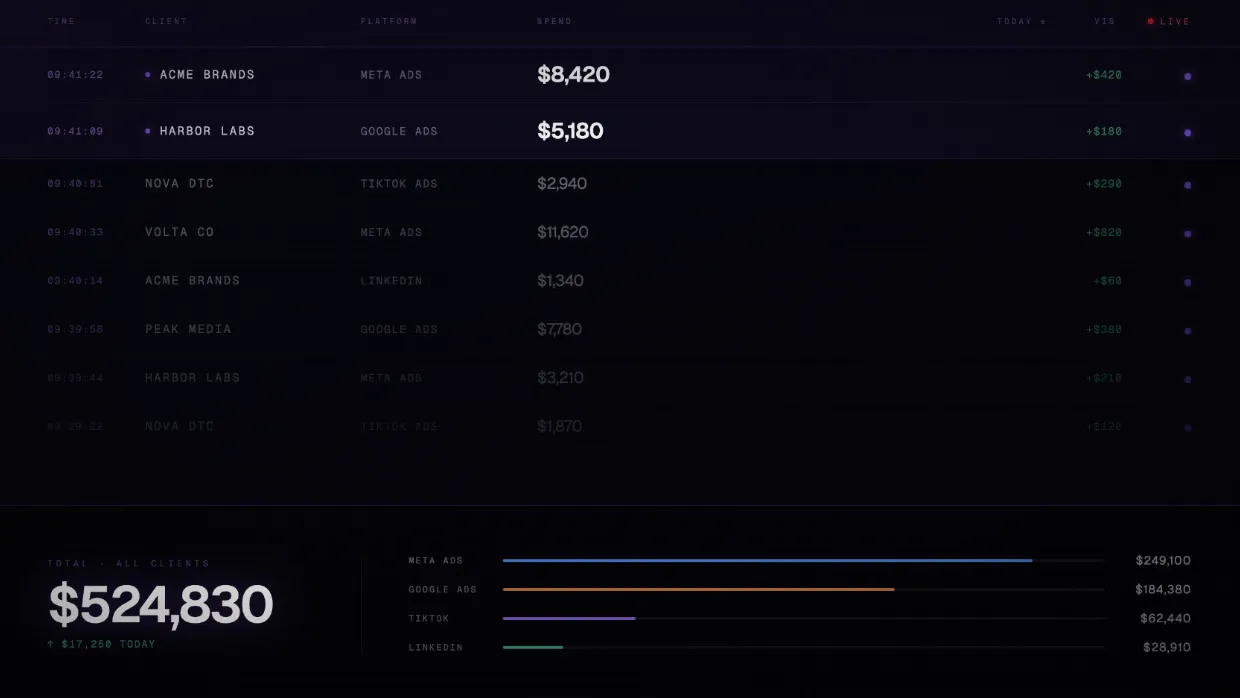
In a real-time setup, every dollar of ad spend is tagged to the correct client budget the moment it is authorized, not after the fact during reconciliation. The client can log in and see exactly where their budget went: which platform, which campaign, which date, and how it compares to what was planned. There is no waiting for a monthly wrap-up. There is no "we'll send you the report next week." The data is just there.
The Structural Difference
The key distinction is where reconciliation happens. In a traditional setup, reconciliation is a manual step that happens after spend occurs. Someone has to match what the platform says was spent against what the card statement shows, and any discrepancy has to be investigated and corrected. This takes time, introduces error, and creates a lag between when money moves and when the client sees it.
In a real-time setup, reconciliation is automated and continuous. Spend data syncs directly from ad platforms, so there is no manual export step and no spreadsheet matching exercise. The numbers the client sees are the same numbers the agency sees, pulled from the same source.
What the Client Experience Looks Like
From the client's perspective, this means:
They can check their spend at any point in the month, not just after the report arrives
They can see budget pacing in real time, so there are no end-of-month surprises
Every charge maps to a specific campaign or platform with no ambiguity
Invoice reconciliation is a formality rather than a multi-hour exercise
This is what clients mean when they say they want "transparency." They don't mean more slides in the monthly deck. They mean access to the underlying data, on demand, without having to ask.
How Automation Makes Transparency Effortless
The reason most agencies haven't solved this yet isn't that they don't care about transparency. It's that building a real-time reporting workflow manually is genuinely hard. Pulling data from five different ad platforms, normalizing it, matching it to the right client budget, and presenting it in a way the client can actually read: that's a significant operational lift if you're doing it by hand.
Automation changes the math entirely.
The Opal Model: Spend Tagged at the Source
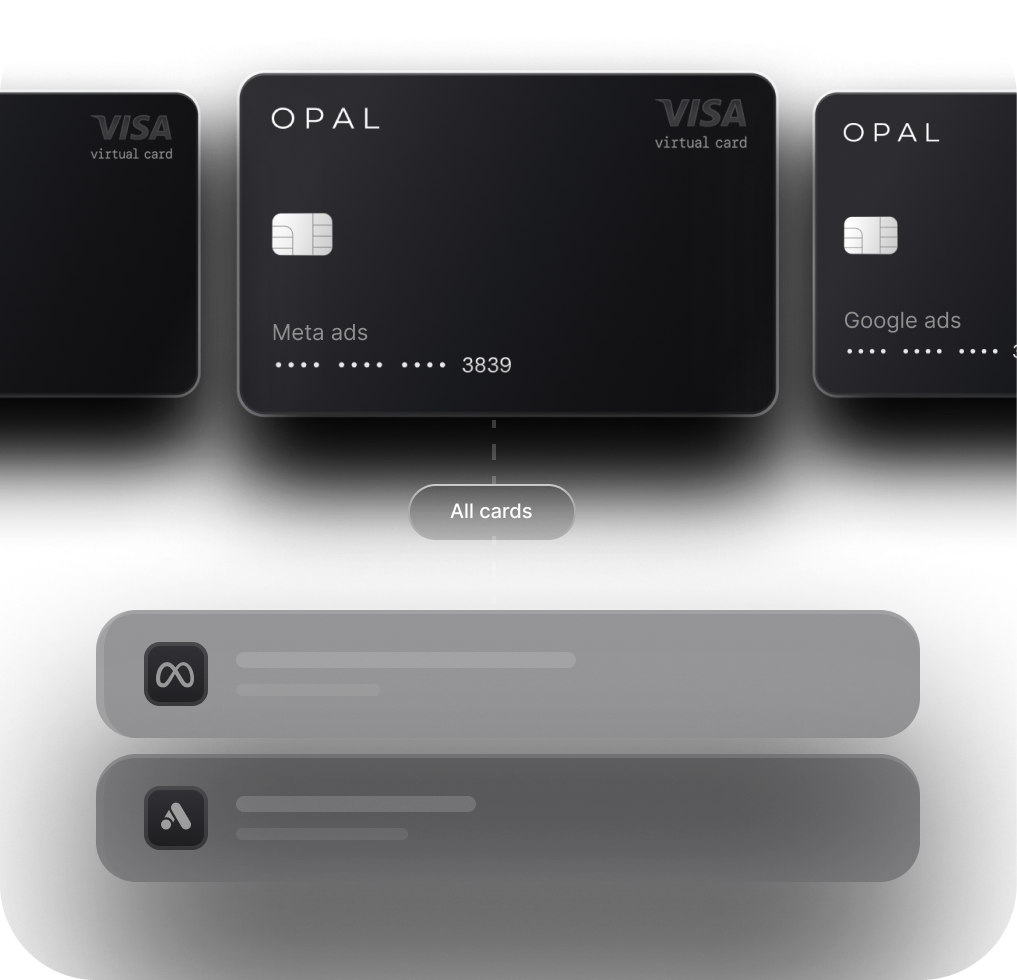
Opal uses a Client-Funded Card model, which means each client's ad spend runs through a dedicated card tied directly to their budget. Every dollar is tagged to the correct client from the moment it is authorized. There is no ambiguity at reconciliation time because the categorization happened at the point of purchase, not retroactively.
Automated reconciliation then syncs spend data directly from ad platforms, eliminating the manual export and spreadsheet work that typically consumes hours of account manager time each month. The result is that both the agency and the client are looking at the same live data, pulled from the same source, with no manual intervention required.
Outsmart Labs, a performance marketing agency, saved 15 hours per month on reconciliation after switching to this model. That's nearly two full business days per month returned to the team, time that can go toward strategy, creative, or new business instead of spreadsheet cleanup.
What This Looks Like for the Account Manager
Before automation, a typical end-of-month reconciliation cycle might look like this:
Export spend data from Google Ads, Meta, and TikTok
Pull the card statement and match line items to platform charges
Investigate any discrepancies (there are always some)
Build the client-facing report
Send and wait for questions
After automation, steps one through three effectively disappear. The data is already matched. The report builds itself. The account manager's job shifts from data wrangling to interpretation and communication, which is where the actual value is.
The hours saved aren't just an efficiency gain. They're a margin improvement and a morale improvement. Account managers who spend less time on reconciliation are less likely to burn out and more likely to do the kind of proactive work that actually retains clients.
The Retention and Pitch Advantage Transparent Agencies Have
Let's look at the two scenarios where spend transparency has the most direct business impact: retention conversations and new business pitches.
Retention: When a Client Starts Asking Questions
The moment a client starts asking detailed questions about where their budget went, the relationship is already under strain. If your answer is "let me pull the report and get back to you," you've just confirmed their anxiety. If your answer is "log into the dashboard and you can see everything in real time," you've just defused it.
Clients who have live access to their spend data are less likely to reach that anxious state in the first place. They can see budget pacing throughout the month. They can see that the campaign launched on the date you said it would. They can see that the spend matches the plan. When performance does dip, the conversation is about strategy, not about whether the numbers are accurate.
That shift, from "do I trust this agency with my money?" to "how do we solve this performance problem together?", is the difference between a client who churns and a client who renews.
New Business: The Transparency Story Most Competitors Can't Tell
Here is where it gets interesting from a pitch perspective. When you walk into a new business meeting and tell a prospective client that they'll have real-time access to their spend data at any time, that they'll never have to wait for a monthly report to know where their budget went, you are offering something the majority of agencies cannot match.
Most agencies are still running the manual workflow described earlier. They can't make that promise because they don't have the infrastructure to back it up. You do.
That is a genuine competitive differentiator, and it's one that resonates with the exact people who sign agency contracts: CFOs, CMOs, and founders who are accountable for every dollar of ad spend.
Reporting Setup: Traditional vs. Real-Time
Traditional Agency Setup |
Real-Time Visibility Setup |
|
|---|---|---|
|
Reporting frequency |
Monthly (sometimes bi-weekly) |
Continuous, on demand |
|
Time to produce a spend report |
3 to 8 hours per client per month |
Near zero (automated) |
|
Client access to live data |
None until report is delivered |
Full access at any time |
|
Reconciliation method |
Manual: platform exports matched to card statement |
Automated: spend synced directly from ad platforms |
|
Error rate |
Higher (manual entry and matching) |
Significantly lower (no manual steps) |
|
Client satisfaction impact |
Reactive: clients ask questions, agency responds |
Proactive: clients self-serve, fewer escalations |
|
New business pitch advantage |
Limited: same workflow as most competitors |
Strong: real-time access is a differentiable promise |
FAQ
What is the best way to give clients visibility into their ad spend?
The best way to give clients visibility into their ad spend is to move from periodic reporting to continuous, automated data access. This means using a spend management system where every dollar is tagged to the correct client budget at the point of authorization, and where spend data syncs directly from ad platforms without manual export steps. Clients should be able to log in and see current spend, budget pacing, and platform-level breakdowns at any time, not just after a monthly report is delivered. The goal is to make the client's access to their own data as frictionless as possible, which builds trust and reduces the volume of ad hoc questions your team has to field.
How often should agencies report ad spend to clients?
The honest answer is that frequency matters less than access. Monthly reports are the industry standard, but they leave a significant lag between when money moves and when the client sees it. Agencies that provide real-time or near-real-time access to spend data effectively make the question of reporting frequency irrelevant: the client can check whenever they want. For formal reporting cadences, bi-weekly or weekly check-ins are more effective than monthly for clients managing large budgets, because they allow for mid-course corrections before significant spend has occurred. The best setup combines continuous data access with a regular strategic review, rather than treating the monthly report as the primary communication vehicle.
How does real-time spend visibility help agencies retain clients?
Real-time spend visibility helps agencies retain clients by removing the information gap that fuels distrust. When clients can see exactly where their budget is going at any point in the month, they don't have to wait for a report to know whether their spend is on track. This shifts the relationship from reactive (client asks a question, agency responds) to proactive (client self-serves, agency focuses on strategy). Retention risk tends to spike when clients feel they lack control over their own budget. Real-time visibility directly addresses that feeling by giving clients genuine oversight, which makes the agency harder to replace and easier to defend during a competitive review.
What does good client ad spend reporting look like?
Good client ad spend reporting is specific, timely, and requires no interpretation. It shows exactly how much was spent on each platform, how that compares to the planned budget, and what the pacing looks like for the remainder of the period. It does not require the client to ask follow-up questions to understand where their money went. Ideally, it is available on demand rather than delivered on a fixed schedule, and it reconciles automatically so there are no discrepancies between the report and the invoice. The benchmark for good reporting is simple: the client should never be surprised by a charge, and they should never have to email their account manager to get basic spend information.
How does Opal help agencies provide real-time spend visibility?
Opal helps agencies provide real-time spend visibility through its Client-Funded Card model, where each client's ad spend runs through a dedicated card tied directly to their budget. Every dollar is tagged to the correct client at the moment of authorization, which means there is no manual reconciliation step at the end of the month. Automated reconciliation syncs spend data directly from ad platforms, so both the agency and the client see the same live numbers without any spreadsheet work in between. Clients can access their spend data at any time, and agencies can walk into new business pitches with a transparency story most competitors cannot offer. Outsmart Labs, for example, saved 15 hours per month on reconciliation after switching to Opal.
The agencies winning new business right now aren't necessarily the ones with the best creative or the lowest fees. They're the ones who can walk into a pitch and say: "You'll always know exactly where your money is going." That's a promise most agencies still can't make.
If you're ready to make transparency a competitive advantage rather than a reporting obligation, see how Opal makes it possible at opalspend.com.