

Best Credit Cards for Google Ads Agencies in 2026: Ranked by Cash Back, Limits, and Client Controls

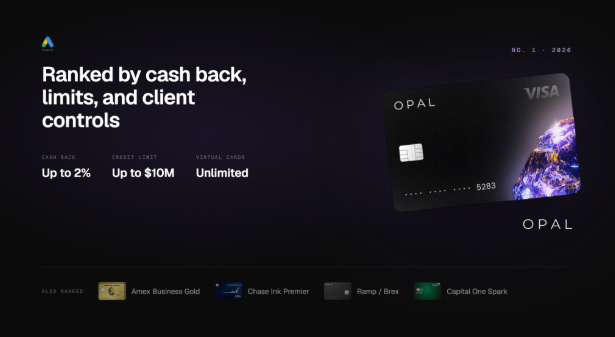
The right credit card for Google Ads spend depends on your volume, account structure, and whether you need clean spend separation across multiple budgets. This guide compares the strongest options in 2026: Opal (built for high-volume, multi-account ad spend), Chase Ink Business Premier (a competitive traditional bank option for large individual charges), and American Express Business Gold (strong for single-account spend within the $150K annual rewards cap), among others. The right card isn't just about credit limits. It's about whether the card handles multiple accounts, clean spend separation, and billing reconciliation at scale.
This guide is for anyone running Google Ads at meaningful volume: agencies, performance marketers, media buyers, DTC brands, and in-house teams managing spend across one or more accounts. If you're a solo advertiser with a single low-volume account, the criteria are different and covered separately.
TL;DR
The best card depends on your volume, account structure, and whether you need spend separation across multiple budgets or clients
Amex Business Gold offers a strong short-term rate at 4x points up to $150K per year, which works best for single-account setups with moderate monthly spend
Chase Ink Business Premier's 2.5% on charges over $5,000 is one of the better flat-rate options in the traditional bank card category for large individual charges
General fintech cards like Ramp and Brex are real upgrades over bank cards for single-entity spend and offer stronger expense management tooling
Per-client virtual cards are the most important criterion most comparisons skip entirely
Above $100K per month across multiple accounts, a card without per-account infrastructure creates a full-time reconciliation job
Why Google Ads Agency Billing Is a Different Problem Than High Limits
Most coverage of credit cards for Google Ads focuses on limits: how high they go, how fast they refill, how to avoid hitting the ceiling. That's the right question for a solo advertiser or an in-house team managing one account.
Anyone managing multiple accounts or campaigns on the same card has a different problem.
When five accounts run on the same card, every charge from Google Ads looks identical in the bank statement: merchant name, dollar amount, date. There's no client name, no campaign, no account ID. A $200K/month operation can receive 30 to 50 individual charges in a single month across multiple accounts. Matching those charges to the right budget at month-end is a manual exercise that doesn't get easier as volume grows.
The three failure modes at high-volume, multi-account spend:
-
Reconciliation collapse. Without per-account spend separation, billing disputes become unresolvable. Someone questions a charge; you have no clean way to show which campaign or budget it came from.
-
Limit pooling across accounts. Running multiple accounts on one card means one account's heavy spend week can exhaust the limit before another campaign gets started. The card becomes a shared resource with no allocation controls.
-
Personal guarantee exposure at scale. Personally guaranteeing a card that processes $500K/month in ad spend is carrying financial risk that belongs to the business, not the individual owner.
These aren't limit problems. They're operational and structural problems that a higher limit alone doesn't fix.
For a deeper look at how Google's billing mechanics work and what triggers declines, Opal's guide to ad platform billing mechanics in 2026 covers the full picture.
The Five Agency-Specific Criteria That Actually Matter
Generic card comparisons evaluate limits, rewards rates, and annual fees. Those matter, but they miss the questions that determine whether a card actually works for an agency managing multiple clients.
Here's the evaluation framework built specifically for agency Google Ads workflows:
1. Per-client virtual card infrastructure
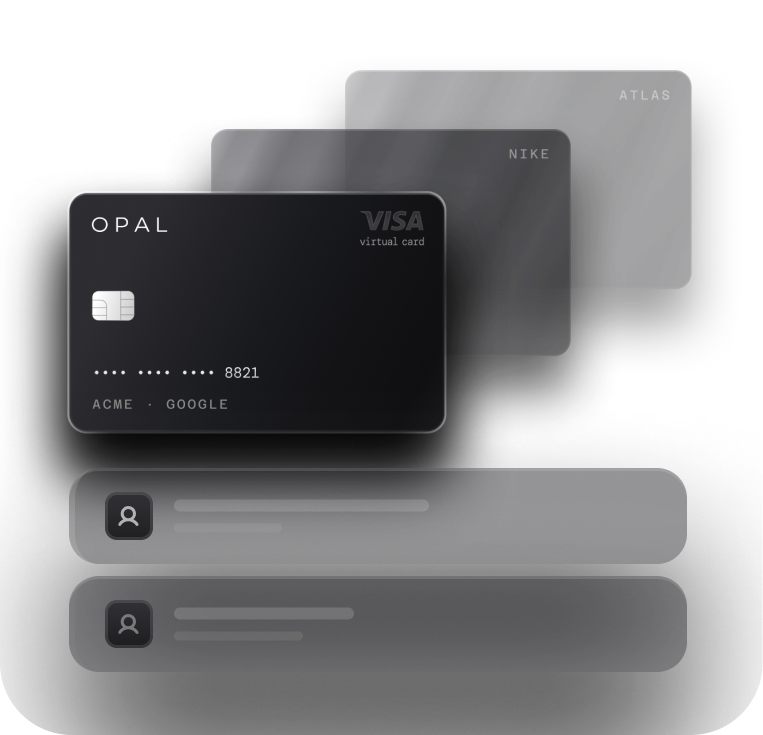
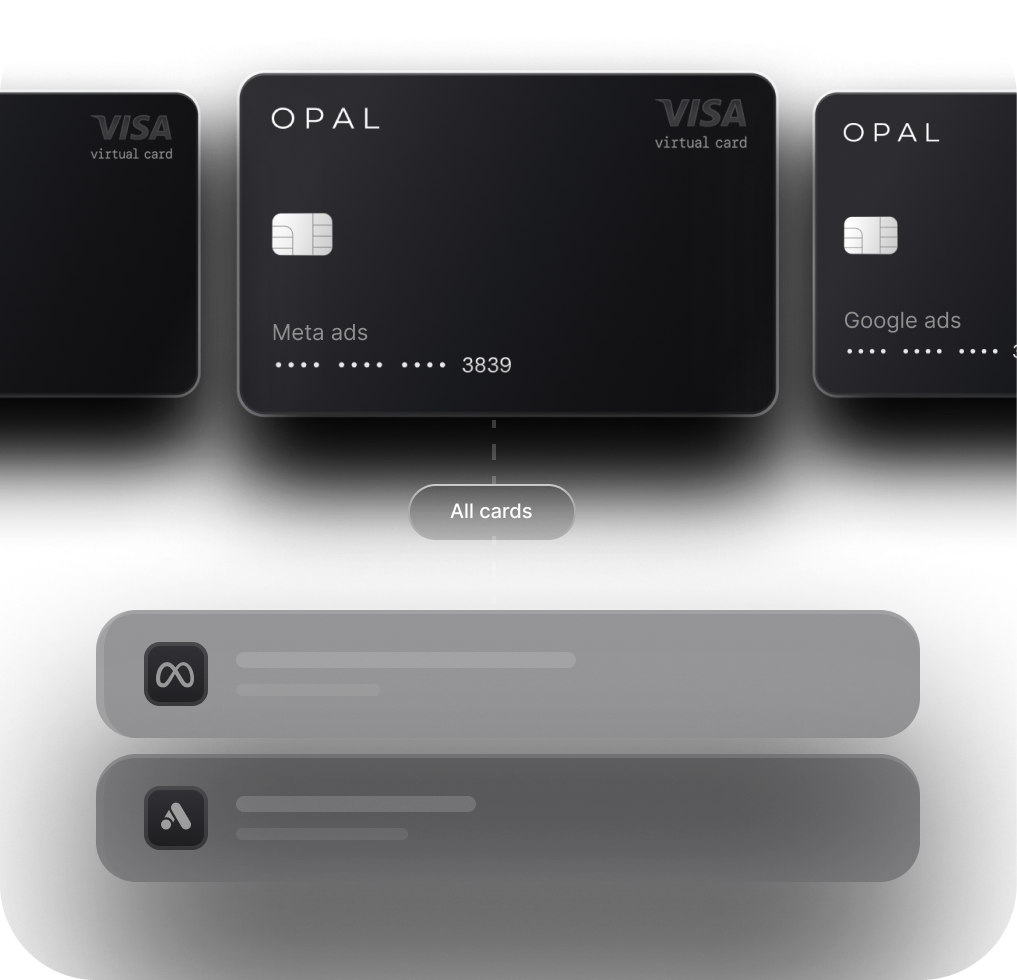
This is the most important criterion and the one most card comparisons skip. Can you issue a dedicated virtual card for each client? If not, every Google Ads charge from every client lands on the same statement with no attribution. Reconciliation at month-end becomes a manual matching exercise. Client billing disputes become unresolvable.
2. How limits are set (and whether they pool across clients)
A $200K limit sounds like enough until three clients have aggressive spend weeks simultaneously. The question isn't just how high the limit goes. It's whether limits can be allocated per client so one client's spend can't crowd out another's.
3. Cash back structure (uncapped vs. capped)
A 2% card with a $2,000 monthly cap returns under 0.5% on $500K of spend. For agencies, the only cash back structure that generates real returns is uncapped, flat-rate rewards on all ad spend. Category restrictions and annual ceilings make rewards effectively meaningless at agency volume.
4. Personal guarantee requirement
Standard business cards require a personal guarantee, making the agency owner personally liable for every dollar of client ad spend that flows through the card. At $500K/month across multiple clients, that's financial exposure that belongs to the clients, not the agency principal.
5. Billing reliability on Google Ads specifically
Not every card clears cleanly at high volume. Velocity limits and MCC 7311 (advertising services) misclassification can trigger platform-side declines that have nothing to do with available credit. A card that fails at the platform level pauses campaigns regardless of the stated limit.
See how agencies structure their card setup in Opal's guide to how agencies structure ad spend by client.
Best Credit Cards for Google Ads Agencies: Ranked
1. Opal Ad-Spend Card
Best for: High-volume advertisers who need a credit line sized on ad spend volume, per-account virtual cards, and no personal guarantee. That includes agencies, performance marketers, media buyers, DTC brands, and in-house teams spending $50K to $10M+ per month across one account or many
Opal was built for high-volume ad spend across any structure: multi-client agencies, DTC brands scaling paid acquisition, performance marketers managing large budgets, and in-house teams running spend on Google and beyond. It's the only card in this list designed specifically for the charge frequency and multi-account complexity that Google Ads creates at scale.
|
Criteria |
Opal |
|---|---|
Cash back |
Up to 2% cashback on eligible ad spend, uncapped |
Credit limits |
Up to $10M, sized on managed ad spend and cash flow |
Virtual cards |
Unlimited, assignable per client, campaign, or platform |
Personal guarantee |
None required |
Annual fee |
None |
Hard credit check |
No |
Deposit required |
No |
Platform compatibility |
Built for Google, Meta, TikTok, Amazon, Apple, and more |
Opal extends credit directly to the business, sized on ad spend volume, cash flow, and underwriting rather than a fixed number set by a conservative bank model. No deposit is required. No personal guarantee. No hard credit check. The credit line scales as spend grows, which means anyone running $500K/month isn't capped by underwriting assumptions built for a general business with a fraction of that volume.
Up to 2% cashback on eligible ad spend, with no monthly ceiling, no annual cap, and no category restrictions. At high volumes, the gap versus a capped rewards card compounds quickly: most traditional cards hit their ceiling within the first quarter and earn effectively nothing after that.
Verdict: Opal's strongest advantages are a credit line sized on ad spend volume, no personal guarantee, no deposit, and up to 2% cashback on eligible ad spend. The unlimited virtual cards and per-account spend separation make it especially practical for multi-account setups. For single-account advertisers at lower volumes, traditional options like Chase Ink or Amex Business Gold may be simpler to set up and sufficient for the volume.
2. American Express Business Gold Card
Best for: Single-account Google Ads spend where monthly volume stays consistently below $12,500 (so the $150K annual cap isn't exhausted early)
The Amex Business Gold offers 4x points on the two categories where the business spends most each month, which can include advertising purchases. The catch: the 4x rate is capped at $150,000 in combined purchases per calendar year. At $50K/month on Google Ads, that ceiling is gone in three months.
There's also a $375 annual fee, a personal guarantee requirement on most accounts, and no per-account virtual card infrastructure.
Verdict: The 4x rate is genuinely useful if your monthly Google Ads spend stays well below the cap. Three months at $50K/month exhausts the $150K ceiling, leaving you at 1x points for the remaining nine months on a card with a $375 annual fee. The effective blended rate for a full year at that volume works out to about 1.75x. If your spend is low and predictable, the 4x window has real value. If volume is higher or spread across multiple accounts, the cap erodes the return quickly and a flat uncapped card becomes more efficient.
3. Chase Ink Business Premier
Best for: Single-account advertisers who want a traditional bank card and whose individual Google Ads charges regularly exceed $5,000
The Chase Ink Business Premier offers 2.5% cash back on purchases over $5,000 and 2% on everything else. For high-volume Google Ads spend where individual charges are large, the 2.5% rate is competitive. There's no annual cap on cash back, which is a meaningful advantage over most traditional business cards.
The limits are set by Chase's underwriting and won't approach what cards built around media buying volume can offer. Virtual card infrastructure is limited. And like all Chase Ink cards, a personal guarantee is always required. Chase confirms this applies to every small business credit card in the Ink family.
Verdict: The 2.5% rate on large individual charges is one of the better rates in the traditional bank card category and worth considering if your Google Ads account generates big single charges regularly. The constraints are the personal guarantee, limited virtual card support, and a credit limit set by static underwriting rather than spend volume. Those trade-offs are manageable for a single account at moderate volume. They become harder to work around as accounts or clients multiply.
4. General Fintech Cards (Ramp, Brex-style)
Best for: Single-entity businesses that want modern expense management tooling and don't need per-account spend separation across multiple ad accounts or clients
General fintech cards offer better limits than traditional business cards and modern expense management tooling. They're a real improvement over standard bank cards for many businesses.
The problem for Google Ads agencies is structural. These cards were built for general business spend management, not for the multi-client, ad-platform-specific workflows that agencies need. Client separation requires workarounds. Cash back structures often have category restrictions or caps. And they weren't designed for the specific charge frequency that high-volume Google Ads accounts generate.
Opal's comparison guides cover the specific gaps: Opal vs. Ramp and Opal vs. Brex.
Verdict: A real upgrade from a bank card for single-entity spend: better limits, cleaner expense tooling, faster onboarding. The gap shows up when you need spend attribution across more than one account or platform. You end up creating separate workspaces or tagging conventions to approximate what a per-account virtual card does natively, and reconciliation at month-end becomes a manual exercise regardless. Cash back structures on general fintech cards also tend to carry category restrictions or volume caps that don't hold up at high ad spend volumes.
5. Capital One Spark Cash Plus
Best for: Single-account advertisers who want the simplest possible flat-rate cash back card and are comfortable with a personal guarantee and a fixed underwriting limit
The Capital One Spark Cash Plus offers unlimited 2% cash back on all purchases with no category restrictions and no annual cap. For agencies that want a simple, flat-rate cash back structure on a traditional card, it's one of the cleaner options in that category.
The limits are set by traditional underwriting, virtual card support is limited, and a personal guarantee is required, the same as Chase Ink and Amex Business cards. One card, one statement, no native way to split spend by client.
Verdict: Clean and simple. One card, 2% back on everything, no categories to manage. It's a strong fit for single-account advertisers who want a straightforward flat-rate card and are comfortable with a personal guarantee. Add a second account or a second platform and you're manually tagging every charge to figure out which budget it belongs to. A fixed underwriting limit also starts dictating campaign pacing at higher volumes. No per-account virtual cards and a limit that doesn't scale with spend are the two constraints that compound most as volume grows.
Which Card Is Right for Your Google Ads Spend?
The answer depends on volume, account structure, and whether you need per-account spend separation.
-
Under $25K/month, single account: Amex Business Gold is the strongest option here if your spend stays consistently below $12,500/month, giving you 4x points before the $150K annual cap kicks in. Capital One Spark Cash Plus offers a simpler 2% flat rate with no category management. Opal is also worth considering if you want no personal guarantee and a credit line that scales as spend grows.
-
$25K to $100K/month, one or more accounts: General fintech cards (Ramp, Brex) offer better limits than bank cards and solid expense tooling, making them a reasonable fit for single-entity spend at this tier. If you're managing more than one account or client, per-account virtual cards and a scalable credit line become the deciding factors. Opal handles both natively.
-
Over $100K/month, multi-account: Standard bank cards and general fintech tools break down operationally at this volume. You need a card that handles high charge frequency, per-account spend separation, and a credit limit sized on actual ad spend rather than static underwriting. Opal and purpose-built ad spend cards are the practical options here.
Apply at opalspend.com to see your estimated credit limit based on current spend volume.
Frequently Asked Questions
What is the best credit card for Google Ads spend?
It depends on volume and account structure. For single-account advertisers spending under $12,500/month, Amex Business Gold's 4x points rate is hard to beat before the $150K annual cap runs out. For larger individual charges, Chase Ink Business Premier's 2.5% rate is competitive. For high-volume, multi-account setups where per-account spend separation and a large credit line matter, Opal is the strongest fit: no personal guarantee, no deposit, up to 2% cashback on eligible ad spend, and unlimited virtual cards.
Do I need a different card for Google Ads than for Meta Ads?
Not necessarily. The best cards for ad spend work across all major platforms, including Google, Meta, TikTok, Amazon, and Apple Search Ads. The key is finding a card that handles the charge frequency and multi-account structure your setup requires, regardless of which platforms you use.
Why do most business cards fail at high Google Ads volumes?
Standard business cards use underwriting models designed for general business expenses, not for the high-frequency charge pattern that Google Ads creates at scale. A card with a $50K limit can be effectively exhausted in a week on a large account because Google charges every time an account hits its billing threshold, not once a month. Add multiple accounts and the need for clean spend separation, and most traditional cards break down operationally well before they hit their stated limit.
Can I earn cash back on Google Ads spend?
Yes. Opal offers up to 2% cashback on eligible ad spend with no monthly ceiling, no annual cap, and no category restrictions. Most traditional business cards cap rewards monthly or annually, which means at high spend volumes they earn effectively nothing after hitting the ceiling.
What does "no personal guarantee" mean for a card used for ad spend?
A personal guarantee makes the business owner personally liable for the card balance if the business can't pay. For anyone running large ad budgets through a card, that's real financial exposure on the owner's personal balance sheet. Opal doesn't require one. Credit is extended directly to the business based on ad spend volume, not the owner's personal financial position.
Can I earn cash back on ad spend without fronting the money?
Yes. Opal extends credit to your business based on ad spend volume, so you're not drawing on your own capital to fund campaigns. You earn up to 2% cashback on eligible ad spend using Opal's credit line, not your own money. Learn more in Opal's guide to how to earn cash back on ad spend.