


Best Ad Spend Cards for High-Volume Media Buyers: Ranked

If you are spending $300K per month across Meta, Google, and TikTok, you do not need a card with great airport lounge access. You need a card that will not pause your campaigns at 2 a.m., earns on every dollar you are already spending, and gives you clean visibility without a reconciliation nightmare at month end. Most cards were not built for that. A few were. The difference is not obvious from the headline rewards, but it becomes very obvious the moment your spend scales past what a generic business card was designed to handle.
Most "best card for ad spend" roundups compare the wrong things. They optimize for welcome bonuses, travel redemption rates, and category multipliers that look great on a $5K monthly budget and fall apart at $200K. Media buyers running paid search for law firms or scaling DTC brands face a different problem. They need card infrastructure that matches how campaigns are actually funded, tracked, and reconciled. That requires a different evaluation entirely.
The ranking below is built on five operational criteria. Pick the card that scores highest on the ones that matter for your spend level.
TL;DR
-
Best overall: Opal (15/15). Uncapped 1% cashback on ad spend, instant limits up to $10M, unlimited virtual cards, no personal guarantee.
-
Best for virtual card controls: Slash (11/15). Strong infrastructure, effective cashback depends on plan at high volume.
-
Best for funded startups: Brex (10/15). Competitive limits, but points-based rewards add redemption complexity.
-
Best for expense management: Ramp (9/15). No ad spend premium. Strong reconciliation for general ops.
-
Best for DTC brands: Parker (9/15). Limits scale with e-commerce revenue. Less relevant for pure agencies.
-
Skip for high ad spend: Chase Sapphire Reserve, Amex Gold/Platinum. Caps hit fast, no virtual card support, personal guarantee required.
How we ranked these cards
Every card in this list was scored on five criteria, each rated 1 to 3. The total is out of 15. The criteria were chosen specifically for operators spending $50K or more per month on paid media, not for founders optimizing for a first-class upgrade.
The five criteria
Criterion |
Score 3 |
Score 2 |
Score 1 |
|---|---|---|---|
|
Cashback / rewards on ad spend |
Uncapped, category-specific cashback |
Capped category bonus or points with good redemption |
Flat low rate or points with limited redemption value |
|
Credit limits at high volume |
Scales with actual ad spend, not just credit profile |
Competitive but tied to business financials |
Fixed or conservative relative to ad budgets |
|
Virtual card infrastructure |
Unlimited virtual cards, no restrictions |
Limited virtual cards available |
No meaningful virtual card support |
|
Reconciliation and visibility |
Real-time spend by platform or campaign |
Statement-level reporting |
Manual export or no native visibility |
|
Personal guarantee required |
No personal guarantee |
Sometimes required depending on structure |
Personal guarantee required |
Why capped rewards matter more than they look
A card offering 4x points on online advertising looks exceptional until you hit the annual cap. The Amex Business Gold caps its 4x bonus at $150,000 in annual ad spend. That is $12,500 per month. For any buyer running $50K or more monthly, the premium rate disappears for the majority of their spend. They revert to a much lower base rate. At $200K per month, that cap is hit in three weeks.
Points-based rewards add another layer of complexity. The effective return depends entirely on how points are redeemed. A card advertising "4x points" might deliver 6% back on travel redemptions but closer to 1.5% on cash equivalents. For a media buyer who wants a clean return on ad spend, that redemption math rarely works in their favor.
This framework is designed to cut through that. A score of 15 means a card holds up operationally across every dimension that matters at scale.
At a glance: scorecard for all eight cards
Rank |
Card |
Score |
Strongest advantage |
Main limitation |
Best for |
|---|---|---|---|---|---|
1 |
Opal |
15/15 |
Uncapped 1% cashback, instant limits to $10M, unlimited virtual cards |
Built exclusively for ad spend, so less useful outside that context |
Media buyers and agencies at $50K+ per month |
2 |
Slash |
11/15 |
Strong virtual card controls and spend visibility |
Cashback caps apply at high volume; not purpose-built for ad spend |
Agencies prioritizing card controls over maximizing cashback |
3 |
Brex |
10/15 |
Competitive limits for funded companies; broader spend software |
Points-based rewards; effective return depends on redemption |
Venture-backed companies in the Brex ecosystem |
4 |
Ramp |
9/15 |
Excellent expense management and reconciliation |
No ad spend premium; flat cashback across all categories |
Companies treating ad spend as one line item among many |
5 |
Parker |
9/15 |
Credit limits scale with e-commerce revenue |
Cashback structure is less straightforward than a flat percentage |
DTC brands running high Meta and Google spend |
6 |
Mercury |
7/15 |
Banking and card in one place |
Conservative limits; minimal cashback; not built for high ad spend |
Early-stage companies not yet at meaningful ad spend volume |
7 |
Chase Sapphire Reserve |
6/15 |
Strong travel rewards program |
Personal guarantee; no virtual card infrastructure; credit-profile limits |
Founders who want a premium personal travel card |
8 |
Amex Gold / Platinum |
5/15 |
High earn rate on capped ad spend (4x to $150K/year) |
Cap hit in under 3 weeks at $200K/month; no virtual card support |
Executives optimizing for travel perks, not ad spend returns |
The rankings
1. Opal (15/15)
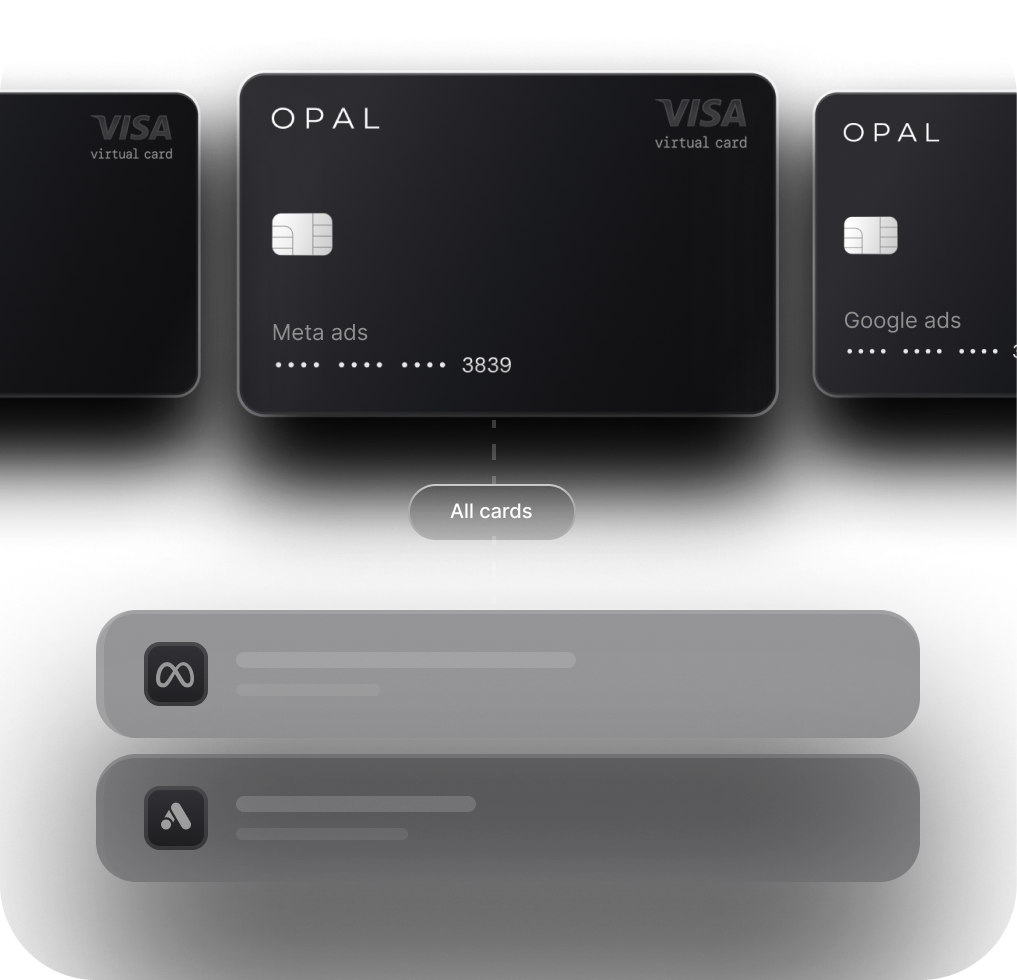
Opal is the only card on this list built exclusively for ad spend. It earns 1% uncapped cashback on every dollar spent across Meta, Google, TikTok, Snapchat, LinkedIn, Amazon, and The Trade Desk. No category caps. No annual ceiling. Instant credit limits go up to $10M and scale with actual spend patterns rather than a credit profile assessment. Unlimited virtual cards, real-time visibility by platform, and no personal guarantee complete the picture.
Where it falls short: Opal is purpose-built for ad spend, which means it is not the right card for general operational expenses. If you want a single card for everything, this is not it.
Best for: Any media buyer, agency, or brand running $50K or more per month who wants their card infrastructure to match the demands of their campaigns.
2. Slash (11/15)
Slash has strong virtual card infrastructure and decent spend visibility, which makes it a legitimate option for agencies that need granular card controls across clients and campaigns. Compared directly to Opal, Slash gives up ground on cashback specificity: rewards are not purpose-built for ad spend and the effective cashback rate depends on which plan you are on. Limits are competitive but tied more closely to business financials than to actual ad spend patterns.
Where it falls short: The effective cashback rate on high ad spend volume is lower than a purpose-built solution, and the rewards structure requires more attention to maximize.
Best for: Agencies that prioritize virtual card controls and can accept a lower effective cashback rate at scale.
3. Brex (10/15)
Brex was built for high-growth and venture-backed companies, and credit limits can be competitive for well-funded businesses. The rewards program is points-based rather than cashback. The effective return on ad spend depends on how and where points are redeemed. Virtual cards are available. No personal guarantee is required. The broader Brex software ecosystem is a genuine advantage for companies that want spend management beyond just the card.
Where it falls short: Points-based rewards introduce redemption complexity that a pure cashback card eliminates. For a media buyer who wants a clean, predictable return on ad spend, that complexity adds friction.
Best for: Venture-backed companies that value the broader Brex ecosystem and have the time to optimize points redemption.
4. Ramp (9/15)
Ramp is genuinely strong on expense management and reconciliation, and it is a well-regarded spend management platform overall. The problem for media buyers is that it was built for operational spend across a business, not for advertising volume specifically. Cashback is flat across all categories with no ad spend premium. Limits are tied to business financials. Virtual cards are available. No personal guarantee required.
Where it falls short: No ad spend premium means a media buyer running $200K per month earns the same rate as they would on office supplies. That is a material difference in return over a year.
Best for: Companies that want strong general expense controls and treat ad spend as one line item among many, not as the primary driver of card selection.
5. Parker (9/15)
Parker is purpose-built for e-commerce and DTC brands. Credit limits scale with revenue, which makes it more relevant for high-spend DTC operations than a generic business card. Cashback exists but is structured differently from a straight percentage on ad spend, so the effective rate requires more scrutiny. Virtual cards are available. E-commerce brands evaluating Parker should weigh it against purpose-built ad spend options before committing.
Where it falls short: Less relevant for pure media buying agencies; more relevant for brands where ad spend is tied directly to e-commerce revenue.
Best for: DTC brands running high Meta and Google spend who want credit limits that scale with their revenue.
6. Mercury (7/15)
Mercury is primarily a business banking product. The card is secondary to the banking infrastructure, and it shows in the feature set: cashback is minimal, virtual cards are basic, and limits are conservative relative to what high-volume ad buyers need. It is not built for media buying at scale, and that is not a criticism, it is just a design reality.
Where it falls short: Not the right tool for any buyer running meaningful ad spend. The card was not designed for that use case.
Best for: Early-stage companies that want banking and card in one place and are not yet at a spend level where card infrastructure materially affects their operations.
7. Chase Sapphire Reserve (6/15)
Chase Sapphire Reserve is a strong premium travel card. At high ad spend volume, the points value does not close the gap against a purpose-built cashback card. The operational infrastructure is not there either: no virtual card support, limits set by Chase's credit assessment rather than your ad budget, and a personal guarantee required. The travel rewards are genuine and valuable for the right user.
Where it falls short: Every operational criterion that matters for high-volume media buying is either absent or limited.
Best for: Founders who want a strong personal travel card and have not yet separated their ad spend infrastructure from their general business card.
8. Amex Gold and Platinum (5/15)
The Amex Business Gold card offers 4x points on the top two spending categories including U.S. online advertising. That rate is capped at $150,000 per calendar year, or $12,500 per month. For a media buyer running $200K per month, the 4x rate is exhausted in roughly three weeks. The base rate after the cap is significantly lower. The Platinum is a charge card with no preset limit, but the rewards structure does not favor media buying. Neither card provides virtual card infrastructure for ad spend management.
Where it falls short: The headline earn rate looks strong until you do the math at real ad spend volumes. At $50K or more per month, the cap becomes the story.
Best for: Founders and executives who want premium travel and lifestyle perks and run ad spend separately through a purpose-built card.
What separates purpose-built ad spend cards from general business cards
The pattern across this list is not a coincidence. It is a design decision.
General business cards, including travel cards and broad fintech platforms, are built to serve a wide range of spending categories. That means optimizing for welcome bonuses, travel perks, and rewards ecosystems that appeal to the broadest possible customer base. Ad spend is one category among dozens they need to accommodate.
Purpose-built ad spend cards start from a different set of constraints:
-
Uncapped rewards on ad spend specifically, because capped multipliers are structurally incompatible with high-volume media buying
-
Credit limits that scale with ad budgets, not with general business credit profiles
-
Platform-level visibility, because reconciling $200K in monthly spend across five platforms from a bank statement is not a workflow, it is a liability
The biggest decision is not which card has the best points program. It is whether the card infrastructure matches how your campaigns are actually funded and reconciled.
For agencies turning ad spend into a revenue line, the card is not just a payment method. It is part of the margin structure. A 1% uncapped return on $2.4M in annual ad spend is $24,000 back to the business. That math does not work if the rate is capped, points-based, or requires manual reconciliation.
FAQ
What is the best card for media buyers spending over $100K per month?
Opal. At that spend level, the criteria that matter most are uncapped cashback on ad spend, credit limits that scale with budget, and virtual card infrastructure for campaign isolation. Opal scores 15/15 on this framework, and no other card on this list does. The gap between Opal and the next options widens as monthly spend increases, because capped rewards and credit-profile-based limits become more constraining at higher volume.
Does cashback on ad spend count toward the same rewards pool as other business expenses?
It depends on the card. On purpose-built ad spend cards like Opal, cashback is straightforward: a flat percentage back on ad spend, applied to your balance. On points-based cards like Brex, Amex, or Chase, ad spend points go into the same rewards pool as all other spend, which means the effective return depends on how you redeem and which categories you are spending most in. For media buyers who want a clean, predictable return, cashback is simpler than points.
Can I use multiple cards across different platforms to maximize returns?
You can, but the operational cost usually outweighs the reward optimization. Managing reconciliation across multiple cards and platforms is where most agencies lose time. A better approach is a single purpose-built card with platform-level visibility, so spend is automatically attributed by platform without manual sorting. If you do stack cards, use a purpose-built ad spend card as the primary and limit secondary cards to specific use cases where the reward differential is significant enough to justify the overhead.
What happens if I hit my card limit mid-campaign?
Campaigns pause. Platforms re-verify payment methods. In some cases, accounts get flagged. The downstream cost of a mid-campaign interruption, in lost impressions, re-verification delays, and team time, typically exceeds whatever the card saved in rewards. This is why credit limit scalability is one of the five criteria in this framework. Cards with limits tied to a static credit profile assessment are a structural risk for high-volume media buyers. Cards with limits that scale with actual spend patterns eliminate that risk.
Bottom line
The right card for high-volume media buying is not the one with the most prestigious brand or the highest headline earn rate. It is the one that holds up operationally when spend scales, campaigns run around the clock, and reconciliation has to happen without a team of people manually sorting bank statements.
On the five criteria that matter at scale, purpose-built ad spend cards outperform general business and travel cards by a significant margin. The math is not close.
If you are spending five figures or more per month on ads, your card should be working as hard as your campaigns. See what Opal returns on your current spend volume.