
Best Credit Card for Online Advertising in 2026

Quick answer: For agencies, media buyers and brands with high or variable ad spend, Opal is the strongest choice. It is a pay-in-full charge card with up to $10M in credit limits, uncapped cash back on ad spend, unlimited free virtual cards and no personal guarantee. For smaller advertisers, the right card comes down to reward caps, annual fees and whether points or cash back suit you better.
The best credit card for online advertising depends on three things: how much you spend on ads each month, whether you want cash back or points, and whether you need agency-grade controls such as client-level virtual cards.
A business spending $5,000 a month on Google Ads has different needs from an agency running $500,000 a month across ten clients and five platforms.
This guide compares the main business credit card options for online advertising on rewards, caps, fees, personal guarantees and multi-client controls, then shows which card fits which advertiser.
Which card fits which advertiser
-
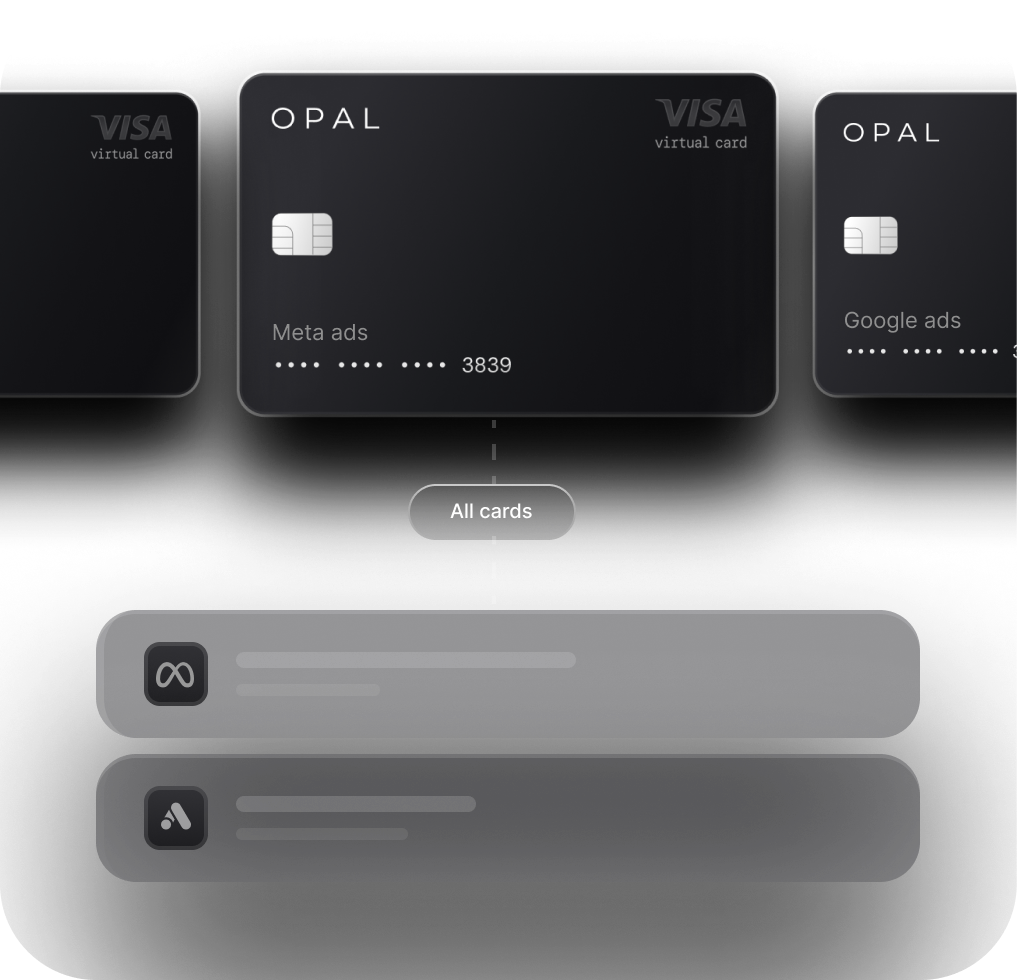
Opal (our pick for agencies and high-volume media buyers): built for client-funded ad spend, with a virtual card for every client, platform or campaign and no personal guarantee.
-
American Express Business Gold: designed for businesses whose ad spend stays under its $150,000 annual bonus cap and who want Membership Rewards points.
-
Chase Ink Business Preferred: designed for smaller advertisers who want a $95 annual fee and points on up to $150,000 of combined bonus-category spend.
-
Chase Sapphire Reserve for Business: designed for travel-heavy businesses that will use enough of its credits to offset a $795 annual fee.
-
Ramp: designed for general corporate expense management across many spend categories.
In this guide
Online advertising credit cards compared
The table below compares the cards most often considered for ad spend on the factors that matter at scale. Card terms were checked in October 2026, and points and cash back are kept in separate terms because they are worth different things.
Card |
Designed for |
Ad-spend rewards |
Reward cap |
Annual fee |
Personal guarantee |
Multi-client controls |
|---|---|---|---|---|---|---|
Agencies, media buyers and brands with high-volume ad spend |
Up to 1.5% cash back* |
No cap |
$0 |
None |
Unlimited free virtual cards per client, platform or campaign; Client-Funded Card model |
|
Advertisers under the bonus cap who want points |
4X Membership Rewards points on the top 2 eligible categories, which can include U.S. online advertising |
$150,000 combined per calendar year, then 1X |
$375 |
Yes |
Employee cards and unlimited virtual cards; no client-funded model |
|
Smaller advertisers who want a low fee and points |
3X Ultimate Rewards points on social media and search engine ads |
$150,000 combined with other bonus categories per anniversary year, then 1X |
$95 |
Yes |
Employee cards |
|
Chase Sapphire Reserve for Business |
Travel-heavy businesses |
3X Ultimate Rewards points on social media and search engine ads |
$1M per anniversary year from Nov 15, 2026, then 1X |
$795 |
Yes |
Employee cards |
Ramp |
General corporate expense management |
Variable cash back up to 1.5%, set by Ramp |
No category cap |
$0 |
None |
Virtual cards for company expenses; no client-funded model |
*1% on credit accounts and 1.5% on pre-funded accounts, on eligible ad spend.
Best credit card for online advertising: how to choose in 2026
The right advertising credit card is the one that matches how your business actually buys media. Work through these five questions before comparing headline reward rates:
-
How much do you spend on ads each month? Below roughly $12,500 a month ($150,000 a year), capped bonus categories can cover all of your ad spend. Above that, a growing share of every dollar earns the base rate, and an uncapped structure holds its value.
-
Do you want cash back or points? Cash back is a fixed, predictable return that can flow straight to margin or back to clients. Points vary in value with how and when you redeem them.
-
Do you manage spend for clients? Agencies need each client's charges kept apart for billing and reconciliation. Shared limits and employee cards make that a manual job.
-
What does a declined charge cost you? Ad platforms charge cards automatically, and a failed payment can pause delivery. The higher and more variable your spend, the more limit headroom and payment reliability matter.
-
Will you sign a personal guarantee? Most traditional business cards make the applicant personally liable for the balance. At agency-scale spend, that liability can run into six or seven figures.
How reward caps change the math at high ad spend
Bonus caps are where traditional rewards cards and high-volume advertising part ways. Each capped card earns its bonus rate up to a threshold, then drops to 1X for the rest of the year.
Annual ad spend |
Amex Business Gold |
Chase Ink Business Preferred |
Chase Sapphire Reserve for Business |
Opal |
|---|---|---|---|---|
$150,000 ($12,500 a month) |
0% at base rate |
0% at base rate |
0% at base rate |
Same rate on every dollar |
$600,000 ($50,000 a month) |
75% at base rate |
75% at base rate |
0% at base rate |
Same rate on every dollar |
$1.2M ($100,000 a month) |
87.5% at base rate |
87.5% at base rate |
17% at base rate |
Same rate on every dollar |
$6M ($500,000 a month) |
97.5% at base rate |
97.5% at base rate |
83% at base rate |
Same rate on every dollar |
The table shows the share of annual ad spend that falls above each card's bonus cap. It assumes all of the spend qualifies for the bonus category and, for Chase Ink Business Preferred, that no other bonus-category spend uses up the cap first.
Credit limits compound the problem. A card with a preset limit sized on your business credit file can block a campaign that doubles in a week, while Opal sizes limits on managed ad spend, up to $10M.
Best credit card for Google Ads, Meta Ads and TikTok Ads
Ad platforms charge your card automatically, and at high spend that can mean several charges a day.
If a charge fails, campaigns can stop delivering until the balance is settled, so the best card for each platform is the one that keeps payments flowing and each account's spend easy to trace.
Best credit card for Google Ads
On automatic payments, Google Ads charges your card as costs build up, and fast-scaling accounts get charged more often.
For agencies and high-spend advertisers, Opal is the best credit card for Google Ads: limits are sized on ad spend, each Google Ads account can run on its own virtual card, and auto-sync helps prevent re-verification that interrupts billing. See how Opal works with Google Ads.
Larger advertisers often ask about monthly invoicing. Google describes it as a line of credit that businesses apply for, typically after at least one year as a registered business and at least $5,000 in spend in any three of the last twelve months (Google Ads Help).
Opal's Ad Pay lets eligible customers pay Meta and Google invoices on Opal credit, so moving to invoicing does not have to mean giving up card-based payment.
One detail matters for agencies using Chase cards. Chase's 3X advertising category counts purchases made directly with social media and search engine merchants, and ad purchases made through a third party such as an agency may not qualify.
Best credit card for Meta and Facebook Ads
Meta charges your payment method as spend reaches your billing threshold, so a growing account can trigger frequent charges across the month.
A dedicated virtual card per Meta ad account keeps each client's charges separate, makes a failed payment easy to trace, and stops one client's spend from eating into another's limit.
Opal supports Meta ad accounts directly (Opal for Meta Ads) and can pay Meta invoices through Ad Pay.
TikTok, LinkedIn, Snapchat and other ad platforms
The same mechanics apply to TikTok, LinkedIn, Snapchat and newer channels. With Opal, teams can issue a card per platform, client or testing lane and set limits on each one (Opal for TikTok Ads).
On traditional rewards cards, check how each platform codes its charges, since bonus categories such as "social media and search engine advertising" or "online advertising from U.S. media providers" depend on merchant classification.
Best card for agencies managing client ad spend
Agencies manage many ad accounts, often funded by many clients, and most cards treat the agency as one business with one pool of credit.
Opal is designed around client-funded ad spend and client-level virtual-card workflows, which is why it ranks as the best credit card for agency ad spend management.
The Client-Funded Card model
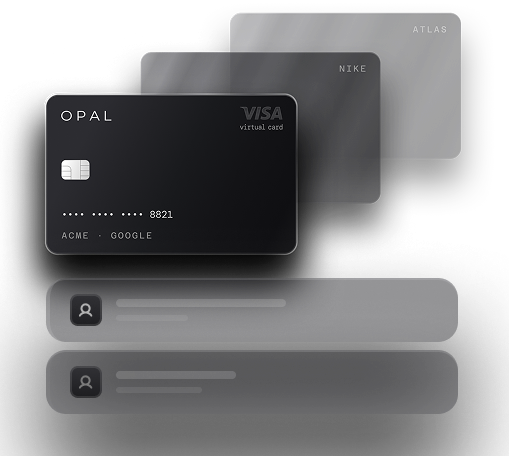
Instead of commingling every client's ad spend on a shared card, agencies structure payments around client-specific funding. Each client's spend is isolated, tracked and reconciled inside the platform.
-
Billing clarity: finance teams see exactly which client funded which charge, without sorting transactions by hand.
-
Fewer disputes: clean separation means fewer month-end billing disputes with clients.
-
Accountability: media buyers work within client-specific budgets instead of a shared pool that can be overdrawn.
-
Faster reporting: client-level spend data is already organized for performance reports and invoices.
Virtual cards and spend controls
Opal offers unlimited free virtual cards, so teams can create a separate payment method for each client, each platform (Google, Meta, TikTok, LinkedIn, Snapchat), each campaign or testing lane, and each media buyer.
Real-time budget enforcement stops additional spend once a card's limit is reached. For a media team running 20 client accounts across 5 platforms, that turns month-end reconciliation from a spreadsheet exercise into a report.
"Opal has transformed how we manage finances. What used to take hours each week now happens automatically. The cashback alone has become a significant revenue stream, we're more profitable, more efficient, and our clients love the transparency."
Operations Lead, Outsmart Labs
Outsmart Labs is one of the teams managing ad spend on Opal. See how other agencies set up client cards on the Opal for Agencies page.
Best no-personal-guarantee card for high-volume media buying
A personal guarantee makes the person who applies liable for the card balance if the business cannot pay.
Most traditional business cards, including the Amex and Chase cards above, require one, which means an agency owner funding client media can carry personal liability for spend that belongs to clients.
Opal requires no personal guarantee and no hard credit check, and limits are sized on managed ad spend instead of a personal credit file.
That makes it the strongest no-personal-guarantee option for media buyers and agencies running high-volume campaigns. For more on the risk, read why agency owners should stop using personal credit to fund client ad spend and what to know about business cards with no personal guarantee.
Credit card vs. charge card for advertising spend
A revolving credit card lets you carry a balance and pay interest on it, with a preset credit limit. A charge card requires the full balance each billing period, so there is no revolving debt and no interest, and limits can be sized on spending patterns instead of a fixed line.
For high ad spend, a charge card usually fits better: campaigns need limit headroom more than they need borrowed time, and paying in full keeps client funds and agency cash cleanly matched.
The trade-off is that a charge card needs consistent cash flow to settle each statement. Opal is a pay-in-full charge card, with the balance debited automatically on each payment due date. Read the full breakdown in charge card vs. credit card for high ad spend.
How much ad spend should you put on a business card?
Put recurring ad-platform charges on a card when its limit covers your peak month with room for a campaign that doubles in a week.
If your limit only just covers today's spend, a strong week of performance can turn into a declined charge.
A few practical rules help. Keep each client or ad account on its own card so one account's spike cannot block another's.
Track where your spend sits against any annual bonus cap, because every dollar above it earns the base rate. If you qualify for platform invoicing, compare it with paying the invoice on a card that rewards the spend, such as Opal's Ad Pay.
Why Opal is built for advertising spend
Opal is a charge card and spend management platform designed for digital marketing agencies and brands managing paid media at scale. Every feature below maps to a specific pain point in media buying.
Feature |
Opal |
|---|---|
Card type |
Pay-in-full charge card |
Credit limit |
Up to $10M |
Cash back |
Up to 1.5%, uncapped |
Virtual cards |
Unlimited, free |
$0 |
|
Personal guarantee |
None |
Hard credit check |
None |
Application time |
2 to 3 minutes |
Ad platform sync |
Yes, auto-sync to prevent re-verification |
Accounting integration |
QuickBooks and Workday |
Credit limits built for campaign scale
A campaign that starts at $5,000 a day can double or triple in a week if performance holds. Opal's limits of up to $10M give agencies and brands room to scale without constant limit-increase requests, which makes limit size the most operationally important feature for high-volume advertisers.
Cash back that keeps its rate at any spend level
Opal pays up to 1.5% cash back on ad spend with no cap, so the rate on your first $20,000 is the rate on your next $2 million. For agencies managing large client budgets, that return can become a real margin line.
Platform compatibility and accounting
Opal auto-syncs with ad platforms to help prevent the re-verification issues that slow account setup and interrupt billing. On the finance side, integrations with QuickBooks and Workday reconcile advertising expenses automatically, so the loop from spend to invoice to reconciliation closes without a manual step.
Who should use Opal
Opal is purpose-built for operators whose ad spend is high, variable or spread across clients. If you fit one of these profiles, it is likely the strongest option available:
-
Digital marketing agencies managing paid media across multiple clients and platforms
-
Performance media buyers running high-volume campaigns where payment continuity is critical
-
E-commerce brands with large paid acquisition budgets that scale quickly
-
Agency finance leads who need cleaner reconciliation and less manual bookkeeping
-
Startups that want high credit capacity without a personal guarantee or hard credit check
Because Opal is a charge card, the full balance is settled each billing period, which requires consistent cash flow. The application takes 2 to 3 minutes and involves no hard credit check, so applying does not add a hard inquiry to your credit report.
Bottom line: the best credit card for online advertising in 2026
For a small business spending under its card's bonus cap, the right advertising card comes down to fees and whether points or cash back suit you better.
For agencies, media buyers and brands with high or variable ad spend, the best credit card for online advertising is the one that handles scale, protects campaign continuity and keeps client spend separate.
Opal was built for that job. It combines up to $10M in credit, uncapped cash back on ad spend, unlimited free virtual cards, a Client-Funded Card model, ad platform auto-sync and QuickBooks and Workday integration, with no annual fee, no personal guarantee and no hard credit check.
Apply at opalspend.com, the application takes 2 to 3 minutes.
Prefer a walkthrough? Book a meeting with the Opal team.
How we evaluated these cards
We compared each card on the factors that decide outcomes for advertisers: reward structure on ad spend, reward caps, annual fees, personal guarantee requirements, credit limit structure, virtual cards and client-level controls, payment reliability on ad platforms, and accounting workflows.
Card terms come from issuer pages and published coverage, checked in October 2026, and this guide is reviewed whenever fees, reward caps or product policies change.
Points and cash back are reported separately. A point's value depends on how and when it is redeemed, so this guide does not convert points into a cash equivalent.
Opal publishes this guide, and the recommendation reflects Opal's focus on agencies and high-volume advertisers.
Frequently Asked Questions (FAQs)
What is the best credit card for online advertising in 2026?
It depends on your monthly ad spend, whether you want cash back or points, and whether you manage spend for clients. For agencies, media buyers and brands with high or variable ad spend, Opal is the best option, with up to $10M in limits, uncapped cash back, unlimited virtual cards and no personal guarantee.
What is the best credit card for Google Ads?
For high-spend advertisers and agencies, Opal is the best credit card for Google Ads. Limits are sized on ad spend, each account can run on its own virtual card, and auto-sync helps prevent billing interruptions.
What is the best credit card for Meta and Facebook Ads?
Opal is the best fit for agencies and brands running Meta Ads at scale. A virtual card per ad account keeps each client's charges separate, and Ad Pay lets eligible customers pay Meta invoices on Opal credit.
Do business credit cards reward online advertising spend?
Yes. Some cards offer bonus points on advertising categories, usually up to an annual cap, while Opal pays cash back on ad spend with no cap.
Are advertising reward categories capped?
On most traditional rewards cards, yes. Amex Business Gold caps its 4X categories at $150,000 a calendar year, Chase Ink Business Preferred caps its 3X categories at $150,000 a year, and Chase Sapphire Reserve for Business caps 3X advertising at $1M a year from November 15, 2026. Spend above each cap earns 1X.
Can agencies use one card for multiple clients?
They can, but a shared card mixes client spend and makes reconciliation and client billing harder. Opal's Client-Funded Card model gives each client its own virtual cards, so spend stays isolated and attributed automatically.
Is a charge card better than a credit card for high ad spend?
For most high-volume advertisers, yes. A charge card is paid in full each period, carries no interest, and can size limits on spending patterns, which suits ad budgets that scale quickly.
Can Google Ads or Meta require a different payment method at high spend?
Google describes monthly invoicing as a payment setting that eligible businesses apply for, typically after a year of registration and $5,000 in spend in three of the last twelve months. Platforms can also ask you to re-verify a payment method, which is the friction Opal's ad platform auto-sync is designed to prevent.
What is the best card for ad spend with no personal guarantee?
Opal requires no personal guarantee and no hard credit check, and sizes limits on managed ad spend. Most traditional business cards, including Amex and Chase business cards, make the applicant personally liable.
Is Opal a credit card?
Opal is a pay-in-full charge card built for advertising spend. The full statement balance is settled each billing period, so there is no revolving balance and no interest, and limits are sized on managed ad spend instead of a credit file.
Charge Card vs. Credit Card for High Ad Spend: What Actually Matters
Why Agency Owners Should Stop Using Personal Credit to Fund Client Ad Spend
Business Card With No Personal Guarantee for Agencies: What You Need to Know