

Business Card With No Personal Guarantee for Agencies: What You Need to Know
TL;DR
Most business cards require a personal guarantee, which makes you personally liable for the card balance if your business can't pay. For agencies running client ad spend, that balance can reach six figures in a single month - for money that isn't even yours. This post explains what a personal guarantee actually means, why agencies face disproportionate exposure, and what to look for in a business credit card without a personal guarantee.
Picture this: you're sitting across from your accountant, reviewing last month's numbers. She points to your business card balance: $147,000. "You know that's personally guaranteed, right?" she says. "If the business couldn't pay this, they could come after your savings. Your house."
You signed the application. You just didn't read that part.
This is the moment a lot of agency owners have. Not a crisis - just a quiet realization that a risk they thought was a business risk has been a personal risk the entire time. The balance on your card from running client campaigns? Personally guaranteed. The spike in spend when a client launched a new product? Personally guaranteed. The month a client went dark and paid 60 days late while the card balance sat there? Personally guaranteed.
If you're in that moment right now, this post is for you. We'll explain exactly what a personal guarantee means, why agencies are more exposed than most businesses, how no-PG cards actually work, and what to look for when you're ready to evaluate alternatives.
As always, this post is educational, not legal or financial advice. For guidance specific to your situation, consult your attorney or accountant.
What a Personal Guarantee Actually Means
A personal guarantee is a legal agreement in which you, as an individual, agree to be personally responsible for a debt if your business cannot pay it.
When you apply for most business credit cards, the application includes a personal guarantee clause. By signing, you're telling the card issuer: if my business defaults, you can come after me personally to collect.
What "default" means in practice
Most people assume default means bankruptcy. It doesn't. In a typical cardholder agreement, default can include:
Missed or late payments on the card balance
Exceeding your credit limit
Material changes to your business that the issuer deems a credit risk
Issuer discretion, in some agreements, if they determine your creditworthiness has changed
In other words, you don't have to go out of business for a personal guarantee to become relevant. A rough quarter, a slow payment month, a balance that runs over limit - these can all trigger default provisions depending on the agreement.
What the issuer can typically do under a PG
Under a standard personal guarantee, the cardholder agreement typically allows the issuer to:
Report the balance to personal credit bureaus, damaging your personal credit score
Pursue collections against you personally, not just the business
Seek a court judgment against you, which can be used to garnish wages or place liens on personal assets
This doesn't mean every missed payment leads to a lien on your home. But the agreement gives the issuer the legal basis to go there if they choose to. That's the exposure you're accepting when you sign.
The bottom line: a personally guaranteed business card is not a business liability. It is a personal liability that happens to be used for business purposes.
Why Agencies Are Uniquely Exposed
For most businesses, a personal guarantee on a business card is a manageable risk. A SaaS company paying for software subscriptions and cloud infrastructure has predictable monthly balances - maybe $10,000 to $30,000 - that closely track the business's actual operating costs. If the business has a bad month, the owner has a clear picture of the exposure.
Agencies are structurally different. And that difference matters a lot when there's a personal guarantee attached.
The balance on your card isn't really yours
When an agency runs client ad spend on a business card, the balance on that card at any given moment represents money spent on behalf of clients - not the agency's own operating costs. The agency is a pass-through for that capital. But the personal guarantee doesn't make that distinction. It covers the entire balance, regardless of who the money was spent for.
An agency running $200,000 per month in client ad spend has $200,000 of personal guarantee exposure for money that isn't theirs. If something goes wrong - a payment processing failure, a cash flow crunch, a client dispute - the issuer doesn't care that the spend was for a client. The personal guarantee covers it.
Spend can spike without warning
Agency card balances don't behave like normal business expenses. They follow client campaign calendars. A client launches a new product in Q4. Another client doubles their budget for a seasonal push. A third client adds platforms. In a single month, your card balance can go from $80,000 to $300,000.
That entire balance is personally guaranteed. And if a client is slow to pay - or disputes a charge, or goes silent entirely - you're holding a balance you personally guaranteed for money you may never fully recover.
This is the scenario that makes a no PG business card worth understanding. It's not about expecting disaster. It's about recognizing that the structure of agency finances creates exposure that most card agreements weren't designed to account for.
For a deeper look at how ad spend limits work on cards with no personal guarantee, see our guide to ad spend limits and no-PG cards.
How No-PG Cards Actually Work
A charge card with no personal guarantee works differently from the start. Instead of evaluating your personal credit history to decide whether to extend credit, the issuer underwrites the card based on your business financials: revenue, cash flow, and managed spend volume.
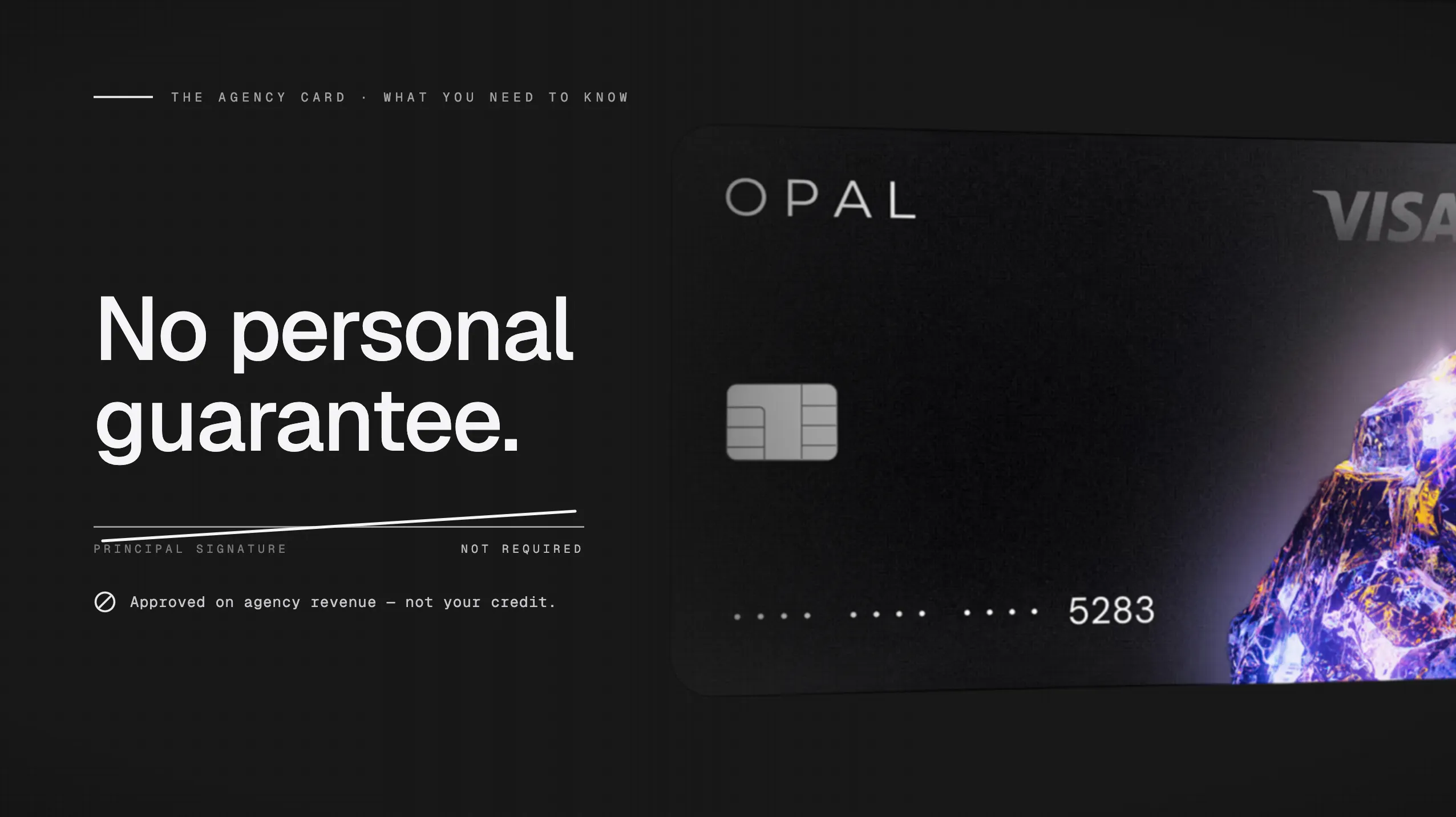
No hard pull on your personal credit at application. No personal liability clause in the cardholder agreement. If the business can't pay, the issuer's recourse is against the business - not against you personally.
What you're giving up
This is worth being direct about, because no-PG cards are not a free upgrade. The tradeoffs are real:
Qualification requires stronger business financials. Because the issuer can't fall back on personal assets, they need confidence in the business itself. Newer agencies or those with limited revenue history may not qualify.
Underwriting is based on managed spend volume, not personal credit score. An agency with a strong book of business and consistent client revenue is a good candidate. An agency with irregular income or limited operating history may face more friction.
Payment cadence may differ. Charge cards (as opposed to revolving credit cards) typically require full payment each cycle rather than allowing a revolving balance. This is a meaningful operational difference if your agency is used to carrying a balance.
The honest framing: a no-PG charge card for agencies is a better structural fit for the way agency finances actually work. But it requires the business to stand on its own financials. If your business can do that, the tradeoff is straightforward.
To understand how Opal structures credit for agencies specifically, see how the Opal card works for client ad spend.
What to Look for When Evaluating No-PG Options
If you're ready to evaluate a business card with no personal guarantee, here are the three things that actually matter for agencies.
1. No personal credit check at application
A genuine no-PG card should not require a hard pull on your personal credit to apply. If a card advertises no personal guarantee but still runs your personal credit at application, that's a signal the underwriting model is still anchored to you personally - not your business.
Ask directly: "Does this application include a hard pull on my personal credit?" If the answer is yes or unclear, keep looking.
2. No personal liability clause anywhere in the agreement
This is the one that catches agency owners off guard. Some cards market themselves as having "no personal guarantee" but include personal liability language elsewhere in the cardholder agreement - in sections covering fraud, misuse, or default remedies.
The distinction matters. "No personal guarantee" is a marketing phrase. "No personal liability" is a legal standard. When you're reviewing an agreement, look specifically for language that holds you personally responsible for any portion of the balance under any circumstance. If it's there, the protection is incomplete.
3. Underwriting based on business revenue, not personal credit score
The most durable no-PG cards underwrite based on what your business actually does: managed spend volume, revenue, client base stability. This is the model that scales with your agency. As your book of business grows, your credit limit can grow with it - without you taking on additional personal exposure.
Opal is built specifically for this. Opal extends credit to agencies based on managed spend volume, with no personal guarantee, no hard credit check, and limits that scale up to $10M. If you're an agency running significant client ad spend, it's worth understanding how the underwriting model works and whether your business qualifies.
See how Opal works for agencies running client ad spend
Frequently Asked Questions
Do all business credit cards require a personal guarantee?
Most do, especially cards issued by major banks. Personal guarantees are standard practice for small business credit products because they reduce the issuer's risk. However, a growing number of fintech-issued charge cards underwrite based on business financials and do not require a personal guarantee. These are typically better suited to businesses with established revenue.
Is a "no personal guarantee" card the same as a card with no personal liability?
Not always. "No personal guarantee" is a marketing term; "no personal liability" is a legal standard. Some cards use the former phrase while still including personal liability provisions elsewhere in the cardholder agreement. When evaluating any card that claims no PG, read the full agreement and ask specifically about personal liability clauses - not just the personal guarantee section.
What happens to my personal credit if I use a personally guaranteed business card?
It depends on the issuer. Some business cards report to personal credit bureaus regardless of payment history. Others only report if the account goes delinquent. If your card balance is large relative to your personal credit profile, this reporting can affect your personal credit utilization and score. A business credit card without a personal guarantee and no hard credit check removes this exposure entirely.
Can I qualify for a no-PG business card if my agency is relatively new?
Qualification requirements vary by issuer, but most no-PG cards require demonstrated business revenue and a track record of managed spend. A very early-stage agency may not qualify. As your book of business grows, the qualification picture typically improves. If you're not ready today, it's worth understanding the criteria so you know what to work toward.
Does Opal require a personal guarantee?
No. Opal does not require a personal guarantee and does not run a hard credit check at application. Credit limits are based on your agency's managed spend volume and scale up to $10M. The application takes approximately two to three minutes. You can learn more about how Opal works here.