

Media Buying for Law Firms: How to Manage Ad Spend at Scale


Picture a mid-size personal injury firm running $80,000 a month in Google Ads. CPCs on their core keywords average $120. At that volume, a single declined card or a campaign that pauses mid-month because a credit limit wasn't sized for legal ad budgets isn't a bad ROAS week. It's a missed intake. And in personal injury, a missed intake isn't a lost lead. It's a contingency case worth $50,000 or more that went to the firm down the street. The math on downtime is brutal in a way that e-commerce brands, running comparable budgets on lower-stakes keywords, simply don't face.
Legal advertising runs at different stakes than almost any other vertical. The cost of a disrupted campaign isn't measured in ROAS or CPL. It's measured in cases. That changes how you have to think about everything behind the spend: the cards, the limits, the controls, the visibility. The firms winning on digital aren't just outspending competitors. They're running their ad spend like infrastructure.
TL;DR: Legal keywords cost $50-$200+ per click. A paused campaign or declined card isn't a bad week; it's a missed case worth tens of thousands in contingency fees. This post covers the operational problems law firms hit at scale, what proper spend infrastructure looks like, and where Opal fits as the financial layer behind high-volume legal advertising.
Why Law Firms Spend More on Digital Ads Than Almost Any Other Vertical
Legal keywords are among the most expensive in Google Ads, and it's not close. "Car accident lawyer," "criminal defense attorney," and "divorce lawyer near me" routinely clear $100 per click. In competitive metro markets, top personal injury terms can hit $200 or more. The reason is straightforward: the lifetime value of a single client in contingency-based practice areas is enormous, and firms have been willing to pay for intent.
The result is a vertical where $50,000/month in ad spend is a modest budget, not an aggressive one.
Meta has entered the mix alongside Google. Firms are using it for retargeting (capturing people who searched but didn't convert) and for brand awareness in family law and immigration, where the decision cycle is longer and emotional context matters. The combination of Google for high-intent search and Meta for nurture has become the standard playbook at firms running serious budgets.
The spend gap between firms that have figured out digital lead gen and those that haven't is widening. Firms that invest in paid search and have the infrastructure to run it reliably are compounding their case volume. Firms still running campaigns through a shared corporate card with a $25,000 limit are hitting ceilings every month and losing ground.
The Operational Problems That Show Up at Scale
Ad spend grows. Infrastructure doesn't. That's where the problems start. Most law firms hit the same three walls once their digital budgets cross a meaningful threshold.
Campaigns pausing mid-month because card limits weren't built for legal ad volume
A standard business card with a $20,000 or $30,000 limit sounds like enough. Until you're running $80K in Google Ads and the card hits its ceiling on the 18th. Google pauses the campaigns. The phone stops ringing. By the time the limit is raised or the card is replaced, you've lost days of intake volume in your highest-spend practice area. Generic cards are built for general business expenses, not for a single platform billing $3,000 a day. The infrastructure problem isn't the card company's fault. No one sized the limits against actual ad budget requirements.
No visibility into cost-per-case by channel
The firm knows it spent $80,000 last month. It does not know how much of that went to personal injury search versus family law retargeting, or which campaigns drove the intakes that actually converted. Without that visibility, budget decisions are guesswork. You can't optimize toward the campaigns that are working or cut the ones that aren't. You're flying with no instruments.
Multiple people touching the same card with no controls
The marketing director has the card number. The agency has the card number. Maybe an in-house media buyer does too. When something goes wrong (an overspend, an unauthorized charge, a reconciliation discrepancy), there's no audit trail. No one knows who authorized what. This is a common pattern, and it's the kind of thing that creates billing disputes and reconciliation chaos that take weeks to untangle.
These aren't edge cases. They're the default operating conditions for law firms that have scaled their ad spend without scaling the financial infrastructure behind it.
What Ad Spend Management Actually Looks Like for a Law Firm
When a law firm has proper spend infrastructure in place, it looks like this:
-
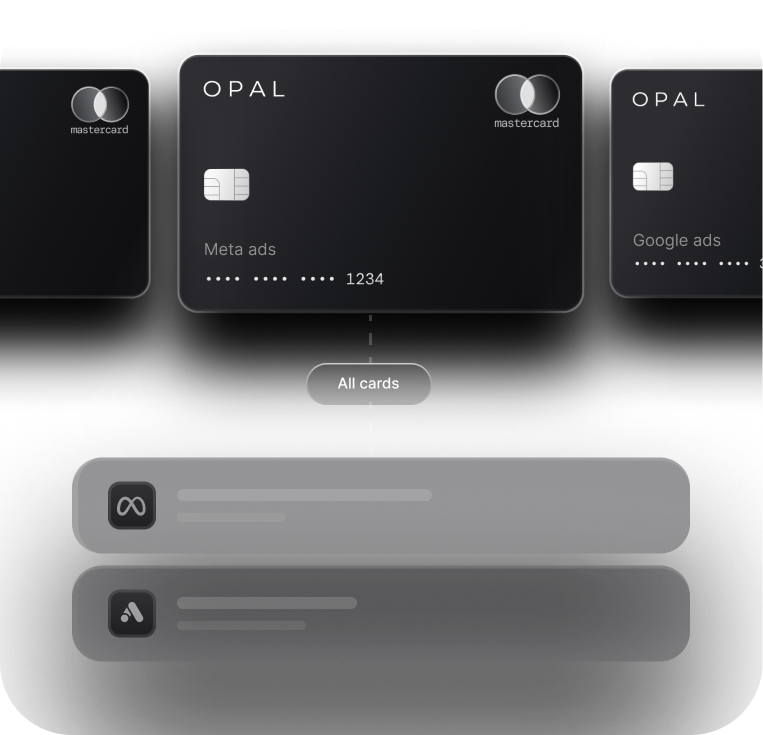
Dedicated virtual cards per campaign type or practice area. Personal injury Google Ads runs on one card. Family law Meta campaigns run on another. Each card has a limit that matches the actual approved budget for that practice area, not a shared limit that has to stretch across everything.
-
Limits that reflect real ad volume. A firm running $80K/month needs a card infrastructure that can handle $80K/month without hitting ceilings mid-cycle. That means high-limit cards sized to legal ad budgets, not general business expense cards repurposed for media buying.
-
Real-time visibility into where every dollar went. Not a monthly statement that arrives after the fact. Spend data that's available now, mapped to the campaign and practice area it belongs to.
-
Clean data that connects spend to intakes. When each practice area has its own card, reconciliation becomes straightforward. You can see exactly what personal injury search cost this month, compare it against intake volume, and calculate a cost-per-case that's actually defensible.
This is operational maturity, not a technology upgrade. Reactive management means responding to problems after they happen. Proactive management means setting the controls before anything can go wrong.
The firms that have built this infrastructure don't spend more on advertising. They spend more efficiently, and they have the data to prove it.
How to Structure Ad Spend Across Practice Areas
A firm running Google for personal injury and Meta for family law has fundamentally different budget logic for each. Personal injury is high-intent, high-CPC, and time-sensitive. Family law is longer-cycle, more relationship-driven, and often uses Meta for awareness before someone is actively searching. Treating them the same way, same card, same limit, same reporting, means you can't measure either one properly.
Here's a practical structure that works for multi-practice-area firms:
Practice Area |
Primary Channel |
Card Setup |
Budget Logic |
|---|---|---|---|
Personal Injury |
Google Search |
Dedicated card, high limit |
CPC-driven; size limit to monthly Google budget |
Family Law |
Meta (awareness + retargeting) |
Separate card per channel |
Lower CPCs, longer cycle; separate from PI spend |
Criminal Defense |
Google Search |
Dedicated card |
High-CPC, high-intent; do not share with PI card |
Immigration |
Meta + Google |
One card per platform |
Awareness-heavy; budget logic differs from PI |
The rule is simple: one card per channel per practice area. That's the minimum unit of spend visibility. Anything broader than that and you're back to the reconciliation problem: you know what you spent, but not where it went or what it produced.
Once the card structure is in place, maintaining visibility across channels doesn't require a spreadsheet. It requires spend data that's already tagged by card, which means by practice area and channel. Monthly cost-per-case calculations become a matter of pulling the card spend for each practice area and dividing by intakes. That's a five-minute exercise, not a three-hour reconciliation project.
Where Opal Fits
Opal is built for exactly this use case: high-volume ad spend that needs real controls behind it.
For law firms, that means virtual cards per practice area or campaign type, with limits that scale to legal ad budgets. Credit lines go up to $10M, sized to actual spend volume, not general business expense thresholds. There's no personal guarantee and no hard credit check. The application takes a few minutes.
Every card is tracked in real time. Spend maps automatically to the card it came from, which means practice area and channel are already separated before anyone opens a spreadsheet. When it's time to calculate cost-per-case, the data is there.
Opal also earns up to 1.5% cashback on ad spend. For a firm running $80,000/month in ad spend, that's up to $1,200/month back, or $14,400 a year, from spend the firm was going to run anyway.
It's not a law firm-specific product. It's built for any vertical running serious ad budgets, which is exactly the point. The infrastructure requirements for legal advertising (high limits, granular card controls, real-time visibility, clean reconciliation) are the same requirements that any high-volume media buyer has. Opal is designed for that operating model. See how it compares to other ad spend cards for high-volume media buyers.
Law firm ad budgets are too large and too consequential to run through a generic business card. See how Opal handles high-volume ad spend across any vertical.
Frequently Asked Questions
What's the average Google Ads CPC for legal keywords?
Legal keywords are among the most expensive in Google Ads. Personal injury terms like "car accident lawyer" typically range from $50 to $200+ per click depending on market and competition. These CPCs reflect the high lifetime value of a single legal client. In contingency-based practice areas, one case can generate $25,000 to $100,000 or more in fees.
How do law firms typically structure their digital advertising budgets?
Most firms allocate the majority of their digital budget to Google Search, where intent is highest. Personal injury firms concentrate spend there; family law and immigration firms often split between Google and Meta, using Meta for awareness and retargeting. Firms with multiple practice areas should structure budgets by practice area, with separate spend allocations and separate payment methods for each, so cost-per-case can be tracked cleanly by channel.
Can ad spend cards work for legal marketing agencies managing multiple firm clients?
Yes, and it's one of the strongest use cases. An agency managing paid search for multiple law firm clients needs separate cards per client to keep spend isolated, billing clean, and reporting defensible. Unlimited virtual cards with per-card limits let the agency run each client's budget independently and reconcile without cross-contamination between accounts.
How do you track cost-per-case from digital ad spend?
Assign a dedicated card to each practice area and channel combination. Each month, pull the spend total for each card and divide by intakes from that channel. The card-level spend data gives you the numerator; your CRM or call tracking gives you the denominator. The accuracy of the calculation depends entirely on how cleanly the spend is separated at the card level.