

Opal vs. Dash.fi: Which Ad Spend Card Is Right for Your Agency or Brand?
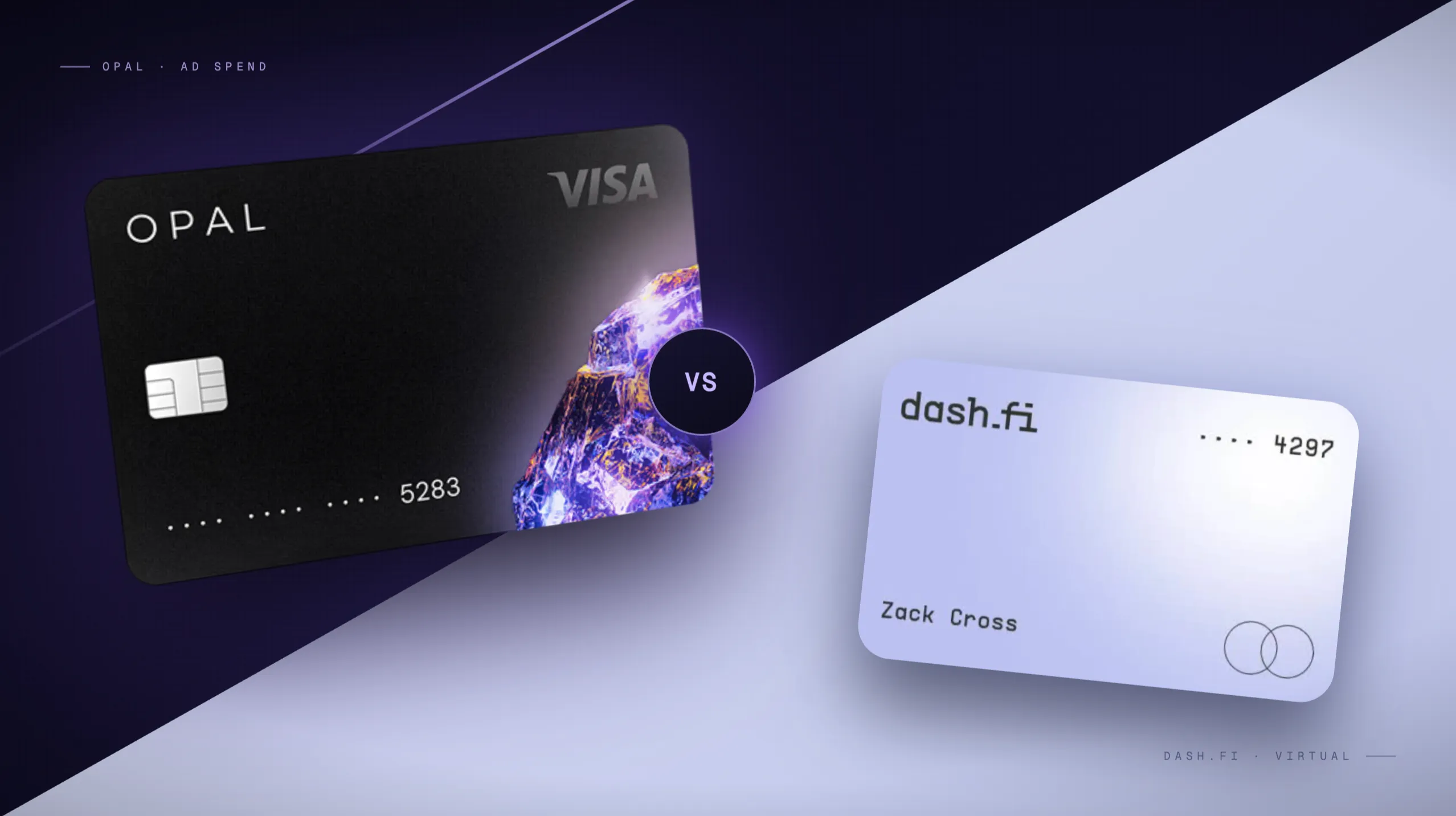
TL;DR: Opal and Dash.fi are both purpose-built ad spend cards with no annual fee and no personal guarantee. Opal is built for anyone spending at scale, whether that is an agency managing client budgets, a media buyer running accounts across platforms, or an ecommerce or DTC brand funding its own campaigns. You get up to 2% cashback on eligible ad spend with no tiers and no cap, credit limits up to $10M with no personal guarantee and no credit check, unlimited free virtual cards with spend controls, Ad Pay to extend cash flow up to 55 days on Meta and Google invoices, and setup in 2 to 3 minutes with no demo call. Dash.fi is a credible product with a strong billing audit tool and a wider financial product suite. Here is the honest comparison.
Most ad spend card comparisons are easy to write because the products are obviously different. This one isn't.
Opal and Dash.fi are both purpose-built charge cards for ad spend. Both offer unlimited virtual cards. Neither requires a personal guarantee. Neither charges an annual fee. If you're comparing either of them to a general-purpose corporate card like Ramp or Brex, the argument writes itself. But comparing Opal and Dash.fi to each other requires more precision.
The real question isn't which card has the longer feature list. It's which one fits how you spend, how much credit you need, and what you actually keep at the end of the month.
If you spend at scale on ads, Opal is built for you. That includes agencies managing client budgets, media buyers running dozens of accounts, ecommerce and DTC brands funding their own campaigns, and in-house performance teams. Dash.fi is worth evaluating too, particularly if automated invoice auditing sits at the top of your list. The rest of this post explains where the line actually sits.
Who Each Product Is Built For
Dash.fi is positioned around advertisers spending their own money, with product language aimed at founders and in-house teams. It offers a "Founders Reward Card," deposits cashback to a personal wallet, and integrates with Shopify, Amazon, and PayPal. The product suite has expanded to include an HYSA, a crypto rewards wallet, AI-powered billing audit agents, and payables automation. If you want card, banking, and audit tooling bundled together, that breadth is real.
Opal is built for high-volume ad spend, whoever is doing the spending. The card was designed around advertising from the start, which is why the credit limits, the rewards, and the controls all key off ad spend rather than general business expenses. Issue unlimited virtual cards per client, per campaign, per platform, or per employee, then set limits that map to how your budgets are actually approved. Agencies use that structure to separate client budgets. Media buyers use it to separate Google, Meta, TikTok, and LinkedIn spend instead of running everything through one card. Ecommerce and DTC brands use it to fund campaigns without tying up working capital and without a personal guarantee.
Same card, same rewards, same limits. The difference is how you choose to organize it.
Side-by-Side Comparison
Here's how the two products stack up on the dimensions that matter most when you're spending real money on ads.
|
Opal |
Dash.fi |
|
|---|---|---|
|
Built for |
Anyone spending at scale: agencies, media buyers, ecommerce and DTC brands, in-house performance teams |
Brands and performance advertisers spending their own money |
|
Cashback |
Up to 2% on eligible ad spend, uncapped, no tiers or enrollment |
Up to 3% (conditions apply: spend tiers, loyalty boosts, referral program, product enrollment) |
|
Credit limit |
Up to $10M, no personal guarantee, no credit check |
Performance-based underwriting |
|
Virtual cards |
Unlimited and free, per client, campaign, platform, or employee |
Unlimited, per ad account/campaign |
|
Cash flow |
Ad Pay extends cash flow up to 55 days on Meta and Google invoices |
Net 1 to Net 60 depending on product chosen |
|
Reconciliation |
Dedicated cards by client, platform, or campaign, with real-time visibility and bookkeeping automation |
Transaction-level daily sync |
|
QuickBooks sync |
Yes |
Yes |
|
Platform coverage |
Google, Meta, TikTok, LinkedIn, Snapchat, Amazon, The Trade Desk and more |
Ad platforms plus Shopify, Amazon, and PayPal integrations |
|
Personal guarantee |
No |
No |
|
Fees |
No annual fee, unlimited free cards, no cancellation fee, and no cut of your media spend |
No annual fee |
|
Setup |
2 to 3 minutes online, no credit check, virtual cards issued in 24 to 48 hours |
Demo call required |
A note on cashback
Both cards advertise an "up to" rate, so the number that matters is the one you'll actually earn.
Dash.fi's 3% headline rate is real, but it isn't unconditional. What you earn depends on your spend level, which products you've enrolled in, whether you've met loyalty tier thresholds, and in some cases referral activity. Their Ad Pay Agent product offers 3% back on ad spend or 50% of recovered billing discrepancies, whichever is greater, and that's a separate product tied specifically to Meta and Google.
Opal pays up to 2% on eligible ad spend with no spend tiers, no enrollment requirements, no minimum spend, and no cap. Whether you run $100,000 or $100,000,000 a month, the rate doesn't step down and the rewards don't expire into a points program you have to redeem.
The practical test: ask both providers what you'd earn at your current spend level, in cash, over the next twelve months. A conditional 3% that resolves to 1.2% in practice is worth less than a straightforward rate you can forecast.
What You Actually Get With Opal
The comparison table is the short version. Here's the full picture.
Credit that scales with your spend
Limits up to $10M, with no personal guarantee and no hard credit check. Opal underwrites against ad spend, not against your personal balance sheet, which is how limits land up to 20 times higher than traditional business cards. You fund campaigns without parking your own cash, and Opal reviews performance periodically for increases as you grow.
Unlimited free virtual cards with real controls
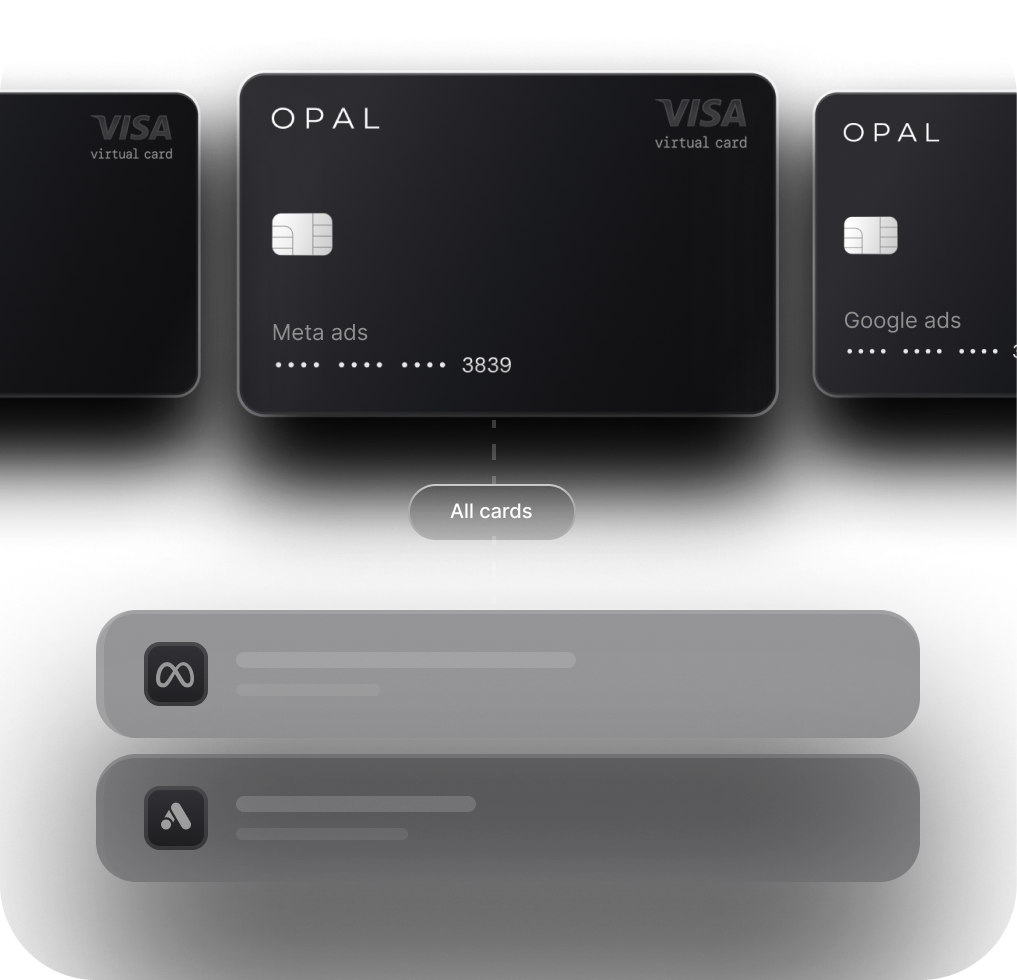
Create a card for every client, campaign, platform, vendor, or team member at no cost. Set spend limits at the card level and Opal enforces them automatically, so budgets can't quietly overrun. You keep full visibility into where every dollar went, in real time, without waiting for a statement.
Reconciliation that doesn't eat your month-end
Dedicated cards separate advertising transactions at the source, so spend is already sorted by client, platform, or campaign before anyone opens a spreadsheet. Bookkeeping automation and QuickBooks sync handle the rest.
Ad Pay: pay Meta and Google invoices by card
Meta and Google pushed high-spend accounts onto invoice billing and off cards. Ad Pay puts them back. It detects Meta and Google invoices from your inbox automatically, lets you review and pay in one click using Opal credit or your own card, and extends cash flow by up to 55 days so you pay after results come in rather than before campaigns run. No bank transfers, no three-day delays, no campaigns pausing over a billing lag.
Meta ad account support
If a Meta ad account goes down, spend stops and so does revenue. Opal helps restore disabled Meta ad accounts and supports Meta whitelist applications. That's operational help most card issuers simply don't offer.
3% back on AI platform ad spend
Through Opal's Gravity partnership, you can earn 3% cashback on ad spend across AI platforms, from ChatGPT to a growing list of chatbots, agents, and AI search engines. If you're testing the next channel before it gets expensive, the rewards are already there.
Set up in minutes, supported around the clock
The onboarding form takes 2 to 3 minutes, with no demo call required and no credit check. Virtual cards are typically issued within 24 to 48 hours. Opal works with any U.S.-based bank, there's no cancellation fee, and support is available 24/7 by email, phone, or call from a team that has run this exact operation before.
David Azar, Founder and CEO at Outsmart Labs, put it plainly after switching: reconciliation is simple, payments happen automatically, and there have been no card declines or funding delays.
Client-Funded Cards: An Extra Option for Agencies
If you're spending your own budget, everything above applies as-is. If you're spending someone else's, Opal adds a structure most cards don't have.
Agencies manage client money, not their own. Every dollar through the card is a dollar a client approved, budgeted, and expects accounted for separately. When those funds commingle on one card, the operational and financial complexity compounds fast.
Opal's client-funded card model lets each virtual card be funded directly by the client it belongs to. The client loads their own balance. The agency never fronts that spend. There's no commingling, because the money never touches a shared pool in the first place.
What this means in practice
-
No liability exposure: You're not floating client spend on your balance sheet while waiting for reimbursement. The client's money is on the client's card.
-
Clean reconciliation by default: Each card maps to one client. Month-end isn't a cleanup exercise; it's already organized the way your invoices are structured.
-
Spend limits that mean something: When a client approves $50,000 for the month, that card is funded to $50,000. The limit isn't a policy, it's the balance.
You can read more about how high limits work without a personal guarantee in our breakdown of ad spend limits and no personal guarantee requirements.
One Honest Note on Dash.fi's Audit Product
Dash.fi offers something Opal doesn't: AI-powered billing audit agents that scan ad platform invoices for overcharges and discrepancies. Their data shows they've found 5-33% in billing discrepancies across the spend they've audited. If recovering platform overcharges is the single problem you're solving for, that's a real capability and worth evaluating on its own terms.
Opal solves for the money side of the same problem from a different angle: a higher effective rate you don't have to qualify for, credit you don't have to personally guarantee, cash flow you can extend by up to 55 days, and no cut taken out of your media spend. Worth knowing which problem is actually costing you more before you choose.
The Verdict
Both products are legitimate. The decision comes down to what you're optimizing for.
Dash.fi is worth a look if:
Automated invoice auditing and discrepancy recovery is your top priority
You want banking, a rewards wallet, and payables automation bundled with the card
You're comfortable working spend tiers, enrollment, and referrals to chase the headline rate
Choose Opal if:
You spend at scale on ads, whether you're an agency, a media buyer, an ecommerce or DTC brand, or an in-house performance team
You want up to 2% cashback on eligible ad spend with no tiers, no enrollment, and no cap
You need credit limits up to $10M with no personal guarantee and no credit check
You want unlimited free virtual cards with enforced spend limits and real-time visibility
You want to pay Meta and Google invoices by card and extend cash flow up to 55 days
You'd rather be live in 2 to 3 minutes than book a demo call to find out your rate
You want 24/7 support and help if a Meta ad account goes sideways
The best ad spend card isn't the one with the highest headline number. It's the one that gives you the most credit, the most control, and the most cash back with the fewest conditions attached. For anyone spending at scale, that's Opal.
Frequently Asked Questions
Is Opal only for agencies?
No. Opal is built for anyone spending at scale on advertising, including ecommerce and DTC brands, performance marketers, media buyers, and in-house growth teams. Agencies get an additional client-funded card structure for separating client budgets, but the card, the rewards, the credit limits, and the controls are the same regardless of whose budget you're spending.
What is the actual cashback rate on Dash.fi?
Dash.fi advertises up to 3% cashback, but the rate you earn depends on your spend level, loyalty tier, product enrollment, and in some cases referral activity. Their Ad Pay Agent product offers 3% back on Meta and Google ad spend specifically, or 50% of recovered billing discrepancies, whichever is greater, and that is a separate product with its own enrollment requirements. Opal pays up to 2% on eligible ad spend with no tiers, no enrollment, no minimum spend, and no cap.
Which card is better for a DTC brand or ecommerce advertiser?
It depends on what's limiting you. Dash.fi brings Shopify, Amazon, and PayPal integrations plus billing audit tooling. Opal brings up to 2% cashback with no tiers to qualify for, credit limits up to $10M with no personal guarantee or credit check, unlimited free virtual cards per campaign or platform, and Ad Pay to push Meta and Google invoices out by up to 55 days. If your constraint is credit, cash flow, or the rate you actually earn, Opal is the stronger fit, and you can be live in a few minutes without a demo call.
How much credit can I get with Opal?
Up to $10M, with no personal guarantee and no hard credit check. Opal underwrites against ad spend rather than your personal balance sheet, which is why limits run significantly higher than traditional business cards. Opal reviews performance periodically and may offer increases as your spend grows.
Is Dash.fi good for agencies?
Dash.fi can work for teams spending their own money, and its virtual cards help organize spend across campaigns and ad accounts within a single company. For agencies managing separate client budgets, the model still assumes the cardholder is carrying the spend. Opal's client-funded card model keeps each client's budget separated at the card level and funded by the client, so the agency isn't fronting money it has to chase later.
What is a client-funded card?
A client-funded card is a virtual card where the client loads their own budget directly. The agency never fronts the spend. Each card maps to one client's approved budget, so there is no commingling of funds across clients and no waiting for reimbursement after the fact. Opal's client-funded card model is available on top of everything else the card does.
Can I use Opal for Google, Meta, TikTok, and other platforms?
Yes. Opal works across all major ad platforms including Google Ads, Meta Ads, TikTok, LinkedIn, Snapchat, Amazon, and The Trade Desk. Virtual cards are issued within 24 to 48 hours and can be assigned per platform, per campaign, per client, or per team member. Ad spend on AI platforms through Opal's Gravity partnership earns 3% back.
Can Opal help if my Meta ad account is disabled?
Yes. Opal supports Meta ad account recovery and helps with Meta whitelist applications, so a disabled account doesn't take your campaigns offline indefinitely.
Does Opal require a personal guarantee?
No. Opal requires no personal guarantee and no hard credit check, and setup takes 2 to 3 minutes. Opal underwrites against advertising spend, which makes the liability structure fundamentally different from a traditional corporate card.