

Best Corporate Card for Advertising Spend in 2026

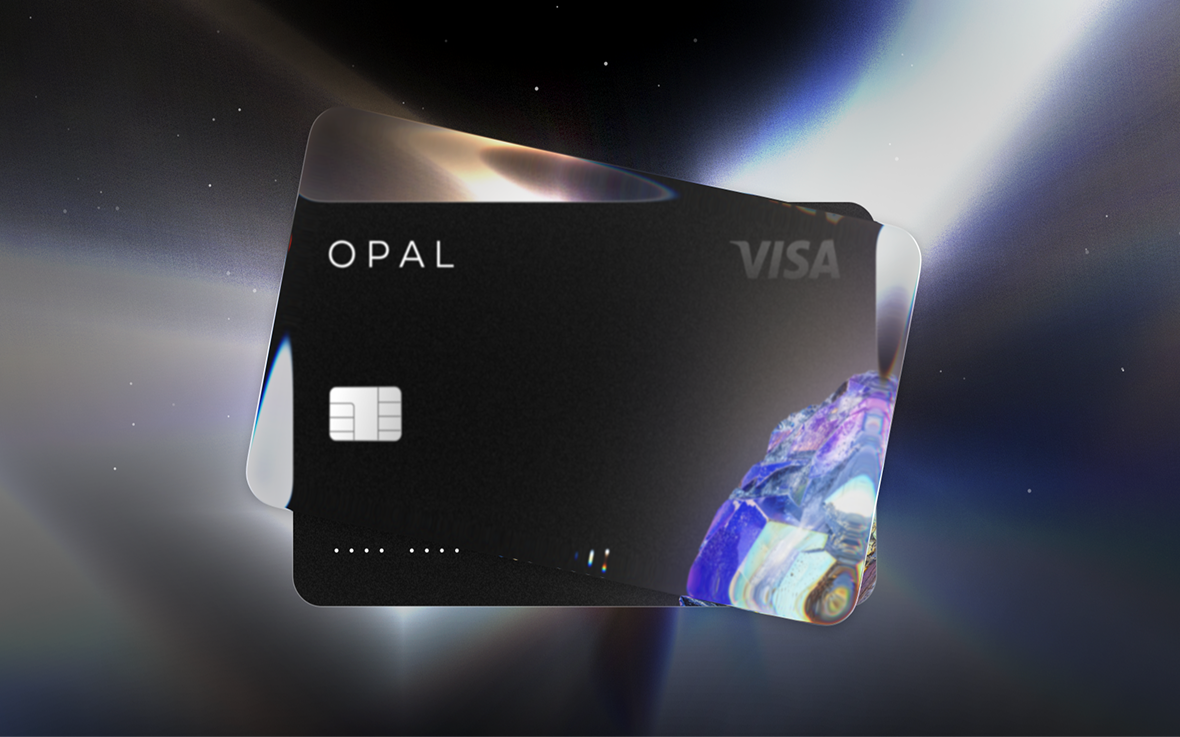
The best corporate card for advertising spend is Opal for teams running $50K/month or more. It offers limits up to $10M underwritten on managed ad volume, unlimited free virtual cards, and up to 2% cashback with no annual fee, no personal guarantee, and no hard credit check.
For teams spending under $150K/year on ads, Amex Business Gold (4x points capped at $150K/year) and Chase Ink Business Preferred (3x on $150K/year combined) are competitive until the caps erode the value.
Most corporate cards were not built for media buying. At scale, the problems are predictable: limits that cap mid-month, cashback that stops accruing before Q3, and no way to separate client budgets by card. This guide ranks the cards that hold up at scale.
Key Takeaways
-
Opal is the strongest fit for ad-heavy teams because its limits scale with managed spend volume, not personal credit, making it the only card built specifically for agencies and media buyers.
-
Amex Business Gold can work for lower-volume teams if you stay under the annual category cap.
-
Brex is the better ops-first option when spend controls matter more than cashback.
-
Chase Ink Business Preferred makes sense for smaller budgets that still want a low annual fee and points.
-
Once ad spend gets large, capped rewards cards lose value fast. The ceiling matters more than the headline rate.
How Did We Compare These Cards?
Most card comparisons rank by welcome bonus or headline points multiplier. That does not help when you are running $200K a month across Google and Meta.
This ranking looks at five things that actually matter: credit limit structure, virtual card controls, cashback or rewards structure, spend controls, and reconciliation. A card that scores well on points but breaks down on limits or virtual cards is not built for media buying.
What Are the Best Corporate Cards for Ad Spend?
|
Card |
Cashback on Ad Spend |
Cap |
Credit Limit |
Virtual Cards |
Annual Fee |
Personal Guarantee |
|---|---|---|---|---|---|---|
Opal |
Up to 2% |
None |
Up to $10M |
Unlimited, free |
$0 |
Not required |
Amex Business Gold |
4x points (top 2 categories) |
$150K/year |
No preset limit |
Limited |
$375 |
Required |
Brex |
1x points (about 0.6% redeemed as cash) |
None |
Dynamic |
Unlimited, free |
$0 |
Not required |
Chase Ink Business Preferred |
3x points |
$150K/year combined |
$5K-$25K typical |
Limited |
$95 |
Required |
Mercury |
1.5% |
None |
Tied to Mercury balances |
Unlimited, free |
$0 |
Not required |
The part most comparisons skip is the effective rate after the cap. Amex Business Gold earns 4x points on the first $150K a year in eligible categories, then drops to 1x on everything after. At $50K a month in ad spend, the 4x rate covers three months of volume. The remaining nine months run at 1x. The cap is shared across both of your top two categories each cycle, so a business spending on ads plus software burns through it faster than ad spend alone suggests.
Why Is Opal the Best Corporate Card for Advertising Spend?
Opal is the only card on this list where the credit limit scales with your managed ad volume rather than your personal credit score or cash deposits.
Opal extends credit directly to your agency based on managed spend volume. A $2M/month agency gets limits that match what it actually runs, without a personal guarantee.
Why it ranks first:
Credit limits up to $10M, underwritten against managed ad spend volume
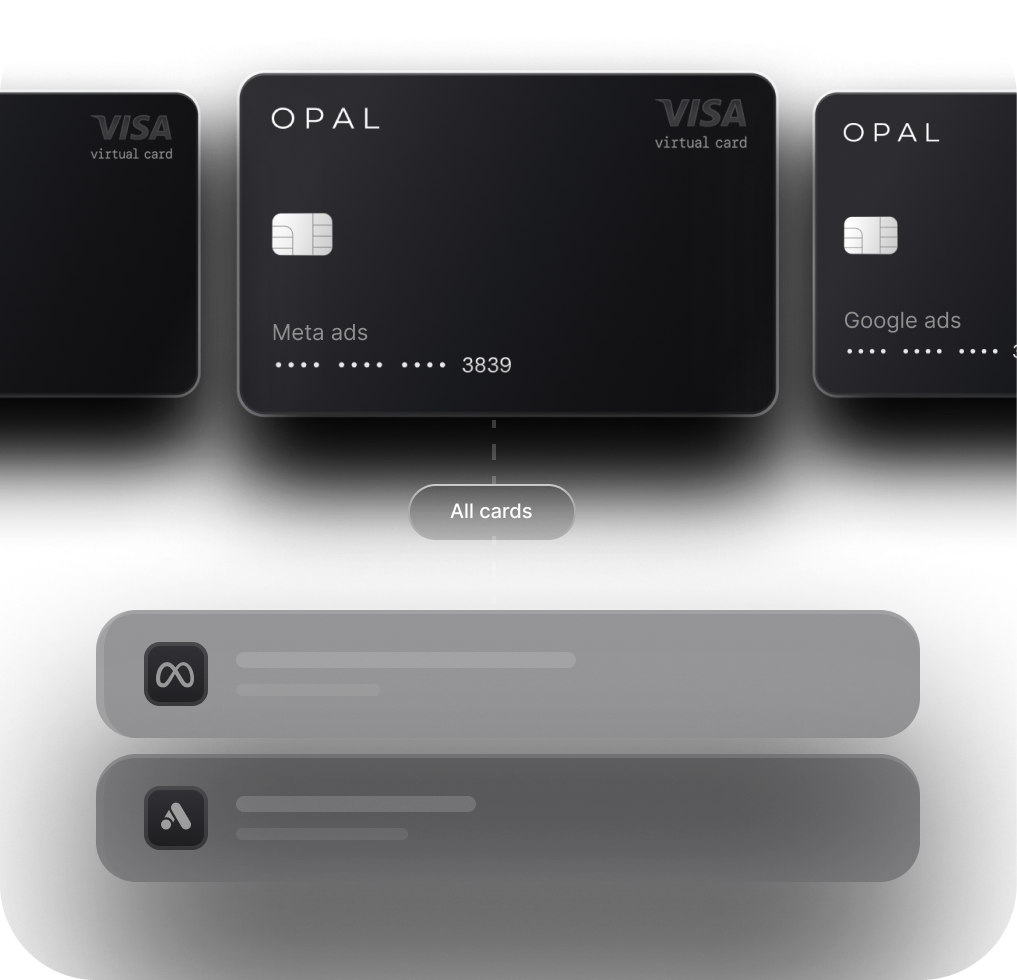
Unlimited free virtual cards with per-card merchant locking: one card per client, per platform, per campaign
No personal guarantee or credit check required
Up to 2% cashback across Meta, Google, TikTok, Amazon, LinkedIn, Snapchat, The Trade Desk, Apple, and more
Native QuickBooks or Workday sync with per-client transaction tagging
Application takes 2-3 minutes; virtual cards issued within 24-48 hours
The cashback math at $300K/month:
|
Opal (up to 2%) |
Amex Gold (4x capped at $150K/year) |
|
|---|---|---|
Monthly ad spend |
$300K |
$300K |
Effective monthly cashback |
Up to $6,000 |
~$2,025 in points value (cap hit in month one, 1x after) |
Annual return |
Up to $72,000 |
~$24,300 |
Opal cashback figures reflect the maximum rate of 2%. Actual cashback depends on your approved rate. Contact Opal to confirm the rate applicable to your account.
Not recommended for: Businesses spending under $14K/month on ads who want to maximize welcome bonuses or points-to-travel redemptions. At very low volume, a capped 4x card earns more before the ceiling becomes a problem.
Apply for Opal or learn more about the Ad-Spend Card
When Does Amex Business Gold Make Sense for Ad Spend?
Amex Business Gold earns 4x points on the top two categories where your business spends the most each billing cycle, automatically. Purchases at U.S. media providers for advertising in select media (online, TV, radio) has historically qualified as one of the six eligible categories, though you should verify current Amex terms before relying on this. The card selects your top two categories each month without manual election.
The cap is the problem. The 4x rate applies to the first $150K in combined eligible category spend per calendar year, then drops to 1x. At $10K/month you never reach the ceiling. At $20K/month you hit it around month eight.
Annual fee |
$375 |
Rewards |
4x points on top 2 categories (capped at $150K/year, calendar year), 1x after |
Credit limit |
"No preset spending limit" is Amex's own marketing term. Eligible charges can go to a Pay Over Time balance, but interest applies if you don't pay in full each month. |
Virtual cards |
Limited; no per-card merchant locking |
Personal guarantee |
Required |
Best for: Businesses spending under $150K/year on advertising that want maximum points value and already spend across multiple Amex bonus categories.
Not recommended for: Any team where ad spend alone exceeds $12,500/month. The cap hits before year-end and the effective rate drops to 1x for the remainder.
What Corporate Card Features Matter Most for Ad-Spend Heavy Companies?
Cards built for ad-spend heavy companies offer three things standard corporate cards don't: credit limits sized on ad volume rather than personal credit, unlimited virtual cards that map to your account structure, and spend controls at the campaign level. Opal is the only U.S. card built specifically around all three.
Most corporate cards were not built with media buyers in mind. These are the features that separate a card designed for ad spend from one that merely tolerates it.
Credit Limits That Scale With Ad Volume
Standard business credit cards underwrite limits against personal credit history. A $500K/month agency owner with a solid credit score might get a $25K limit. That is not a spending tool; it is a bottleneck.
Purpose-built ad spend cards underwrite limits against managed spend volume. The agency's book of business is the collateral, not the owner's personal finances. Without it, limit increase requests and mid-campaign declines become recurring operational problems.
Virtual Card Infrastructure
Every client account, every ad platform, and ideally every campaign should run on its own virtual card number. For agencies, this is the only way to reliably:
Maintain clean spend separation per client
Prevent one billing dispute from affecting unrelated campaigns
Produce accurate per-client reporting without manual reconciliation
Cancel a card instantly when a client offboards without touching anything else
The cap problem: Some programs limit virtual cards to 10, 50, or 100. For an agency with 40 clients across three platforms, that is 120 cards minimum. A cap of 50 is a bottleneck before you have finished onboarding.
Cashback Structure: Flat Rate vs. Capped Category
|
Structure |
How it works |
Where it breaks |
|---|---|---|
Up to 2% (e.g. Opal) |
Same rate on every dollar, no ceiling |
Nowhere |
Capped category (e.g. 4x on $150K/year) |
High rate up to the ceiling, then 1x |
Above $12,500/month in ad spend |
Low base rate (e.g. 1x, about 0.6%) |
Consistent but low |
At any meaningful volume |
The advertised rate and the effective annual rate diverge the moment you cross the cap. Run the math on your actual volume, not the headline multiplier.
Reconciliation and Accounting Sync
Month-end reconciliation across 20 clients and four platforms is where most agencies lose time. Native QuickBooks or Workday sync with per-client transaction tagging eliminates the manual export-and-match workflow. At scale, it is the difference between a two-hour close and a two-day one.
How Do You Choose the Best Corporate Card for Advertising Spend?
The right card depends on two variables: monthly ad spend volume and whether you're managing spend for one entity or multiple clients.
|
Your situation |
Best option |
Why |
|---|---|---|
Agency or media buyer, $50K+/month, multiple clients |
Opal |
Limits scale with volume, unlimited virtual cards, up to 2% cashback |
Single-entity brand, under $150K/year in ad spend |
Amex Business Gold |
4x points on top categories before the cap hits |
Need virtual cards and expense ops, cashback is secondary |
Brex |
Strong spend controls, no personal guarantee |
Under $50K/month, want a low-fee card with welcome bonus |
Chase Ink Business Preferred |
Low annual fee, solid welcome offer, 3x before cap |
The Threshold That Changes Everything
$12,500/month is the break-even point for capped category cards (the $150K/year Amex Gold cap divided by 12 months).
Below it, a 4x capped card outperforms an up to 2% card. At Amex's statement-credit rate of 0.6 cents per point, 4x works out to about 2.4% in cash terms, so the crossover sits closer to $14,000/month once the $375 fee is factored in.
At $50K/month, a capped 4x card earns the bonus rate for three months of the year. Nine months run at 1x, which drags the blended return to roughly 1%. An up to 2% card earns on that same volume every month, with no ceiling to track.
Multi-Client Operations Change the Calculus Further
If you're managing ad spend across multiple clients, the card you choose isn't just a financial instrument. It's an operational system.
A shared card number across clients creates reconciliation confusion at month-end, billing disputes that affect multiple accounts simultaneously, and no clean way to track performance per client without manual tagging.
The only structural solution is one virtual card per client, per platform. That requirement eliminates any card with a virtual card cap below your client count.
For a deeper look at how agencies structure this, see how agencies structure ad spend by client and how to automate ad spend reconciliation in QuickBooks.
FAQ: Corporate Cards for Advertising Spend
What is the best corporate card for advertising spend?
For companies spending $50K/month or more, Opal is the strongest option: limits up to $10M underwritten on managed spend volume, unlimited free virtual cards, and up to 2% cashback with no personal guarantee or annual fee. For lower volumes, Amex Business Gold (4x on top two categories, capped at $150K/year) or Chase Ink Business Preferred (3x on $150K/year combined) are competitive provided you stay under the cap.
What corporate card solutions are tailored for digital ad-spend heavy companies?
Purpose-built ad spend cards differ from general corporate cards in three ways: credit limits sized on advertising volume rather than personal credit, virtual cards that map to your ad account structure, and campaign-level spend controls. Most standard corporate programs don't offer all three. Opal is the only U.S. card built specifically around that combination.
Do corporate cards have cashback caps on advertising spend?
Most do. Standard business cards cap advertising category bonuses at a yearly threshold, which is $150K per year in combined eligible categories for both Amex Business Gold and Chase Ink Business Preferred. Once you cross that ceiling, the effective rate drops to 1x. Cards built specifically for ad spend, like Opal, offer rates with no category ceiling.
What are virtual corporate cards and how do they work for online advertising?
A virtual card is a unique digital card number tied to one ad platform account or client. You set a spend limit, lock it to a specific merchant, and it charges like any other card. If a campaign ends or a client offboards, you cancel the card without affecting any other account. For agencies, this is the only way to maintain clean per-client spend separation.
What corporate card do agencies use for large advertising and marketing spend?
Agencies managing multi-client ad spend at scale need a card that separates budgets by client, scales to $1M+ in monthly volume, and doesn't require a personal guarantee. Standard business credit cards create reconciliation problems and limit ceilings that break down at agency scale. Opal is designed specifically for this use case.
Is a charge card better than a credit card for large ad spend?
Usually, yes. Charge cards and purpose-built spend cards often provide larger limits and better control than revolving business credit cards. That matters when you're moving large monthly budgets across Google, Meta, TikTok, and other platforms without wanting to run into utilization issues or personal guarantee requirements.
What Is the Bottom Line on Corporate Cards for Ad Spend?
Most agencies don't switch cards because of a bad cashback rate. They switch after a campaign goes dark mid-flight, a client dispute surfaces because three accounts shared one card number, or a month-end close takes two days longer than it should.
If you're running $50K/month or more in ad spend across multiple clients, Opal is built for that operation: limits that scale with your book of business, unlimited virtual cards with merchant locking, and up to 2% cashback with no annual fee or personal guarantee.
Apply for the Opal Ad-Spend Card or see how Opal compares to general spend tools for agency ad spend.