


The Client-Funded Card Model: How It Works, Who It’s For, and What the Risks Are
TL;DR: What This Article Covers
-
What it is: The Client-Funded Card model is a financial architecture where a client's budget pre-funds a dedicated payment card before ad spend runs. The agency never uses its own working capital to cover media costs.
-
Three required components: Pre-funding by the client, segregation of funds per client, and agency-side rewards. All three must be present for the model to qualify.
-
What this post covers: Precise definition, legal and liability structure, economics, fit criteria, and honest risks.
-
What it does not cover: The Liability Gap definition, product comparison table, case studies, or FAQ. Those live at Opal's Client-Funded Card overview.
Marketing agencies occupy an unusual position in the financial ecosystem. They spend money that belongs to someone else, on behalf of that someone else, and then wait to be paid back. For most service businesses, that would describe a catastrophic arrangement. For agencies, it is simply Tuesday.
Most writing on agency finance focuses on symptoms: cash flow pressure, card limits, reconciliation headaches. Few pieces examine the underlying architecture that causes those symptoms.
The Client-Funded Card model is a structural fix. It is a specific financial arrangement with a precise definition, a distinct legal profile, and economic characteristics that differ meaningfully from both traditional corporate cards and prepaid programs. It is also a new category, coined and operationalized as a commercial product only within the last several years.
This post is a reference document for agency owners, CFOs, journalists, and analysts who want a complete and accurate understanding of the model. The analysis is neutral. Promotional framing appears only in the final section.
The Agency Financial Problem: Why Agencies Structurally Act as Banks
To understand why the Client-Funded Card model exists, you have to understand the financial position agencies occupy by default.
A digital marketing agency does not manufacture a product or hold inventory. Its primary asset is expertise. Its core function is deploying client capital across ad platforms. That sounds straightforward. The financial mechanics are not.
How the Money Actually Flows
When an agency takes on a client with a $300,000 monthly ad budget, the standard arrangement works like this:
The client approves the budget and signs a contract.
The agency loads campaigns across Google, Meta, TikTok, and other platforms.
The platforms charge the agency's payment method (typically a corporate card or direct debit) on a daily or weekly basis.
The agency invoices the client for the spend, usually at month-end or on a defined billing cycle.
The client pays the invoice on net-30, net-45, or net-60 terms.
The gap between step 3 and step 5 is where the structural problem lives. The agency has paid the platforms and has not been reimbursed. By every practical definition, it is extending unsecured credit to its client.
The Math on Exposure
The scale of this exposure is frequently underestimated. Consider an agency managing $1 million per month in client ad spend on net-45 payment terms.
Scenario |
Monthly Spend |
Payment Terms |
Capital Floating |
|---|---|---|---|
Single billing cycle |
$1,000,000 |
Net-30 |
$1,000,000 |
Overlapping cycles (net-45) |
$1,000,000 |
Net-45 |
$1,500,000 |
Two overlapping cycles (net-60) |
$1,000,000 |
Net-60 |
$2,000,000 |
On net-45 terms, the agency is floating one-and-a-half months of spend at any given time. That is $1.5 million of client money sitting on the agency's balance sheet, drawn from the agency's credit line, and subject to the agency's card limits and personal guarantees.
This is not a marginal issue. For a mid-size agency running $1M/month, the effective working capital requirement is $1.5M or more. None of it is the agency's own money.
Why Growth Makes It Worse
The compounding effect is counterintuitive. An agency that doubles managed spend from $500,000 to $1 million per month does not double its risk. On net-45 terms, the floating capital requirement triples: from $750,000 to $1.5 million.
This creates a structural ceiling. Agencies relying on corporate cards routinely hit credit limits before they hit their growth potential. When a card declines mid-campaign, campaigns pause, platforms flag the failure, and clients lose confidence.
Personal liability compounds the problem. Most business credit cards require a personal guarantee. A single large client who pays late or disputes an invoice does not just create a cash flow problem. It can create a personal financial crisis.
What the Market Offered Before
Before the Client-Funded Card model emerged, agencies had three imperfect options:
-
Standard corporate cards: High limits, but tied to the agency's balance sheet. Require personal guarantees and co-mingle all client spend on a shared statement.
-
Prepaid cards: No credit risk, but the agency funds them from its own cash. The liability problem is solved only by transferring the cash burden.
-
Direct platform billing: Eliminates agency exposure entirely, but also eliminates rewards, spend control, and consolidated visibility.
None solved all three problems at once: eliminating liability, maintaining control, and generating agency-side rewards. That gap is what the Client-Funded Card model was built to close.
Precise Definition: What Makes a Card Genuinely "Client-Funded"
The term "client-funded card" is occasionally used loosely to describe any arrangement where a client is involved in the payment flow. Not every prepaid card, virtual card, or client-billed arrangement qualifies in the structural sense. Three components must all be present.
Component 1: Pre-Funding by the Client
The client must transfer funds to the card before spend runs. This is not a reimbursement model, a credit model, or a billing model. The sequence is simple: funds arrive first, campaigns run second.
This distinguishes the model from the standard agency arrangement (agency pays first, invoices later) and from a prepaid card the agency loads from its own cash. The funding cash originates with the client, not the agency.
The practical implication: if the pre-funded balance runs out, spend stops. The agency has not advanced any of its own capital.
Component 2: Segregation of Funds
Each client's pre-funded balance must be held separately from other clients' balances and from the agency's own operating funds. This is not merely a bookkeeping preference. It is a structural requirement that carries legal and accounting significance.
Segregation means:
Client A's balance cannot be drawn down by Client B's campaigns.
The agency's operating expenses cannot be charged to a client's balance.
In a dispute, each client's funds are identifiable and traceable.
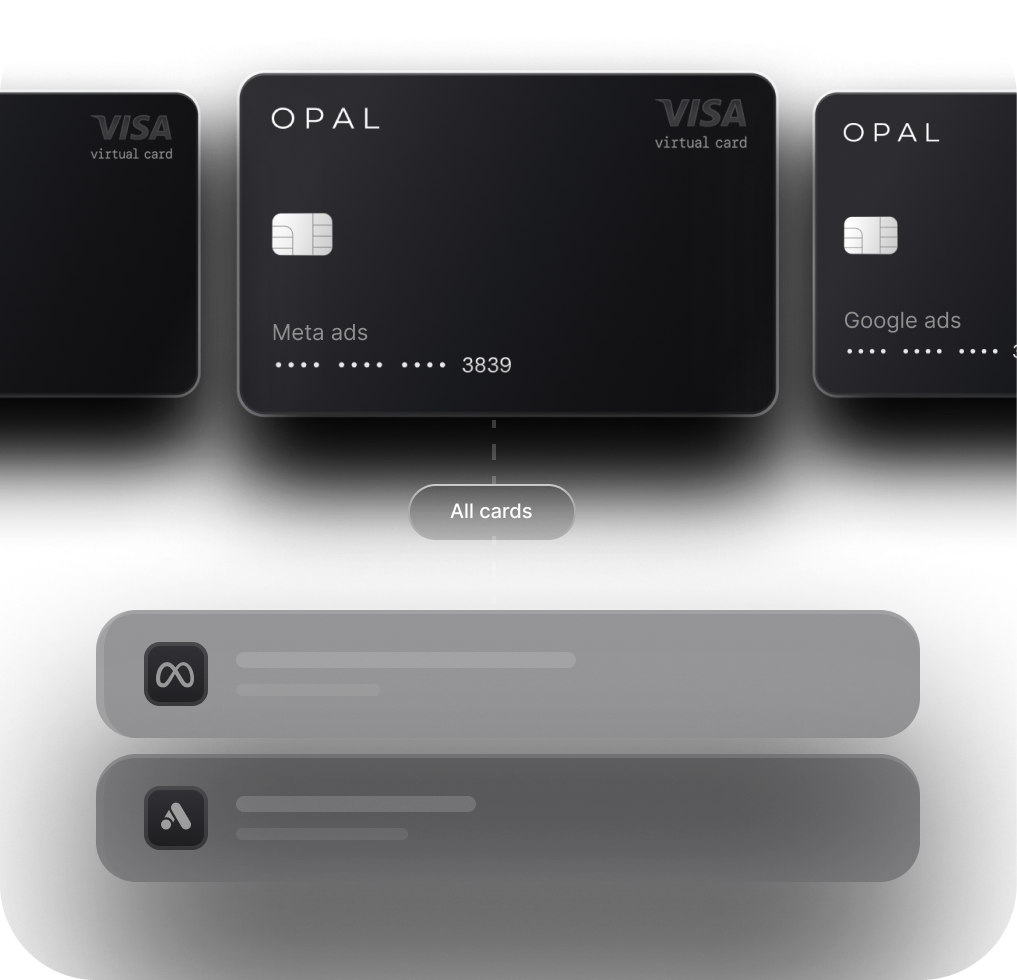
In practice, this is implemented through dedicated virtual cards: one per client, each with its own balance, spend limit, and transaction history. The virtual card enforces segregation at the payment rail level.
A shared corporate card with manual transaction tagging does not meet this requirement. The segregation must be structural, not administrative.
Component 3: Agency-Side Rewards
The cashback or rewards generated by spend on the card must accrue to the agency, not the client. This component is what makes the model economically distinctive.
In most payment arrangements, rewards follow the cardholder or account owner. In the Client-Funded Card model, the client provides the capital but the agency controls the card and captures the rewards. This is not incidental. It is a deliberate design choice that creates a new revenue line on spend the agency is already running.
This also clarifies why asking clients to pay platforms directly does not replicate the model. When clients pay platforms directly, they capture any platform-level rewards or billing credits. The agency earns nothing. In the Client-Funded Card model, the agency earns on every dollar, regardless of which client's budget funded it.
Why All Three Must Be Present
Remove any one of the three components and the model breaks down:
Missing Component |
What You Have Instead |
|---|---|
No pre-funding |
Standard agency card (agency fronts spend) |
No segregation |
Pooled prepaid card (attribution is manual) |
No agency-side rewards |
Direct platform billing (agency earns nothing) |
The Client-Funded Card model is the specific intersection of all three. That intersection is what makes it a distinct financial category rather than a variation on existing card products.
Legal and Liability Structure: Who Owns What
This section covers territory that most coverage of the Client-Funded Card model skips entirely. Understanding the legal and liability implications is essential for any agency evaluating this model at scale, and for any CFO or legal counsel advising on it.
Ownership of Pre-Funded Balances
When a client pre-funds a card, the question of who legally owns those funds matters. The answer depends on how the arrangement is structured in the underlying agency-client agreement.
In most implementations, the pre-funded balance is held by the card issuer in a pooled or segregated account. The client has transferred funds for a specific purpose: to pay for ad spend on their behalf. This is functionally similar to a retainer or escrow, not a sale.
The key implication: the funds are not agency revenue until spent on the client's campaigns. Treating a $200,000 pre-funding deposit as income before spend occurs is an accounting error with potential tax consequences.
What Happens If the Client Doesn't Pay
In the Client-Funded Card model, the more precise question is: what happens if the client does not pre-fund? Since spend requires pre-funding before it runs, the scenario of a client failing to pay after spend has occurred is structurally different from the traditional model.
There are two edge cases worth distinguishing:
Edge Case 1: The client pre-funds and then disputes the spend. The funds are already in the account. The dispute is over whether the spend was authorized or appropriate, not over whether money is owed. Resolution follows the contract between the agency and client. The agency is not out of pocket.
Edge Case 2: The client pre-funds, spend runs, and the client demands a refund. This is where refund timing becomes relevant. Ad platforms do not issue instant refunds. If a campaign is paused or cancelled mid-flight, the remaining balance on the platform may take days or weeks to return. During that window, the agency holds pre-funded client capital that has not yet been returned by the platform. Clear contractual language about refund timelines is essential.
The critical structural advantage: in neither edge case is the agency in the position of having spent its own money and waiting to be reimbursed. The financial exposure is categorically different from the traditional model.
The Personal Guarantee Question
Whether a Client-Funded Card arrangement requires a personal guarantee depends on the underlying card product, not the model itself.
Traditional business cards require a personal guarantee because the issuer is extending credit to the agency. In a true Client-Funded Card model, the card is funded by client capital before spend runs. The issuer is not extending credit in the traditional sense, which typically eliminates the personal guarantee requirement.
The absence of a personal guarantee is a consequence of the funding structure, not a product feature. Agencies evaluating products that claim this model without a personal guarantee should verify the underlying funding mechanism is genuinely pre-funded by the client, not simply a credit product with a marketing label applied.
For more on how agencies can access higher spend limits without personal liability, see Higher Ad Spend Limits Without a Personal Guarantee.
Accounting Treatment
The accounting treatment of the Client-Funded Card model has several non-obvious dimensions.
Pre-funded balances as liabilities. When a client pre-funds a card, the agency receives cash but has not yet performed the service (running the campaigns). Under standard accrual accounting, this is a liability, specifically deferred revenue or a client deposit, until the spend occurs. Agencies that book pre-funded deposits as income before spend runs are misstating their financials.
Cashback as revenue. The cashback the agency earns on client spend is agency revenue, not a client credit. It accrues to the agency regardless of the source of the spend. Recognize it as income in the period it is earned, typically when the spend is settled. Tax treatment follows standard income recognition rules for the agency's jurisdiction.
Commingling risk. When client spend runs through a shared corporate card, operating expenses and client spend appear on the same statement. Separating them requires manual reconciliation, and errors create legal exposure. Per-client virtual cards with segregated balances eliminate this risk structurally. The separation is enforced by the payment infrastructure, not by manual process.
Reconciliation and audit trail. Because each client's spend flows through a dedicated card with its own transaction history, the audit trail is clean by design. This simplifies both internal bookkeeping and any external audit or client-requested spend review. Agencies managing multiple clients across multiple platforms often cite ad spend dispute elimination as one of the most immediate operational benefits of the model.
Who the Client-Funded Card Model Is For (and Who It Isn't)
The "not for" section is what separates a reference document from a brochure. Any financial model has a specific fit profile, and the Client-Funded Card model is no exception.
Who It's For
The model fits best when three conditions are present: the agency manages ad spend for multiple clients, spend volume is large enough to make working capital exposure meaningful, and client relationships are ongoing rather than project-based.
Digital marketing agencies and performance shops. Agencies running paid media across Google, Meta, TikTok, LinkedIn, Snapchat, and Amazon for multiple clients are the primary beneficiaries. Multi-client complexity, high spend volume, and recurring billing cycles are exactly what the model is designed to handle.
Media buying agencies at mid-market scale and above. The working capital math becomes compelling once monthly managed spend crosses roughly $100,000 to $200,000. Above that threshold, eliminated float and earned cashback create measurable P&L impact.
Agencies with recurring client relationships. The pre-funding workflow requires client cooperation. Recurring retainer structures are the natural fit. Clients engaged for a single project are far less likely to participate.
Finance-stretched agencies. Eliminating manual reconciliation can recover 10 to 20 hours per month of finance team capacity. For agencies where one person manages bookkeeping across dozens of client accounts, that is material.
Who It Isn't For
This is where most coverage stops short. The model has genuine limitations, and agencies that don't fit the profile should know that before evaluating it.
In-house marketing teams. An in-house team spending its own company's ad budget has no client to pre-fund a card. The standard corporate card or spend management tool is the appropriate instrument.
Agencies with very small budgets. At $10,000 to $15,000 in monthly client spend, the cashback generated (up to $200 to $300) is unlikely to justify the workflow change. The model's economics are compelling at scale; they are marginal at low volumes.
One-time or project-based engagements. Clients engaged for a single project, especially first-time clients, may resist the pre-funding requirement. The ask creates friction in transactional relationships.
Agencies where clients pay platforms directly. If clients have their own platform accounts and pay directly, there is no spend for the agency to run through a card. The model does not apply.
Agencies outside the supported geography. Current commercial implementations are limited to specific markets. Verify availability before evaluating.
The clearest indicator of fit: If your agency is currently fronting client ad spend and waiting for reimbursement, the model addresses your exact problem. If you are not fronting spend, the model does not solve a problem you have.
The Economics: Working Capital, Cashback, and Reconciliation
The financial case for the Client-Funded Card model operates across three distinct dimensions. Each has a different mechanism and a different magnitude of impact.
Working Capital Released
Under the traditional model, an agency on net-45 terms has roughly 1.5 months of managed spend tied up in receivables at any given time. That capital shows up as a receivable but is unavailable for operational use.
When the Client-Funded Card model is implemented, that capital is released. The agency no longer needs a credit line large enough to cover 1.5 months of client spend. For agencies bridging the gap with a line of credit, there is also a direct cost reduction: interest and fees on the facility that was covering the float.
Cashback as a Compounding Revenue Line
The cashback component is straightforward in concept but often underestimated in magnitude. At up to 2% on ad spend, the cashback scales directly with managed spend volume.
Monthly Managed Spend |
Monthly Cashback (2%) |
Annual Cashback |
|---|---|---|
$100,000 |
$2,000 |
$24,000 |
$250,000 |
$5,000 |
$60,000 |
$500,000 |
$10,000 |
$120,000 |
$1,000,000 |
$20,000 |
$240,000 |
$2,000,000 |
$40,000 |
$480,000 |
$5,000,000 |
$100,000 |
$1,200,000 |
Two characteristics make this revenue line valuable. First, it is earned on spend the agency is already running. No incremental work required. Second, it scales automatically as client budgets grow.
An agency that adds $100,000 in managed spend per month each year will see annual cashback grow by up to $24,000 per increment. After three years of growth, the cashback line can represent a significant portion of agency profit.
Cashback earned on client ad spend is not a perk. It is a profit margin improvement with no additional cost to generate.
Reconciliation Time Savings
The third economic dimension is operational efficiency. Manual reconciliation is a significant cost center for agencies, even if it does not appear as a P&L line item.
A finance person at a mid-size agency typically spends 10 to 20 hours per month matching transactions to clients, identifying platform charges, and preparing spend reports. At $50 to $80 per hour fully loaded, that is $500 to $1,600 per month in reconciliation overhead.
Per-client virtual cards eliminate most of this. Each transaction is already tagged to a client and platform by the payment infrastructure. The finance team shifts from data entry to review and exception handling.
Reconciliation Scenario |
Hours/Month |
Cost at $65/hr |
|---|---|---|
Manual (shared card, 10 clients) |
15-20 hours |
$975-$1,300 |
Automated (per-client virtual cards) |
2-3 hours |
$130-$195 |
Monthly savings |
13-17 hours |
$780-$1,105 |
Annualized, the reconciliation savings alone can exceed $10,000 for a mid-size agency. Combined with cashback and released working capital, the total economic impact of the model is substantially larger than any single component suggests.
Real Risks and Limitations
No financial model is without trade-offs. The Client-Funded Card model solves real problems, but it introduces a different set of operational and structural challenges that any agency should understand before adopting it. What follows is an unvarnished accounting of those challenges.
Client Pre-Funding Friction
The most common implementation challenge is behavioral, not technical. Asking a client to transfer money before campaigns run is a meaningful shift from the standard billing arrangement.
Some clients will resist. The pre-funding ask can feel like a cash flow imposition, particularly for clients accustomed to net-30 or net-45 terms. New clients may view it as a red flag rather than a structural improvement.
Agencies that implement this successfully frame pre-funding as a budget control mechanism that benefits the client: no overspend, real-time visibility. But not every client will be receptive regardless of how it is framed.
Overspend Edge Cases
The pre-funding model is designed to prevent overspend by limiting campaigns to the pre-funded balance. In practice, ad platforms do not always stop spending at exactly the balance threshold.
Most major platforms (Google, Meta, and others) operate on a billing cycle that may allow spend to run slightly beyond a set limit before the charge is processed. The gap between the spend trigger and the billing event can result in a small overage beyond the pre-funded balance. This is typically a minor amount, but it is not zero, and agencies should have a clear protocol for handling it.
Additionally, campaigns with automated bidding or performance-based spend can accelerate unexpectedly, particularly during high-traffic periods. An agency that sets a card limit and does not monitor spend in real time may find that a client's balance is exhausted faster than expected, pausing campaigns mid-flight. The solution is active monitoring, but that monitoring is an operational requirement that does not disappear just because the payment model changed.
Refund Timing
When campaigns are paused, cancelled, or restructured, ad platforms do not issue immediate refunds to the card. Refund timelines vary by platform, but delays of five to fifteen business days are common. During that window, the pre-funded balance that has been "returned" by the platform is not yet available on the card.
For agencies managing tight client budgets, this can create a gap: the client's campaign is paused, the funds are in transit, and new spend cannot run until the refund clears. Agencies need to account for this lag in their client-facing communication and in their operational planning.
Accounting Complexity at Scale
The per-client virtual card structure simplifies reconciliation for most agencies. At very high client volumes (50+ active clients), however, the administrative overhead of managing individual card balances, monitoring pre-funding levels, and processing top-ups can itself become a significant operational task.
Agencies at this scale need integrated tooling that automates balance monitoring and top-up requests. The model does not eliminate financial operations work. It shifts it from reconciliation to balance management.
The Model Is Only as Strong as the Contract
The model changes the payment flow but does not substitute for clear contractual terms. Agencies that implement it without updating client agreements to address pre-funding requirements, refund timelines, overspend protocols, and cashback ownership may find themselves in disputes the payment model alone cannot resolve.
Cashback ownership is worth addressing explicitly. Clients who discover the agency is earning rewards on their spend may raise questions. The agency's right to retain cashback should be stated in the contract, not assumed.
Opal and the Origins of the Client-Funded Card Category
The Client-Funded Card model was built by Opal, a company founded by former media buyers who experienced the agency financial problem firsthand and designed a product to solve it structurally.
Opal coined the term "Client-Funded Card" and operationalized the model as a commercial product. Prior to Opal, no commercial product combined all three required components (pre-funding, segregation, and agency-side rewards) in a single, purpose-built offering.
Opal is backed by Founders Co-op and Exit North Ventures, and has been covered by Axios, Betakit, and the Financial Post. The platform is currently available to U.S.-based agencies and supports ad spend across Google, Meta, TikTok, Snapchat, LinkedIn, Amazon, and The Trade Desk, with credit limits up to $10 million, no annual fees, no personal guarantee, and no hard credit check.
For a detailed look at how the product works, including the mechanics of card issuance, spend controls, and cashback payout, see the Client-Funded Card product overview.
The Client-Funded Card model is a specific financial architecture with a precise definition, a distinct legal profile, and a measurable set of economic outcomes. It is not a better version of a corporate card. It is a different category of financial product, designed for a structural problem that general-purpose cards were never built to address.
Whether it is the right model for a given agency depends on the specific conditions outlined in this document: managed spend volume, client relationship structure, billing terms, and operational readiness. For agencies that meet those conditions, the model changes the fundamental economics of running a media buying business. For those that do not, the traditional card model, with its limitations, remains the appropriate instrument.
The category is new. The documentation around it is sparse. This post is intended to be the reference that fills that gap.
Frequently Asked Questions
What is a client-funded card?
A client-funded card is a payment structure where the client transfers money to a dedicated card before ad spend runs, so the agency never uses its own capital to cover media costs. The card is segregated per client, and any cashback earned on the spend accrues to the agency. All three elements must be present: pre-funding by the client, structural segregation of balances, and agency-side rewards.
How is a client-funded card different from a regular business credit card?
A business credit card extends credit to the agency, which means the agency fronts the spend and waits to be reimbursed. A client-funded card uses money the client has already transferred, so the agency carries no financial exposure during the campaign. The agency also earns cashback on spend it never personally funded, which is not possible with a standard corporate card.
Who owns the money on a client-funded card?
The pre-funded balance belongs to the client until it is spent on their campaigns. When a client transfers funds to the card, those funds are held for a specific purpose and are not agency revenue. The agency should record them as a liability or deferred revenue until spend occurs. Treating pre-funded deposits as income before campaigns run is an accounting error.
What happens if a client refuses to pre-fund or stops sending money?
If the client does not pre-fund, spend simply does not run. That is the structural protection the model provides. The agency is never in the position of having already paid a platform and waiting on reimbursement. The risk shifts from collection risk to relationship risk: the campaign pauses, but the agency has no outstanding exposure.
Does the client-funded card model require a personal guarantee?
No, and the reason is structural. A personal guarantee is typically required when a card issuer is extending credit to the agency. In the client-funded model, the card is funded by client capital before spend runs, so the issuer is not extending credit in the traditional sense. That changes the risk profile and, in products built around this model, eliminates the personal guarantee requirement.
Can clients ask for the cashback back?
Clients have no automatic right to cashback earned on their spend. The cashback accrues to the agency as the cardholder, not to the client who provided the funds. That said, agencies should address this explicitly in their client agreements. A client who discovers the agency is earning rewards on their budget may raise the question. A clear contractual clause prevents it from becoming a dispute.
Is the client-funded card model right for a small agency?
It depends on spend volume. The model's economics become compelling once monthly managed spend crosses roughly $100,000 to $200,000. Below that threshold, the cashback generated is modest and the operational change of implementing a pre-funding workflow may not justify the effort. For agencies at that scale or below, a standard business card with good rewards is likely the more practical choice.