


What Financial Tools Do Large Marketing Agencies Use?

Every agency that scales past $5M in revenue has something in common: they stopped treating their financial operations as admin and started treating them as infrastructure.
The agencies that stall are almost always running the same tools they used at $500K. One corporate card. QuickBooks. A spreadsheet for tracking client spend. It worked then. It doesn't work now.
The difference isn't discipline or effort. It's architecture. Mature agencies run a layered financial stack, and each layer does a specific job. When a layer is missing or filled with the wrong tool, the whole system leaks: hours in reconciliation, margin that disappears before anyone notices, and billing disputes that erode client trust.
This post maps that stack. Seven layers, the tools that belong in each one, and what it costs when the layer has a gap.
TL;DR: Large marketing agencies run a seven-layer financial stack covering ad spend payments, accounting, internal expense management, client billing, financial forecasting, payroll, and project profitability. Most growing agencies have gaps in at least three layers. The tools at each layer are specific and different from general-purpose business software. This post names them.
Most growing agencies have gaps in at least three of these layers. The goal here isn't to sell you a complete rebuild; it's to give you the map so you know exactly where to look.
Layer 1: Ad Spend Payment Infrastructure
This is the layer most agencies get wrong first, and it's the one with the highest financial stakes.
Ad spend payment infrastructure is not the same as a corporate card. It's a purpose-built payment layer designed for one specific job: funding client advertising across Google, Meta, TikTok, LinkedIn, Amazon, and other platforms without exposing the agency to financial liability or operational chaos.
What this layer needs to do
A card that belongs at this layer has to handle several things that general business cards don't:
-
High credit limits scaled to actual managed spend, not the agency's balance sheet
-
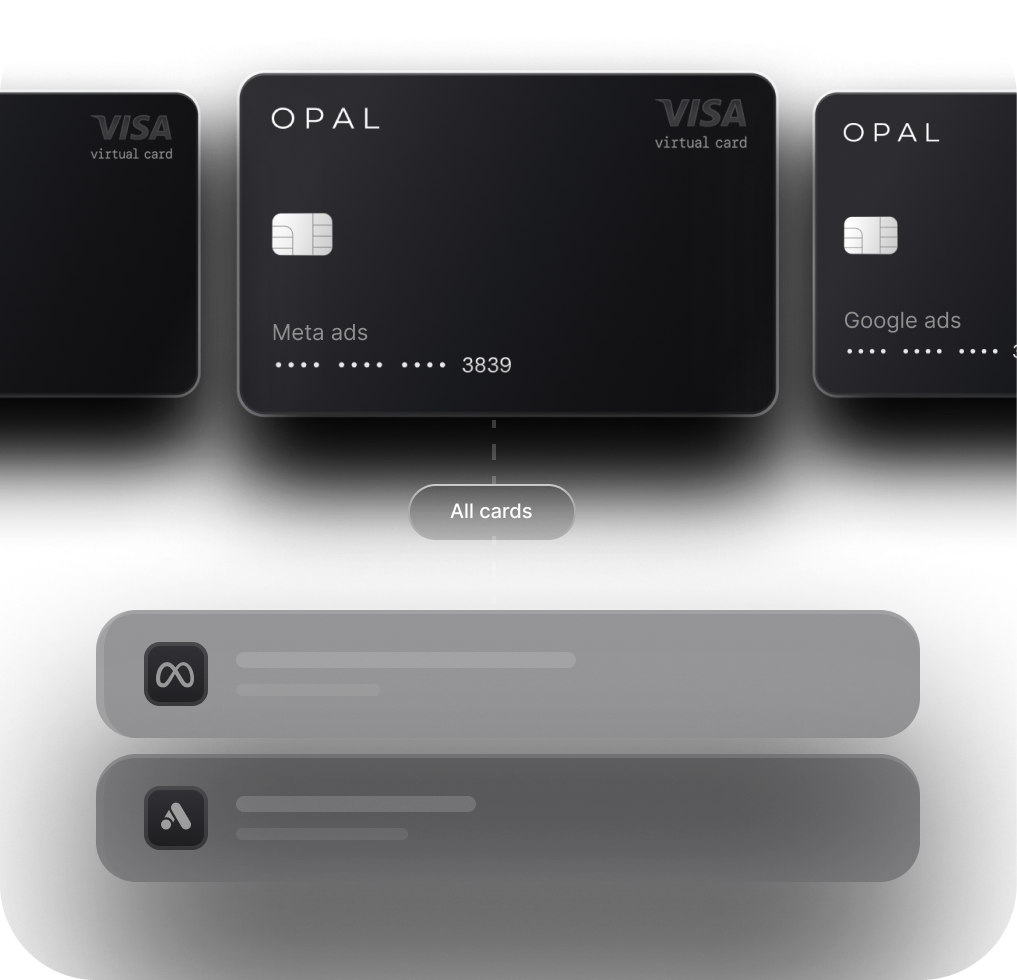
Virtual cards per client, so every client's ad spend is isolated and traceable
-
No personal guarantee, because an agency principal shouldn't be personally liable for a client's media budget
-
Cashback on ad platform spend, which is a meaningful revenue line at scale
-
Billing controls that prevent overspend and eliminate the need for manual monitoring
What mature agencies use here
Opal is purpose-built for this layer. It operates on a client-funded model where clients pre-fund their own balance, which means the agency never fronts client spend. Credit limits go up to $10M, virtual cards are free and unlimited, and the platform earns 1% cashback on all ad spend. There's no personal guarantee and no hard credit check. For agencies managing client ad budgets, this is the structural fit.
Dash.fi is a comparable option built more for direct-to-consumer brands managing their own ad spend rather than multi-client agencies.
Why general cards fall short here
General corporate cards (Amex, Chase Ink) and general spend management tools (Ramp, Brex) are not built for this use case. The problems are structural:
Credit limits are tied to company financials, not managed spend volume
No native virtual card per client architecture
Cashback rates aren't optimized for ad platform spend
Manual reconciliation is required at month-end
The gap cost: Agencies running client ad spend on general cards are either capping their spend capacity, floating client money on their own balance sheet, or spending 10-15 hours a month on manual reconciliation. Often all three. The ad spend structure post covers the card architecture in more detail if you're evaluating this layer.
Layer 2: Accounting and Bookkeeping
Every agency needs a system of record for its finances. This is the layer that tracks revenue, expenses, taxes, and profit. It's the foundation everything else reports into.
Tools by agency size
Agency Stage |
Best Fit |
Why |
|---|---|---|
Under $3M revenue |
QuickBooks Online |
Most common, broad accountant support, solid integrations |
$3M-$15M revenue |
Xero |
Cleaner interface, growing ecosystem, strong bank feeds |
$15M+ revenue |
NetSuite |
Multi-entity support, advanced reporting, enterprise-grade |
QuickBooks Online remains the dominant choice for marketing agencies at the 10-50 employee stage. Most agency-focused accountants know it, most tools integrate with it, and it handles the core job well. Xero is the main alternative and has been gaining ground, particularly with agencies that have international operations or prefer its reporting interface.
NetSuite is a different category entirely. It's an ERP, not just accounting software. Agencies that have grown past $15M in revenue, operate multiple entities, or need consolidated reporting across business units often move to NetSuite. The implementation cost and complexity are real, so it's not a decision to rush.
The reconciliation requirement
Here's the non-negotiable: whatever accounting system you use, your ad spend card layer needs to sync directly into it. Automated reconciliation is not a nice-to-have at scale; it's a structural requirement.
If your finance team is manually matching ad platform statements to card transactions at month-end, that's a red flag. It means your Layer 1 and Layer 2 aren't connected.
Opal has a direct QuickBooks integration. Every transaction on your Opal card syncs automatically into QuickBooks, with client-level tagging intact. That means no manual exports, no end-of-month data entry, and no reconciliation backlog. The QuickBooks reconciliation post covers what automated sync looks like in practice and how much time it saves.
The gap cost: Manual reconciliation at $500K in monthly managed spend typically takes 10-15 hours per month. At $2M in monthly managed spend, that number becomes untenable. Agencies that don't solve this layer lose their finance team to data entry instead of analysis.
Layer 3: Spend Management and Expense Reporting
This layer is separate from the ad spend card, and the separation matters.
Layer 3 covers the agency's internal operating expenses: software subscriptions, team travel, contractor invoices, office costs, and any other spend that isn't a client ad budget. This is where tools like Ramp and Brex belong, and they're genuinely good at this job.
The distinction to get right: Ramp and Brex are built for corporate spend management. They're excellent for issuing employee cards, enforcing spend policies, automating expense reports, and syncing to your accounting system. They are not built for the multi-client, high-volume, ad-platform-specific requirements of Layer 1.
The mature agency setup: Separate cards for separate purposes. Ramp or Brex for internal agency expenses. A purpose-built ad spend card (Layer 1) for client media budgets. Mixing these on the same card creates reconciliation problems, muddy reporting, and makes it nearly impossible to track true client profitability.
If you're currently running all agency spend on a single card, that's the first thing to fix. The reporting clarity alone is worth the switch.
The gap cost: Agencies that don't separate internal spend from client ad spend typically discover the problem during a client billing dispute or an audit. By then, untangling months of mixed transactions is a significant project.
Layer 4: Client Billing and Invoicing
This is how the agency gets paid. It sounds simple. At scale, it's one of the most operationally complex layers in the stack.
A mature client billing setup handles three distinct revenue types simultaneously: management fees (flat or percentage-based), ad spend pass-through (billing clients for what you spent on their behalf), and retainers (recurring monthly fees for ongoing work). Each of these may have different billing cycles, different line item structures, and different approval workflows.
Tools at this layer
-
QuickBooks invoicing handles the basics well for agencies under $2M in revenue. If you're already on QuickBooks for accounting, it's the path of least resistance.
-
Harvest is the most common choice for agencies that bill by the hour or need time tracking tied directly to invoices. It integrates with project management tools and makes time-to-invoice workflows clean.
-
FreshBooks is a simpler alternative to Harvest, better suited for agencies with straightforward retainer structures and less complex project billing.
-
HoneyBook is popular with smaller creative agencies but has limitations for agencies with complex multi-line invoicing or large client rosters.
Larger agencies with complex retainer structures and multiple billing cycles often build custom invoicing workflows on top of their accounting system, using QuickBooks or NetSuite as the billing engine with custom templates per client.
What a mature billing setup looks like
The key signal of a mature Layer 4 is line item clarity. Every invoice should show:
Management fee (with the basis: percentage of spend, flat fee, or hourly)
Ad spend pass-through as a separate line (if applicable)
Any platform fees or third-party costs billed to the client
Payment terms and due date
Automated invoicing on billing cycles is the other signal. If someone is manually generating invoices every month, that's a scaling bottleneck.
The gap cost: Agencies with unclear invoicing lose money two ways: clients dispute charges they don't understand, and agencies under-bill because they lose track of billable hours or ad spend pass-throughs in the chaos of month-end.
Layer 5: Financial Reporting and Forecasting
Bookkeeping tells you what happened. This layer tells you where you're going.
Financial reporting and forecasting is the layer that most agencies build last, and the agencies that build it early are the ones that make better decisions faster. This is where leadership gets visibility into gross margin by client, revenue per employee, cash flow runway, and managed spend growth trends.
Tools at this layer
Jirav, Mosaic, and Fathom are the purpose-built FP&A (financial planning and analysis) tools that growing agencies use when they outgrow spreadsheets. All three connect to your accounting system and let you build driver-based models, track actuals vs. forecast, and create board-ready reports without a full-time CFO.
-
Fathom is the most accessible entry point, with strong visual reporting and a relatively fast setup on top of QuickBooks or Xero.
-
Jirav and Mosaic are more powerful for scenario modeling and headcount planning, and better suited for agencies approaching $10M+ in revenue with dedicated finance staff.
That said, Google Sheets and Excel still dominate at mid-market agencies for custom financial models. The flexibility of a well-built spreadsheet model is hard to beat for agency-specific metrics that off-the-shelf tools don't natively support.
What mature agencies track here
The metrics that separate a financially mature agency from one that's flying blind:
-
Gross margin by client: Revenue minus direct costs (ad spend, contractor costs, platform fees) per client. This tells you which clients are actually profitable.
-
Revenue per employee: Total revenue divided by headcount. Industry benchmarks vary, but tracking this over time reveals staffing efficiency trends.
-
Cash flow runway: How many months of operating expenses you can cover with current cash. Critical for agencies with long client payment cycles.
-
Managed spend growth: Total client ad spend under management, tracked monthly. This is the leading indicator of revenue growth for media-buying agencies.
The gap cost: Agencies without this layer make hiring decisions, client pricing decisions, and growth investments based on gut feel instead of data. The cost shows up slowly and then all at once.
Layer 6: Payroll and Contractor Payments
Agencies are people businesses. This layer pays them.
The tool decision here depends on two variables: headcount size and contractor mix. Agencies with a heavy contractor workforce (common in media buying, where you might have a mix of full-time buyers and freelance specialists) need a system that handles 1099s cleanly, not just W-2 payroll.
Tools at this layer
Gusto is the default choice for agencies under 50 employees. It handles payroll, benefits administration, and 1099 contractor payments in one system. The interface is straightforward, setup is fast, and it integrates with QuickBooks and Xero. For most agencies at the 10-30 employee stage, Gusto handles everything they need.
Rippling is the choice for agencies that want HR and payroll in a single system. It handles onboarding, device management, benefits, and payroll, which reduces the number of HR tools in the stack. The tradeoff is more complexity and higher cost than Gusto.
Deel is the right answer for agencies with international contractors or distributed remote teams. It handles compliance across countries, contractor agreements, and payments in local currencies. If you're hiring media buyers or specialists outside the US, Deel eliminates significant legal and compliance friction.
The gap cost: Agencies that manage contractor payments manually (wire transfers, PayPal, paper checks) create 1099 compliance exposure and spend significant time on payment logistics. At 10+ contractors, a dedicated system pays for itself quickly.
Layer 7: Project Management with Financial Visibility
This is the layer where time and money meet.
Most agencies have some form of project management. What separates mature agencies isn't whether they use a PM tool; it's whether their PM tool gives them financial visibility at the project level. Specifically: do you know the profitability of every client engagement, not just total agency revenue?
Tools at this layer
Teamwork is the most agency-specific project management platform at this layer. It was built with agency workflows in mind and includes time tracking, budget tracking, and profitability reporting natively. For agencies that want financial visibility built into their project management rather than bolted on, Teamwork is the closest fit.
Harvest bridges Layer 4 and Layer 7. It's primarily a time tracking tool with invoicing capabilities, and it integrates with most project management systems. Agencies that use Harvest for billing (Layer 4) often use it here as well for project-level time and cost tracking.
Monday.com and Asana are strong general-purpose project management tools but don't have native financial features. Agencies using these typically pull time data from a separate tracker (Harvest, Toggl) and reconcile it manually or via integration.
What financial visibility at this layer actually means
A mature agency running Layer 7 correctly can answer these questions for every active client:
What's the budgeted hours vs. actual hours this month?
What's the gross margin on this engagement?
Are we over-servicing relative to the retainer?
What's the effective hourly rate we're earning on this client?
If you can't answer those questions today, Layer 7 has a gap.
The gap cost: Agencies without project-level financial visibility often have profitable-looking top-line revenue but unprofitable individual clients. The problem is invisible until a key client churns and the margin impact is suddenly obvious.
How to Audit Your Own Financial Stack
Before you go shopping for new tools, run this audit. Five questions that will tell you exactly where your gaps are.
1. Is your ad spend card purpose-built for multi-client agency use, or is it a general corporate card? If you're running client media budgets on an Amex, Chase Ink, or general spend management tool, you have a Layer 1 gap. The structural problems (limits, reconciliation, liability) compound as spend grows.
2. Does your accounting system receive transaction data automatically, or does someone manually enter or reconcile it? Manual reconciliation at scale is a Layer 2 integration gap. Your ad spend card, bank accounts, and expense tools should all feed your accounting system automatically.
3. Do you have separate cards for internal agency expenses and client ad spend? If the answer is no, you have a Layer 3 gap. Mixed spend makes reconciliation harder, client billing less defensible, and profitability reporting nearly impossible.
4. Can you pull gross margin by client in under five minutes? If this requires a manual spreadsheet exercise, you have a Layer 5 gap. Gross margin by client is the single most important financial metric for an agency, and it should be accessible on demand.
5. Do you know whether each of your active client engagements is profitable at the project level? If you know total agency revenue but not per-client profitability, you have a Layer 7 gap. This is the gap that tends to surface during client churn, when the margin impact becomes suddenly visible.
Most agencies that run this audit find gaps in at least three layers. That's not a failure; it's a roadmap. Pick the layer with the highest cost of the gap and fix that one first.
For most agencies at the 10-50 employee stage, Layer 1 (ad spend payment infrastructure) has the highest immediate cost because it compounds with every dollar of managed spend. If that's where you want to start, Opal was built specifically for this layer.
Frequently Asked Questions
What financial tools do large marketing agencies use for ad spend?
Large agencies use purpose-built ad spend cards rather than general corporate cards. The key requirements are high credit limits scaled to managed spend volume, virtual cards per client for clean reconciliation, no personal guarantee, and cashback on ad platform spend. Opal is built specifically for this use case. General cards (Amex, Chase Ink) and general spend management tools (Ramp, Brex) are not designed for multi-client ad spend management at scale.
What accounting software do marketing agencies use?
QuickBooks Online is the most common choice for agencies under $15M in revenue. Xero is a growing alternative with a cleaner interface and strong bank feeds, particularly for agencies with international operations. NetSuite is the enterprise option for agencies above $15M with multi-entity structures or complex reporting requirements.
What is the difference between Ramp/Brex and a purpose-built ad spend card?
Ramp and Brex are corporate spend management tools designed for internal company expenses: employee cards, travel, software subscriptions, and general operating costs. They are not designed for multi-client ad spend management. A purpose-built ad spend card (like Opal) is designed specifically for agencies funding client media budgets: it offers per-client virtual cards, limits tied to managed spend rather than company financials, and cashback on ad platform spend. The two tools serve different layers of the financial stack and should not be used interchangeably.
How do agencies track profitability by client?
Mature agencies track client profitability at two levels: gross margin (revenue minus direct costs per client, tracked in their accounting system) and project-level profitability (budgeted vs. actual hours, tracked in a project management tool like Teamwork or Harvest). Agencies that only track total revenue miss the per-client picture and often discover unprofitable clients only after they churn.
What payroll software do marketing agencies use?
Gusto is the most common choice for agencies under 50 employees, covering both W-2 payroll and 1099 contractor payments. Rippling is used by agencies that want HR and payroll in a single system. Deel is the right choice for agencies with international contractors or distributed remote teams, handling cross-border compliance and local currency payments.
Do agencies need a separate tool for financial forecasting?
Not necessarily at the early stage. Many agencies at the 10-20 employee stage run their financial models in Google Sheets or Excel. As the agency grows past $5M in revenue, purpose-built FP&A tools like Fathom (accessible entry point), Jirav, or Mosaic become valuable for driver-based forecasting, actuals-vs-budget tracking, and board-ready reporting without requiring a full-time CFO.