



Why Law Firms Need a Dedicated Card for Legal Marketing Spend

TL;DR
Law firms face stricter financial separation requirements than almost any other business, and that standard should extend to how marketing spend is structured. Using a general firm card for ad spend creates commingling risk, reconciliation complexity, and audit exposure that a dedicated card eliminates by design. For firms running campaigns across multiple practice areas or locations, the compliance case is as strong as the operational one. A dedicated card per practice area or campaign type is the cleanest solution.
Law firms hold themselves to a higher standard of financial separation than most businesses. That standard is not optional: it is enforced by state bar rules, codified in trust accounting obligations, and backed by the kind of reputational risk that can end a firm's relationship with its clients overnight. Most attorneys understand this when it comes to client funds. Fewer apply the same discipline to marketing spend.
That gap is worth closing. The way a firm structures its law firm ad spend management is not just an accounting preference. It is a risk management decision with compliance implications that no general business card was designed to address.
The Separation Standard Already Exists. Marketing Spend Should Follow It.
Law firms are already required to keep client funds strictly separate from operating funds. That principle, enforced through IOLTA accounts and trust accounting requirements, exists because financial clarity is a professional obligation, not just good bookkeeping. When money from different sources flows through the same account, the audit trail becomes unreliable, and unreliable audit trails create liability.
That same logic applies to marketing spend. A personal injury practice running $200,000 per month in Google Ads is not operating in the same financial category as the estate planning practice running $8,000 per month in local search. When both campaigns run through the same general firm card, you lose the ability to cleanly attribute spend, reconcile charges by practice area, or demonstrate clean financial separation if a question ever arises. The separation standard your firm already lives by professionally should be reflected in how your marketing budget is structured.
Best practice: Consult your firm's ethics counsel for guidance specific to your state bar rules. The principles described here are operational and risk management best practices, not legal advice.
Key takeaway: The financial separation discipline your firm applies to client funds is the right model for marketing spend. A dedicated card per practice area makes that separation automatic.
Law Firm Ad Spend Is Not Normal Business Spend
Legal advertising is one of the highest-cost categories in digital marketing, and a general business card was never designed to handle it. Personal injury firms, criminal defense practices, and family law attorneys compete in some of the most expensive keyword auctions on Google. A mid-size PI firm can spend $50,000 to $500,000 per month on paid search alone. Running that volume through a general firm card creates three compounding problems:
-
Credit limit exposure: A single campaign surge can hit the card ceiling and pause live ads mid-flight.
-
Cash flow unpredictability: High and variable ad spend on a shared card makes monthly budgeting unreliable.
-
Reconciliation complexity: Mixed charges across campaigns and practice areas turn month-end close into a manual reconstruction project.
The card infrastructure needs to match the spend volume. A general business card built for office supplies and travel is not the right tool for a firm managing six-figure monthly ad budgets across multiple platforms. When limits are hit mid-campaign, ads pause. When charges from multiple campaigns land on one statement, reconciliation becomes a manual reconstruction project. A dedicated legal marketing budget card with limits sized to actual campaign budgets eliminates both problems before they start.
Key takeaway: High and variable ad spend volumes are a law firm-specific risk. A card with limits sized to actual campaign budgets prevents mid-flight pauses and month-end reconciliation nightmares.
Billing Disputes Require a Paper Trail You Can Actually Use
When a billing dispute arises with an ad platform or media vendor, the firm's ability to win it depends entirely on the quality of its transaction records. Law firms understand billing disputes better than any other business. Your attorneys resolve them professionally, every day. That same standard should protect the firm when disputes arise on the other side of the table.
When a vendor overbills, a platform charges incorrectly, or a campaign spend does not match what was authorized, a dedicated card for each practice area produces a clean, isolated transaction record automatically. Every charge is attributable to a specific campaign, a specific platform, and a specific budget authorization. A shared general card produces the opposite: a mixed statement that requires manual reconstruction to isolate the disputed charges, and manual reconstruction creates gaps that weaken the firm's position.
Key takeaway: A dedicated card is self-documenting. Every transaction is already isolated by practice area and platform, with no manual reconstruction required if a dispute arises.
Multi-Practice and Multi-Location Firms Need Spend Separation by Default
A firm running separate campaigns for personal injury, family law, and estate planning is not running one marketing program. It is running three, and a shared card makes it impossible to measure any of them accurately.
Each practice area has its own budget, its own platforms, its own target geography, and its own ROI expectations. Tracking the return on that investment requires knowing exactly what each practice area spent. That is impossible when all three campaigns run through the same card.
The same problem applies to firms with multiple office locations running separate local campaigns. If your Dallas office and your Houston office are both running Google Ads on the firm's general card, you cannot cleanly report on either location's marketing performance without manually parsing every line item. A dedicated card per practice area or location makes that reporting automatic. The financial clarity benefit alone justifies the switch. The compliance and audit trail benefits are structural advantages on top of it.
Key takeaway: Multi-practice and multi-location firms cannot accurately measure marketing ROI without separated spend data. Dedicated cards make that separation automatic, with no manual work at month-end.
What a Dedicated Card Setup Actually Looks Like
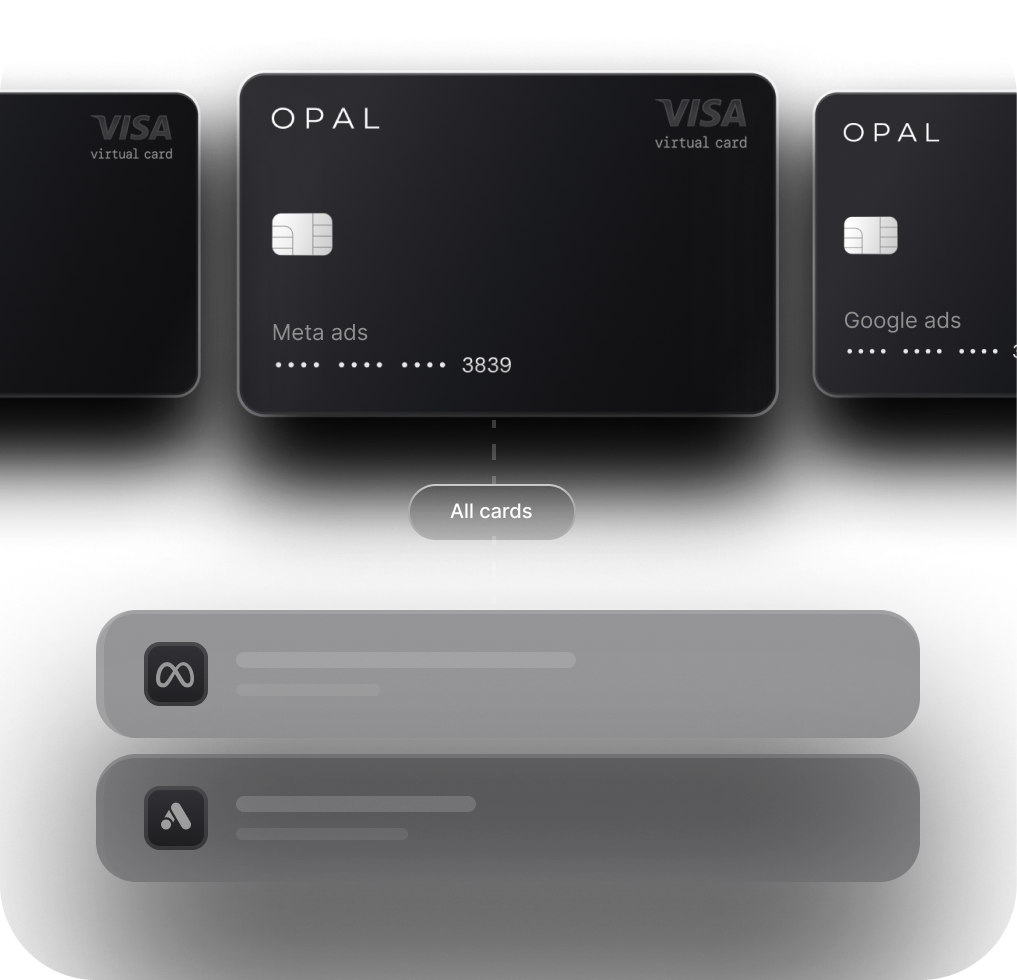
The practical implementation is straightforward. Each practice area or campaign type gets its own virtual card, locked to the specific ad platforms that practice area uses, with a spend limit that matches the approved marketing budget for that practice area.
Practice Area |
Platforms |
Monthly Limit |
|---|---|---|
Personal Injury |
Google Ads, LSA |
$150,000 |
Family Law |
Google Ads, Meta |
$30,000 |
Estate Planning |
Meta, Display |
$8,000 |
Criminal Defense |
Google Ads |
$25,000 |
Neither card can be used outside its designated platforms, and neither limit can be exceeded without an explicit approval.
This structure gives the firm's administrator or CFO real-time visibility into spend by practice area, automatic documentation for every transaction, and a clean audit trail that requires no manual reconstruction at month-end. Opal is purpose-built for this kind of setup: unlimited free virtual cards, spend limits per card, and platform-level controls designed for high-volume ad spend. The configuration takes minutes, and the reporting benefit starts immediately.
The firms that get this right treat their law firm marketing spend card infrastructure the same way they treat their trust accounting: as a professional obligation, not an afterthought.
Frequently Asked Questions
Do law firms need a separate card for marketing spend?
Not legally required in most jurisdictions, but strongly advisable as a risk management practice. Law firms operate under stricter financial separation standards than most businesses. A dedicated card for legal advertising spend creates clean documentation, eliminates commingling risk across practice areas, and produces the audit trail a firm needs if a billing dispute or financial review ever arises.
How should a law firm separate ad spend by practice area?
The cleanest method is one virtual card per practice area, locked to the platforms that practice area uses, with a spend limit matching the approved budget. This makes reconciliation automatic, reporting accurate, and financial separation clear. It also prevents one practice area's campaign from accidentally drawing against another area's budget.
What are the risks of using a general business card for law firm advertising?
The main risks are credit limit exposure on high-volume campaigns, reconciliation complexity when multiple practice areas share one statement, and weak documentation if a billing dispute arises with a vendor or platform. For firms with trust accounting obligations, the optics of mixed financial records, even for operating expenses, add an additional layer of risk.
How do law firms track marketing ROI by practice area?
Accurately tracking ROI by practice area requires spend data that is already separated by practice area. If all campaigns run through one card, you cannot cleanly attribute spend without manual parsing. A dedicated card per practice area or campaign type produces separated spend data automatically, which feeds directly into any ROI reporting framework the firm uses.
What card features should a law firm look for in a marketing spend card?
Look for: unlimited virtual cards so each practice area or campaign gets its own, per-card spend limits that match approved budgets, platform-level controls that restrict each card to its designated ad platforms, and real-time transaction visibility. A card with no personal guarantee requirement is also worth prioritizing, given the high spend volumes common in legal advertising. See how Opal handles ad spend limits and credit for reference.