

Opal vs. Capital on Tap: Which Card Is Better for Advertising Agencies?

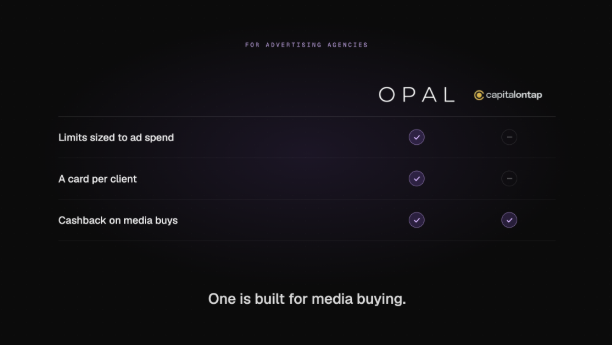
Direct answer: For advertising agencies, media buyers, and any business running significant ad spend, Opal is the better card. Capital on Tap is a capable general business credit card, but its $50,000 credit ceiling, employee-oriented virtual card model, and lack of ad platform integration make it structurally unsuitable for high-volume paid media operations. Opal was built specifically for this workflow: credit limits up to $10M, unlimited free virtual cards, up to 2% cashback on eligible ad spend, and a credit model that scales with managed spend volume rather than a personal credit profile or cash deposits.
If you are running paid media at scale and comparing these two cards, the choice comes down to one question: is your card built for your business, or just available to it?
Key Takeaways
Capital on Tap is a solid SMB card with up to $50,000 in credit and 1.5% flat cashback, but it was designed for general small business use, not agency ad spend workflows.
Opal offers credit limits up to $10M, scaling with actual spend rather than a credit profile assessment.
Both cards offer free virtual cards with spend controls. Capital on Tap caps accounts at 99 virtual cards organized around employees, with controls set per person. Opal issues unlimited virtual cards, each with its own dedicated spend limit, organized around clients and ad platforms. That architectural difference is what makes Opal's virtual card infrastructure actually usable at agency scale.
Opal earns up to 2%. Capital on Tap earns 1.5% flat, or 2% with weekly AutoPay enrollment. The rate comparison is close at low volumes. The credit ceiling is what makes it irrelevant at scale.
At $25,000 per month in ad spend, Capital on Tap's $50K credit ceiling becomes a ceiling in under two billing cycles. Opal's limits do not create that constraint.
Opal carries no annual fee, no personal guarantee, and no hard credit check. Capital on Tap requires a personal guarantee and runs a soft check on personal credit only (no impact to personal FICO). A personal FICO score of approximately 670 or higher improves approval odds.
For agencies at $25K or more per month in client media spend, the infrastructure gap between these two cards is material, not marginal.
What Is Capital on Tap, and Who Is It Actually Built For?
Capital on Tap is a business credit card issued through WebBank in the US, designed for small and medium-sized businesses with general operating expenses. It offers 1.5% flat cashback on all purchases, boosted to 2% if you enroll in weekly AutoPay. Credit lines go up to $50,000, and there is no annual fee. (Rates and terms as of August 2026, per Capital on Tap's published US terms.)
To qualify, a business must be incorporated (LLCs, corporations, and LLPs are eligible; sole proprietors are not), have been operating for at least six months, and generate a minimum of $2,500 in monthly revenue. Approval requires a personal guarantee. Capital on Tap runs a soft check on personal credit only, with no impact to personal FICO score. A personal FICO score of approximately 670 or higher gives the best approval odds.
The profile Capital on Tap was built for: a small business owner with a few thousand dollars in monthly operating expenses, looking for a simple, no-fuss card with flat cashback. A landscaping company, a consulting firm, a local retailer.
That is a real and valuable product. It is just not the same problem that a digital marketing agency faces.
An agency managing paid media for clients is not a small business with ordinary operating expenses. It is a financial intermediary running hundreds of thousands of dollars in client money through ad platforms every month, across multiple accounts, with billing cycles that do not wait for month-end reconciliation. The requirements are fundamentally different.
How Do Opal and Capital on Tap Compare on the Features That Matter for Agencies?
Here is the direct comparison across the five dimensions that determine whether a card actually works for agency ad spend.
|
Feature |
Opal |
Capital on Tap |
|---|---|---|
Credit limit |
Up to $10M |
Up to $50,000 |
Cashback on ad spend |
Up to 2% on eligible ad spend |
1.5% flat; 2% with weekly AutoPay enrollment |
Virtual cards |
Unlimited, free, no per-account cap |
Free, capped at 99 per account; tied to employee cards |
Credit scales with managed spend |
Yes (up to $10M) |
No (fixed $50K ceiling) |
Ad platform sync |
Yes |
No |
Annual fee |
$0 |
$0 |
Personal guarantee |
None |
Required |
Credit check |
No hard check; no personal guarantee |
Soft check only; does not affect personal credit score; personal guarantee required |
QuickBooks integration |
Yes |
Yes |
Sole proprietors eligible |
No |
No |
Credit limits: the number that ends the conversation
An agency spending $25,000 per month in client ad spend will hit Capital on Tap's $50,000 ceiling inside two billing cycles. At $50,000 per month, the ceiling is reached in a single month. At $100,000 per month, the limit is not a ceiling at all; it is a wall that stops operations mid-campaign.
Opal's limits scale with actual spend patterns, not a credit profile snapshot. A business spending $250,000 per month on ads gets credit infrastructure that matches that reality. That is not a minor feature difference; it is the difference between a card that works and one that doesn't.
Virtual cards: both offer them, but Opal's are built for client separation
Capital on Tap offers free virtual cards with individual spend limits, employee-level controls, and QuickBooks sync. For a small business managing employee expenses, that is a complete solution.
For agencies, the model runs into a structural mismatch. Capital on Tap caps accounts at 99 virtual cards total, and the card architecture is organized around employees: each card belongs to a person, with controls set per person. That works for expense management. It does not map cleanly to an agency workflow where the organizing unit is a client or an ad platform, not a headcount.
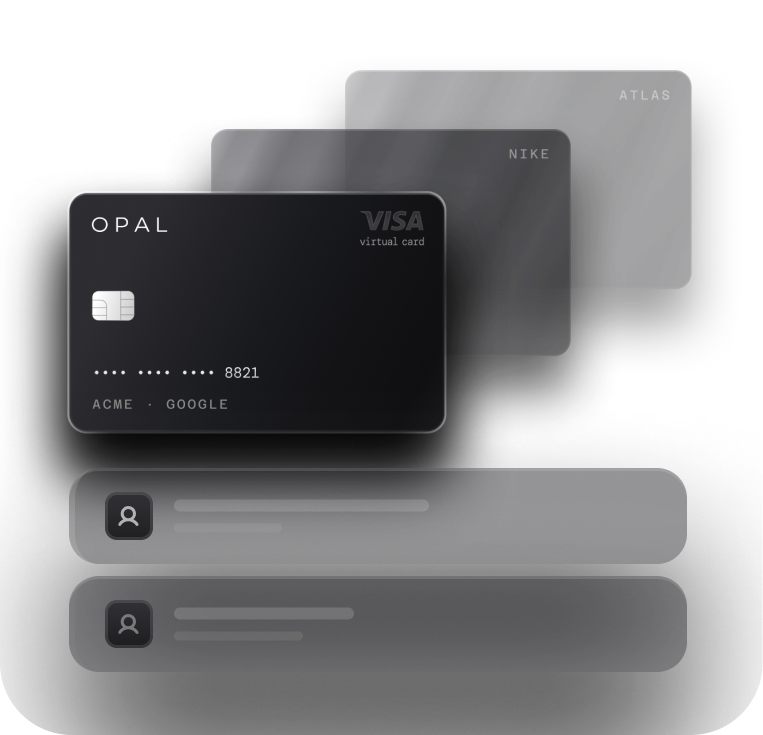
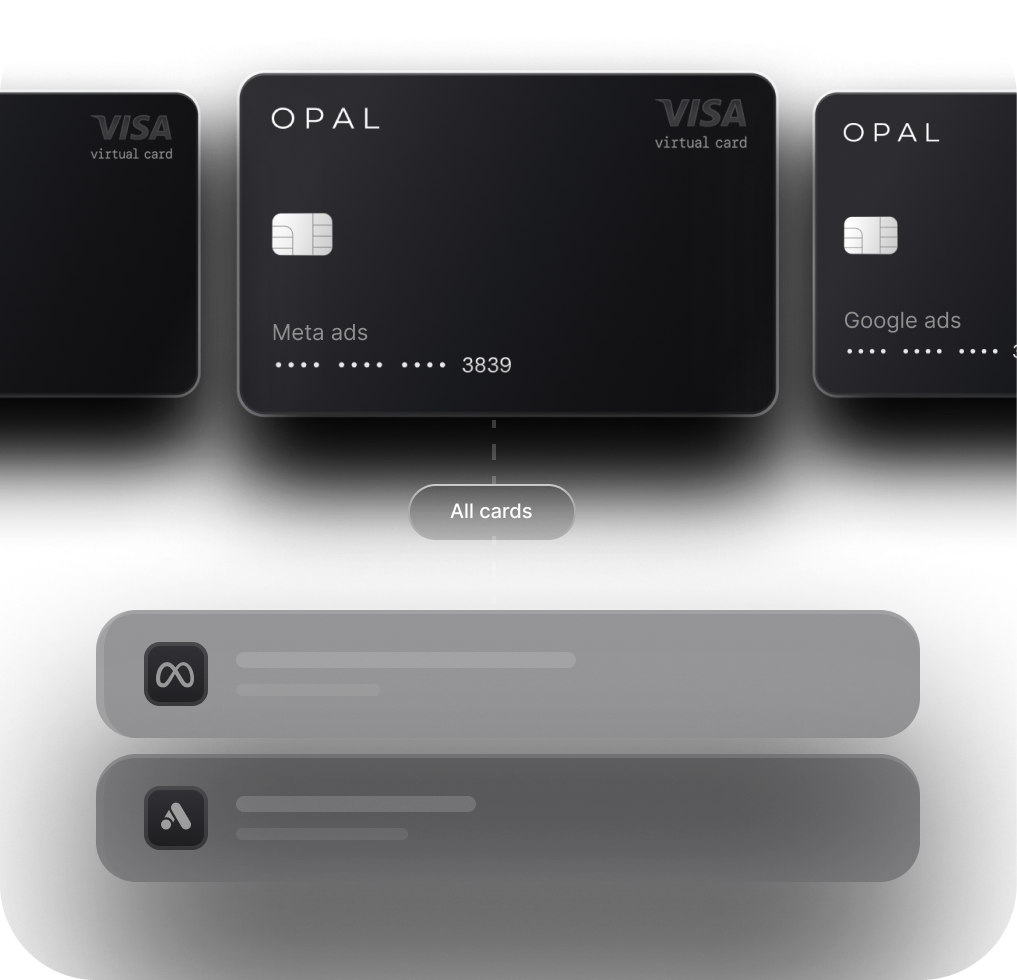
Opal issues unlimited virtual cards, each with its own dedicated spend limit, with no per-account cap. The intended use case is exactly what agencies need: one card per client, one card per platform, spend isolated at the account level from the moment the charge hits. An agency running eight clients across four platforms each can assign every client-platform combination its own card with its own limit. Month-end reconciliation becomes a lookup, not a sorting exercise.
See how agencies structure ad spend by client to keep billing clean across accounts.
The cashback math at agency scale
Capital on Tap's rates are competitive: 1.5% flat, or 2% if you enroll in weekly AutoPay. And because it is a revolving card, you can technically run more than $50,000 through it in a month by paying it down mid-cycle. The 2% AutoPay tier actually requires weekly payment, so high-spend users are doing exactly that.
The real constraint is not cashback math. It is cash flow.
To run $250,000 per month through a $50,000 line, you are paying the card down five or more times per billing cycle from your own operating cash. Every paydown cycle is a window where the line is temporarily exhausted. If a platform charges during that window, the transaction declines. Campaign pauses, re-verification queues, and account flags follow. The weekly paydown rhythm that unlocks the 2% rate is the same rhythm that creates the exposure. Opal's credit scales with actual spend volume, so that paydown tightrope does not exist. At $250,000 per month, Opal's up to 2% on eligible ad spend returns up to $5,000 per month, or up to $60,000 per year. On $500,000 per month, that is up to $10,000 per month, or up to $120,000 per year.
Capital on Tap's 2% AutoPay tier is competitive on rate. The credit ceiling is what makes the comparison academic at any meaningful agency spend level. For a deeper look at how cashback caps erode returns at scale, see the hidden cost of ad spend cashback caps.
How Does Opal's Credit Model Differ From a Standard Business Card?
This is the structural difference that separates Opal from every general business card, including Capital on Tap.
Most business cards size your credit limit against a personal credit profile, a revenue snapshot, or the cash you hold in a linked account. For agencies, that creates a hard ceiling that has nothing to do with actual spend volume. An agency managing $300,000 per month in client budgets can easily be capped at $50,000 because the card issuer is looking at the agency's balance sheet, not its book of business.
Opal extends credit directly to the agency, sized against actual managed spend volume. The limit scales with what the agency is already running, not with what the owner's FICO score or cash reserves look like. An agency doing $500,000 per month in client ad spend gets credit infrastructure that reflects that reality.
This matters for three reasons:
-
No deposit required. Agencies do not need to park cash in a linked account to unlock their limit. The credit is based on spend patterns, not collateral.
-
No personal guarantee. The agency owner is not personally on the hook for the credit line. That is a meaningful distinction when limits reach six or seven figures.
-
Scale without friction. Taking on a new client with a $100,000 monthly media budget does not require a credit renegotiation. The limit adjusts with the business.
Capital on Tap has no equivalent structure. It is a fixed $50,000 line assessed against a personal credit profile. Every dollar of client ad spend draws from the same capped pool, regardless of how large the agency's book of business grows. For a small agency with one client and modest budgets, that is manageable. For any agency running multiple accounts at meaningful scale, it becomes an active constraint on growth.
The question is not just which card pays more cashback. It is which card gives you credit infrastructure that actually matches the size of the business you are running.
Is There Any Scenario Where Capital on Tap Makes Sense?
One: a very early-stage operation billing primarily for services, not yet managing significant paid media budgets. At under $10,000 per month in ad spend, the $50,000 ceiling is not a constraint, and the 1.5% flat cashback applies to all business expenses, including software and contractors.
The table below shows where that changes:
|
Monthly ad spend |
Capital on Tap |
Opal |
|---|---|---|
Under $10K |
Functional |
Functional |
$10K - $25K |
Workable, limit not yet a constraint |
Better fit for multi-client setup |
$25K - $50K |
Approaching ceiling; limited headroom |
Comfortable operating range |
$50K+ |
Credit limit hit; operations at risk |
Built for this range |
$100K+ |
Not viable |
Designed for this |
The ceiling arrives faster than most agencies expect. For context on what a mid-campaign payment failure actually costs, see why ad campaigns pause mid-flight.
The Bottom Line
Most agencies don't switch cards because they planned to. They switch after a campaign pauses mid-flight, after a month-end reconciliation takes three days, or after they lose a client pitch because they couldn't demonstrate clean billing separation. By that point, the cost of staying on the wrong card is already visible on the P&L.
Capital on Tap works fine until it doesn't. The ceiling is fixed, the virtual card model is organized around headcount rather than clients, and the credit model was never designed to scale with a book of business. For agencies under $10K per month with one or two clients, that's manageable. For anyone growing past that, the constraint arrives faster than expected.
The better time to switch is before the constraint hits, not after.
Apply at opalspend.com in 2 to 3 minutes. No hard credit check, no personal guarantee, no annual fee.
FAQ
Is Capital on Tap available to advertising agencies in the US?
Yes. Capital on Tap is available to incorporated US businesses (LLCs, corporations, LLPs) with at least six months of operating history and $2,500 or more in monthly revenue. Sole proprietors are not eligible. Advertising agencies that meet these criteria can apply, but the card's $50,000 credit ceiling, employee-oriented virtual card model, and absence of ad platform sync create operational constraints for agencies managing significant client ad spend.
Can I use Capital on Tap for Google Ads and Meta Ads?
Capital on Tap is a Visa business credit card and can be used on any platform that accepts Visa. It does offer virtual cards and spend controls, but it does not offer ad platform sync or automatic billing updates with Google, Meta, TikTok, or other ad networks. That means payment method changes require manual updates across every platform, and a billing issue on one platform can cascade if multiple platforms share the same card.
Does Opal require a personal guarantee?
No. Opal does not require a personal guarantee and does not conduct a hard credit check. Credit limits are based on actual ad spend patterns and cash flow, not a personal credit profile. Capital on Tap does require a personal guarantee.
What happens if I hit my credit limit mid-campaign?
Campaigns pause. Ad platforms re-verify payment methods, which can take hours or days. In some cases, accounts are flagged. The downstream cost of a mid-campaign interruption, in lost impressions and re-verification time, typically exceeds any savings from the card. This is the core operational risk of using a card with a fixed $50,000 ceiling for agency ad spend.
Can an agency earn cashback on client ad spend with Opal?
Yes. Opal extends credit directly to the agency, and the agency earns cashback on every dollar charged to the card, including all client ad spend. Opal earns up to 2% on all eligible ad spend, uncapped. At $250,000 per month, that is up to $5,000 per month, or up to $60,000 per year. No deposit required, no personal guarantee, and no cashback cap.