




How to Scale a Media Buying Agency Financially
TL;DR: Most media buying agencies don't hit a growth ceiling because they lack clients. They hit it because their financial infrastructure was never designed to scale. Cash flow gaps, card limits, reconciliation bottlenecks, billing disputes, and personal liability exposure compound as you grow. This post walks through each failure point and the structural fix for each one.
You land the client. It's the biggest one yet. Twice the monthly ad spend of your current largest account. You say yes, run the numbers, and start onboarding.
Then reality lands.
Your card limit is already at 80% utilization. Your bookkeeper is three weeks behind on reconciliation. A current client just emailed asking why there's a charge they don't recognize. And you're about to personally guarantee another line of credit to cover the float.
This is the inflection point that catches most growing agencies off guard. Not the sales ceiling. Not the talent ceiling. The financial ceiling.
The agencies that scale cleanly treat financial infrastructure as something they build. The ones that stall treat it as something they patch.
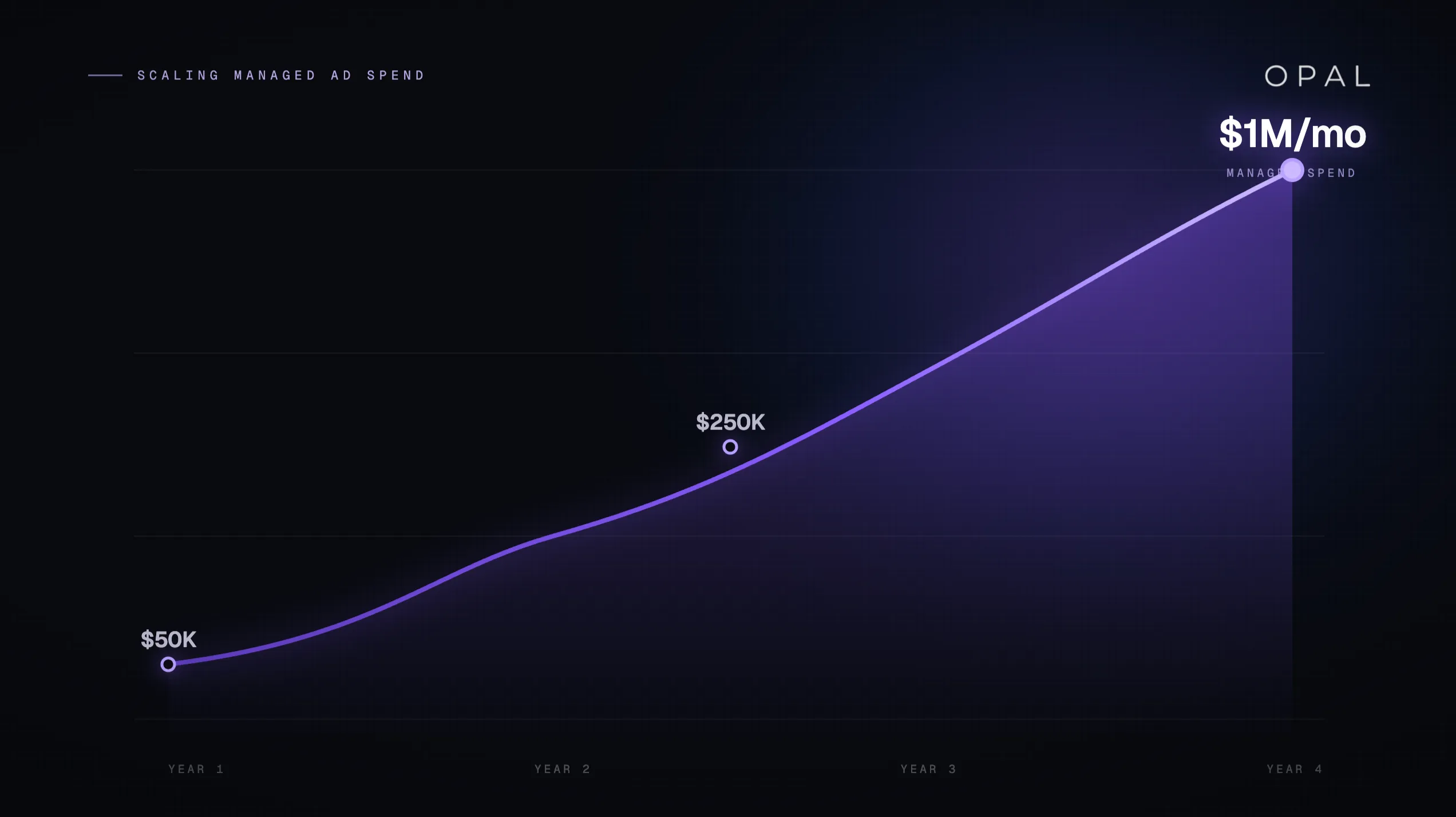
The financial model that got you to $1M in managed spend will not get you to $10M. The bottleneck is not your pipeline. It is the card setup, cash flow model, bookkeeping process, client billing structure, and liability exposure underneath your business. At five clients, these are manageable. At twenty, they are a crisis in slow motion.
Here are the five financial failure points that appear as agencies grow, and the structural fix for each one.
Failure Point 1: Cash Flow Gaps from Fronting Client Ad Spend
At small scale, fronting ad spend feels like a minor inconvenience. You charge the campaigns to your card, invoice the client, and get reimbursed in 30 to 45 days. The gap is manageable.
At scale, it becomes a structural problem. If you're managing $500K per month in ad spend across 15 clients, and your average reimbursement window is 30 days, you are carrying up to half a million dollars of client money on your own balance sheet at any given time. That is not a cash flow inconvenience. That is a working capital crisis.
What It Looks Like in Practice
You decline a new client because you can't front their spend. Or you slow-walk campaign launches to stay within your float capacity. Growth becomes gated by your personal liquidity, not your team's ability to execute.
The Structural Fix
Stop fronting spend entirely. The model that scales is one where clients pre-fund their own ad spend before campaigns go live. Under this structure, you collect client funds upfront, hold them in a dedicated account, and draw against that balance as campaigns run. The agency never carries the float.
This is not a new concept; it is how the largest agencies have always operated. The structural shift is formalizing it as your standard billing model, not a special arrangement for big clients. If you want to understand how this works operationally, the client-funded card model is worth reading in full. It changes the entire cash flow equation.
Failure Point 2: Card Limits That Cap Your Growth
Traditional business credit cards are underwritten on your agency's revenue and credit history. The limit you get approved for reflects what your business looks like today, not the spend volume you're managing on behalf of clients. That mismatch becomes a hard ceiling.
You hit $300K per month in managed spend. Your card limit is $250K. You either cycle payments mid-month, split spend across multiple cards, or turn down new business. None of those are real solutions. They are workarounds that add operational complexity and create new failure points.
What It Looks Like in Practice
A media buyer pauses a campaign because the card is at limit. A client's Google Ads account gets flagged for payment failure. You spend an afternoon on the phone with your bank asking for a temporary limit increase that takes two weeks to process.
The Structural Fix
The limit on your card should be tied to the spend you manage, not the size of your agency's balance sheet. That requires using a card product underwritten differently: one that looks at cash flow and managed spend volume rather than personal or business credit.
Some agencies solve this by spreading spend across five or six cards, which creates its own reconciliation nightmare. The cleaner fix is a single card architecture with limits that scale with your book of business. If you're running into this ceiling now, the post on ad spend limits without a personal guarantee covers the underwriting models that make higher limits possible without putting your personal credit on the line.
Failure Point 3: Reconciliation Time That Scales With Clients, Not Revenue
This is the failure point that sneaks up on you. At five clients, reconciliation takes a few hours. At twenty clients, it takes a week. The problem is that reconciliation time scales linearly with the number of clients, not with your revenue or team size.
Every new client adds more card statements, more platform exports, more line items to match, and more invoices to cross-reference. If you're running spend across Google, Meta, TikTok, and Amazon for ten clients, you're reconciling 40 platform accounts every month. That is a full-time job, and most agencies are doing it with a part-time bookkeeper and a spreadsheet.
What It Looks Like in Practice
Month-end becomes a fire drill. Invoices go out late. Clients wait longer for spend reports. Your finance lead is doing manual data entry instead of analysis. And because the reconciliation is manual, errors creep in.
The Structural Fix
Reconciliation should be automated at the infrastructure level, not managed manually at the accounting level. The structural change is assigning a dedicated virtual card to each client and each platform. When every dollar of spend on Meta for Client A flows through one card, and every dollar on Google flows through another, the reconciliation is done before it starts.
This is not a bookkeeping tip. It is a card architecture decision. The way you set up your virtual cards determines how much manual work your team does at month-end. If you want to see how agencies structure this in practice, the post on how agencies structure ad spend lays out the card-per-client and card-per-platform models in detail.
Key takeaway: One card per client, per platform. It feels like more setup upfront. It saves dozens of hours every month at scale.
Failure Point 4: Client Billing Disputes from Commingled Spend
Commingled spend is when multiple clients' ad budgets run through the same card or account. It is extremely common at early-stage agencies. It is also the source of almost every billing dispute that damages client relationships.
The scenario plays out the same way every time. A client reviews their invoice and sees a line item they don't recognize. They ask you to explain it. You go back to the card statement and realize it's a charge from another client's campaign that got routed through the wrong card. Or a platform fee that wasn't itemized. Or a currency conversion charge that wasn't disclosed. The amount is usually small. The trust damage is not.
What It Looks Like in Practice
A client puts their invoice on hold pending clarification. You spend two hours reconstructing the transaction history to prove the charge is legitimate. Even when you resolve it, the client now scrutinizes every invoice. The relationship gets harder to manage, not easier.
The Structural Fix
Complete spend separation by client is non-negotiable at scale. Every client's ad spend should flow through dedicated cards, held in a structure where their budget cannot touch another client's. This is both a financial control and a client relationship tool.
When you can send a client a monthly report that maps directly to a single card statement, disputes disappear. The numbers are self-evident. There is no ambiguity about what was spent, where, and when. This is one of the strongest trust-building moves an agency can make, and it costs nothing to implement beyond the discipline of setting it up correctly from the start of each client relationship.
Failure Point 5: Personal Liability Exposure That Grows With Volume
Most agency founders don't think about personal liability until they're signing their third personal guarantee on a credit line. By then, the exposure is already significant.
Standard business credit cards require a personal guarantee. That means if your agency can't pay the balance, the card issuer can come after your personal assets. At $50K per month in managed spend, the risk feels abstract. At $500K per month, you have personally guaranteed a revolving balance that could exceed your home's equity. The business risk has become personal financial risk.
What It Looks Like in Practice
You lose a major client mid-month. Their spend is already charged to your card. You're now carrying a six-figure balance with no reimbursement coming. Your card issuer expects payment. You are personally on the hook.
The Structural Fix
The fix has two components. First, move to a billing model where clients pre-fund their spend before it's charged, which eliminates the scenario where you're holding a balance you can't cover. Second, use card products that do not require a personal guarantee.
Cards underwritten on business cash flow rather than personal credit exist specifically for this use case. They are not widely advertised, but they are available, and they are the standard for agencies that have thought carefully about how to scale a media buying agency without increasing personal financial risk as volume grows.
The rule of thumb: If your card limit requires a personal guarantee, your personal net worth is a cap on your agency's managed spend. Remove the personal guarantee, and the limit can grow with your business instead of your balance sheet.
Build Your Financial Stack Like You Build Your Tech Stack
The agencies that scale cleanly have one thing in common: they treat financial infrastructure as something they architect, not something they inherit.
Your tech stack is intentional. You chose your project management tool, your reporting platform, your analytics stack. You made those decisions because you knew they'd need to support 10x the volume eventually. Your financial stack deserves the same thinking.
Before you look at the summary table, here is the quick checklist. If you can check all five boxes, your financial infrastructure is built to scale:
Client spend is pre-funded before campaigns go live
Card limits are tied to managed spend volume, not agency credit
Every client has at least one dedicated virtual card
No client's spend touches another client's card or account
No card product in your stack requires a personal guarantee
Here is what a scaled agency financial infrastructure looks like, summarized:
Problem |
Structural Fix |
|---|---|
Cash flow gaps from fronting spend |
Client pre-funds spend before campaigns launch |
Card limits capping growth |
Cards underwritten on spend volume, not agency credit |
Reconciliation scaling with clients |
Dedicated virtual card per client, per platform |
Billing disputes from commingled spend |
Complete spend separation from day one of each client |
Personal liability growing with volume |
No personal guarantee card products tied to cash flow |
None of these fixes require a specific tool. They require a decision about how you want to operate. Make the decision once, build the structure around it, and it holds at 20 clients the same way it holds at five.
The agencies that struggle at scale are not struggling because they lack clients or talent. They are struggling because their financial model was never designed to handle growth. The ones that scale cleanly made deliberate choices about cash flow, card architecture, and liability before those choices became urgent.
If you're looking for a purpose-built layer specifically for ad spend, Opal was built for exactly this infrastructure: high limits, no personal guarantee, virtual cards per client, and automatic reconciliation across platforms. But the structural principles above apply regardless of what tools you use to implement them.
The bottleneck is never the clients. It's the infrastructure underneath them.
Frequently Asked Questions
At what point should an agency start thinking about financial infrastructure?
Before you feel the pain. Most agencies wait until reconciliation is breaking down or a client dispute surfaces. The right time to build the structure is when you're onboarding your fifth or sixth client. The cost of fixing it early is low. The cost of rebuilding it at 20 clients is high.
What is a client-funded card model and how does it work?
A client-funded card model is a billing structure where the client pre-loads their ad budget before campaigns go live. The agency holds those funds in a dedicated account and draws against them as spend occurs. The agency never fronts the money. This eliminates cash flow gaps and removes the agency's personal liability from the equation. See the full breakdown in the client-funded card post.
Why do standard business credit cards create problems for media buying agencies?
Standard business cards are underwritten on the agency's revenue and credit history, not on the volume of ad spend being managed. This creates two problems: limits that are too low for the agency's actual spend volume, and personal guarantee requirements that tie the founder's personal assets to the business's card balance. Neither is appropriate for an agency managing millions in client budgets.
How do you prevent client billing disputes at scale?
Complete spend separation. Every client's ad budget should flow through dedicated virtual cards that are isolated from other clients. When each client's spend maps to a single card statement, there is nothing ambiguous to dispute. The numbers speak for themselves.
What is the biggest financial mistake growing agencies make?
Treating financial infrastructure as an admin problem instead of a systems problem. The agencies that scale cleanly make deliberate architectural decisions about cash flow, card structure, and liability early. The ones that struggle are the ones who patch these issues reactively, one client at a time, until the patchwork becomes unmanageable.