


How Agencies Manage Ad Spend Across 50+ Clients Without the Chaos

At 10 clients, a spreadsheet, two corporate cards, and a finance lead reconciling on the last Friday of the month is enough. Not elegant, but functional.
At 50 clients, that same setup costs you campaigns, client relationships, and eventually the agency itself.
It is not a matter of doing more of the same thing. The tools that work at small scale contain failure modes that only surface at volume. By the time they do, you are already dealing with the consequences: a declined card that paused three clients' campaigns at once, a reconciliation backlog your finance team cannot clear, or a billing threshold collision that got your primary card flagged for fraud.
TL;DR
Managing 50+ clients requires a different card infrastructure, a different approach to billing thresholds, and automated reconciliation. Manual processes and shared cards are not just inefficient at this scale, they are actively dangerous. This post covers what breaks, why it breaks, and what the right operational architecture looks like.
This guide is written for agency operators who are already at 20-30 clients and can see what's coming. The goal is not to describe the problem in abstract terms. It is to give you a precise operational picture of what changes at scale and what you need to put in place before the chaos arrives.
What Breaks at 50 Clients That Worked Fine at 10
Four failure modes cause the most damage.
Card proliferation gets unmanageable
At 10 clients, someone on the team knows which card goes to which platform. Informal, but it works.
At 50 clients, that same system produces a card inventory no one fully understands. Cards tied to media buyers who left. Cards created for a campaign and never deactivated. Cards near their limit but still active. Billing addresses that no longer match platform verification.
When something goes wrong, and at 50 clients something goes wrong every week, you spend hours tracing which card is attached to which account before you can fix anything.
Billing threshold collisions become a fraud signal
Meta, Google, and TikTok all use automatic billing thresholds. When your account balance hits a certain level, the platform charges your card. The threshold resets. The cycle repeats.
At 50 clients, a single shared card hits thresholds across dozens of accounts on the same day: $12,000 from Meta account A, $8,500 from Google account B, $6,200 from TikTok account C, all within 24 hours.
To the card issuer's fraud detection system, that looks like a compromised card being tested across multiple merchants. Fraud holds follow. Campaigns pause. Clients notice.
Reconciliation volume exceeds manual capacity
At 10 clients on two platforms, your finance lead processes 200-300 transactions a month. Manageable.
At 50 clients on three platforms, that becomes 1,500-2,500 transactions, many of them partial charges, threshold hits, and adjustments that do not map cleanly to a single client or campaign. Manual reconciliation at this volume is not just slow. It is structurally impossible to do accurately.
One payment failure cascades across multiple accounts
This is the failure mode that agencies underestimate most. At 10 clients, a card decline affects one or two accounts. At 50 clients, if your primary card is declined or frozen, you have potentially paused campaigns across every account that card touches.
A single fraud hold, a billing dispute, or an issuer-side limit breach can take down 15-20 active campaigns simultaneously. The client calls start within hours. The cost in paused spend, lost momentum, and emergency remediation is significant. The damage to client trust is harder to quantify but just as real.
The Card Infrastructure Problem
Most agencies arrive at 50 clients with one of two card setups. Both are wrong.
Option A: One shared card across all clients. This is the most common setup at agencies that grew fast. It is also the highest-risk configuration. Every client's spend runs through the same card number, the same billing address, and the same credit limit. A single decline, freeze, or limit breach takes down every client simultaneously. Reconciliation is a nightmare because every transaction requires manual attribution. And the fraud signal problem described above gets worse with every client you add.
Option B: Separate cards, each on a personal guarantee. Some agency owners respond to the shared-card problem by opening individual cards for each client. The intent is right. The execution is catastrophic. You are now personally liable for 50 separate credit lines. Your personal credit profile is attached to every card. A bad month across a few clients can damage your personal credit score, your borrowing capacity, and in extreme cases, your personal financial position.
Neither option scales. Neither option is safe.
What the right architecture actually looks like
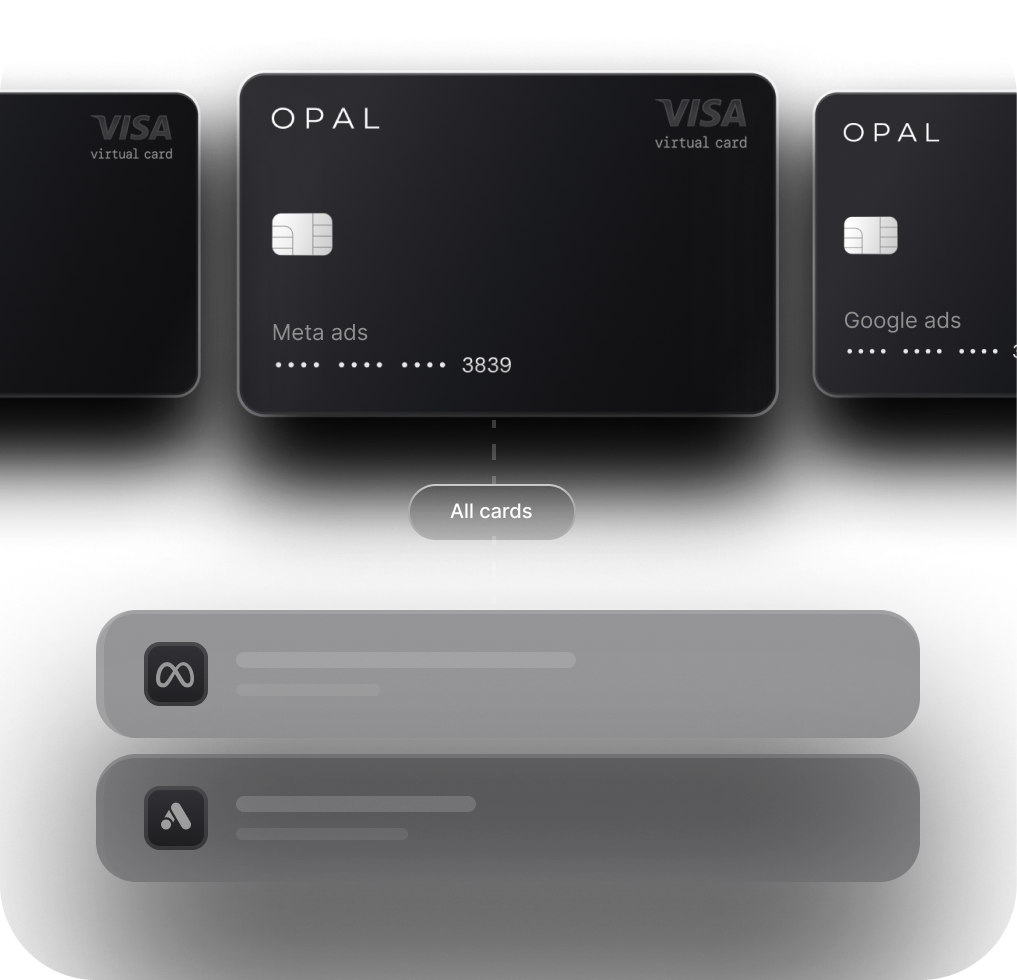
The correct infrastructure for a 50-client agency is one virtual card per client per platform, with each card isolated at the infrastructure level.
Here is what that means in practice:
-
Client A / Meta: dedicated virtual card, unique card number, tied only to Client A's Meta account
-
Client A / Google: separate virtual card, different number, tied only to Client A's Google account
-
Client B / Meta: its own card, completely isolated from Client A
-
Client B / TikTok: its own card, isolated from every other account
At 50 clients running three platforms each, that is up to 150 virtual cards. That sounds like it would be more complex to manage. In practice, it is far simpler, because every transaction has a clear origin. There is no attribution work. There is no shared-limit risk. A problem with one card affects exactly one client on one platform.
The key requirement is that these cards need to be issued from a single infrastructure, not 150 separate card applications. Unlimited virtual card issuance, instant provisioning, and centralized management are not optional features at this scale. They are the foundation.
For a deeper look at how to structure client budget separation before it becomes a dispute problem, see our guide on how to separate client ad budgets at your agency.
Billing Threshold Management at Scale
Understanding how each platform bills is not optional at 50 clients. The differences between Meta, Google, and TikTok are significant enough that a single card strategy will not work across all three.
How each platform's billing threshold works
Platform |
Billing trigger |
Threshold behavior |
Key risk at scale |
|---|---|---|---|
|
Meta |
Threshold-based |
Starts at $25, rises to $500 or $750 for established accounts |
Multiple accounts hitting thresholds simultaneously creates dense charge clusters |
|
|
Threshold + monthly |
Charges at threshold OR on the 1st of the month, whichever comes first |
Monthly billing date creates a predictable spike that can exhaust card limits overnight |
|
TikTok |
Prepaid or threshold |
Many accounts run on prepaid credit; threshold billing varies by account type |
Prepaid top-ups and threshold charges can hit the same card on the same day |
The practical implication: if you are running 50 clients across all three platforms, you will have days where 30-40 threshold charges hit within a few hours. If those charges are concentrated on one card, you have a limit exposure problem and a fraud signal problem at the same time.
Why a shared card looks like fraud to your issuer
Card issuers use velocity checks and merchant pattern analysis to detect fraud. A card that charges $847 at Meta, then $1,200 at Google, then $2,400 at TikTok, then $950 at Meta again, all within six hours, matches the behavioral profile of a stolen card being tested across multiple merchants. The Federal Trade Commission's guidance on card fraud detection outlines how issuers assess these patterns, and high-velocity multi-merchant activity is one of the clearest triggers.
The card issuer does not know you are a legitimate agency running 50 clients. It sees unusual multi-merchant velocity and responds accordingly. The result is a fraud hold that takes hours or days to resolve, during which every campaign on that card is paused.
How to structure payment methods so platforms see clean behavior
The solution is not to call your card issuer and explain the situation. The solution is to make the behavior look clean in the first place.
When each client has a dedicated virtual card on each platform, the charge pattern for any individual card looks like a single advertiser running normal campaigns. The threshold hits are predictable. The merchant pattern is consistent. There is no velocity anomaly because the card only touches one account on one platform.
The structural rule: one card, one account, one platform. Any deviation from this creates shared-limit risk, fraud exposure, or reconciliation complexity. At 50 clients, the cost of those deviations compounds every month.
For a detailed breakdown of how Meta, Google, and TikTok billing mechanics work and what agencies need to know before scaling, see our guide on ad platform billing mechanics for agencies.
Reconciliation at Volume
Reconciliation is where the shared-card problem becomes a dollar problem.
What manual reconciliation actually costs at 50 clients
Run the math on what you are paying for manual reconciliation today, and then project it forward.
At 50 clients running three platforms each, with an average of 30-50 billing events per client per month, you are processing between 1,500 and 2,500 transactions monthly. Each transaction needs to be matched to a client, a campaign, a platform, and a billing period. Threshold charges that span two campaigns need to be split. Partial charges need to be investigated. Adjustments and refunds need to be matched to their originating transactions.
A competent finance lead can process roughly 50-75 reconciliation line items per hour, assuming clean data. At 2,000 transactions per month, that is 27-40 hours of reconciliation work every single month. At a fully-loaded cost of $50-75 per hour for a finance role, that is $1,350-$3,000 per month in labor, dedicated entirely to matching transactions you already ran. According to QuickBooks' small business benchmarks, manual bookkeeping errors cost businesses an average of 5% of annual revenue in corrections and rework.
That is before you account for errors. Manual reconciliation at this volume produces errors. Those errors create billing disputes with clients, delays in financial reporting, and periodic audit work to find and fix discrepancies.
What clean data looks like versus the shared-card mess
The fundamental problem with shared-card reconciliation is that the data is dirty by design. Every transaction on a shared card requires a human decision: which client does this belong to? That decision takes time, introduces error risk, and cannot be automated.
Clean reconciliation data has a different structure entirely:
Every transaction is tagged to a specific virtual card
Every virtual card is mapped to a specific client and platform at issuance
Transaction-to-client attribution is automatic, not manual
The reconciliation step becomes verification, not investigation
When your card infrastructure is built correctly, a $3,200 Meta charge hits a card that is already labeled "Client B / Meta." The transaction flows into your accounting system pre-tagged. Your finance lead confirms it rather than researching it. The 40-hour monthly process becomes a 4-hour monthly process.
What automated reconciliation requires at the infrastructure level
Automated reconciliation is not a feature you add on top of a broken card setup. It requires the right foundation:
-
One virtual card per client per platform so every transaction has an unambiguous owner
-
Auto-sync between your card platform and your accounting system so transactions flow in real time, not as a month-end export
-
Consistent transaction tagging at the card level so your QuickBooks or accounting software receives pre-attributed data
-
Spend controls at the card level so you can set limits per client without manual oversight
Without all four, you are still doing manual work. With all four, reconciliation becomes a confirmation task rather than an investigation task.
For a step-by-step breakdown of how to set this up in QuickBooks, see our guide on how to automate ad spend reconciliation.
The Cash Flow Math at Scale
The operational problems above are serious. The cash flow problem is existential.
Most agencies operate on some version of net-30 or net-45 payment terms with their clients. Industry surveys from the Association of National Advertisers consistently show that extended payment terms are one of the top financial stressors for independent agencies, with float obligations frequently exceeding available credit. The agency runs the spend, the platforms charge the card, and the client pays the invoice 30-45 days later. At small scale, this float is manageable. At large scale, it becomes the single biggest constraint on agency growth.
The float calculation at $5M per month
Here is the math for an agency managing $5M per month in ad spend across 50 clients on net-45 terms:
-
Monthly spend: $5,000,000
-
Payment terms: Net-45
-
Float window: 45 days = 1.5 months of spend outstanding at any time
-
Capital required to float: $5,000,000 x 1.5 = $7,500,000
That is $7.5 million of client money sitting on your balance sheet at all times, funded by your card limit, your credit line, or your own cash reserves.
The growth trap: every new client you add increases the float requirement. Adding 10 clients at $100K/month each adds $1.5M to your float obligation. If your credit line does not scale with your book of business, you hit a ceiling. You cannot take on new clients because you do not have the card capacity to fund their spend while you wait for payment.
What this means for hiring and risk
The cash flow math creates two second-order problems that agency operators often underestimate.
Hiring constraints. Capital tied up in float cannot fund headcount. Growth stalls not from lack of clients, but lack of working capital.
Concentration risk. At $7.5M in outstanding float, a 10% disruption is a $750,000 problem. A late-paying client or a billing dispute that delays collections can create a liquidity gap fast.
What changes the math
The float problem does not go away entirely, but it changes significantly based on your card structure.
An agency with a credit line that scales with managed spend volume rather than cash deposits or personal financial position can take on more clients without hitting a capital ceiling. The credit limit grows as the book of business grows. Float is still a reality, but it is not a growth constraint.
The agencies that scale past 50 clients successfully are almost always the ones that solved the credit infrastructure problem before they needed to. Waiting until you are already capital-constrained means negotiating from a position of weakness.
What the Operational Stack Looks Like When It Works
Agencies that successfully manage 50+ clients without operational drag have a consistent infrastructure pattern. It is not complicated. It is just specific.
The components of a working stack
Virtual card infrastructure. Unlimited virtual cards, issued instantly, with unique card numbers per client per platform. Cards are named and tagged at creation so every transaction is pre-attributed. Spend limits are set at the card level, not managed manually. Cards can be paused or cancelled instantly without affecting any other account.
A credit line that scales with managed spend. The card infrastructure needs to be backed by a credit limit that grows with the book of business, not one that is capped by cash deposits or personal financial exposure. At 50 clients managing $5M/month, you need a credit line in the millions. That limit should scale automatically as your managed spend volume increases.
Auto-sync to ad platforms. When a card is provisioned and assigned to a client's platform account, the billing relationship is established cleanly. Threshold charges hit the right card. Platform re-verification events, which happen when billing information changes, are avoided because the card-to-account relationship is stable.
Accounting integration. Transactions sync automatically to QuickBooks or your accounting system of choice, pre-tagged by client and platform. Month-end reconciliation becomes a review process, not a research process.
Spend controls and visibility. Budget limits per card, real-time spend visibility across all clients, and instant notifications for declines or threshold hits. Your ops team sees the full picture without logging into 50 separate platform accounts.
Where Opal fits
Opal is built for exactly this stack. It provides unlimited free virtual cards, a credit line sized to your agency's managed spend volume (up to $10M, no personal guarantee, no hard credit check), auto-sync with Meta, Google, TikTok, and other major platforms, and a native QuickBooks integration that handles transaction tagging and reconciliation automatically. Agencies use Opal to provision one card per client per platform, set spend limits at the card level, and earn up to 2% cashback on ad spend run on Opal's credit line.
The setup takes a few minutes. The operational benefit compounds every month as client count grows.
For a detailed look at how the client card model works and why it changes the economics of agency ad spend, see our guide on the client-funded card model.
The Transition from 20 Clients to 50
Most agencies do not fix their infrastructure proactively. They fix it after something breaks.
When you are at 20 clients and the current setup is working, it is hard to justify rebuilding something that is not visibly broken yet. The problems in this guide feel theoretical until they are not.
The answer is straightforward: isolated virtual cards, a credit line that scales with managed spend, and automated reconciliation before the manual process becomes a bottleneck. None of these are complex changes. They just require making the decision before the operational pressure forces it.
The agencies that wait until 50 clients to solve the infrastructure problem are the ones that lose clients at 50 clients.
The ones that solve it at 20 or 30 are the ones that reach 100.