
How to Separate Client Ad Budgets at Your Agency (Before It Costs You a Client)


A client emails on a Tuesday afternoon asking for a spend breakdown by platform for Q1. Google, Meta, TikTok, Amazon. Simple enough request.
You open your card statement. There are 847 transactions. Every client you manage is on the same card. Client A's Google campaigns are three rows above Client B's Meta campaigns, which are two rows above Client C's TikTok spend. Nothing is labeled. Nothing is separated. It's all just... there.
What happens next is what this post is about.
You spend two hours pulling exports, cross-referencing campaign dashboards, and building a spreadsheet that approximates what you actually spent. You send it over with a note that says "let me know if you have questions." The client says thanks. But something shifted. They noticed it took you two hours to answer a basic question about their own money.
Most agencies don't lose clients over a single bad month of performance. They lose them over a slow accumulation of moments where the client stops feeling confident. An inability to produce clean spend reporting is one of those moments.
The fix isn't a better spreadsheet process. It's structural separation at the card level, from day one.
What "Commingling" Actually Means for Agencies
Commingling, in the agency context, means running ad spend for multiple clients through the same card or small set of cards. Client A and Client B's transactions are interleaved in the same statement, with no structural way to tell them apart beyond manually reading each line item.
It happens because it's the default. Most agencies start with one card. It works fine with one client. When the second client comes on, there's no obvious forcing function to create a new card. The same card gets used. Then the third client. Then the fifth.
By the time the problem becomes visible, it's already deeply embedded in your billing infrastructure.
Every ad platform has that card saved. Every campaign is charging to it. Restructuring feels like too much work, so it gets deferred. The agency grows. The statement gets longer. The risk compounds quietly until someone asks a question you can't answer cleanly.
The Four Ways Commingled Budgets Hurt Agencies
The operational pain is real, but the client-facing consequences are what actually put revenue at risk.
1. Billing Disputes Become Hard to Resolve
When a client questions a charge, "let me look into it" should take five minutes, not five hours. With a shared card, tracing a disputed transaction means manually scrolling through a combined statement, cross-referencing campaign dashboards, and reconstructing context from weeks ago.
The math might be right. You might be able to prove it. But the process of proving it is itself a problem. Clients notice when their agency has to dig to answer basic questions about their money.
For a deeper look at preventing these situations before they start, see how to eliminate ad spend disputes with clients before they happen.
2. Month-End Reconciliation Takes 10x Longer
Every transaction on a shared card has to be manually tagged to a client before it can be reconciled. At five clients and $100K/month in spend, that's manageable. At 20 clients and $500K/month, it's a part-time job.
The agencies that are most underwater on reconciliation aren't doing anything wrong operationally. They just never restructured their card setup as they grew.
That manual tagging work also introduces error risk. A misattributed transaction means a client gets billed for spend that wasn't theirs, or your books don't close cleanly. Both outcomes create problems downstream.
For agencies using QuickBooks, see how to automate ad spend reconciliation to understand what a structured card setup makes possible.
3. Client Offboarding Creates Liability
When a client leaves, you need to remove their payment method from every platform where it was saved. With a shared card, that's not straightforward. The card is also attached to other clients' campaigns. You can't just cancel it.
So the card stays active. The offboarded client's platforms may still have it saved. If a campaign runs after the relationship ends, you're paying for it. And if the card number was ever shared with the client for their own platform access, the exposure is even messier.
With dedicated virtual cards, offboarding is a single action: freeze the card the moment the relationship ends. No campaigns on other clients' accounts are affected. No platforms need to be updated before the card is locked. You close the loop in seconds, not days.
4. You Can't Show Clean Reporting in New Business Pitches
Prospective clients are increasingly asking operational questions during the pitch process: "How do you track our spend? Can we see reporting in real time? What happens to our budget if we leave?"
A shared card model has no good answers to any of these. You can describe your process, but you can't show them a clean, client-specific statement. You can't point to a dedicated card with their name on it. You're describing a workflow instead of demonstrating a system.
That gap costs agencies pitches they don't even know they lost.
What Proper Separation Looks Like
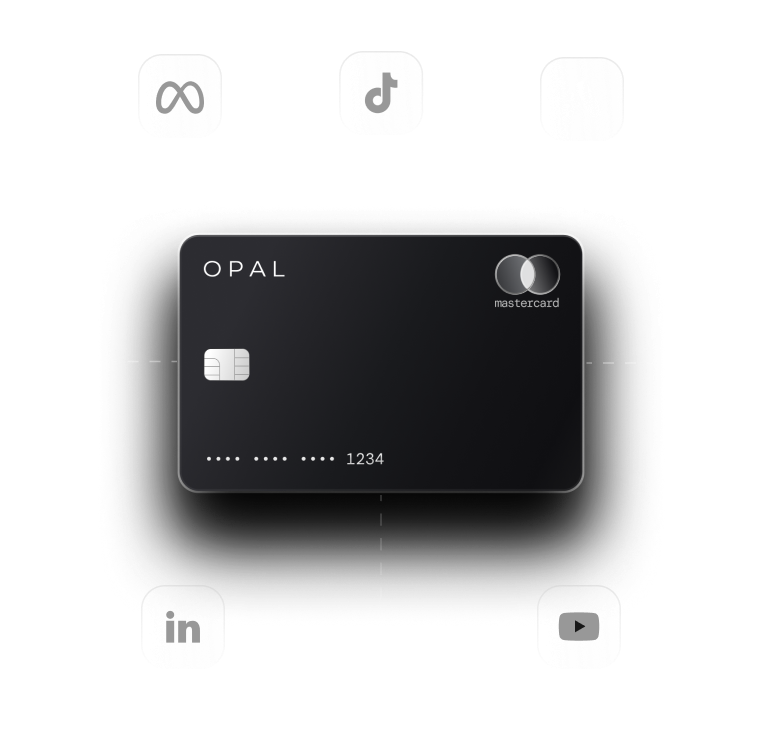
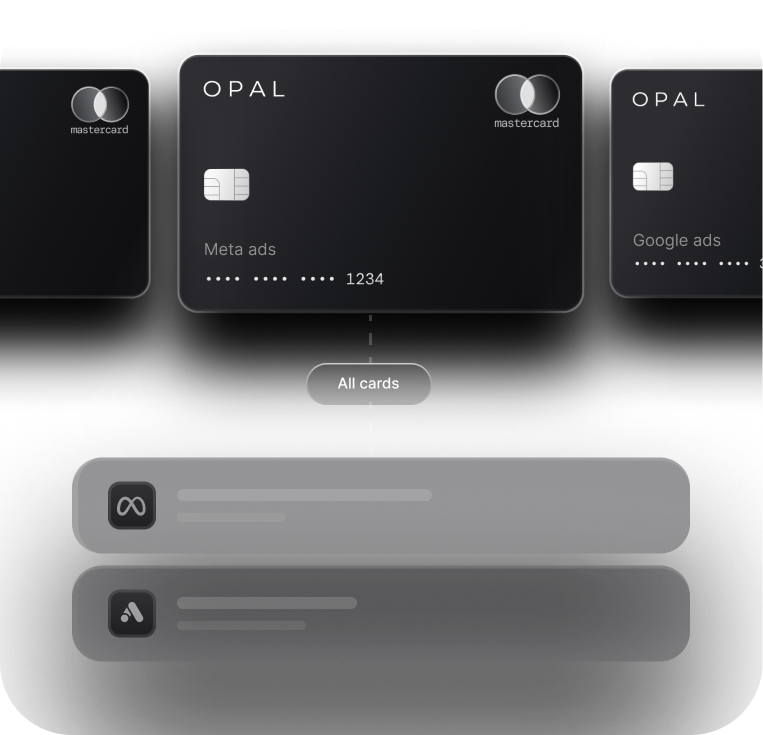
The model that solves this is straightforward: one dedicated virtual card per client, issued at the start of the engagement.
Each card is attached exclusively to that client's campaigns. Transactions on that card are, by definition, that client's spend. There's no tagging required. No manual attribution. Month-end reconciliation becomes a report pull, not a manual exercise.
For agencies running multiple platforms per client, you can go one level deeper: one card per client per platform. Client A gets a Google card and a Meta card. Client B gets the same. Every transaction is already sorted before you open a spreadsheet.
What this makes possible:
Spend limits set per card, enforced automatically. A client with a $30K/month budget can't accidentally go over it.
Real-time visibility into each client's spend, without logging into each ad platform separately.
Clean offboarding: when a client leaves, their card gets archived. No cross-contamination with other clients' campaigns.
Reconciliation that closes in minutes instead of hours.
The right infrastructure makes all of this the default, not the exception. For a full breakdown of how to structure cards across clients and platforms, see how agencies structure ad spend without card chaos.
If your clients are pre-funding their own budgets rather than being invoiced after the fact, the Client-Funded Card model takes this a step further by removing the agency's liability exposure entirely.
The New Business Angle Most Agencies Miss
Most agencies treat financial infrastructure as a back-office problem. The agencies winning new business are treating it as a front-office differentiator.
Consider what you can say in a pitch when your card structure is clean:
"Every client gets their own dedicated card. Your spend is completely isolated from our other clients. You can see your transactions in real time, and we can produce a clean report for any period in under 60 seconds."
That's not a feature. That's a trust signal. It answers the question prospective clients are asking but rarely say out loud: "How do I know my money is being managed carefully?"
Agencies that can demonstrate financial transparency in a pitch are selling something their competitors can't. Most competing agencies are running shared cards and hoping the client doesn't ask too many questions. When you can show structural separation, you're not just describing a process. You're proving it.
This is especially true when pitching clients who have been burned before. An agency that lost track of their spend, overbilled them, or couldn't produce clean reporting when the relationship ended. Those clients aren't just buying media management. They're buying proof that it won't happen again.
Financial transparency isn't an operational nicety. It's a competitive advantage.
How to Restructure If You're Already Commingled
If you're already running multiple clients on shared cards, the restructure is more straightforward than it feels. Here's the sequence:
-
Audit your current card setup. List every active card and identify which clients and platforms are attached to each. This gives you the full scope of what needs to change.
-
Issue a dedicated virtual card for each active client. With virtual cards, there's no waiting period. You can issue a new card in minutes.
-
Update payment methods on each ad platform. Log into Google Ads, Meta, TikTok, and any other platform for each client and swap the shared card for the new dedicated card. This typically takes five to ten minutes per platform.
-
Set spend limits on each new card that match the client's monthly budget. This prevents overruns going forward.
-
Archive the old shared card once all platforms have been updated. Don't cancel it immediately in case any pending charges need to clear, but stop adding it to new platforms.
The transition creates no campaign downtime. Virtual cards are active immediately, and platform payment method updates take effect on the next billing cycle.
The hardest part of this process isn't the technical steps. It's deciding to do it. Most agencies know their card structure is messy. The restructure gets deferred because it feels disruptive. In practice, it takes a few hours of focused work and eliminates a recurring problem that costs far more time every single month.
Frequently Asked Questions
Is it a legal requirement to separate client ad budgets?
No universal legal mandate exists, but commingling can create fiduciary or contractual issues depending on your client agreements. The real consequences are operational: disputes, misattributed charges, and eroded client confidence.
How do I explain the card structure to a client who asks?
Keep it simple: "We issue a dedicated card for your campaigns. Your spend is completely isolated from our other clients, which means we can give you a clean statement at any time and there's no risk of cross-billing." Most clients see this as a feature, not a complication.
What happens to a client's card when they offboard?
Freeze it immediately from your dashboard - one click, instant effect. No other client's campaigns are touched. Once any pending charges clear, archive the card entirely. Because it was dedicated to that client, there's zero cross-contamination risk.
Can I set a spend limit per client so they can't go over budget?
Yes. With virtual cards, you set a limit at the card level. Once it's reached, the card declines. Budget enforcement becomes automatic rather than something you monitor manually.
How many virtual cards do I actually need?
At minimum, one per client. One per client per platform gives you transaction-level clarity without manual attribution. Start with one per client and add platform-level cards as your reconciliation needs grow.
.webp)