

Best Ad Spend Card for Dental Offices Running Large Ad Spend
If you run a dental practice or manage advertising for a DSO, you already know that patient acquisition spend is not a small line item. A single-location practice in a competitive metro can spend $5,000 to $8,000 per month on Google Ads alone. A five-location DSO running separate campaigns per practice can clear $250,000 in annual ad spend before the end of Q2.
That's not a marketing budget. That's a financial infrastructure problem.
The card you put on file with Google, Meta, and Google Local Services Ads determines whether your billing is clean or chaotic, whether your cost-per-patient reporting is accurate or useless, and whether your personal assets are exposed or protected. Most dental practices and DSOs are using the wrong card for the volume they're running.
This guide is written for practice owners, office managers, and DSO finance directors who want to fix that.
TL;DR: Generic business cards (Amex, Chase Ink) are built for general business expenses. Dental ad spend is high-volume, multi-platform, and multi-location. The right card has high limits, no personal guarantee, virtual cards per location, and uncapped cashback on ad platforms specifically.
Why Dental Ad Spend Is Different
Most industries run one type of paid search campaign on one billing relationship. Dental is not most industries.
The CPC problem is real and it's getting worse
Dental keywords are among the most expensive in local search. According to LocaliQ's 2025 industry benchmark data, average CPCs for competitive dental keywords now run $8.50 to $15.75 in major markets. Implant and specialty procedure keywords like "dental implants near me" and "Invisalign provider" can hit $12 to $50+ per click. Emergency dental terms run $6 to $15 per click.
The math compounds fast. A practice running 500 clicks per month on implant keywords at a $30 average CPC is spending $15,000 on that campaign alone. Add general new patient acquisition, emergency terms, and a Meta retargeting campaign, and a single competitive urban practice can easily run $10,000 to $20,000 per month in total paid media.
Google Local Services Ads add a second billing layer
Most practices running Google Ads are also running Google Local Services Ads (LSAs). These are the "Google Guaranteed" listings at the very top of local search results. They are billed differently from standard search campaigns.
-
Standard Google Ads: Billed per click, charged to the card on file in your Google Ads account
-
Google Local Services Ads: Billed per lead (phone call or message), invoiced separately through the LSA platform with its own billing relationship
This means a single dental practice can have two separate payment relationships with Google, each requiring its own card and payment method. If you put the same card on both, you lose the ability to track LSA spend separately from search spend. If you put different cards on each, you need a card infrastructure that can support that separation cleanly.
Multi-location DSOs multiply every billing problem
A DSO running 10 locations ideally runs separate Google Ads campaigns per practice, with separate budgets, separate landing pages, and separate conversion tracking. That's the right way to do it.
The billing implication: you now need 10 separate payment methods, one per location, so spend is tracked at the practice level and not pooled across the organization. Without that separation, your cost-per-patient calculation for any individual location is guesswork.
Most DSOs don't have 10 separate cards. They have two or three shared cards, and their finance team spends hours each month trying to reverse-engineer which charges belong to which practice.
The Billing Problems Dental Practices Actually Hit
These are not hypothetical problems. They show up consistently when practices start scaling spend.
Card limits that don't match ad volume
A standard business credit card might carry a $25,000 to $50,000 limit. For a single-location practice spending $8,000 per month on ads, that feels fine. For a 10-location DSO spending $50,000 per location per month, that's $500,000 in monthly ad spend. A $50,000 card limit covers five days of billing.
When a card hits its limit mid-month, Google pauses campaigns automatically. You don't get a warning. Campaigns go dark, leads stop coming in, and the practice owner finds out when the phones go quiet.
Cross-contamination between locations
When multiple practice locations share a card, spend bleeds together. This is not just an accounting inconvenience. It means:
You cannot calculate cost per new patient by location
You cannot compare marketing efficiency across practices
You cannot identify which locations are overspending relative to their revenue
Offboarding a location from the DSO becomes a billing audit nightmare
Shared cards also create exposure: if one location's campaign triggers a fraud flag or payment dispute with Google, it can affect billing for every location using that card.
Personal guarantees that shouldn't exist at scale
Dental practice owners are accustomed to signing personal guarantees. Equipment loans, buildout financing, lease agreements. It's part of the industry.
But putting a personal guarantee on a card used for $500,000 per year in ad spend is a different risk profile entirely. If the practice hits a rough patch, if a DSO management structure changes, if a billing dispute with Google escalates, the personal guarantee means the owner's personal assets are on the line for charges that were always a business expense.
This is unnecessary. Purpose-built ad spend cards extend credit based on managed spend volume, not personal financial history. No personal guarantee required.
The reconciliation time sink
Even practices that have the right limits and the right card structure often don't have the right reporting. When ad spend, LSA spend, and Meta spend all hit the same card statement, the monthly reconciliation process is manual, slow, and error-prone.
For a DSO with 20 locations, this isn't a minor inefficiency. It's a full-time accounting problem. And it gets worse every time you add a location or a new ad platform. See how ad platform billing mechanics create reconciliation headaches at scale.
What to Look for in an Ad Spend Card for Dental
Not every card feature matters equally for dental. Here's what actually moves the needle.
Credit limits that scale with your practice count
The minimum viable limit for a dental ad spend card is roughly five times your monthly ad budget, with enough headroom to handle billing spikes and seasonal campaign increases.
Practice Structure |
Estimated Monthly Ad Spend |
Minimum Card Limit Needed |
|---|---|---|
Single location, competitive metro |
$8,000-$15,000 |
$75,000+ |
3-location DSO |
$30,000-$60,000 |
$250,000+ |
10-location DSO |
$100,000-$200,000 |
$750,000+ |
20+ location DSO |
$400,000+ |
$2M+ |
Generic business cards don't reach these limits. Purpose-built ad spend cards size credit based on managed spend volume, not the owner's personal credit profile.
Virtual cards per location (non-negotiable for DSOs)
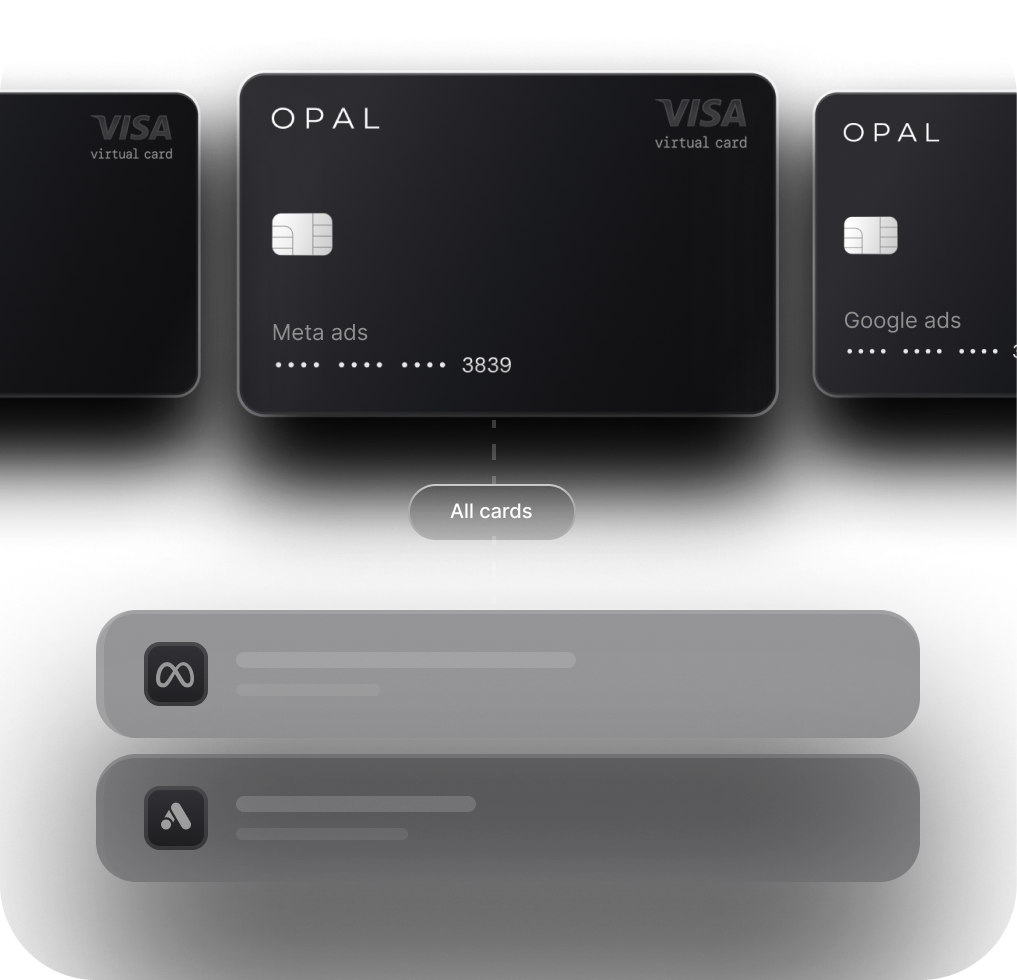
A virtual card is a unique card number that you create digitally and assign to a specific ad account or location. For a DSO, this means:
Each practice location gets its own virtual card number
That card is assigned to that location's Google Ads account, LSA account, and Meta account
All charges to that card are automatically attributable to that location
No manual tagging, no reverse-engineering at month-end
Virtual cards are also how you separate LSA billing from standard search billing for the same location. Two virtual cards, two billing relationships, clean separation. This is the right structure.
No personal guarantee
At the scale dental practices and DSOs operate, a personal guarantee on an ad spend card is unnecessary risk. Credit should be extended based on the practice's or organization's managed spend volume. If a card requires a personal guarantee as a condition of approval, it is not built for this use case.
Cashback on Google and Meta specifically
Many business cards offer rewards on travel, dining, or broad "advertising" categories with caps and restrictions. What dental practices actually need is uncapped cashback on the specific platforms where they spend: Google Ads, Google LSA, and Meta.
The cashback math is not trivial. A DSO spending $200,000 per month on ads can earn up to $48,000 per year at up to 2% cashback. That's a meaningful offset to patient acquisition costs, and it compounds as the organization grows.
Clean reconciliation that maps to practice-level P&L
The card infrastructure should produce spend data that flows directly into practice-level reporting. This means transaction-level data tagged by location, platform, and campaign type, not a flat statement of charges that requires manual sorting.
Generic Business Cards vs. Purpose-Built Ad Spend Cards
The two most common cards dental practices use for ad spend are the Amex Business Gold and the Chase Ink Business Preferred. Both are solid general business cards. Neither is designed for the way dental ad spend actually works.
Where Amex Business Gold breaks down
The Amex Business Gold offers 4x points on the two categories where you spend the most each month, which can include advertising purchases. The cap is $150,000 in combined eligible purchases per year.
A mid-size DSO running $50,000 per month in ad spend hits that $150,000 cap in three months. For the remaining nine months of the year, you earn 1x points on ad spend, not 4x. The headline rewards rate is effectively a fraction of what's advertised for any practice spending more than $12,500 per month.
There's also the limit issue. Amex Business Gold is a charge card with a "Pay Over Time" option, but the spending limit is set based on personal and business financial history, not on managed ad spend volume. A DSO with strong revenue but a complex ownership structure may not qualify for the limit it actually needs.
Where Chase Ink breaks down
The Chase Ink Business Preferred offers 3x points on advertising purchases up to $150,000 per year. Same cap problem as Amex. Beyond the cap, rewards drop to 1x.
Chase Ink is also a traditional credit card with a fixed credit limit. For a DSO, the limit is typically $25,000 to $50,000. That's a hard ceiling that doesn't flex with ad spend volume.
The comparison, side by side
Feature |
Amex Business Gold |
Chase Ink Preferred |
Purpose-Built Ad Spend Card |
|---|---|---|---|
Cashback/rewards on ad spend |
4x (capped at $150K/yr) |
3x (capped at $150K/yr) |
Up to 2% |
Credit limit |
Personal-history based |
$25K-$50K typical |
Up to $10M, spend-volume based |
Virtual cards per location |
Not supported |
Not supported |
Unlimited, free |
Personal guarantee |
Required |
Required |
Not required |
Reconciliation automation |
None |
None |
Platform-level sync |
LSA billing support |
Single card number |
Single card number |
Separate virtual cards |
The 4x and 3x rewards rates look compelling until you run the actual math at DSO scale. A DSO spending $600,000 per year on ads earns up to $12,000 in cashback at up to 2%. Under Amex Business Gold at 4x with the $150K cap, that same DSO earns 4x on $150,000 (worth roughly $6,000 in points at ~1 cent per point) and 1x on the remaining $450,000 (worth $4,500). Total: $10,500 in points, but redeemable only through Amex's travel and redemption ecosystem, not as direct cashback.
A card paying up to 2% cashback wins on simplicity and predictability, and can come out ahead on actual dollar value once you account for the cap.
For a deeper look at how generic cards fail at scale, see why general spend tools break down for high-volume ad spend.
How DSOs Should Structure Cards Across Multiple Locations
The card structure question gets more complex as a DSO grows. Here's how to think about it at different stages.
1 to 5 locations
At this scale, the goal is clean separation without complexity. One virtual card per location, assigned to that location's Google Ads account. A second virtual card per location for LSA billing if you're running both. Meta spend can share a card with Google search at this stage if needed, though separating them makes reporting cleaner.
Total virtual cards needed: 5 to 10. Manageable with any card platform that supports virtual card issuance.
5 to 20 locations
This is where shared cards become a serious liability. At 10 locations, the manual reconciliation burden of a shared card is significant. At 20, it's untenable.
The right structure at this scale:
One virtual card per location per platform (Google Ads, LSA, Meta)
Cards named by location and platform ("Practice 7 - Google Search," "Practice 7 - LSA")
Spend limits set per card to enforce location budgets automatically
All cards consolidated under one organization-level account for billing and reporting
This structure means your finance team can pull a report that shows, by location and by platform, exactly what was spent in any given period. No manual sorting required.
20+ locations and management company structures
At scale, DSOs often operate through a management company that runs advertising on behalf of individual practice owners. This introduces a structural question: who is the cardholder?
If the management company is running spend on behalf of individual practices, the card infrastructure needs to reflect that relationship. Each practice's ad spend should be tracked separately, with clear attribution, even if the management company is the entity making payments. This is the same challenge agencies face when running spend on behalf of clients, and the solution is the same: dedicated cards per client or location, with spend limits and reporting that maps to the underlying entity.
Key point for DSO finance directors: The card structure is not just a billing convenience. It's the foundation of your practice-level P&L. If your card infrastructure doesn't produce clean per-location spend data, your financial reporting is built on estimates.
Patient Acquisition ROI Tracking Starts With Your Card
The most important metric in dental marketing is cost per new patient. According to industry benchmarks, the average dental patient acquisition cost runs $150 to $350, with Google Ads delivering patients at $100 to $300 each depending on market and procedure type. For high-value procedures like implants or full-mouth reconstruction, the cost per booked case can reach $400 to $600, but a single case can justify months of spend.
Knowing your actual cost per new patient, by location and by procedure type, is what separates practices that optimize their ad spend from practices that just run campaigns and hope.
The card infrastructure is where this calculation either works or breaks.
Here's why: your cost per new patient calculation requires two inputs.
Total ad spend for a given location and campaign type
Number of new patients booked from that spend
If your card data doesn't cleanly attribute spend to a specific location, you can't complete the calculation. You end up with an aggregate number that tells you nothing actionable. You can't identify which location has a $90 cost per patient and which has a $400 cost per patient. You can't reallocate budget toward the higher-performing markets.
What clean card data enables
When each location has its own virtual card, your spend data automatically segments by practice. Combined with proper conversion tracking in Google Ads (call tracking, form submissions, appointment bookings), you can produce a report that shows:
-
Spend by location: What each practice spent on Google Ads, LSA, and Meta
-
Leads by location: How many calls and form fills each practice generated
-
Cost per lead by location: Which practices are efficient and which need attention
-
Cost per booked appointment: The number that actually drives business decisions
This reporting is what DSO finance directors and practice owners need to make informed budget decisions. It requires clean spend data at the source, and clean spend data at the source requires the right card structure.
Without it, you're making six-figure marketing decisions based on incomplete information.
Why Opal Works for Dental Practices and DSOs
Opal is an ad spend card built specifically for organizations running large, multi-platform advertising budgets. It extends credit directly to your practice or DSO based on managed spend volume, not personal financial history. No personal guarantee, no hard credit check, and setup takes about two minutes.
Credit limits scale up to $10M, sized to match the actual volume you're running. You can issue unlimited free virtual cards, assign them by location and platform, set spend limits per card, and pull transaction-level reporting that maps directly to your practice-level P&L. Cashback is up to 2% on eligible ad spend, including Google Ads, Google LSA, and Meta.
For a DSO managing advertising across 10 or more locations, this is the infrastructure that makes clean reporting possible. For a single-location practice that's tired of hitting card limits mid-month or signing personal guarantees for business expenses, it removes both problems in one application.
Apply for Opal or see how the card structure compares to what e-commerce brands use for high-volume ad spend.
Frequently Asked Questions
What is the best card for dental practice Google Ads?
A purpose-built ad spend card with high credit limits, no personal guarantee, and unlimited virtual cards is the best option for dental practices running significant Google Ads budgets. Generic business cards like Amex Business Gold and Chase Ink Preferred cap bonus category rewards at $150,000 per year and have fixed limits that don't scale with ad volume. For practices spending more than $10,000 per month on ads, a dedicated ad spend card with uncapped cashback and spend-volume-based credit limits will outperform a general business card on both rewards and reliability.
How do DSOs manage ad spend across multiple locations?
The most effective structure for DSOs is one virtual card per location per ad platform. Each practice location gets its own card number assigned to its Google Ads account, LSA account, and Meta account. Spend limits are set per card to enforce location budgets. All cards are consolidated under a single organizational account for billing and reporting. This structure eliminates cross-contamination between locations, enables accurate cost-per-patient calculations by practice, and makes month-end reconciliation straightforward.
Does Opal work for dental marketing agencies?
Yes. Dental marketing agencies running ad spend on behalf of multiple dental practice clients can use Opal the same way any marketing agency does: one virtual card per client, with spend limits and reporting that maps to each client's budget. Credit is extended to the agency based on total managed spend volume. There is no personal guarantee and no requirement to front client spend from the agency's own capital. See how agencies structure ad spend across clients for the full model.
Why does Google Local Services Ads billing need to be separated from standard Google Ads?
LSA billing is invoiced separately from standard Google Ads search campaigns, even within the same Google account. They are two distinct billing relationships. Putting both on the same card number makes it impossible to track LSA spend separately from search spend in your financial reporting. Using separate virtual cards for each billing relationship keeps the data clean and enables accurate platform-level spend reporting.
What credit limit does a dental practice need for ad spend?
As a general rule, your card limit should be at least five times your monthly ad budget to avoid hitting limits mid-month during billing cycles. A single-location practice spending $8,000 per month needs at least $40,000 to $75,000 in available credit. A 10-location DSO spending $500,000 per month needs a limit in the $2M to $3M range. Generic business cards typically max out at $25,000 to $50,000, which is insufficient for mid-size DSOs.