

How to Scale a Media Buying Agency Without Turning Into a Bank

Direct answer: Scaling paid media spend without fronting client money on personal credit comes down to one structural decision: your billing model. The three models that close the cash flow gap are advance billing, client cards on file, and a credit line sized to manage spend volume rather than personal credit history. Get the model right and every new client is net-zero on your working capital. Get it wrong and your credit ceiling becomes your growth ceiling.
This article covers billing model selection: the decision that determines whether you carry client money on your own balance sheet or route it through infrastructure built for the purpose.
Key Takeaways
-
The growth trap is financial, not operational. Most agencies hit a ceiling not because they lack clients or talent, but because their billing model requires more capital on the balance sheet every time managed spend increases.
-
Fronting ad spend is a choice, not a requirement. Three billing models close the cash flow gap without requiring clients to manage their own ad accounts.
-
The right card infrastructure lets the model scale. A credit line tied to managed spend volume, not a personal credit score, removes the ceiling.
-
Every new client should be net-zero on your working capital. If adding a client increases your personal financial exposure, the model is broken.
-
Cashback turns infrastructure into margin. At up to 2% cashback on eligible ad spend, the card generates returns on spend you were already running.spend you were already running.
Why Fronting Ad Spend Creates a Cash Flow Ceiling
Most people running paid media at scale assume the hard part is winning clients, managing more campaigns, or hiring the right people. Those are real challenges. The one that actually stops growth is almost always financial.
If you manage $500,000 a month across 20 clients on net-30 terms, you have roughly $500,000 of client money sitting on your own credit line at any given time. Add 10 more clients and that number climbs. Raise budgets and it climbs faster.
The growth trap: every incremental dollar of managed spend requires an incremental dollar of working capital to float it.
Why Patchwork Card Solutions Fail
The typical response is to open a second card when the first hits its limit, negotiate a higher personal credit line, or ask a partner to put spend on their card. The result: 5 to 10 cards across multiple accounts, each with its own billing cycle, limit, and reconciliation headache.
Three failure modes follow:
Problem |
What it looks like at scale |
|---|---|
|
Credit ceilings |
Card limits are based on personal credit, not managed spend volume. A $25K limit is gone in the first week of a $200K campaign. |
|
Reconciliation collapse |
Multiple cards across multiple owners means no clean attribution. Month-end becomes archaeology. |
|
Personal financial exposure |
Every new client increases the amount of spend sitting on your personal credit. One slow-paying client can create a personal cash crisis. |
The fix is not a bigger personal credit line. It is a different model entirely.
What Does Fronting Ad Spend Actually Mean for Agencies and Other High-Spend Teams?
Fronting ad spend means you pay the ad platforms with your own credit, invoice the client afterward, and wait to be reimbursed. The platforms get paid immediately. You get paid later, sometimes 30, 45, or 60 days later.
The gap between those two dates runs on your credit card, your credit line, or your own cash. You are, functionally, extending a short-term loan to every client on your roster every single month.
Why this feels normal: Most operations start this way because it is simple. There is a card, the card has a limit, and the limit covers early spend. It works at $50K a month. It starts to crack at $200K. It breaks at $500K and above.
The real cost is not just the interest or the float. It is the ceiling it puts on how fast you can grow. Every time a prospect wants to raise their budget, your first question becomes "do I have the card capacity for this?" instead of "is this the right client to take on?" That is the wrong question.
The Three Billing Models That Eliminate the Cash Flow Gap
Three billing structures take you out of the lender role. Each works. The right choice depends on client type, contract terms, and how much operational lift you can absorb.
Model 1: Advance Billing
Charge clients for the estimated month of ad spend before the month begins. You collect, then deploy. Your credit line never touches client ad spend because their money is already in your account.
This is the cleanest model operationally and gives you the most predictable cash position. The main friction is client acceptance: enterprise accounts with procurement processes often push back on paying before results are delivered. For those accounts, a deposit structure, typically one month of estimated spend held on account, gets you to the same place.
Model 2: Client Card on File
The client provides a card that funds their ad accounts directly. You manage the campaigns; billing goes to the client's card. You invoice separately for management fees, ideally in advance.
This removes the cash flow gap entirely. The client's money never touches your balance sheet. The tradeoff: card declines can pause campaigns without warning, and some clients resist sharing card details. A dedicated virtual card infrastructure isolates each client's spend on its own card, so one funding issue does not cascade across accounts.
Model 3: A scalable credit line tied to managed spend volume
You use your own card to fund ad spend, but the credit limit is tied to managed spend volume rather than personal credit history. As managed spend grows, the credit line grows with it. No personal guarantee. No hard credit check. No ceiling that caps growth at the owner's personal credit score.
Most high-volume operations land here because it preserves operational control while removing personal financial exposure. The credit line is purpose-built for ad spend, with limits up to $10M, and does not require a personal backstop on every dollar running through the account.
The goal of all three models is the same: client money funds client campaigns. Your credit infrastructure handles timing, not permanent financial exposure.
What Infrastructure Does a Scalable Paid Media Operation Actually Need?
Choosing the right billing model is the strategic call. Four infrastructure components make it work in practice.
One virtual card per client per platform
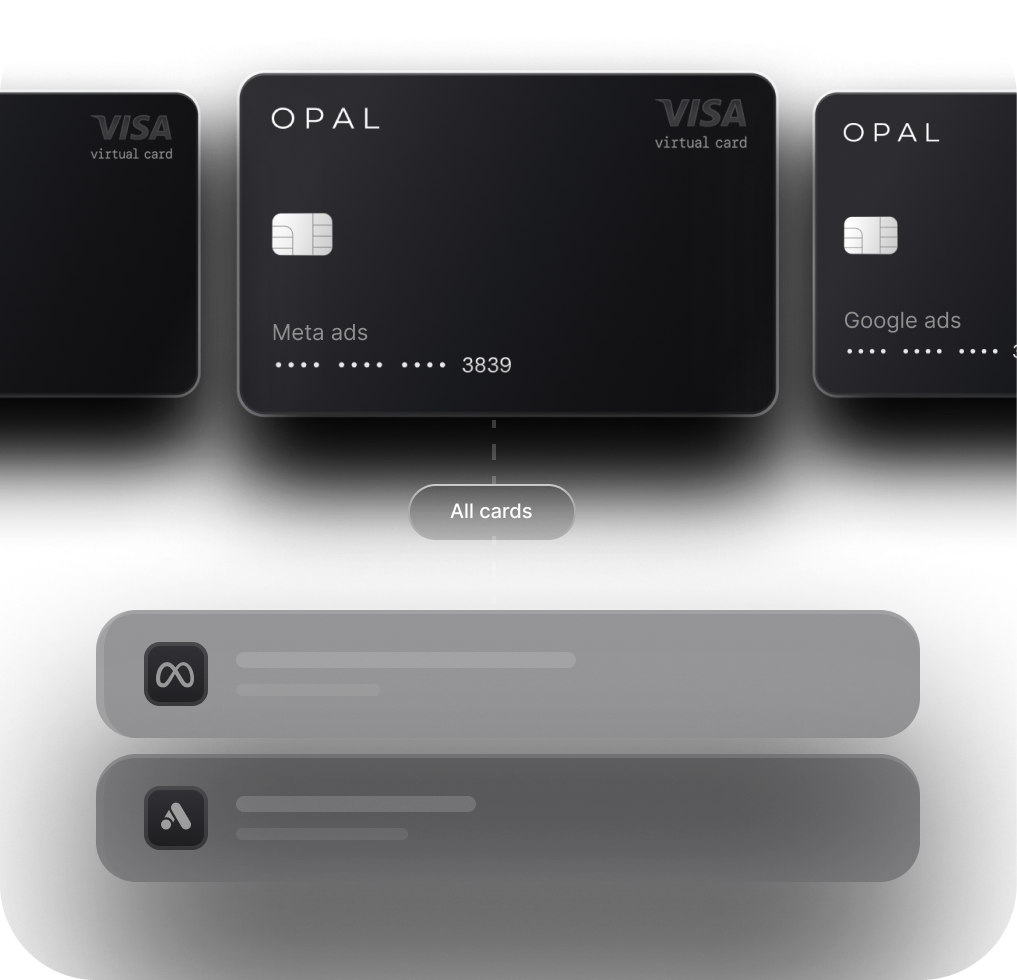
When every client's spend runs on its own dedicated virtual card, reconciliation becomes automatic. Every charge has an unambiguous owner. No manual sorting at month-end, no chasing transactions across five card statements, no risk of one client's decline affecting another's campaigns.
At 10 clients this is convenient. At 50 it is the difference between a functioning operation and a chaos machine. The 50-client guide covers this in detail, including the float math at different managed spend levels.
A Credit Line That Grows With Managed Spend
The credit line backing your agency's cards needs to scale with your book of business, not with your personal credit score. That means:
Limits that increase as managed spend increases
No personal guarantee required
No hard credit check
A ceiling high enough to handle growth without constant renegotiation
An operation moving from $500K to $2M in monthly managed spend needs credit infrastructure that can move with it. A card capped at $25K or tied to a personal FICO score cannot do that.
Automated Reconciliation
Every transaction should map to a client and a platform automatically, not through a month-end export and manual tagging process. When reconciliation is automated, your finance team's job becomes reviewing output rather than producing it. That is the difference between a two-hour close and a two-day close.
Spend Controls at the Card Level
Budget limits should be enforced at the card level before overspend happens, not caught in a reconciliation report after the fact. Setting hard limits per client per platform means campaigns stay on budget without requiring manual oversight across every account. This matters more as the number of clients grows, because manual oversight does not scale.
For agencies dealing with Meta and Google invoice billing, which kicks in automatically at higher spend thresholds, tools like Opal Ad Pay extend cash flow by up to 55 days by paying invoices on credit, so campaigns never pause over a payment timing issue. The paid search cash flow guide covers how to evaluate budget increases against payback periods when credit capacity is a constraint.
How Cashback Turns Ad Spend Infrastructure Into a Margin Engine
Most people treat their card as a cost center. It is a margin engine.
A card that earns up to 2% back on eligible ad spend generates margin on spend that was already leaving the account. Opal cashback figures reflect the maximum rate of 2%. Actual cashback depends on your approved rate.
Monthly managed spend |
Monthly cashback (up to 2%) |
Annual cashback (up to 2%) |
|---|---|---|
$100,000 |
Up to $2,000 |
Up to $24,000 |
$250,000 |
Up to $5,000 |
Up to $60,000 |
$500,000 |
Up to $10,000 |
Up to $120,000 |
$1,000,000 |
Up to $20,000 |
Up to $240,000 |
Figures reflect the maximum rate of up to 2% on eligible ad spend. Actual cashback depends on your approved rate.
At $500K a month, that is up to $120,000 a year in margin on spend you were running regardless. It does not require winning a new client, raising rates, or cutting costs.
As managed spend grows, cashback grows with it. The infrastructure that removes the cash flow ceiling also generates increasing returns as you scale. The agency ad spend cashback guide covers the full math across different spend levels.
The right card for this is purpose-built for ad spend: up to 2% cashback on eligible spend, credit limits that scale with managed spend volume, unlimited free virtual cards, no annual fee, and no personal guarantee. General business cards cap rewards, cap limits, and require personal backstops that become a liability as spend grows.
How to Get Started: A Five-Step Checklist
The model described above is not a long implementation project. Most operations can restructure their billing and card infrastructure in a single week. Here is the sequence.
-
Audit your current float exposure. Multiply your average monthly managed spend by your average payment terms in months. That number is the working capital you are currently floating on your own credit. If it exceeds your card limits, you already have a ceiling problem.
-
Choose your billing model. Advance billing is the cleanest. Client cards on file remove the gap entirely but require client cooperation. A card backed by a scalable credit line works for most operations and preserves operational control. Pick the one that fits your current client mix and contracts.
-
Issue one virtual card per client per platform. Provision dedicated virtual cards for each client across Meta, Google, TikTok, and any other platforms you manage. Set spend limits at the card level. This step alone eliminates reconciliation chaos.
-
Replace patchwork cards with a single scalable credit line. Consolidate onto a card built for ad spend, with limits tied to managed spend volume rather than personal credit. The credit line should grow as your book of business grows, without requiring a new application or personal backstop each time.
-
Track cashback as a margin line. Once your infrastructure is running on a purpose-built card, cashback should appear as a monthly revenue line in your reporting. At $500K a month in managed spend, that is up to $10,000 a month in margin on spend you were already running.
If you are hitting credit ceilings or watching working capital disappear into the float, the infrastructure fix is straightforward. Apply for Opal to get a credit line sized to your managed spend, unlimited free virtual cards, and up to 2% cashback on eligible ad spend, with no personal guarantee and no hard credit check. Application takes two to three minutes.
Frequently Asked Questions
What is the cash flow gap in a media buying operation?
The cash flow gap is the time between when an agency pays ad platforms on behalf of clients and when it receives reimbursement from those clients. On net-30 terms, an agency managing $500K a month has roughly $500,000 of client money tied up in that gap at any given time, funded by its own credit or cash reserves.
How do I stop fronting ad spend for clients or accounts?
The most practical approach is advance billing, where spend is collected before the month begins, or a card infrastructure where funds flow through dedicated virtual cards rather than your own credit. A purpose-built card with a credit line tied to managed spend volume, rather than personal credit, handles the timing gap without creating permanent financial exposure.
What credit limit does a media buying operation actually need?
It depends on managed spend volume and billing terms. Running $1M a month on net-30 terms means you need at least $1M in available credit to operate without constraint. Traditional business cards cap out well below this. Purpose-built ad spend cards like Opal offer limits up to $10M, scaled to actual managed spend, with no personal guarantee required.
Can I earn cashback on ad spend I manage for others?
Yes. If the card running ad spend earns up to 2% cashback on eligible spend with no cap, that cashback accrues to you regardless of which account or campaign generated it. On $500K a month in managed spend, that return compounds on spend that was leaving the account anyway.
What happens when Meta or Google moves a high-spend account to invoice billing?
Ad platforms automatically shift accounts spending above certain thresholds from card billing to invoice billing. When that happens, the agency receives an invoice rather than a card charge. Tools like Opal Ad Pay automatically detect those invoices and pay them on credit, extending cash flow by up to 55 days so campaigns are never paused over a payment timing issue.
Is a personal guarantee required for ad spend cards?
Not with purpose-built ad spend cards. Traditional business cards and general-purpose corporate cards typically require a personal guarantee, which ties your personal credit to every dollar running through the account. Cards built specifically for high-volume ad spend, like Opal, extend credit based on managed spend volume and cash flow, with no personal guarantee and no hard credit check.a