




Paid Search Is Getting More Expensive: How to Protect Marketing Cash Flow When Google Ads CPCs Rise

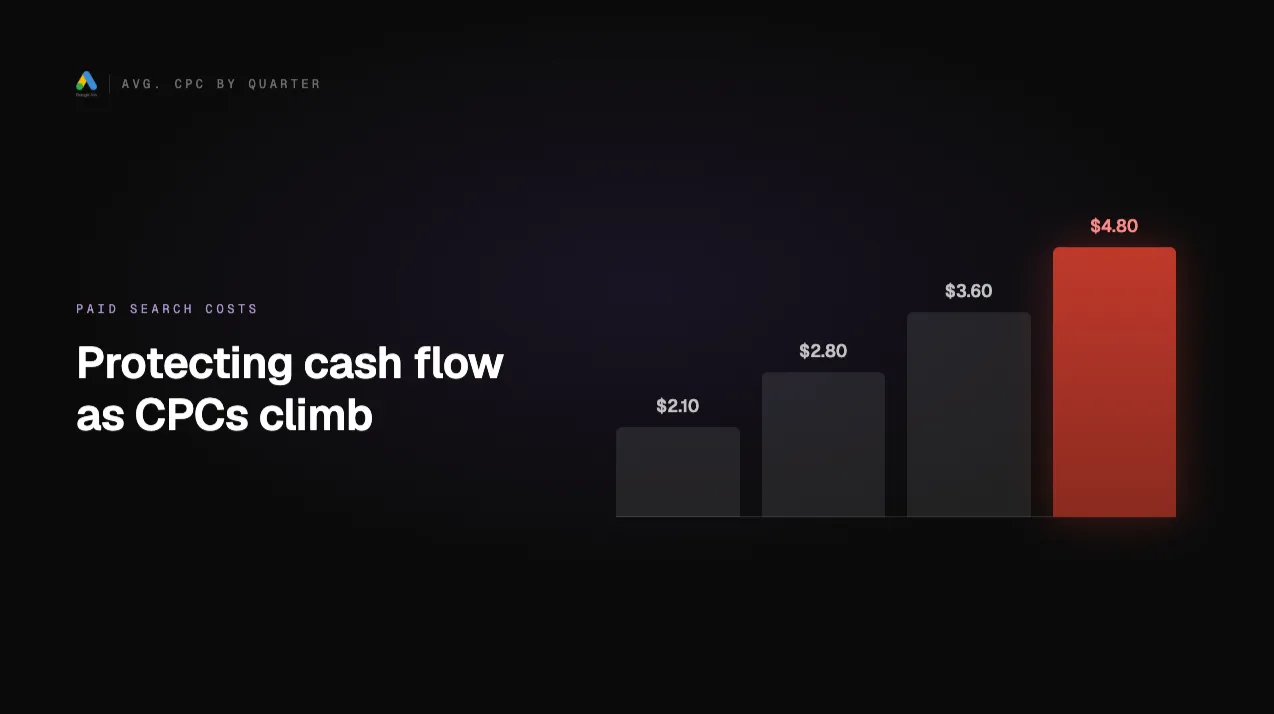
Paid search budgets are rising. The auction pool is shrinking. And the structural reasons behind both trends are not going away.
Tinuiti's Q2 2026 Digital Ads Benchmark Report shows Google paid-search spend up nearly 14% year over year, while click growth came in at 13% and average CPC increased just 1%. On the surface, that looks manageable. But a separate analysis of 21,425 Google Ads accounts by Optmyzr found that available impressions fell 11% year over year, from 45.9 billion to 40.25 billion, meaning advertisers are competing for a meaningfully smaller auction pool. A major structural driver: Google AI Overviews cut organic CTR by 61% on affected queries between mid-2024 and late 2025, according to Seer Interactive's study of 25 million impressions across 42 organizations. Brands that previously captured traffic organically are now bidding for it.
The result is a market where more advertiser dollars are chasing fewer available clicks. For most teams, this registers as a media-buying problem. But there is a second problem that gets less attention, and it is operational. When CPCs rise, more cash leaves your account before a single conversion happens. Payback periods stretch. Working capital tightens. And teams that lack visibility into spend-to-return ratios often make reactive cuts to exactly the campaigns they should be protecting.
The direct answer: When Google Ads CPCs rise, the right response is not just to optimize campaigns. It is to treat paid search as a capital-allocation decision. That means reviewing spend against payback periods, separating budget by campaign objective, and ensuring marketing and finance are operating from the same visibility window. Efficiency tactics help at the margin. Operational discipline protects the business.
This piece is for growth leaders, finance teams, and operators who need to think about paid search as both a marketing decision and a capital-allocation decision. The goal is not to discourage investment in paid search. It is to help teams invest in it more deliberately.
Key Takeaways
The available Google Ads auction pool shrank 11% year over year through Q1 2026, even as spend kept rising. More dollars are chasing fewer clicks, and the structural pressure is not easing.
The most common mistake under CPC pressure is cutting high-intent, bottom-funnel campaigns alongside inefficient prospecting spend. Those are not the same problem.
Separating budgets by objective (brand defense, demand capture, testing, expansion) makes it possible to pause one category without disrupting another.
ROAS alone does not capture when revenue is actually received. Payback period is the metric that connects paid-search performance to cash flow.
Marketing and finance need to operate from the same visibility window. When they do not, budget decisions default to whoever has the most recent data, which is rarely the full picture.
Short-term funding flexibility (extended billing cycles, card rewards, deferred settlement) can be a legitimate lever for proven campaigns during constrained periods. It is not a fix for underperforming spend.
Why Rising CPCs Are a Cash Flow Problem, Not Just a Campaign Problem
Most paid-search discussions focus on efficiency metrics: cost per acquisition, return on ad spend, impression share. These matter. But they do not tell the full story of what rising CPCs do to a business's financial position.
More cash committed before any return
When CPCs increase, you spend more to generate the same volume of qualified traffic. That spend is charged to your card or account before a visitor converts, before a deal closes, and before revenue is recognized. For businesses with longer sales cycles or slower cash conversion, the gap between outlay and return can stretch across weeks or months. WordStream's Q1 2026 benchmark across 20+ industries found the cross-industry average Search CPC rose 12% year over year to $2.96, the steepest annual increase since 2021. In high-competition verticals like legal, B2B software, and financial services, the increases were considerably sharper.
A team spending $150,000 per month on paid search with a 45-day payback window is carrying roughly $225,000 in unrecovered spend at any given time. If CPCs rise 20% and volume holds flat, that unrecovered balance grows to $270,000. The campaign metrics may look identical. The cash position does not.
Reactive cuts to the wrong campaigns
The second consequence is behavioral. When budgets tighten under CPC pressure, teams often pause or reduce spend across the board rather than making surgical decisions. High-intent, bottom-funnel campaigns, the ones most likely to convert and recover their cost quickly, get cut alongside inefficient prospecting campaigns that deserve scrutiny.
This is a predictable outcome when marketing and finance are working from different visibility windows. Finance sees total spend. Marketing sees ROAS. Neither team is looking at payback period by campaign type, which means the cuts tend to be blunt.
The risk is not overspending. It is misallocating the cuts when pressure arrives.
Warning Signs That Paid-Search Spend Is Outpacing Return
Before adjusting strategy, it helps to know whether CPC pressure is already affecting your financial position. These are the signals worth watching:
-
Spend is growing faster than conversions, revenue, or pipeline. If your paid-search budget increased 20% quarter over quarter but attributed revenue grew 8%, the efficiency gap is widening.
-
CPCs are rising without a corresponding lift in conversion rate or average order value. Higher cost-per-click only makes sense if something downstream improved. If it did not, you are paying more for the same outcome.
-
Branded and non-branded search are being evaluated together. Brand defense campaigns and demand-capture campaigns serve different purposes and carry different cost structures. Mixing them into a single ROAS or CPA target obscures where the real pressure is coming from.
-
Campaign-level overspend is discovered after the month closes. If budget variances surface in the monthly finance review rather than in real time, your controls are lagging your spend.
-
Marketing and finance are using different reporting or different targets. When the two teams cannot agree on what success looks like, budget decisions default to whoever has the most recent data, which is rarely a complete picture.
Any one of these signals is worth investigating. More than two appearing at the same time usually points to a structural gap in how paid-search decisions are being made and monitored.
Practical Ways to Protect Cash Flow Without Pulling Back on Growth
The goal is not to spend less. It is to spend with more precision and more visibility. Several operational changes can help teams hold their position in paid search while managing cash exposure more deliberately.
Set campaign-level guardrails, not just account-level budgets
Daily budget caps at the campaign level are one of the most underused controls in Google Ads. They prevent any single campaign from consuming a disproportionate share of monthly budget during high-traffic periods, which is especially relevant when automated bidding strategies are active and spending patterns are harder to predict. Pair these caps with an internal approval workflow: requiring sign-off from a finance lead for any increase above 25% of a campaign's current monthly budget adds a checkpoint without creating meaningful friction.
Separate budget ownership by campaign objective
Not all paid-search spend serves the same purpose. Treating it as a single pool makes it harder to evaluate performance and harder to make targeted cuts when needed. Consider organizing budgets around four distinct objectives:
Objective |
Purpose |
Evaluation metric |
|---|---|---|
Brand defense |
Protect branded queries from competitors |
Cost, impression share |
Demand capture |
Convert high-intent, non-branded searches |
CPA, payback period |
Testing |
Validate new keywords, audiences, or formats |
Cost per learning |
Expansion |
Scale into new markets or segments |
Revenue attribution |
Separating these buckets makes it possible to pause or reduce one category without disrupting another, and makes the conversation between marketing and finance significantly more productive.
Measure against payback period, not ROAS alone
ROAS is a useful signal, but it does not account for when revenue is actually received. A campaign generating 4x ROAS on a 90-day sales cycle looks very different from a campaign generating 3x ROAS with a 14-day cash conversion cycle, especially when working capital is constrained. Adding payback period as a standard reporting metric gives finance teams the context they need to evaluate paid-search investment the same way they would evaluate any other capital deployment.
Protect a dedicated test budget
When budgets tighten, test spend is usually the first to go. The problem is that pausing all experimentation during a difficult period means missing the opportunities that tend to surface when competitors are pulling back. Maintaining a fixed, intentional test budget preserves the ability to validate new channels or audience segments without requiring a full budget review each time. Modern spend-management tools can help teams apply these controls at the campaign level, consolidate visibility across channels, and manage payment timing in ways that reduce month-end surprises.
When Short-Term Funding Flexibility Is Worth Considering
There are situations where the right response to CPC pressure is not to reduce spend, but to find a way to sustain it through a constrained period without compromising working capital. Funding flexibility, in the form of extended billing cycles, charge cards with deferred settlement, or cashback that offsets net spend, can be a legitimate tool in those situations.
A few scenarios where this tends to apply:
-
High-intent seasonal demand. If your business has a predictable peak period and paid search is a proven driver of revenue during that window, maintaining or increasing spend during that window can be worth financing. The key is that the demand signal is real and the campaign performance is already validated.
-
Proven campaigns temporarily constrained by cash timing. A campaign with a consistent, documented cost-per-acquisition that is temporarily paused because of a cash flow gap is a different situation than a campaign that has never demonstrated clear return. Funding the former can make sense. Funding the latter to buy time rarely does.
-
Payment timing that creates a cash management advantage. Depending on how your card billing cycles align with your revenue recognition cycle, there may be legitimate opportunities to improve your net cash position through payment timing, card rewards, or both.
The important distinction is that funding flexibility should support disciplined, measured growth. It is not a substitute for fixing inefficient campaigns or a way to defer hard decisions about spend allocation. Teams that use short-term financing to sustain campaigns they already know are underperforming tend to arrive at the same decision point with a larger problem.
Questions to Ask Before Increasing Paid-Search Spend
Before approving a budget increase in a rising-CPC environment, run through this checklist. It is not a gate designed to slow decisions down. It is a prompt to make sure the decision is being made with the right information.
What is the current CPA or cost per qualified lead for this campaign, and how has it trended over the last 60 to 90 days?
What is the estimated payback period for this campaign, given our average sales cycle and current conversion rate?
Is spend in this campaign growing faster than attributed conversions, revenue, or pipeline?
Have we separated branded and non-branded performance before making this evaluation?
Do we have a campaign-level daily budget cap in place to prevent unintended overspend?
Does our current cash position support the additional outlay through the expected payback window?
Is this a proven campaign we are scaling, or a new hypothesis we are testing? (The answer changes how much we should commit.)
Are marketing and finance aligned on what success looks like for this increase?
What is the plan if performance does not improve within 30 days?
If several of these questions do not have clear answers, that is useful information. It usually means the decision is being driven by urgency rather than evidence.
A Framework for Finance and Growth Teams to Operate From the Same Page
The most durable way to manage paid-search spend in a rising-CPC environment is to establish a shared operating framework between marketing and finance before the pressure arrives. Teams that build this infrastructure proactively are in a much better position to make fast, confident decisions when conditions shift.
The four variables to review together
Paid-search decisions should be evaluated against four variables simultaneously, not in isolation:
-
Current spend and trend. Where is spend relative to plan, and is it accelerating?
-
Pipeline or revenue attribution. What is paid search actually delivering, and over what time horizon?
-
Payback period. How long does it take for each dollar of paid-search spend to return as cash?
-
Available working capital. Can the business sustain the current spend level through the expected payback window without creating a cash constraint elsewhere?
Shared thresholds for scaling, pausing, and testing
Establish clear, agreed-upon thresholds in advance:
-
Scale when CPA is within target, payback period is acceptable, and working capital supports the increase.
-
Pause or reduce when spend is growing faster than pipeline and there is no near-term catalyst to explain the gap.
-
Maintain test budget regardless of overall budget pressure, with a fixed ceiling that does not require re-approval each cycle.
Paid search as capital allocation
The shift in framing matters. Paid search is not a marketing expense to be managed in isolation. It is a form of capital deployment with a return profile, a risk profile, and a cash flow implication. Teams that treat it that way tend to make better decisions under pressure, and tend to have more productive conversations between growth and finance when the numbers are not moving in the right direction.
CPC pressure is not going away. The advertisers who navigate it best will be the ones who have built the operational infrastructure to respond with precision rather than panic.
Frequently Asked Questions
Why are Google Ads CPCs rising in 2026?
Google Ads CPCs are rising because of three converging structural pressures. First, the available auction pool is shrinking: Optmyzr's analysis of 21,425 accounts found impressions fell 11% year over year through Q1 2026. Second, Google AI Overviews compressed organic CTR by 61% on affected queries, pushing brands that previously relied on organic traffic into paid auctions. Third, Performance Max campaigns, which now represent 35% of total Google Ads spend, compete across multiple inventory types simultaneously, inflating prices across channels. The result: cross-industry average Search CPC rose 12% year over year to $2.96 in Q1 2026, the steepest annual increase since 2021.
How do rising CPCs affect marketing cash flow?
When CPCs rise, more cash is committed upfront before any conversion happens. A team spending $150,000 per month with a 45-day payback window is already carrying roughly $225,000 in unrecovered spend at any given time. If CPCs climb 12%, as WordStream's Q1 2026 cross-industry benchmark found, and volume holds flat, that unrecovered balance grows proportionally. Campaign efficiency metrics like ROAS may look unchanged while the underlying cash position deteriorates. This is why rising CPCs are a working-capital problem, not just a media-buying problem.
What is payback period and why does it matter more than ROAS for paid search?
Payback period is the time it takes for a dollar of paid-search spend to return as collected revenue. ROAS measures the ratio of attributed revenue to spend, but it does not account for when that revenue actually arrives. A campaign generating 4x ROAS on a 90-day sales cycle ties up significantly more working capital than a campaign generating 3x ROAS with a 14-day cash conversion cycle. For teams managing cash flow, payback period is the more operationally relevant metric because it connects campaign performance directly to liquidity.
Should you cut paid-search spend when CPCs rise?
Not automatically. The more important question is which campaigns to evaluate. High-intent, bottom-funnel campaigns with documented conversion rates and short payback periods should be protected even under budget pressure. Inefficient prospecting campaigns with no clear return signal are the better candidates for reduction. Cutting spend across the board without separating campaigns by objective is a common mistake that can damage revenue pipeline while failing to address the actual efficiency problem.
How can marketing and finance teams align on paid-search budget decisions?
The most effective approach is to establish shared thresholds before pressure arrives. Both teams should review four variables together: current spend and trend, pipeline or revenue attribution, payback period by campaign type, and available working capital. Agreeing in advance on when to scale (CPA within target, payback acceptable, capital available), when to pause (spend growing faster than pipeline with no near-term catalyst), and how much to reserve for testing removes the friction that typically slows decisions when conditions shift quickly.