

Meta Advantage+ and Google AI Max Are Breaking Agency Cash Flow. Here's the Infrastructure Fix.

Meta Advantage+ and Google AI Max do not break your campaigns. They break your billing infrastructure.
Both products are engineered to consume budgets faster, less predictably, and across more inventory types than manual campaigns ever did. If your agency still manages spend through shared cards or monthly budget conversations with clients, you are carrying financial exposure you cannot see until it has already happened.
The fix is not a campaign setting. It is a payment infrastructure layer that enforces hard spending ceilings the AI cannot override.
Advantage+ has a $75 billion annual revenue run rate as of Q2 2026. Google is auto-upgrading all Dynamic Search Ad campaigns to AI Max starting September 2026. For advertisers running their own money, that scale is a performance story. For agencies running client money, it is a cash flow problem most billing infrastructure was never designed to handle.
Key Takeaways
-
Meta Advantage+ reached a $75 billion annual revenue run rate in Q2 2026, driven by its set-it-and-forget-it model that hands budget control to Meta's AI.
-
Google AI Max has pushed client search budgets up 7-15% year over year, with some agencies reporting CPC increases as high as 25%, according to Digiday's reporting on four media buyers.
A March 2026 Google pacing change means ad-scheduled campaigns can now spend up to 38% more per month than their stated daily budget without any manual changes on your end.
AI-automated campaigns do not respect the mental budget models agencies use in client conversations. They respect the card limit on file.
Campaign-level settings (daily caps, ad scheduling, audience exclusions) reduce overspend risk but cannot enforce a hard ceiling. Only the payment method can do that.
Per-client virtual cards with fixed spending limits are the infrastructure layer that makes AI-automated spend safe to run at agency scale.
What Makes AI-Automated Campaigns Different From Manual Buying?
Manual campaigns give you control in exchange for efficiency. You set a daily budget, a bid strategy, and a targeting scope. The platform spends within those parameters. Overspend is possible but bounded.
AI-automated campaigns invert that tradeoff. You give up control in exchange for efficiency. The algorithm decides where, when, and how aggressively to spend. It expands audiences, tests placements, and reallocates budget in real time based on signals you cannot fully see.
That is the performance pitch.
The billing reality: the AI's spend decisions happen faster than any approval workflow can catch them.
Meta Advantage+: the "opt out" toggle is gone
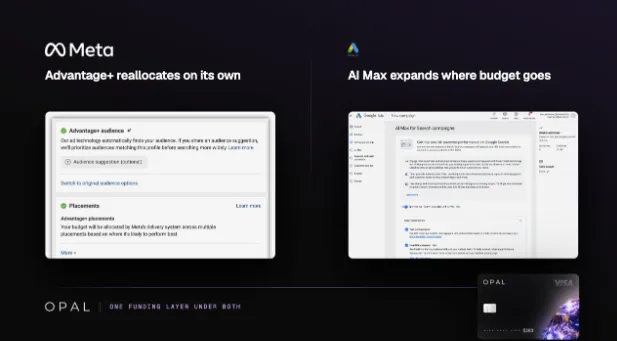
Meta Advantage+ is now the default buying mode for Facebook and Instagram. In 2026, the opt-out toggle for several manual controls was removed entirely. The system takes a budget and a goal, then decides everything else: audience, placement, creative variation, and pacing.
Pacing is where agencies feel the financial impact first. Advantage+ does not spend evenly across a month. It accelerates when its models predict high conversion probability.
That means a campaign allocated $10,000 for the month can consume $4,000 in a single high-traffic weekend. That acceleration also interacts directly with Meta's billing threshold system, which fires multiple card charges per day when spend runs hot.
If your agency funded that campaign from a shared card or a pooled account, that weekend draw affects every other client's available balance simultaneously.
Google AI Max: budget pacing changed in March 2026
Google AI Max for Search is designed to expand your keyword reach into query space you were not previously bidding on. That is the conversion upside. The cash flow downside is that it consistently pushes budgets higher.
Digiday's reporting found that agencies running AI Max saw client search budgets grow 7-15% year over year. CPC increases ranged from 10% to 25% depending on the vertical.
The bigger structural change happened in March 2026.
On March 1, Google rewrote how budget pacing works for campaigns using ad scheduling. The daily and monthly caps did not change. What changed: campaigns now pace proactively toward the full 30.4x monthly cap within whatever schedule is set, regardless of how many days that schedule actually runs. An analysis found that a standard Monday-Friday campaign could see up to 38% additional monthly spend with no account changes at all.
The implication for agencies: A client approved a $15,000 monthly budget in January. By March, the same campaign settings can legally spend $20,700 on that card without a single approval.
Why Does This Create a Specific Problem for Agencies?
Individual advertisers running their own money absorb overspend directly. They see the charge, they adjust, they move on.
Agencies running client money have a different exposure profile. Three things make AI-automated spend structurally riskier at the agency level:
1. You are fronting money that is not yours. Most agencies put client campaigns on agency cards and reconcile later. When an Advantage+ campaign front-loads a weekend spend burst, that charge hits your card before the client has been invoiced and before anyone has noticed. The agency carries the float.
2. Shared cards create shared risk. If five clients run on the same agency card, a pacing spike from one Advantage+ campaign affects the available balance for all of them. A single unexpected draw can trigger a decline on a different client's Google campaign mid-flight. That is the core argument for separating client ad budgets at the card level before AI-automated campaigns scale up.
3. Approval workflows are designed for manual budgets. The standard process: client approves a monthly budget, agency buys media, agency invoices at month-end. That model was built around predictable spend. AI-automated campaigns do not operate on that cadence. By the time the invoice is generated, the spend has already happened, often in amounts the client never explicitly authorized.
The result is a gap between what clients approved and what agencies spent — and a billing dispute waiting to happen. Eliminating those disputes requires the same structural fix: per-client cards with hard limits, not better reconciliation after the fact.
Can Campaign Settings Fix This?
Partially. There are real controls worth using inside both platforms.
Platform |
Control |
What it does |
What it cannot do |
|---|---|---|---|
Meta Advantage+ |
Daily budget cap |
Limits single-day spend |
Does not prevent pacing surges across a billing cycle |
Meta Advantage+ |
Automated pause rule (90% of daily budget) |
Sends alert or pauses campaign |
Requires manual monitoring; does not enforce a hard monthly ceiling |
Google AI Max |
Campaign total budget (3-90 day) |
Sets a fixed ceiling for a defined period |
Only available on new campaigns; cannot be retrofitted |
Google AI Max |
Daily budget reset to monthly ÷ 30.4 |
Corrects for pacing rewrite |
Requires recalculating every ad-scheduled campaign in your portfolio |
These controls reduce overspend risk. They do not eliminate it. And they do not protect against the underlying structural problem: the card on file has no ceiling.
A campaign-level daily cap set at $500 still allows the platform to charge $1,000 on a high-traffic day. That is Google's standard 2x overdelivery allowance. An automated pause rule only fires if someone is watching. A total budget cap requires creating a new campaign, not adjusting an existing one.
The hard ceiling only exists at the payment layer. If the card on file has a $20,000 limit, that is the actual maximum the platform can charge, regardless of what the campaign settings say. Everything above that is declined.
Payment infrastructure is where the AI's spend decisions either stop or don't.
What Does the Right Infrastructure Look Like?
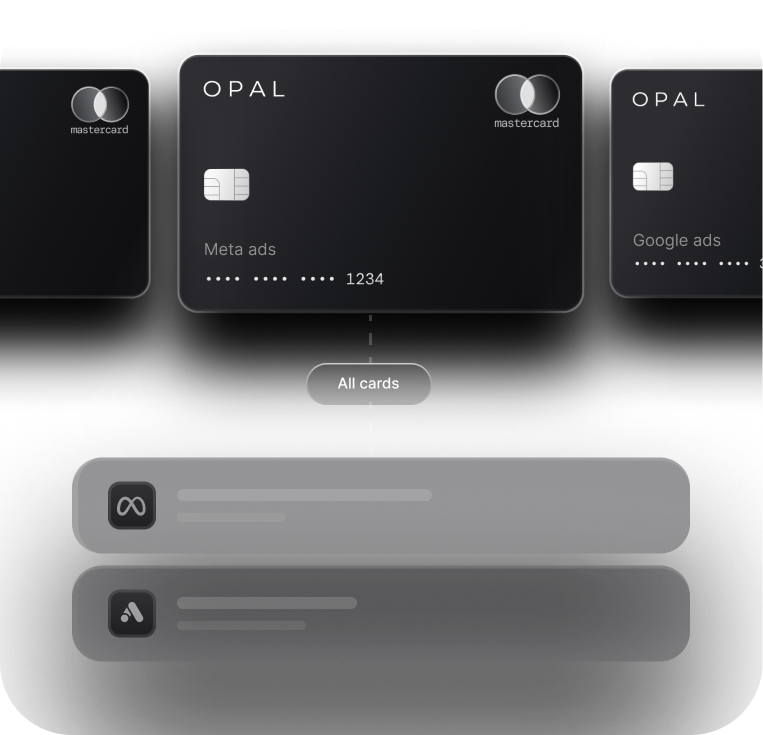
Agencies that have adapted to AI-automated spend have moved away from shared cards and toward a per-client, per-platform card model.
If each client has a dedicated virtual card with a fixed spending limit, the AI campaign's maximum possible charge is bounded by the card. Not by a campaign setting the platform can override.
One card per client, per platform
A client running Meta Advantage+ and Google AI Max gets two virtual cards: one on file with Meta, one on file with Google. Each card has a spending limit equal to the client's approved monthly budget for that platform, plus a small buffer for legitimate overdelivery.
When Advantage+ accelerates spend on a high-traffic weekend, it can only draw against that client's Meta card. It cannot touch any other client's balance. When the card limit is reached, the campaign pauses. The overspend ceiling is enforced at the payment layer, not the campaign layer.
Limits tied to client approvals, not agency credit
The second structural change is who funds the card. In the client-funded card model, the client's bank account is linked directly to their virtual card. The agency never fronts the spend. There is no float, no reconciliation gap, and no situation where an AI campaign's pacing decision creates a liability on the agency's balance sheet.
This matters more with AI-automated campaigns because the spend decisions are no longer entirely within the agency's control.
Spend visibility that matches AI pacing
The third piece is real-time visibility. Monthly reconciliation is not adequate when campaigns can spend 40% of a monthly budget in a single weekend. Agencies running AI-automated campaigns need spend tracking that updates at the same frequency the platforms charge.
Per-client virtual cards make this possible. Every charge is tagged to a specific client and platform at the moment it happens. Finance teams can see current spend against approved budget without waiting for a platform export or a month-end invoice.
When a campaign is trending toward its limit mid-month, the conversation with the client happens before the overspend. Not after.
Campaign settings govern what the algorithm tries to do. The card limit governs what it can actually spend.
The Practical Checklist for Agencies Running AI-Automated Spend
If your agency is already running Advantage+ or AI Max campaigns, or is about to, this is the minimum operational setup worth having in place before you scale:
-
Audit which campaigns are AI-automated. Any campaign using Advantage+, Performance Max, or AI Max for Search should be flagged as high-pacing-variability. These are not the same as standard campaigns and should not be managed the same way.
-
Check whether ad scheduling is active on Google campaigns. If yes, recalculate effective monthly spend using daily budget × 30.4, not daily budget × scheduled days. The March 2026 pacing change makes the old math wrong.
-
Separate each client's spend onto a dedicated card. A shared card across multiple clients is a single point of failure. One Advantage+ surge can cascade into declined charges for unrelated clients.
-
Set card limits equal to approved client budgets. The card limit is the actual ceiling. Set it to match what the client authorized, not what you think the campaign will spend.
-
Move to real-time spend visibility. If your current process surfaces budget variances at month-end, it is not fast enough for AI-paced campaigns. You need transaction-level visibility that updates as charges happen.
-
Establish a mid-month check-in threshold. If any client's card is at 60% of its limit before the 20th of the month, that triggers a conversation before the overspend, not a reconciliation problem after it.
These are not campaign optimization steps. They are financial operations steps. The distinction matters because campaign optimization happens inside the platforms. Financial operations happen in your billing infrastructure, and that is where AI-automated spend creates the most exposure.
The Bottom Line
Both platforms are moving fast and the performance case for using them is real. The agencies getting burned are not the ones running AI campaigns. They are the ones running AI campaigns through billing infrastructure built for manual buying.
The question is not whether to use Advantage+ or AI Max. It is whether your payment layer can enforce the ceilings your clients actually approved before the next pacing surge hits on a Friday night.
If you want to see how Opal's virtual cards and per-client spend controls work for agencies running AI-automated campaigns, you can explore the setup at opalspend.com.
Frequently Asked Questions
What is Meta Advantage+ and why does it affect agency cash flow?
Meta Advantage+ is Meta's AI-automated ad buying product that takes a budget and a goal, then makes all decisions about audience, placement, and pacing. It has removed manual opt-out controls for several settings as of 2026. For agencies, the cash flow risk is pacing unpredictability: Advantage+ can front-load a significant portion of a monthly budget during high-traffic periods, creating charges that hit agency cards before clients have been invoiced or have approved the overage.
How is Google AI Max different from standard Google Ads campaigns?
Google AI Max for Search expands keyword targeting into query space advertisers were not previously bidding on, using AI to match ads to a broader range of searches. It has consistently pushed client search budgets up 7-15% year over year. A separate March 2026 change to Google's budget pacing logic means ad-scheduled campaigns can now spend up to 38% more per month than their stated daily budget settings would suggest, without any account changes.
Can campaign-level budget caps prevent AI overspend?
They reduce the risk but cannot enforce a hard ceiling. Google allows up to 2x daily overdelivery on any given day. Meta's automated pause rules require active monitoring. Google's campaign total budgets (which do enforce a hard ceiling) are only available on new campaigns and cannot be applied to existing ones. The only true hard ceiling is the spending limit on the payment card on file.
What is the client-funded card model and how does it protect agencies?
In the client-funded card model, a client's bank account is linked directly to a dedicated virtual card used for their campaigns. The agency does not front the spend and does not carry the float. When an AI campaign charges the card, it draws from the client's funds, not the agency's working capital. This eliminates the reconciliation gap and removes the agency's liability exposure when AI campaigns spend unpredictably. You can read more about how the client-funded card model works here.
How should agencies set spending limits for AI-automated campaigns?
Set the virtual card limit equal to the client's approved monthly budget for that platform, with a small buffer (typically 5-10%) to avoid legitimate overdelivery triggering a mid-campaign decline. The limit should be reviewed and reset at the start of each billing cycle. Any mid-month spend that approaches 60% of the limit before the 20th of the month is a signal to have a budget conversation with the client before the ceiling is hit.
How Agencies Manage Cash Flow When Meta and Google Invoices Are Due

How to Earn Rewards on Google Ads and Meta Ads Spending
How Ad Platforms Bill in 2026: Meta, Google, TikTok, Amazon, and Apple Search Ads Explained