

Opal vs. Mercury for Ad Agencies: Which One Actually Handles Client Ad Spend?
.webp)
Mercury has a well-earned reputation. Agencies find it because their startup friends swear by it, and the product genuinely delivers: clean UI, no monthly fees, solid banking features. When Mercury launched the IO card, it looked like a natural extension. No annual fee, 1.5% cashback, unlimited virtual cards. For an agency owner already banking with Mercury, the pitch is obvious.
But Mercury IO was built for startups managing their own operational expenses. Not for agencies running $50K, $200K, or $500K a month in client ad spend across Google, Meta, TikTok, and Amazon. The product architecture reflects that. The credit limit is tied to your Mercury account balance. There is no client-level card infrastructure. Reconciliation syncs to QuickBooks, not to your client accounts or campaign structures.
TL;DR: Mercury IO has no annual fee, 1.5% cashback, and unlimited virtual cards. It is a solid card for a startup's general expenses. For agencies managing client ad budgets, the credit limit model, cashback structure, and reconciliation tooling are all wrong for the workflow. Opal is purpose-built for that problem. Many agencies use Mercury for banking and Opal for ad spend at the same time.
That is the core of this comparison. Mercury is an excellent banking product used by a lot of agencies. The IO card is not a purpose-built agency spend tool. Here is exactly where the difference shows up.
Opal vs. Mercury IO at a Glance
The table below covers the features that matter most for agencies running client ad spend.
Feature |
Opal |
Mercury IO |
|---|---|---|
Annual fee |
$0 |
$0 |
Cashback |
Up to 2% on ad spend |
1.5% on all spend |
Cashback model |
Client-funded (agency earns on client money) |
Balance-backed (agency fronts spend) |
Credit limit |
Up to $10M |
Tied to Mercury account balance |
Limit model |
Based on managed spend / cash flow |
Requires $15K minimum balance; scales with deposits |
Personal guarantee |
Not required |
Not required |
Credit check |
No |
No |
Virtual cards |
Unlimited, free |
Unlimited, free |
Card model |
Purpose-built for agencies |
General business / startup card |
Ad platform reconciliation |
Automated (Google, Meta, TikTok, Apple, Amazon) |
General accounting sync (QuickBooks, Xero, NetSuite) |
Client-funded model |
Yes, core feature |
No |
Built for agencies |
Yes |
No, built for startups |
Requires bank account switch |
No |
Yes, IO requires a Mercury bank account |
A few rows look similar on the surface. The differences in how cashback is earned and how credit limits are set are what actually determine whether either card fits your workflow.
Where the Comparison Breaks Down for Agencies
Mercury IO works well as a general business card. The problems show up specifically when you try to use it for client ad spend at agency scale. Four areas stand out.
1. Your credit limit is tied to your balance, not your clients' budgets
Mercury IO's limit scales with how much money you keep in your Mercury account. That might work fine for a software startup managing its own SaaS subscriptions. For an agency, it creates a structural mismatch.
Say you're managing $300K/month in client ad spend and holding $50K in your Mercury account. Your limit is constrained by your own deposits, not by the volume your clients are actually authorizing. Now you win a new client with $80K/month in spend. With Mercury, unlocking a higher limit may require you to increase your own deposits first. You are essentially using your own capital to support your client's budget.
With Opal, the client funds the card directly. Limits go up to $10M and are sized around your managed spend volume, not your agency's cash position. When a new client comes on, the spend capacity scales with their budget, not yours. Read more about how the client-funded card model works and why agencies are switching to it.
2. The cashback math is not what it looks like
Mercury's 1.5% cashback will catch your eye. Opal pays up to 2% on ad spend, but the rate is not the whole comparison. It only makes sense if both cards operate the same way. They don't.
With Mercury IO, the agency fronts the spend from its own balance. You are temporarily out of pocket for every dollar that runs through the card until your clients reimburse you. The 1.5% cashback is earned on money you are carrying the risk on.
With Opal's client-funded model, clients pre-fund their own balance before campaigns run. The agency earns cashback on spend it never fronted.
Here is the math at $200K/month in managed spend:
Mercury IO: 1.5% on $200K = $3,000/month, earned on money the agency is temporarily out of pocket for
Opal: up to 2% on $200K = up to $4,000/month, earned on money the agency never touched
At the full 2% rate, Opal returns $1,000/month more, and with Mercury you are also carrying $200K in float every billing cycle. For most agencies managing multiple clients, earning up to $4,000/month with zero capital at risk is the better deal.
3. No client-level card infrastructure
Mercury IO is designed for team spend management: one card per employee, merchant locks, per-card spend limits. That architecture works for a startup controlling its own expenses. It is not designed for one card per client, per platform.
Most agencies using Mercury for ad spend end up with one or two shared cards running everything. That means a Google charge and a Meta charge and a TikTok charge all appearing on the same statement, tied to the same card, with no client attribution built in. Month-end reconciliation becomes a manual matching exercise.
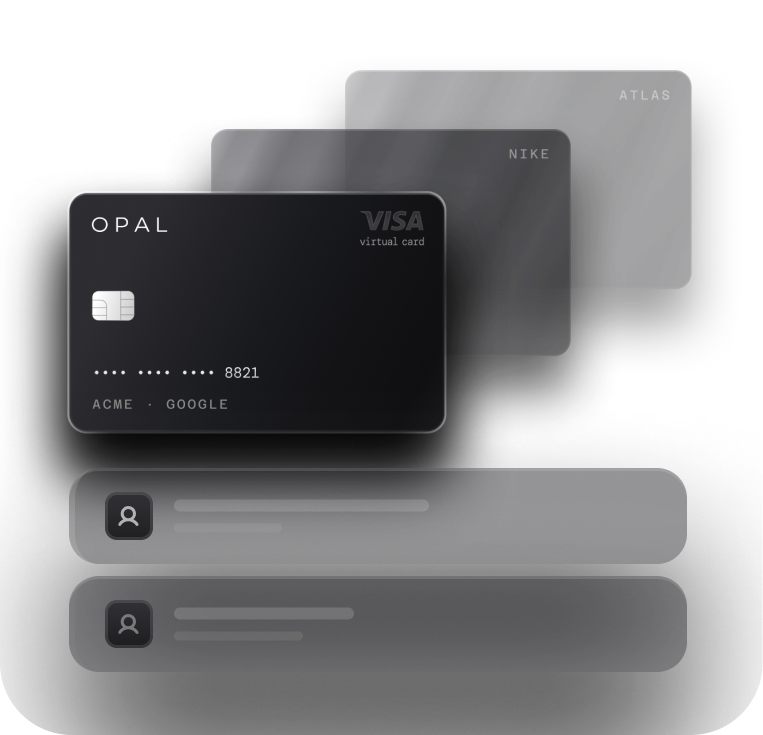
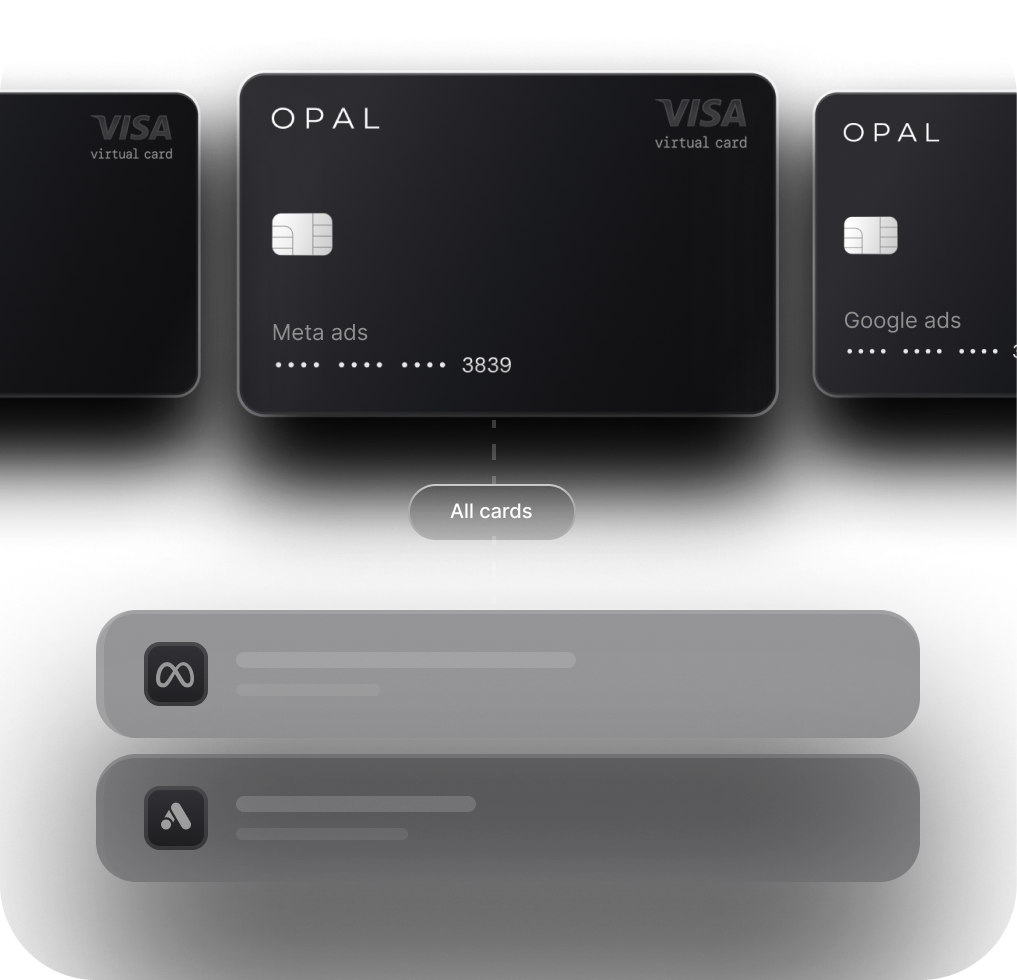
Opal issues dedicated virtual cards by client and by platform. A dispute on one client's Meta card does not touch another client's Google campaigns. The card structure mirrors the agency's actual workflow.
4. Reconciliation is general, not agency-specific
Mercury syncs with QuickBooks, Xero, and NetSuite. That is solid general-purpose accounting integration. But it does not map transactions to client accounts or campaign structures. You still have to do that work manually.
Opal's reconciliation automation is built specifically for the agency workflow. Transactions are categorized by client, by platform, and by campaign automatically. If you are running ad spend reconciliation in QuickBooks, the difference between a generic sync and a client-mapped sync is 10 to 15 hours of manual work per month.
Where Mercury Still Makes Sense
Mercury is a genuinely good product. This is not a dismissal. Here is where it fits well:
-
Business banking: Mercury's checking and savings accounts are excellent for agencies. FDIC-insured, no monthly fees, solid treasury tools. Many agencies bank with Mercury and use Opal for ad spend simultaneously.
-
General team expenses: Software subscriptions, travel, office costs, vendor payments. Mercury IO works fine for anything that is not client ad spend.
-
Early-stage agencies: If you're running one or two clients with modest budgets and your Mercury balance comfortably covers the spend, the IO card is a reasonable starting point. The friction shows up as you scale.
-
Agencies already deep in the Mercury ecosystem: If you are using Mercury for payroll, invoicing, and treasury, keeping general expenses on IO makes sense. Just don't route client ad spend through it.
Some agencies use Mercury for banking and Opal for ad spend. They are not mutually exclusive. If you want to compare how Opal stacks up against other spend management options your team may be evaluating, see Opal vs. Brex for Agencies.
The Recommendation
If client ad spend is your agency's primary expense category and you're managing multiple clients, Mercury IO is not the right card for that workflow. It was designed for a startup's general operational spend. The credit limit model, the cashback structure, the card infrastructure, and the reconciliation tooling all reflect that origin.
Opal was designed specifically for the problem Mercury doesn't address: agencies running client budgets across multiple ad platforms, at scale, without fronting the spend themselves.
The question is not which card has the higher cashback rate. It's which card was built for how your agency actually operates.
For a deeper look at how Opal compares to other cards in this space, see Opal vs. Ramp for Marketing Agencies.
Who should use Opal
Agencies managing $50K or more per month in client ad spend
Agencies running multiple clients across Google, Meta, TikTok, or Amazon
Teams spending hours each month on manual reconciliation
Agencies that want to earn cashback without fronting client budgets
Any agency that has hit a credit limit wall tied to their own cash balance
Who might stick with Mercury IO
Agencies that primarily need a business bank account (Mercury banking is excellent)
Teams using IO for general expenses like software, travel, and vendor payments
Early-stage agencies with one or two clients and modest spend volumes
Agencies that already have Mercury IO working for their current scale and aren't hitting limits
Frequently Asked Questions
Can I use Mercury for banking and Opal for ad spend at the same time?
Yes. Many agencies do exactly this. Mercury is a strong business bank account and there is no reason to move your banking if it is working. Opal is a charge card for ad spend, not a bank. You can keep your Mercury account for payroll, vendor payments, and general expenses while running all client ad spend through Opal.
Mercury IO offers 1.5% cashback. How does that compare with Opal's up to 2%?
The rates are close, but the model is different. With Mercury IO, the agency fronts the spend from its own balance and earns 1.5% on money it is temporarily out of pocket for. With Opal, the client pre-funds the card before spend runs, so the agency earns up to 2% on money it never touched. At $200K/month in managed spend, Opal returns up to $4,000/month with no capital at risk, while Mercury IO returns $3,000/month on spend the agency has to float.
How does Opal's credit limit work compared to Mercury's?
Mercury IO's limit scales with your Mercury account balance. Opal's limits go up to $10M and are sized around your managed spend volume and cash flow, not your own deposits. For agencies managing significant client budgets, Opal's limit model scales with the business rather than constraining it.
Do I need to switch banks to use Opal?
No. Opal is a charge card, not a bank account. You keep your existing banking relationship, whether that is Mercury or anyone else. Opal connects to your current bank for settlement.
Does Opal work with the same ad platforms Mercury does?
Opal has automated reconciliation built specifically for Google, Meta, TikTok, Apple, and Amazon. Mercury IO offers general accounting sync with QuickBooks, Xero, and NetSuite, which covers the bookkeeping side but does not map transactions to client accounts or campaign structures. If your workflow involves multiple clients across multiple platforms, Opal's integration is built for that specifically.
If you're running a paid media agency and you're still relying on a general-purpose card for client ad spend, you're leaving money on the table every month. See how Opal works for agencies like yours or read the Outsmart Labs case study to see what the switch looks like in practice.