



How to Get a $1M Credit Limit for Your Agency Without a Personal Guarantee

.webp)
How to get a $1M credit limit for an agency without a personal guarantee depends almost entirely on where the limit is underwritten. A seven-figure limit becomes reachable when an issuer sizes credit against documented monthly advertising volume instead of the agency's balance sheet or the owner's personal credit.
So the work in front of you is to produce a clean spend record, move client budgets onto separate cards, apply to an issuer that underwrites on that volume, and request written reasons for any limit approved below the amount you asked for.
Media budgets moved onto cards faster than card underwriting moved to meet them. A performance agency can clear seven figures a month across Meta Ads, Google Ads, TikTok Ads, and connected television inventory on a limit sized against its own revenue.
In the United States, asking an issuer to lift that ceiling is a credit application governed by the Equal Credit Opportunity Act (ECOA) and Regulation B, the rule published by the Consumer Financial Protection Bureau (CFPB).
That framework is why a limit approved below what you requested is a defined event with defined consequences rather than a soft no.
Key Takeaways
A seven-figure limit follows the spend record rather than the balance sheet, because an issuer underwriting on documented monthly advertising volume can approve capacity your own revenue would never support.
A personal guarantee and a large limit are separate decisions, and among small employer firms carrying debt, 59% secured that debt with a personal guarantee while 51% pledged business assets, in the Small Business Credit Survey run by the Federal Reserve Banks.
Asking your existing issuer for a higher ceiling is a formal credit application, so a refusal carries the same notification duties as a declined new account.
Under Regulation B, the rule implementing the Equal Credit Opportunity Act (ECOA), approving substantially less than you requested or refusing an increase is adverse action, and a business with more than $1 million in prior-year gross revenues can compel written reasons by asking within 60 days.
The capacity you need is set by your highest balance inside a billing cycle, not by your monthly total, because platform charges and statement dates rarely line up neatly.
We issue the Opal Card with limits of up to $10M, no credit check, and no personal guarantee, and we revisit account performance from time to time to see whether a higher ceiling is warranted.
What Does It Take to Get a $1M Credit Limit for an Agency?
A $1M credit limit for an agency takes three things: an issuer that underwrites against advertising volume, a documented spend history large enough to justify the number, and an account structure that shows where every dollar lands. Dropping the personal guarantee is a separate lever, and pulling it does not have to cost you capacity.
Two of those three are yours to fix before you submit anything. The third belongs to whoever you apply to, and our walkthrough of approval without personal guarantees sets out that path end to end.
Which Inputs Decide the Number
Traditional card underwriting reads your company: time in business, deposit balances, financial statements, annual revenue, and usually the owner's personal credit file. Our glossary entry on how limits get set covers those inputs and how one account limit is split across the cards beneath it.
Spend-based underwriting reads the money moving through you instead. The estimator on our homepage asks what you spend per month on client cards and returns an estimated limit from that figure alone, illustrating $25,000 in monthly client card spend against an estimated $85,000 limit.
Why the Guarantee and the Limit Are Separate Questions
A personal guarantee promises repayment of the company's balance from your own assets, letting an issuer look past the business to the individual who signed. It is a collection mechanism rather than a capacity mechanism, which is why signing one rarely buys the headroom agencies expect.
Guarantees remain common. Among small employer firms carrying debt, 59% had secured it with a personal guarantee, per the Small Business Credit Survey run by the Federal Reserve Banks, and our breakdown of personal guarantee exposure covers what one obligates you to.
How Do Issuers Decide How Large a Limit to Approve?
Issuers approve a limit by modeling how much they could lose and how fast they would see it coming. Balance-sheet underwriting answers that with your assets, while spend-based underwriting answers it with your transaction record and the controls on the account.
The two models give very different answers for the same agency, and the gap widens as managed spend grows relative to revenue. Your choice of issuer matters more than the polish on your application.
1. Reading the Company: Asset-Based Limits
Here your limit is a function of what the issuer could recover. Agency balance sheets are thin by design, since the business sells time rather than holding inventory, so the recoverable number stays small however large managed spend gets.
That mismatch produces the ceiling most growing agencies hit. You can run $2M a month in client media and still be assessed as a services company with modest assets, which our glossary calls credit ceiling risk.
2. Reading the Spend: Volume-Based Limits
Here the issuer prices the risk of the spend itself. Advertising charges are predictable, recurring, and tied to revenue-generating activity, and they land with a small set of large platforms rather than unknown merchants. Controls do the rest: when cards are locked to supported advertising platforms, capped per card, and reconciled transaction by transaction, the issuer watches a narrow, instrumented flow instead of an open line of credit.
|
Question |
Balance-Sheet Underwriting |
Spend-Based Underwriting |
|---|---|---|
Primary input |
Revenue, assets, deposits, time in business |
Documented monthly advertising volume |
A seven-figure request hinges on |
What the issuer could recover from the company |
Whether the spend record supports the number |
Role of a personal guarantee |
Frequently required to offset thin assets |
Not required on our card |
What raises the limit later |
A stronger balance sheet or new financial statements |
A longer, cleaner record of settled spend |
What caps it |
Company size |
Platform coverage and verified spend history |
Evidence you supply |
Financial statements and tax returns |
Platform billing history and card-level records |
What Should You Prepare Before You Apply?
Prepare three things: a request sized to your real peak, a spend record an underwriter can verify without calling you, and an account structure that makes each client's money traceable. All 3 are within your control, and all 3 are what a spend-based underwriter reads. Agencies that arrive with none get assessed on whatever is available, usually the balance sheet they were trying to get past.
1. Size the Peak, Not the Month
The number to request is your highest outstanding balance at any single moment inside a billing cycle, not a month of spend spread evenly across 30 days. Pull 90 days of billing history from every platform you run, chart a running balance by day across each statement cycle, and take the largest of the 3 peaks.
Then add headroom for what you cannot time. Platforms bill on thresholds as well as dates, and a mid-flight budget increase adds demand you never forecast, the mismatch we cover in our piece on ad spend float. A margin above your peak costs nothing now, while a second request is a fresh credit decision.
2. Assemble the Spend Record
Export billing history directly from each ad platform rather than from a reporting dashboard or a spreadsheet you maintain, so the figures carry the platform's own timestamps. Cover at least 90 days, include every platform you run, and keep the exports in their native format.
Then reconcile those exports against your card and bank statements. Gaps between what the platforms billed and what cleared are the first thing an underwriter asks about, and a ready answer shortens the review.
3. Separate Client Budgets First
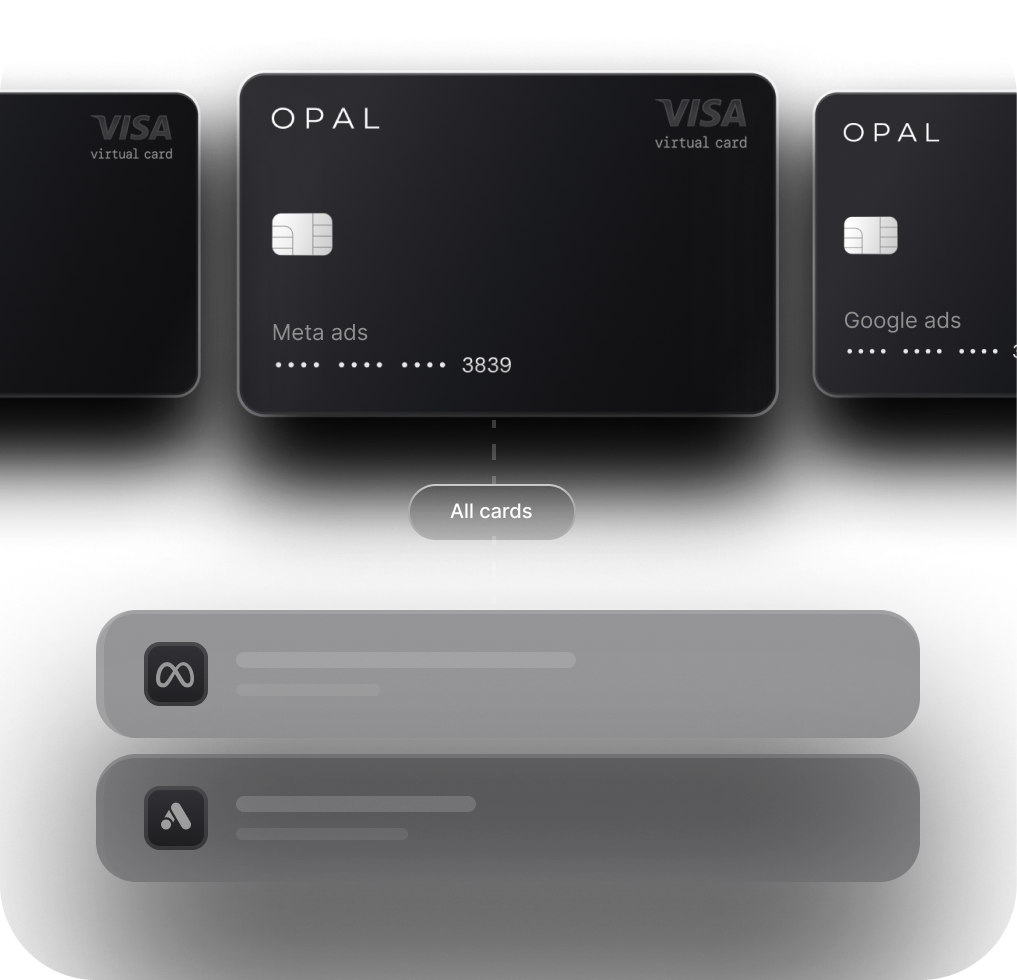
Commingled spend is hard to underwrite because nobody can tell whose money is at risk. A dedicated card per client, platform, or campaign turns one opaque balance into a set of legible, capped exposures, which is how our agency spend platform is built to run.
Do this before you apply rather than after approval. An applicant already running per-client cards with merchant controls presents a lower-risk structure instead of describing one they intend to build.
What Happens If the Limit Comes Back Lower Than You Asked For?
A limit approved substantially below what you requested is adverse action under Regulation B, unless the issuer makes a counteroffer you accept. That classification attaches notification duties to the issuer and a right to reasons to you.
Most applicants meet this at some point, and the useful response is procedural. Regulation B gives you a route to the reasons, and those reasons tell you what to fix before the next request.
When a Smaller Limit Counts as Adverse Action
The CFPB's text of Regulation B defines adverse action to include a refusal to grant credit in substantially the amount or terms requested, where the creditor makes no counteroffer that you use or expressly accept. It separately covers a refusal to increase the credit available to an applicant who applied for an increase.
That second clause is the one agencies overlook. Asking your existing issuer to raise a limit is an application, and a refusal carries the same consequences as a decline.
How to Request the Reasons in Writing
For a business with more than $1 million in gross revenues in its preceding fiscal year, Regulation B requires the creditor to notify you of the action taken within a reasonable time, orally or in writing. A written statement of specific reasons follows only if you make a written request within 60 days of that notification.
So make the request, in writing, inside the window. Below that revenue threshold the rules differ, and a creditor may disclose your right to reasons at application time instead, which is worth reading on your paperwork first.
How Do You Grow a Limit Past Seven Figures Once You Have One?
Growth in a spend-underwritten limit comes from the record you build after approval rather than a renegotiation. Every settled cycle adds evidence, and that evidence is what the next review reads. Our own program works this way: we revisit how an account is performing from time to time, and where the record supports a higher ceiling, you can be offered an increase to accept or decline.
Let the Spend Record Do the Work
Settle in full and on time, every cycle, without exception. On a pay-in-full charge card your full balance is pulled from the bank account on file each due date, and a failed debit can leave the card locked until the balance clears, which is the fastest way to stall a limit review.
Keep your platform coverage stable, and flag a client who triples your volume in one cycle before the spend lands, since from the outside a spike looks identical to an account losing control. Ramping a large new budget across 2 cycles rather than 1 gives the next review something readable.
Apply With Your Spend Record Already in Hand
Reconcile your 90-day platform exports, separate your client budgets onto their own cards, and size your request to your measured peak. Then apply to an issuer that reads all 3. We provide the credit, the cards, and the controls, and you configure the limits, merchants, and permissions that fit how your agency runs.
What You Get With the Opal Card
We offer limits of up to $10M with no credit check and no personal guarantee, unlimited virtual cards at no annual or per-card cost, and cashback of up to 2% on eligible advertising spend at a rate confirmed when your application is approved.
Merchant restrictions, spend limits, approvals, and employee permissions are included, as is syncing into QuickBooks and Workday.
The onboarding form runs 2 to 3 minutes, and we usually have virtual cards ready 24 to 48 hours after you submit.
There is no annual fee, no cut of your media spend, and no cancellation fee. The Opal Card is issued by First Internet Bank of Indiana, a member of the Federal Deposit Insurance Corporation (FDIC), pursuant to a license from Visa Inc., with credit provided by CapitalOS.
Apply now to get the only card exclusively built for ad spend.
Frequently Asked Questions (FAQs)
Can an Agency Get a Seven-Figure Card Limit With No Personal Guarantee?
Yes, when the issuer underwrites against advertising spend rather than company assets. We offer limits of up to $10M with no credit check and no personal guarantee, sized on documented monthly ad volume. Issuers pricing risk from the balance sheet usually want a guarantee.
How Long Does It Take to Get Approved for a High Limit?
Filling in our onboarding form runs 2 to 3 minutes, and we usually have cards ready 24 to 48 hours after you submit. Reconciling your platform billing exports beforehand shortens any follow-up. Issuers reviewing financial statements and tax returns take considerably longer.
Does Applying for a Higher Credit Limit Hurt My Personal Credit?
It depends on whether the issuer pulls your personal credit file during underwriting. Applications relying on personal credit typically involve a hard inquiry, which can affect your score. We do not require a credit check, so our application skips that step entirely.
What Documents Do Issuers Want to See for a Large Limit?
Balance-sheet underwriters ask for financial statements, tax returns, bank statements, and time in business. Spend-based underwriters want the advertising record instead: platform billing exports covering at least 90 days, statements to reconcile against, and a clear view of how client budgets are separated.
Why Did My Limit Come Back Lower Than I Asked For?
Most commonly because the evidence supported a smaller number, or because the model read your company rather than your spend. Under Regulation B, approving substantially less than you asked for is adverse action unless you accept a counteroffer, so you can ask the creditor for reasons.
Can I Get the Limit Raised After Approval?
Yes. We revisit how an account is performing from time to time, and where the record supports a higher ceiling, you can be offered an increase to accept or decline. Settling every statement in full and on time gives that review the strongest record.