


Upgrade your ad spend from Amex to Opal
Opal is built for anyone spending at scale on ads: agencies, performance marketers, media buyers, and ecommerce and DTC brands running serious budgets across Google, Meta, TikTok and other advertising platforms. American Express makes strong general-purpose business cards. Here's how the two compare once advertising is your largest line item.



.svg)

.avif)
.avif)
.avif)


Opal is the more specialized choice for a business managing high-volume digital advertising: up to 1.5% cashback on eligible ad spend with no annual cap, credit limits up to $10M, virtual cards organized by client, platform and campaign with their own limits, real-time visibility, no annual fee, and no personal guarantee or hard credit check.
Amex Business Gold rewards advertising until its annual cap. Business Platinum is built for premium travel and Membership Rewards. Neither is built for advertising, and you feel it once media is your biggest expense.
Keep Amex for travel and company expenses. Put the ad spend on Opal.
.avif)


American Express product terms verified September 2026 and subject to change. Review the applicable Amex product page and Card Member Agreement before applying. American Express, Business Gold, Business Platinum and Membership Rewards are marks of American Express. Opal is not affiliated with or endorsed by American Express. Opal credit availability, limits and cashback rates are subject to underwriting, product availability and applicable terms.
Your cashback shouldn't stop in month one.
Business Gold is the closest Amex comparison for an advertiser. Purchases at U.S. media providers for advertising in select media are one of six categories eligible for 4X Membership Rewards points, and Amex applies 4X automatically to the two eligible categories where your business spends the most each billing cycle. That is a real advertising reward.
Then there is the cap. The 4X rate applies to the first $150,000 in combined purchases across those top two categories each calendar year. After that, eligible purchases earn 1X.
A business placing $200,000 a month runs $2.4M of ad spend a year, and clears the whole 4X allowance in the first month.
That is 2,850,000 Membership Rewards points for the year. At Amex's statement-credit value of 0.6 cents per point, that is about $17,100. The same $2.4M of ad spend on Opal earns up to $36,000 in cash, with no annual cap and nothing to redeem. And the 4X rate covers a smaller share of your spend every time advertising volume rises, while the Opal rate does not move.
Opal works the other way around. Its rewards are built on ongoing ad spend rather than on advertising as one category inside a general business rewards program. Eligible businesses earn up to 1.5% on eligible ad spend with no annual cap and no spend tiers to qualify for.
Business Gold is a good advertising card while qualifying spend stays inside the cap. Above the cap, most of your ad spend earns 1X, and if another eligible category is drawing on the same $150,000, it binds sooner still. As David Azar, founder and CEO of Outsmart Labs, put it after moving to Opal: "The cashback gives us more value than points, and the team is incredibly responsive."
A travel card is not an ad spend card.
Business Platinum carries an $895 annual fee and earns 5X Membership Rewards points on eligible flights and prepaid hotels booked through Amex Travel. It earns 2X on specified business categories and on eligible individual purchases of $5,000 or more, up to $2 million of qualifying purchases each calendar year. Other eligible purchases generally earn 1X.
Advertising is not a dedicated bonus category on this card.
Meta, Google and other platforms usually bill in several charges across the month. A $300,000 budget billed as thirty $10,000 charges qualifies for 2X. The same budget billed in charges under $5,000 earns 1X, however large the budget behind it.
Business Platinum is a strong card for a business that travels. It is not an ad spend card.
Both cards issue unlimited virtual cards. The workflow is the difference.
American Express lets eligible Business Card Members create Virtual Cards with unique numbers and security codes, custom expiration dates and adjustable spending limits. There is no fee to create them and no limit on how many you create.
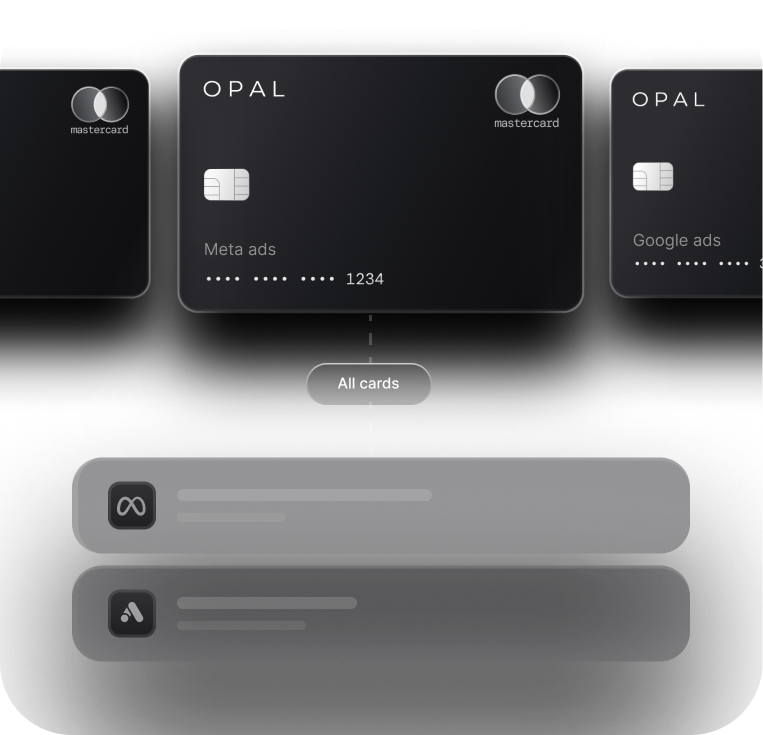
On a general business card, virtual cards tend to be organized around vendors, projects, subscriptions and departments. Opal organizes them around clients, platforms and campaigns: one card for a client's Meta spend, another for their Google spend, another again for the next client.
The difference isn't the virtual card. It's how the cards are organized. Every Opal card can be locked to one platform, given its own spend limit, and issued to a team member with its own permissions, and Opal enforces those limits automatically so nobody overspends a client budget. Transactions are categorized by client, platform and campaign before they reach QuickBooks or Workday, and you see every one of them in real time rather than at statement time. That is what makes month end cheap.
Agencies that work from pre-funded client budgets can also use Opal's client-funded card model, so client money funds client media and the agency isn't fronting it. Outsmart Labs, a Miami digital agency, recovered 15 hours per week after moving to a per-client card structure on Opal.
Your credit should match the ad spend you manage.
Business Gold and Business Platinum both use a No Preset Spending Limit model. That is not unlimited spending. Amex says capacity adapts based on factors including purchase, payment and credit history, and for most businesses that flexibility works well. For an advertiser, it also means a large or sudden platform charge can be declined while capacity catches up, and a paused campaign is how you find out.
High-volume advertisers have a different problem. An agency, an ecommerce brand or an in-house performance team may run $300,000 or $500,000 a month in media that has nothing to do with its own operating expenses. Opal sizes limits up to $10M on managed ad spend, cash flow and underwriting, so capacity scales with the advertising you manage rather than with the expenses you run.
Liability works differently too. The current Business Gold Card Member Agreement states that the Basic Card Member and the company are jointly and severally liable for all charges on the account, which means Amex may seek payment from either or both. On ordinary company spending that is unremarkable. When you're carrying several hundred thousand dollars a month of a client's media and the client pays late, that liability sits with you personally.
Opal requires no personal guarantee and no hard credit check. Eligibility is assessed on the spend you manage, not on the balance sheet behind it. The Opal Card is paid in full once a month, so you aren't paying down mid-cycle to free up capacity, and you can reach a person on Opal's team by email, phone or online meeting when a question comes up.
Invoice billing takes your largest expense off the card.
At high volume, the card's rewards rate stops being the main question. Some high-spend Meta and Google advertisers are billed by invoice rather than by card, which takes the largest expense in the business out of every card rewards program at once.
Opal Ad Pay is built for that. It detects authorized advertising invoices, shows upcoming amounts and due dates in one place, and lets teams settle them with a card or Opal credit, extending the cash-flow window by up to 55 days. Payments on Opal credit carry a 3% processing fee, offset by the cashback earned on eligible spend. Payments on a connected card carry a 3.5% fee.
Where Amex may still be the better fit
American Express is a strong choice for a business that wants one card covering everything it spends on.
General Business Spending
Opal cards are limited to supported advertising and media platforms. Amex covers a far wider range of eligible company expenses: software, vendors, travel, dining, equipment, general operating costs. If advertising is a small part of your spending, Amex is the more practical card.
Business Travel
Business Platinum's travel program is not something Opal tries to replicate. For a business that travels heavily, the travel rewards, lounge access, hotel benefits and credits add up to real money.
Membership Rewards
Both Amex cards earn Membership Rewards rather than cash. A business that actively transfers points to airline and hotel partners may value that flexibility more than cashback.
Low Ad Spend
If you spend under roughly $14,000 a month on ads and care most about welcome bonuses or transferring points to travel partners, Business Gold's 4X category can out-earn Opal before the cap becomes a problem.
Who Opal is for
Opal is the right fit if you are:


Outsmart Labs faced these same challenges. After switching, they recovered 15 hours per week in reconciliation time and added a recurring cashback revenue stream on client spend they were already running.
15+ h per week
15+
Use an ad-spend card for ad spend
Amex covers everything else a business buys. Opal covers the advertising: up to 1.5% cashback on eligible ad spend with no annual cap, credit limits up to $10M with no personal guarantee or hard credit check, unlimited free virtual cards with per-card limits and merchant locks, real-time visibility, Ad Pay for Meta and Google invoices, and reconciliation that syncs to QuickBooks or Workday. Apply online in 2 to 3 minutes, with support from a real person on Opal's team.
Frequently asked questions
For high-volume ad spend, yes. Business Gold's 4X advertising category is strong until you clear the $150,000 combined cap, roughly $12,500 a month. At Amex's statement-credit value of 0.6 cents per point, Opal's up to 1.5% cash pulls ahead at about $25,000 a month (about $56,000 a month at the 1% credit rate), and the gap grows with every dollar above it. Amex is also the stronger card for broad business expenses, travel and Membership Rewards. What Opal adds is up to 1.5% cashback on eligible ad spend with no annual cap, credit limits up to $10M sized on managed ad spend, cards organized by client, platform and campaign with their own limits, real-time visibility, reconciliation that syncs to QuickBooks or Workday, help restoring Meta ad accounts and supporting Meta whitelist applications, no annual fee, no personal guarantee and no hard credit check.
Amex Business Gold is the more relevant of the two, because qualifying purchases at U.S. media providers for advertising are one of six categories eligible for 4X Membership Rewards points. Amex selects the two eligible categories where the business spends the most in each billing cycle. The 4X rate applies to the first $150,000 in combined purchases from those categories per calendar year, after which they earn 1X.
No. Opal does not require a personal guarantee, and it does not require a hard credit check. Eligibility and credit capacity are assessed on managed ad spend, cash flow and underwriting. Amex customers should review the Card Member Agreement for their product: the current Business Gold agreement states that the Basic Card Member and the company are jointly and severally liable for charges on the account, which means Amex may seek payment from either or both.
Business Gold pays 4X Membership Rewards points in the two eligible categories where the business spends the most in each billing cycle. That 4X rate applies to the first $150,000 in combined purchases from those categories per calendar year. Once the threshold is reached, qualifying purchases in those categories earn 1X, so the effective rewards rate on advertising falls as annual ad spend moves past the cap.
Yes. Eligible Amex Business Card Members can create Virtual Cards with unique numbers, adjustable spending limits and custom expiration dates, at no fee, and Amex states there is no limit to the number that can be created. Opal also offers unlimited free virtual cards. The difference is the product experience around them: Opal organizes cards by client, platform and campaign, which is the structure ad spend reconciliation actually runs on.
Yes, and many teams do. The products serve different purposes. A business can use Amex for travel, software, vendors and other general company expenses while using Opal for digital advertising and client media spend.
Amex states that Business Gold and Business Platinum applicants can check whether they are approved without an initial impact to their personal credit score, and that if an applicant is approved and chooses to accept the card there may be an impact to their personal credit score. Opal does not require a hard credit check.
See how Opal compares.


Opal vs Chase
Ink Business Preferred on the $150K bonus cap, credit limits and joint liability.

Opal vs Ramp
Agency ad-spend workflows next to Ramp's broader expense and finance platform.

Opal vs Brex
Credit capacity, virtual cards and reconciliation for agencies.
.avif)
Opal vs Mercury
Opal's ad-spend credit model next to Mercury's business banking and cards.
Opal vs Slash
Cashback, credit capacity, client budgets and Meta invoice payments.
Opal vs Dash.fi
Cashback terms, eligible platforms and credit limits at high volume.