


Best Credit Cards for Ad Spend: 7 Options Compared for Agencies, Brands, and Media Buyers

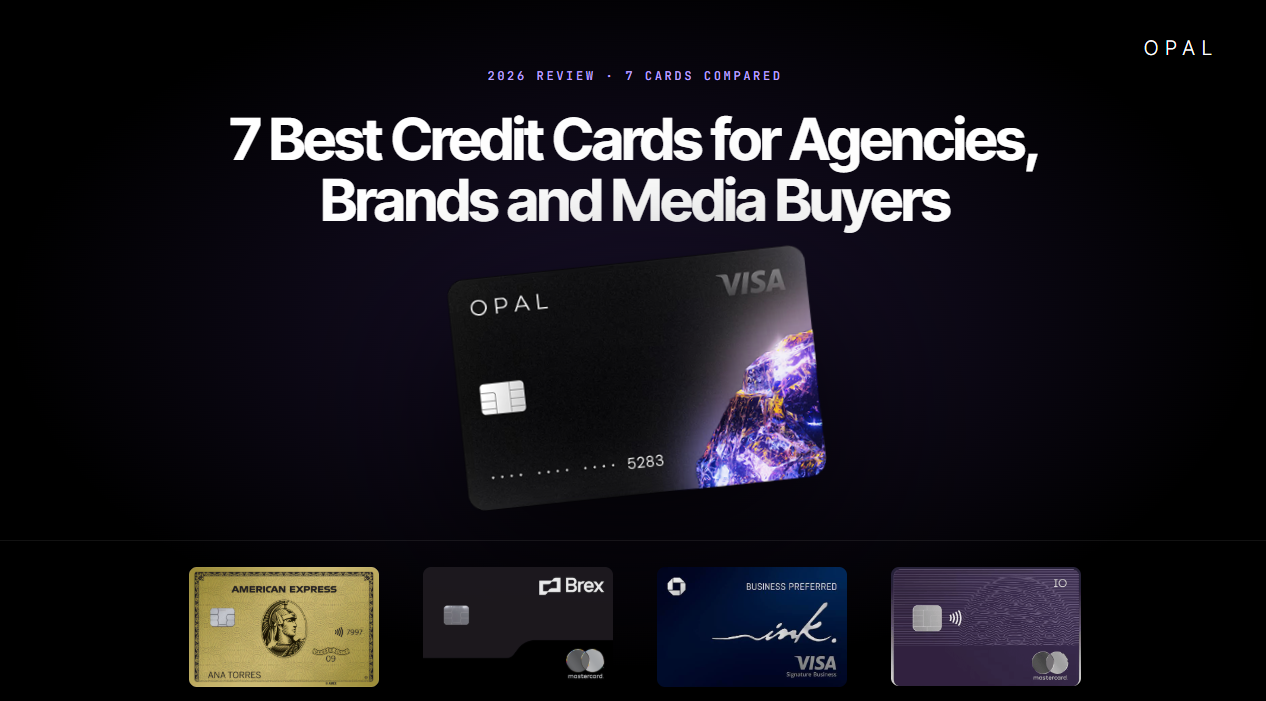
The best credit cards for ad spend are underwritten against advertising volume rather than a personal credit file. They also issue enough virtual card numbers to cover every ad account a team runs, and they keep paying rewards after budgets scale.
Sorting them by headline rewards rate produces the wrong answer, because the constraint that breaks a media budget is rarely the rate.
That's why this comparison groups 7 options by the kind of media spend each product was designed to fund, then tests each group against the way agencies and multi-client teams actually charge a card.
Purpose-built advertising cards, corporate spend management platforms, business banking cards, and rewards-first business cards each answer that collision differently.
Our own solution, the Opal Card, is a pay-in-full charge card issued by First Internet Bank of Indiana, Member FDIC, pursuant to a license from Visa Inc., with credit provided by CapitalOS.
Key Takeaways
Cards for advertising budgets fall into 4 groups by what each was built to fund: advertising, company operating spend, company deposits, or general business rewards. Only the first group sizes a credit limit against advertising volume.
Credit capacity binds more often than rewards rates. In the Federal Reserve Banks' Small Business Credit Survey, 42% of applicants received the full financing amount they sought, which leaves 58% receiving part of it or none at all.
Advertising platforms charge on threshold billing rather than monthly invoicing, so one ad account can trigger dozens of separate charge attempts inside a single month.
Virtual card supply decides whether client separation is structural or a naming convention. A roster of 25 accounts buying on 4 platforms already needs 100 distinct card numbers.
Rewards carrying an annual category cap stop paying partway through the year at advertising volume, which makes the ceiling more decisive than the headline multiplier.
The Opal Card is limited to supported advertising and media platforms, so it funds media budgets rather than general operating expenses.
What Are the Best Credit Cards for Ad Spend at Agency Scale?
The strongest options size a limit against managed advertising volume, issue unlimited virtual card numbers, and apply rewards with no category ceiling.
Seven products are worth comparing for that job, and they sort into 4 groups based on the spending problem each one was built to solve. Grouping them this way is more useful than ranking them. A card that is wrong for a 40-client agency can be the right answer for a single brand spending under five figures a month.
Grouping the Options by What Each Was Built to Fund
Every card in this comparison was designed around a specific customer and a specific kind of spending. Advertising was a first-class requirement for one group and an incidental category for the other three.
-
Built to fund advertising
-
Built to fund company operating spend
-
Built to hold company deposits
-
Built to reward general business spend
Read the group label as a statement about design intent rather than quality, because the operating-spend platforms and the rewards-first cards both do their own jobs well.
The sections that follow break down every card on the same 4 fields: key features, pricing transparency, who it suits, and the trade-offs you accept by choosing it.
Comparing All 7 Side by Side
The columns below are the four variables that decide whether a card survives at advertising volume. Rewards sit last deliberately, because a capped reward on a limit you cannot reach is worth nothing.
|
Group |
Card |
How the Limit Is Set |
Virtual Cards |
Rewards on Advertising |
Personal Guarantee |
Built to fund advertising |
Opal |
Managed ad spend volume, up to $10M |
Unlimited, free |
Up to 2% cashback, no category cap |
Not required |
Built to fund operating spend |
Ramp |
Business financials and cash balance |
Unlimited, free |
Flat cashback across all categories, no advertising premium |
Not required |
Built to fund operating spend |
Brex |
Dynamic, against company financials |
Unlimited, free |
Points, with redemption value varying by how they are cashed out |
Not required |
Built to fund operating spend |
Slash |
Business financials |
Available, with per-card limit controls |
Cashback rate depends on which paid plan tier you are on |
Not required |
Built to hold deposits |
Mercury |
Tied to Mercury account balances |
Unlimited, free |
Flat cashback across all categories |
Not required |
Built to reward general spend |
American Express Business Gold |
Charge structure without a preset spending cap, assessed per transaction |
Limited, without per-card merchant locking |
Points multiplier on top categories, subject to an annual ceiling |
Required |
Built to reward general spend |
Chase Sapphire Reserve for Business |
Preset credit limit set by credit assessment |
Not built for ad account separation |
Points on online advertising |
Required |
How Do Advertising Platforms Actually Charge a Card?
Advertising platforms do not send a monthly invoice and wait for payment. They accrue cost as impressions serve, then attempt a charge the moment accrued cost crosses a billing threshold or a set number of days passes. Google's billing documentation states the rule plainly.
You are billed 30 days after your last automatic payment, or when your costs reach a certain amount known as your billing threshold, whichever comes first.
Threshold Billing Changes the Charge Pattern
A threshold model turns one ad account into a stream of charge attempts. An account running heavy daily budgets can cross its Google Ads billing threshold several times in a week, and each crossing is an independent authorization against your card.
Multiply that across platforms and accounts and the pattern compounds quickly. A team running 20 accounts across 4 platforms is not presenting a card for 4 monthly payments. Instead, they are presenting the card for a few hundred separate authorizations, at hours nobody chose.
Google also declines certain funding types outright for automatic payments, including prepaid cards, which removes a workaround some teams reach for when a primary card is constrained.
What a Declined Charge Costs Mid-Campaign
A declined authorization does not queue politely for retry. Delivery stops, the platform flags the payment method, and in some cases the account requires re-verification before spending resumes.
The direct cost is the lost impressions, and the indirect cost is usually larger. Pausing an actively optimizing campaign disrupts bid strategy and can reset a learning phase, so the recovery takes longer than the outage did. That is the real argument for headroom on a card, and it has nothing to do with rewards.
Which Card Is Built to Fund Advertising?
Only one product in this comparison treats advertising as the spending it exists to carry. That single design choice is what lets its limit be sized on managed ad volume and its rewards run without a category ceiling:
Opal
We built the Opal Card for one job, which is moving advertising budget across platforms that bill on thresholds. Underwriting looks at the ad volume you manage rather than at the credit file sitting behind your business.
-
Key features: Limits up to $10M assessed on managed ad spend, unlimited virtual cards at no cost, per-card controls for account and platform separation, and sync with QuickBooks and Workday. Platform coverage spans Google, Meta, TikTok, LinkedIn, Snapchat, Amazon Ads, and The Trade Desk.
-
Pricing transparency: No annual fee and no charge for issuing virtual cards. Cashback is published as up to 2% on eligible ad spend, and we confirm your approved rate during the application rather than leaving you to assume the headline figure.
-
Best for: Agencies, brands, and media buyers whose monthly advertising volume already exceeds what a credit-file limit will carry.
Which Cards Are Built for Company Operating Spend?
Three products here were built to control what a company spends running itself, covering software, travel, vendors, and equipment. All three issue virtual cards, none requires a personal guarantee, and all three assess limits against company financials rather than advertising volume.
A) Ramp
Ramp is an expense management platform built to govern what a company spends on its own operations. Advertising sits inside it as one category among many rather than as the category the product was shaped around.
-
Key features: Unlimited virtual cards at no cost, policy enforcement and approval workflows, and accounting integrations built for a full expense stack.
-
Pricing transparency: No annual fee on the card, and cashback is a flat published rate applied across categories. There is no separate advertising rate to look up, which makes the math simple and the advertising return unremarkable.
-
Trade-offs: A flat rate means advertising earns what office software earns, and limits track company financials rather than the ad volume you manage.
B) Brex
Brex pairs a corporate card with a wider spend management stack aimed at funded companies. Rewards run on points rather than on a cash rate, which changes how you compare it.
-
Key features: Unlimited virtual cards at no cost, dynamic limits that move with company financials, and spend controls that sit alongside a broader finance product.
-
Pricing transparency: No annual fee. Points are the unit of reward, so there is no single published percentage to compare against a cash rate, and the effective return depends on the redemption you pick.
-
Trade-offs: You have to work out redemption math before you can compare it to a cashback card, and limits follow company financials rather than managed ad volume.
C) Slash
Slash puts virtual card infrastructure at the center of its product, with per-card controls that map onto account separation reasonably well. The reward rate is the part worth reading closely.
-
Key features: Virtual cards with per-card limit controls, and spend visibility organized around those cards.
-
Pricing transparency: The published cashback rate is tied to a subscription tier, so what you earn depends on which plan you pay for each month. The tiers are disclosed, which is fair, but the headline rate and your rate can be different numbers.
-
Trade-offs: A monthly subscription sits between you and the better rate, and limits are assessed on business financials rather than advertising volume.
Which Cards Are Built Around Business Banking?
A banking-first product puts the operating account at the center and attaches a card to it. That ordering decides how much capacity the card can carry, because the limit follows the deposits you hold rather than the spending you run.
A) Mercury
Mercury is a business banking product with a card attached, rather than a card product with banking attached. The ordering shapes what the card is able to do at volume.
-
Key features: Unlimited virtual cards at no cost, and a card sitting directly on top of the operating account.
-
Pricing transparency: No annual fee, with a flat published cashback rate across categories and no advertising-specific rate. What you see is what applies, at any spend level.
-
Trade-offs: Card capacity is tied to the balances you hold rather than the advertising you manage, which constrains it at exactly the point spend scales.
Which Cards Reward General Business Spend?
Two cards here are built around rewards programs for broad business spending, with advertising treated as one eligible category among several. Both require a personal guarantee and both quote returns in points rather than a cash rate, which is the pattern to watch at volume.
A) American Express Business Gold
American Express Business Gold applies a points multiplier to the categories where a business spends most, with online advertising among the eligible ones. That multiplier carries an annual ceiling.
-
Key features: A high multiplier on top spending categories, a charge structure without a preset spending cap, and access to the wider Membership Rewards program.
-
Pricing transparency: An annual fee applies and is published on the issuer's own page. The reward is a multiplier rather than a cash rate, so your return depends on redemption and on staying under the annual category ceiling.
-
Trade-offs: A personal guarantee is required, virtual card support does not extend to per-card merchant locking, and earning drops to a base rate once the ceiling is reached.
B) Chase Sapphire Reserve for Business
Chase Sapphire Reserve for Business earns points on online advertising and is built around a premium travel program. It behaves like a traditional credit card in the ways that matter most to a media budget.
-
Key features: Points earning on online advertising, and a travel redemption program that delivers genuine value for that purpose.
-
Pricing transparency: An annual fee applies and is published by the issuer. Returns are quoted in points, so the cash-equivalent rate depends entirely on how you choose to redeem them.
-
Trade-offs: A preset credit limit is set by credit assessment, a personal guarantee is required, and there is no virtual card layer for separating ad accounts.
Why Do Most Cards Fall Short on Advertising Spend?
The breakdowns above surface each card's individual trade-offs. Step back from them and the same 3 constraints repeat across every card outside the first group, because advertising was not the spending any of them was designed to carry.
1. Limits Underwritten Against the Wrong Balance Sheet
Most business cards set a limit by assessing the business owner's credit file or the company's cash position. Neither number has any relationship to how much advertising a team manages.
The Federal Reserve Banks' Small Business Credit Survey found that 42% of applicants received the full financing amount they sought. The other 58% got part of what they asked for, or nothing at all.
An agency managing large client budgets is not a large borrower on paper. The money it moves belongs to its clients, not its own balance sheet. Underwriting against the owner's file produces a limit sized for the agency's operating costs. That limit then meets a client's media plan. Cards that offer limits without personal guarantee requirements solve the liability question without necessarily solving the sizing question.
2. Card Supply That Runs Out Before Your Account List Does
Separation by client and platform only works if you hold a card number for every combination. A roster of 25 accounts buying on 4 platforms already needs 100 distinct numbers, before anyone issues a card for a single campaign or buyer.
Programs that ration virtual cards to a fixed allowance push teams back onto one shared number with a naming convention painted over it. Labels survive until someone requests a line-by-line account of what ran under their name, at which point the spreadsheet becomes the evidence. The teardown of why general spend tools hit this wall covers the data model behind it in more depth.
3. Rewards That Stop Paying Before the Year Does
Rewards-first cards apply a high multiplier to an advertising category, then cap that multiplier at an annual threshold and drop to a base rate for the rest of the year. At modest budgets the ceiling is invisible, and at media-buying volume it arrives early.
Points programs introduce a second variable, because what a point is worth depends on the redemption you choose rather than on the multiplier printed on the card. The full cashback cap math across several spend levels shows how far a headline number drifts from what actually lands once a ceiling applies.
Why Opal Answers All 3 Constraints
Those 3 constraints are not independent faults that happen to appear together. They share one cause, which is a card underwritten against something other than the advertising it has to carry. That is the assumption we changed, and the answers line up one to one.
The limit reads your managed ad volume instead of a credit file. Card supply runs through agency virtual cards with no allowance to ration against your account list, and the rate has no annual category threshold to cross partway through the year.
The same design sets a boundary worth stating plainly. Opal funds media budgets rather than general operating expenses, and it settles through a pay-in-full charge card settlement structure rather than revolving, with the full statement balance debited on each due date.
Ad Pay, which puts Meta and Google invoices on credit, carries a fee per payment and remains early access rather than an included feature. We would rather you weigh those limits before applying than meet them in month two.
How Do You Match a Card to Your Own Media Operation?
Two numbers settle most of this decision: the monthly volume you manage, and the count of accounts you need to keep separate. Work through both before comparing any rewards rate, because a rate only matters on spend a card will actually approve.
1. Size the Limit Against Your Managed Volume
Take your highest managed spend month from the last year, not your average, and add the headroom a threshold charge needs on top of it. Then ask each provider directly what that limit would be assessed against, and whether the answer is your credit file, your cash balance, or your advertising volume.
Ask for the increase process in writing too. A limit that requires a manual request every quarter is a recurring operational task, and it tends to surface at the worst moment in a flight.
2. Check What the Card Is Allowed to Pay
Read the acceptable use terms before the rewards terms. Some cards restrict spending to specific merchant categories, and a card scoped to advertising and media platforms will decline an office lease or a software renewal by design.
Check the platform list against your own media plan as well. Confirm each platform you buy on is supported, and confirm how the provider handles a platform that re-verifies payment methods, since that is where continuity problems usually start.
Put a Card Behind Your Media Plan
An Opal Card application runs 2 to 3 minutes, without a credit check and without personal liability attached. Once approved, issue one virtual card per account and platform before you move any budget, so separation is structural from the first charge rather than reconstructed at close.
Bring your platform list and your highest-volume month to the conversation. We will tell you what limit that volume supports and which of your platforms are covered, and you will know before you move a budget whether the fit is right.
Book a demo and see how Opal can assist your team and your customers.
Frequently Asked Questions (FAQs)
What Is the Best Card for Ad Spend at Agency Volume?
For teams managing large multi-client budgets, the strongest fit is a card underwritten against managed advertising volume, with card numbers available on demand and rewards that carry no ceiling. Opal is built around that combination, reaching limits of $10M, issuing virtual cards at no cost, and paying up to 2% back on eligible ad spend without personal liability.
Is Opal a Credit Card?
No. The Opal Card is a pay-in-full charge card, so the full statement balance is debited on each due date and no balance revolves. It sits in this comparison because it funds the same media budgets a credit card would, with a limit sized on managed advertising volume rather than a credit file.
Do Business Cards Cap Rewards on Advertising?
Most rewards-first business cards do, typically through an annual ceiling on the bonus category. Once spending crosses that threshold, earning drops to a base rate for the remainder of the year. At media-buying volume the cap usually arrives within the first few months, which makes the ceiling more important to check than the advertised multiplier.
How Many Virtual Cards Does an Agency Actually Need?
Multiply your account count by the number of platforms each one buys on, then add cards for individual campaigns or buyers if you separate at that level. A roster of 25 accounts across 4 platforms already requires 100 numbers. Any program rationing virtual cards below that figure pushes you back to shared numbers and manual tagging.
Why Does an Ad Platform Charge a Card Several Times a Month?
Advertising platforms use threshold billing rather than monthly invoicing. Costs accrue as ads deliver, and the platform charges your payment method once accrued costs cross a set amount or a billing period ends, whichever comes first. High daily budgets cross that threshold repeatedly, producing many separate authorizations in a single month.
Is a Charge Card or a Credit Card Better for Media Budgets?
Charge cards generally offer more capacity, since the balance settles in full each period rather than revolving against a preset limit. That suits advertising, where monthly volume swings widely. The trade-off is cash flow discipline, because the full statement balance is debited automatically on the due date and cannot be carried forward.
Can a Card Built for Ad Spend Cover Other Business Expenses?
Usually not, and that is a design choice rather than an oversight. The Opal Card restricts use to supported advertising and media platforms, which is what allows limits to be underwritten against ad volume. Teams running a purpose-built advertising card typically keep a separate general business card for payroll, software, and travel.