

Opal and Gravity: Fund AI Ad Spend and Earn 3% Cashback
Executive Summary
-
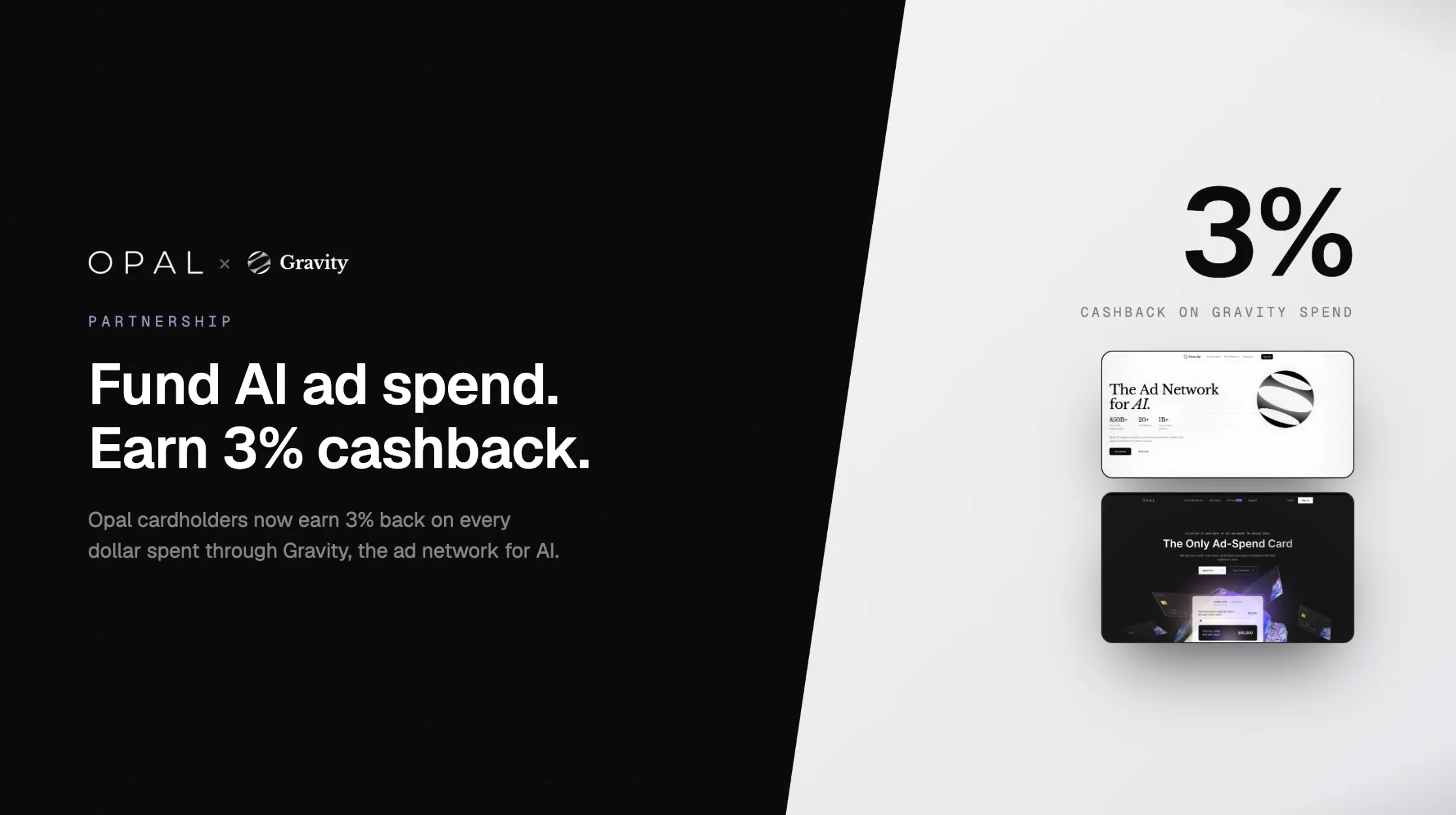
Opal and Gravity have partnered to give growth teams a complete stack for AI advertising: Gravity to launch and measure campaigns across AI platforms, and Opal to fund that spend with the credit capacity and controls that fast-moving budgets require.
-
Opal customers who pay eligible Gravity ad spend with their Opal card receive 3% cashback, credited to their Opal account monthly (subject to Opal's availability and terms).
As brands and agencies begin shifting budget into AI-driven ad channels, this partnership removes two of the biggest friction points: finding a platform to run AI campaigns and finding a card that can actually keep up with the spend.
Discovery is changing faster than most media plans account for. Consumers are turning to AI assistants, chatbots, and agent-powered apps to research purchases and compare options. Not just to answer questions. To make decisions.
That shift has opened a new advertising surface: conversational advertising inside the AI-native experiences where attention now lives. The window to establish a presence before the channel matures is narrowing. Brands that were early to search and social captured outsized returns before CPMs normalized. The same dynamic is playing out now in generative AI advertising environments.
For growth teams, the question is no longer whether to allocate budget toward AI customer acquisition. It is how to execute efficiently when the infrastructure, the platforms, the card limits, and the reward structures were not built with this channel in mind.
That execution gap is what the Opal and Gravity partnership addresses. If your team is moving budget into AI-driven ad channels, two things need to work together: a platform built to run campaigns inside AI environments, and an AI ad spend credit card with the credit capacity and rewards to match the opportunity.
AI Advertising Is Becoming a New Growth Channel
Search and social still dominate most paid media budgets, but the discovery layer underneath them is shifting. Consumers are increasingly turning to AI assistants, chatbots, and agent-powered apps to research purchases, compare options, and get recommendations. That creates a new surface for advertisers: AI search advertising and conversational advertising inside the tools people are already using daily.
Gravity is an AI ad network built specifically for this environment. Advertisers use it to create, launch, and track campaigns across AI platforms, reaching users inside the AI-driven experiences they are already in. Gravity supports campaign objectives including conversions, clicks, and reach, with contextual targeting and real-time optimization built into the platform. For brands exploring advertising in AI assistants, it is one of the few platforms purpose-built for that placement.
The business case is straightforward: if your customers are spending meaningful time in AI interfaces, your AI marketing budget should be there too.
Getting positioned before the channel matures and CPMs climb is the opportunity. Brands and agencies that establish a presence in AI advertising now will have a structural advantage over those who wait until the playbook is obvious.
The challenge for most teams is not interest. It is execution. Running a new ad channel requires budget capacity, card infrastructure that can handle the spend, and a way to make the economics work. That is where Opal comes in.
Most marketers are not struggling because they do not believe in AI advertising. They are struggling because every new channel creates operational friction. Budgets, payment infrastructure, reporting, and approval workflows usually lag behind media innovation. The channel opens before the tooling catches up.
How AI Advertising Differs from Traditional Paid Media
Search and social advertising follow a familiar logic: a user expresses intent (a search query, a scroll, a click), the platform matches that signal to an ad, and the advertiser pays for the impression or action. The mechanics are well-understood. The playbook is established.
AI advertising operates differently at a fundamental level.
Intent is inferred, not declared
On Google Search, a user types "best project management software" and the intent is explicit. In AI search advertising, a user might ask a chatbot to help them plan a product launch. The intent is present but embedded in a conversation, not a keyword. Reaching users at that moment of engagement, without disrupting the experience that made the channel valuable, is the core challenge of conversational advertising.
Gravity's contextual targeting is designed for exactly this. It identifies relevant moments inside AI conversations and matches them to appropriate ads, without relying on keyword bidding or behavioral retargeting.
The format and placement are new
Traditional display and search ads appear in defined slots: above organic results, in a sidebar, between social posts. AI advertising surfaces inside conversational interfaces, agent responses, and AI-powered apps. There is no standard slot. The ad exists within a context, which means creative, messaging, and targeting all need to be rethought for the environment.
This is not inherently harder than traditional paid media. It is just different, and teams that approach it with a search or social mental model will likely misread the results early on.
Measurement is still maturing
Attribution on AI platforms is less standardized than on Google or Meta. Last-click models do not map cleanly to conversational interactions. View-through attribution gets complicated when the "view" is an AI response. Gravity provides real-time optimization and campaign tracking. Even so, advertisers should expect to spend time calibrating how they measure success in this channel versus how they measure it elsewhere.
The practical implication: treat generative AI advertising as a distinct channel with its own learning curve, not a plug-and-play extension of your existing paid media stack. Budget for testing. Measure incrementally. Make sure the infrastructure behind the spend, card limits, virtual card controls, and reporting, is set up before scale arrives. With AI customer acquisition, that moment tends to come faster than teams expect.
What the Opal and Gravity Partnership Delivers
Think of the Opal and Gravity partnership as two purpose-built tools combined into a single workflow for teams running AI ad campaigns.
Gravity handles the campaign side. Advertisers use it to build and launch campaigns across AI platforms, set objectives, apply contextual targeting, and track performance in real time. It is a full-stack solution for running ads in AI-driven environments, not a workaround bolted onto an existing platform.
Opal handles the funding side. As the corporate card built for digital ad spend, Opal gives you the credit capacity to keep campaigns running. Pay eligible Gravity ad spend with your Opal card and you earn 3% cashback, credited to your Opal account monthly. That cashback is an Opal partner perk, subject to Opal's availability and terms.
Put them together and growth teams get what they actually need to operate in this channel:
A platform to reach users inside AI experiences
Credit capacity to fund campaigns at scale
Rewards that reduce the net cost of that spend
Card controls to manage budgets cleanly across campaigns and clients
This is not a co-marketing arrangement. It is a functional integration of two tools that solve adjacent problems in the same workflow.
Why Opal Is Built for Ad Spend
Most business cards were not designed with digital advertising in mind. They cap out at limits that do not match real campaign budgets, require personal guarantees, and offer generic rewards that have nothing to do with media spend.
Opal was built specifically for businesses running significant digital ad budgets, and the product reflects that from the ground up.
Credit Capacity That Matches Your Budget
Opal offers 10-20x higher credit limits than most standard business cards. For teams scaling campaigns across multiple channels, that headroom is not a nice-to-have. It is what keeps campaigns running without hitting limits mid-flight.
Feature |
Opal |
Standard Business Card |
|---|---|---|
Credit limit |
Up to $10M |
Typically $10K–$50K |
Personal guarantee |
No |
Usually required |
Credit check |
No |
Required |
Virtual cards |
Unlimited, free |
Limited or unavailable |
Ad spend cashback |
Up to 3% (Gravity), up to 2% (other eligible platforms) |
1–1.5% general rewards |
Customer support |
24/7 |
Standard business hours |
Built for ad spend |
Yes |
No |
Card Controls Built for Paid Media
-
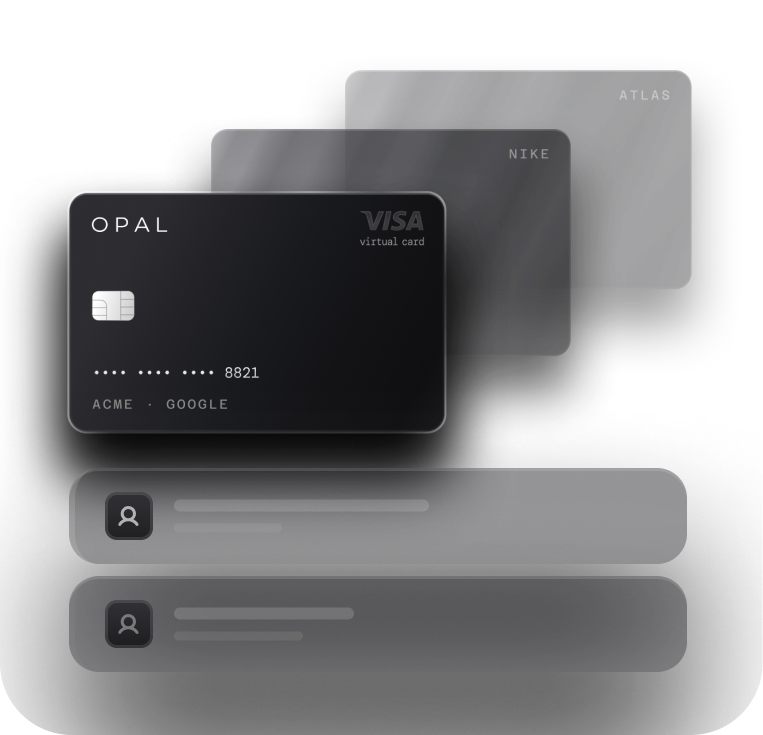
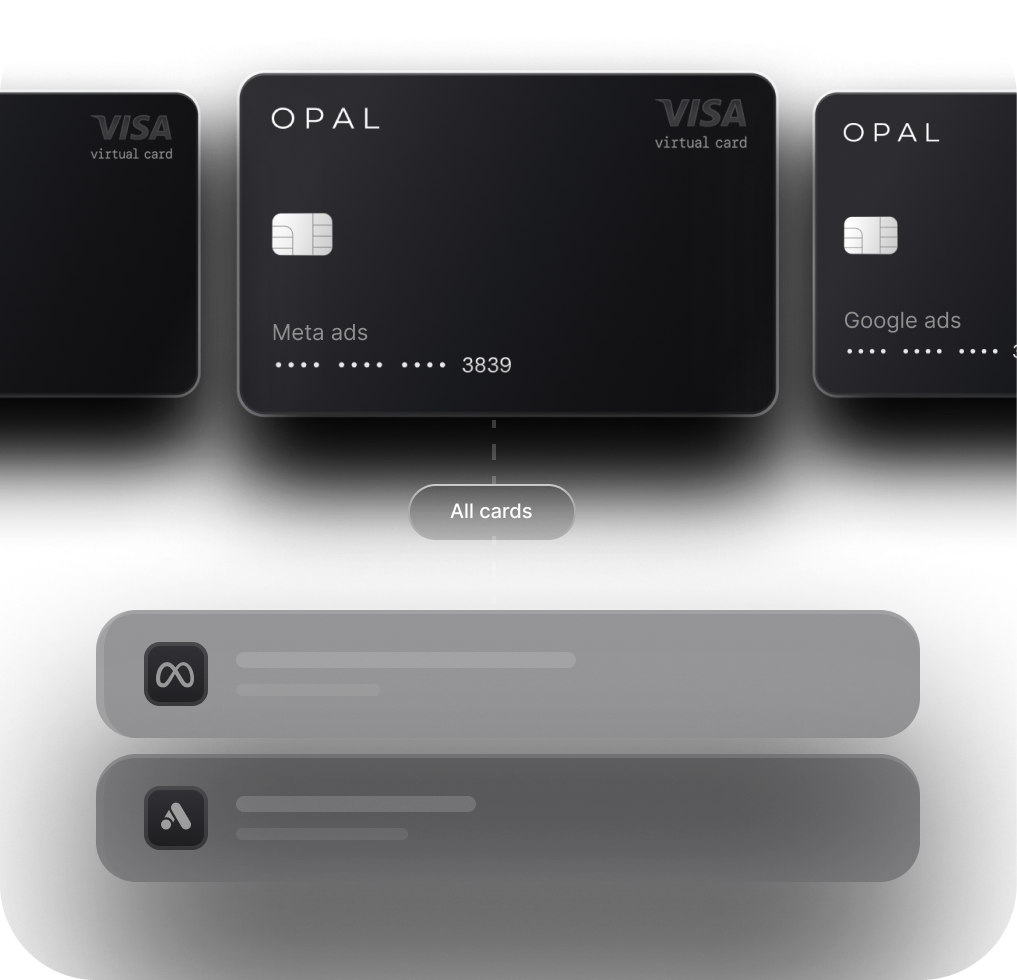
Unlimited virtual cards for campaign-level, client-level, or channel-level spend separation
-
No personal guarantee required
-
No credit check to get started
-
24/7 customer support for teams that cannot afford downtime when a campaign is live
Rewards on the Spend You Are Already Running
Opal offers up to 2% cashback on other eligible digital ad spend, including platforms like Google, Meta, and TikTok. The Gravity partnership adds a higher 3% cashback tier for eligible Gravity spend paid with an Opal card.
If you are running significant budget across multiple channels, the cashback compounds quickly. It is not a marketing claim. It is math: more spend, more cashback, lower effective cost per dollar deployed.
A Better Setup for Agencies and Growth Teams
Whether you are running campaigns in-house or managing budgets across multiple clients, the partnership is built to fit both operating models.
For Agencies
Running multiple clients on a single card is a reconciliation problem waiting to happen. And yet that is exactly how most agencies operate, not because they want to, but because the card infrastructure they have does not give them a better option. With Opal, agencies can issue unlimited virtual cards and assign them by client, campaign, or channel. Clean spend separation from day one, not a cleanup job at month-end.
Eligible Gravity spend run through an Opal card qualifies for 3% cashback, including client campaign spend where applicable. Subject to Opal's terms. For agencies handling significant managed spend across clients, that adds up fast.
The operational picture looks like this:
One virtual card per client or campaign
Gravity spend tagged and tracked at the card level
Cashback credited monthly to the Opal account
No personal guarantee tying the agency owner's credit to client spend
For In-House Growth Teams
In-house teams benefit from the same infrastructure. Separate virtual cards for each channel or campaign make budget tracking straightforward, and higher credit limits mean campaigns do not stall because a card hit its ceiling. The 3% cashback on eligible Gravity spend reduces the net cost of testing and scaling a new channel.
Traditional banking friction, card limits, and generic reward structures were not built for the way performance marketing teams actually operate. Opal was.
The brands that win in new ad channels are rarely the ones with the biggest budgets. They are the ones who removed the operational bottlenecks early, before those bottlenecks became a competitive disadvantage.
How to Get Started
Setup is straightforward. Here is how it works:
-
Get set up with Opal. Apply for your Opal card at opalspend.com/partners-gravity. No personal guarantee and no credit check required.
-
Create and launch a Gravity campaign. Visit trygravity.ai/opal to set up your Gravity account and build your first AI ad campaign.
-
Pay eligible Gravity ad spend using your Opal card. Use your Opal card as the payment method for Gravity campaigns.
-
Receive 3% cashback monthly. Eligible cashback is credited to your Opal account each month, subject to Opal's availability and terms.
Ready to move budget into AI advertising? Book a call with the Opal team to discuss how the partnership works for your specific setup. Whether you are an agency managing client budgets or an in-house team scaling paid acquisition, Opal is the purpose-built AI ad spend credit card for the way growth teams actually operate.
Who This Partnership Is Best For
Not every business is at the same stage with AI advertising, but a few profiles tend to get the most out of combining Opal and Gravity from day one.
Performance marketing agencies managing spend across multiple clients benefit immediately. Virtual cards let you separate Gravity campaigns by client, track spend cleanly, and earn 3% cashback on eligible spend without commingling budgets. The credit capacity scales with your book of business, not your cash on hand.
In-house growth teams at scaling brands that are already running paid acquisition on Google and Meta and want to test AI advertising channels without adding a new card, a new approval workflow, or a new reconciliation headache. Opal handles the funding infrastructure; Gravity handles the campaign side.
Direct-to-consumer brands with meaningful monthly ad budgets and a need to reach customers earlier in the purchase journey. If your customers are researching in AI assistants before they ever hit a search results page, being present in that environment is a strategic priority, not an experiment.
Media buyers and paid acquisition leads who are responsible for hitting CAC targets across a growing channel mix. A purpose-built AI ad spend credit card with higher limits, virtual card controls, and cashback on Gravity spend reduces the operational friction of adding a new channel to the stack.
Early-stage AI advertising testers who want to allocate a defined budget to Gravity campaigns, measure incrementally, and scale up without being constrained by card limits or generic reward structures that do not account for ad spend.
If your team is already running paid media at scale and is evaluating AI advertising as a growth channel, this partnership is built for exactly that transition.
Frequently Asked Questions
How does the Opal and Gravity partnership work?
Gravity is an AI ad network that lets advertisers create, launch, and track campaigns across AI platforms. Opal is the corporate card built for digital ad spend. Through this partnership, Opal customers who pay eligible Gravity ad spend with their Opal card receive 3% cashback, credited monthly. The two platforms work together to give growth teams a complete stack for running and funding AI ad campaigns.
How does the 3% cashback on Gravity ad spend work?
When you use your Opal card to pay for eligible Gravity ad spend, 3% cashback is credited to your Opal account on a monthly basis. This is an Opal partner perk and is subject to Opal's availability and terms. Not all Gravity spend may qualify; eligibility is determined by Opal.
Do I need to be an Opal customer to receive the cashback perk?
Yes. The 3% cashback on eligible Gravity spend is an Opal partner benefit. You need an active Opal card and must use it as the payment method for Gravity campaigns to qualify.
Can agencies earn the perk on client campaign spend?
Eligible Gravity spend run through an Opal card can qualify for 3% cashback, including client campaign spend where applicable, subject to Opal's terms. Agencies should confirm specifics with the Opal team when setting up their account.
Where do Gravity ads run?
Gravity runs ads across its network of AI platforms, chatbots, agents, and consumer AI apps. Gravity supports campaign objectives including conversions, clicks, and reach, with contextual targeting and real-time optimization. For the most current information on platform availability, visit trygravity.ai.
What makes Opal a strong card for ad spend?
Opal is purpose-built for businesses with significant digital advertising budgets. Key features include 10-20x higher credit limits than most standard business cards, unlimited virtual cards for campaign and client-level spend separation, no personal guarantee, no credit check, and 24/7 customer support. Opal also offers up to 2% cashback on other eligible digital ad spend across platforms like Google, Meta, and TikTok. The Gravity partner program adds a higher 3% cashback tier on eligible Gravity spend.