

Corporate Credit Card Controls: How Agencies Prevent Unauthorized and Over-Budget Ad Spend

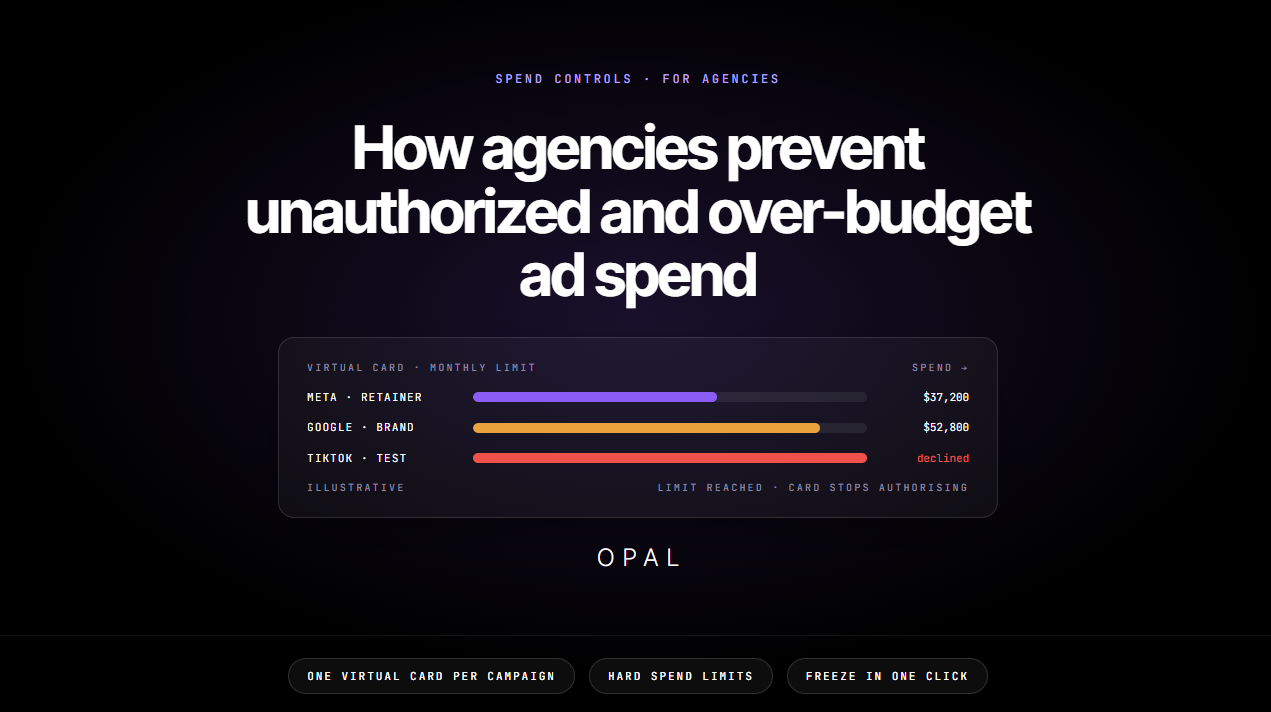
Corporate credit card controls are the conditions a company writes onto a payment card, tested by the issuer at authorization before any charge posts. For an agency funding client campaigns, that timing separates a budget you can enforce from a budget you can only report on.
The four standard control types are:
-
Spending ceiling: A cap that resets on a chosen cycle, refusing anything above it
-
Merchant restriction: A lock to specific vendors or merchant category codes
-
Expiry date: A hard cutoff after which the card number stops working
-
User permissions: Rules governing who may use or administer the card
Advertising is the hardest category to govern this way, because the money leaves on the platform's schedule rather than yours. Meta Ads, Google Ads, TikTok Ads, LinkedIn Ads, Amazon Ads, and The Trade Desk all charge a stored payment credential automatically, either when accrued costs reach a billing threshold or when a cycle closes. Google's automatic payments documentation sets the rule plainly: an account is billed 30 days after its last automatic payment, or when costs reach the billing threshold, whichever comes first. Nobody approves those charges as they happen, which leaves the card as the final enforcement point between a media buyer's decision and money leaving your account.
Key Takeaways
Card rules are tested while a charge is being authorized, so anything outside them fails at that moment and never reaches your statement.
A campaign budget inside an ad platform governs how fast the platform buys, not how much it may ultimately charge you, and anyone with account access can raise it without leaving a trace in your finance system.
The Association of Certified Fraud Examiners (ACFE) found that more than half of occupational fraud cases involved either a lack of internal controls or an override of the controls already in place.
A merchant lock, built on the merchant category code (MCC) the card network assigns each vendor, renders a leaked card number unusable anywhere except the platform it was issued for.
Setting a card ceiling exactly at a client's approved budget produces a decline on the strongest spending day of the month, which is why experienced teams set the ceiling above forecast and treat it as a backstop.
Controls stop spend that is unauthorized, misattributed, or above a hard ceiling. They do not stop a buyer from spending an approved budget badly.
What Are Corporate Credit Card Controls, and Where Are They Enforced?
Controls are conditions attached to an individual card and checked by the issuer before a charge is approved. That placement is the whole point, because the allow-or-refuse decision lands before money moves rather than during a reconciliation weeks later.
Which Rules Sit on the Card Itself
A control is any condition the issuer evaluates at authorization. The common ones are a ceiling that resets on a chosen cycle, a restriction naming which merchants or categories the card accepts, an expiry date, and permissions governing who may use or administer it.
Because each rule is written to the card rather than the account, one credit line can carry many cards with different rules on each. A business holding a $3M line might run 60 cards with ceilings from $2,500 to $250,000, and exhausting any one leaves the other 59 working normally. That isolation makes per-card spending limits containment rather than just accounting.
Why Authorization Timing Changes the Outcome
An after-the-fact policy tells you something went wrong, while a control tells the merchant no. The gap between them shows up in what each costs to resolve: a declined charge needs a conversation, while a posted charge needs a refund request, a credit note, or an awkward line on a client invoice.
The ACFE's Report to the Nations, drawn from 2,402 cases across 143 countries, puts numbers on that gap. Cases caught within 6 months carried a median loss of $40,000, while the median case ran 12 months before anyone noticed and cost $104,000. Detection speed, not detection itself, is what determines the size of the hole.
Why Does a Campaign Budget Fail to Stop Over-Budget Spend?
A campaign budget is a pacing instruction to the platform, editable by anyone with the right role in the ad account. Treating it as a spending control is the most common reason an overage surfaces at invoicing rather than on the day it happened.
How Daily Budgets Overdeliver
Meta and Google can both spend above a stated daily figure and balance the difference across the period. The budget steers how aggressively inventory gets bought without drawing a firm line at the close of each day, which is why campaign budget pacing and a hard ceiling do two different jobs.
Lifetime and account-level caps behave more predictably, though they still sit inside the platform. A cap the platform enforces is only as strong as the access controls on that account.
Who Can Change a Budget Without Telling Finance
Budget fields are edited by the people running campaigns, which is correct operationally and invisible financially. That invisibility sits behind most over-budget months. There is rarely a decision to overspend, only a run of reasonable adjustments that nothing downstream was set up to catch.
Common scenarios where this creates a problem:
A buyer raises a daily budget on Friday to capture weekend traffic, then forgets to lower it Monday
A campaign is duplicated with the original budget intact, doubling spend on the same audience
A test campaign's budget is raised to "see what happens" and left running after the test ends
An account manager updates a budget during a client call and the change never reaches finance
How Do the Two Control Layers Compare?
Spend on an advertising account is governed in two places at once, and the layers differ on who holds the pen and when the rule bites. Side by side, it is clear which failures each one catches.
|
Platform-Side Budget |
Card-Side Control |
|
|---|---|---|
|
Where the rule lives |
Inside the ad account |
On the card, at the issuer |
|
Who can change it |
Anyone with account access |
Whoever holds admin rights on the card program |
|
When it is enforced |
During delivery, as pacing |
At authorization, before the charge posts |
|
What happens at breach |
Spend continues, balanced across the period |
The charge is declined |
|
What it cannot stop |
Charges from a credential stored elsewhere |
A buyer spending an approved budget poorly |
|
Record it leaves |
A change in the platform's edit history |
A decline on the card, visible to finance |
Where Each Layer Fails First
The platform layer fails on access, trusting everyone who can log in. The card layer fails on tightness, because a ceiling set too close to real spend will decline a legitimate threshold charge and pause delivery at the worst moment.
Neither failure argues for dropping a layer. Set the platform budget to the number the client approved, then set the card ceiling above forecast so it fires only on genuine anomalies.
How to Pair the Layers in Practice
Give each client card a ceiling with headroom above the approved budget, sized against the account's billing threshold rather than its monthly total. A client running $90,000 a month through an account that bills at a $900 threshold produces about 100 separate charges, so a ceiling that looks comfortable monthly can still be exhausted by a cluster in one week.
A practical setup for each client card:
-
Set the platform budget to the client's approved monthly figure
-
Set the card ceiling above that figure, sized against the account's billing threshold
-
Add a spend alert at 80% of the ceiling so it is never your first warning
-
Review threshold billing cadence for each platform, since a cluster of charges in one week can exhaust a monthly-looking cap early
Guidance on sizing those thresholds by client is in our piece on monthly client budgets.
Which Controls Actually Stop Unauthorized Charges?
Three control types do most of the work against charges nobody approved, and each closes a different route in. They are worth separating, because they fail in different ways.
Merchant Locks and Category Codes
A merchant lock ties a card to one approved vendor, and card networks assign every vendor a merchant category code under the ISO 18245 standard. A charge attempted outside that lock is refused at authorization, so a number leaking from an ad account, a shared password manager, or a contractor's dashboard cannot be spent elsewhere.
The quieter benefit shows up monthly. Merchant-locked virtual cards produce statement lines that need no interpretation, because only one vendor could have charged that card.
Per-Transaction Caps Versus Period Caps
A period cap governs total exposure over a month or cycle. A per-transaction cap governs the size of any single commitment, which is the control that matters when the risk is one large mistaken charge rather than gradual drift.
Advertising needs both, sized differently. Threshold billing fires many small charges rather than one large one, so a per-transaction cap sized for a subscription blocks legitimate platform charges, while a period cap alone leaves one oversized charge unchallenged.
Expiry Dates on Short-Lived Cards
A card issued for a fixed flight can carry an expiry that matches it. Once the campaign ends, the number stops working without anyone remembering to close it, removing the standing liability of a live credential sitting in a platform's billing settings.
Single-use cards take the idea further, expiring after one cleared transaction. They suit one-off vendor payments rather than ad accounts, where a platform charging repeatedly against a stored method will fail on the second attempt.
What Can Card Controls Not Prevent?
Controls govern whether a charge is allowed, not whether it was a good idea. Being precise about that boundary is what keeps a control policy credible with the media team.
Spend That Is Authorized but Ineffective
A card cannot tell a wasted impression from a converting one. If a buyer runs an approved budget into an audience that does not convert, every charge is legitimate and every control passes it through. That failure belongs to campaign review rather than to your payment stack, and the controls only guarantee the waste is attributed to the right client and capped at the right number.
Changes Made Inside the Ad Account
Card rules cannot reach into a platform to stop a budget being raised or an audience widened. What they can do is cap the consequence, which is why the two layers are worth running together. Deciding who holds account access is a separate exercise, and we cover it in our guide to media buyer permissions.
How Do Controls Change What You Can Prove Later?
Controls produce evidence as a side effect, and that evidence turns a difficult client conversation into a short one. The record a control leaves is often worth more than the single charge it stopped.
Declines Leave a Cleaner Record Than Reversals
A decline is a closed event, in that nothing posted, nothing needs reversing, and the log shows a rule doing its job at a specific moment. A reversal is an open one, involving a merchant, a timeline, and a balance that was wrong for a period, all of which have to be explained to whoever reads the statement.
Attribution That Holds Up in a Client Review
Where a single card covers exactly one client on exactly one platform, every charge arrives already labelled, so a client questioning a figure can be answered from the card ledger rather than from a spreadsheet someone assembled by hand. That is the difference between showing a client your records and rebuilding them afterwards, and a rebuilt figure is the part a client cannot check independently, which is where disputes start.
Put Ad Spend Card Controls in Place With Opal
Our platform gives you the card layer described above, configured around the way your team actually buys media. We issue virtual cards without limit and charge neither an annual fee nor a fee per card, so separating every client, platform, and campaign costs nothing in card charges.
What You Configure
On each card you set the ceiling, the merchant restriction, the approval rule, and who may touch it, then change any of them instantly without reissuing the number or interrupting a recurring charge.
What you get on every account:
-
Unlimited virtual cards at no cost per card, one per client, platform, or campaign
-
Instant control changes without reissuing the card number or pausing delivery
-
Single dashboard covering every client account and every transaction as it posts
-
Up to 2% cashback on eligible advertising purchases, at a rate confirmed at approval
-
Credit sized to ad volume, not your bank balance, with no personal guarantee and no credit check
-
2 to 3 minute setup via our agency spend platform
What We Provide and Where the Limits Sit
The Opal Card is issued by First Internet Bank of Indiana, Member Federal Deposit Insurance Corporation (FDIC), pursuant to a license from Visa Inc., with credit provided by CapitalOS. It is a pay-in-full charge card, so the full statement balance is debited on each monthly due date, and the card can be locked if that payment does not clear.
Card use is confined to supported advertising and media platforms rather than general business spend, so read through the supported list before you migrate an existing account. Ad Pay, our invoice payment product, is a separate early-access offering carrying a per-payment processing fee rather than an included card feature.
Frequently Asked Questions (FAQs)
How Does a Card Limit Differ From a Campaign Budget?
The budget sits in the ad account, governs how quickly inventory gets bought, and can run past its daily figure. The limit sits with the issuer and refuses anything above it. One is a pacing instruction, the other a ceiling applied while the charge is being authorized.
Can Card Controls Stop a Media Buyer From Overspending?
They cap the consequence rather than the decision. A buyer can still raise a budget inside the ad account, but the card refuses any charge above its ceiling, so the overage stops at a number you chose in advance rather than surfacing on the client invoice.
Will a Spending Limit Cause My Ads to Stop Running?
It will if the ceiling sits too close to actual spend. Because platforms bill at thresholds, a strong month can exhaust the cap early, and a run of refusals can change how the platform handles that account. Build headroom above your forecast and this mostly stops being a concern.
When Does a Merchant Restriction Actually Take Effect?
At authorization, before anything posts. A charge attempted at a merchant outside the rule is refused in that moment, so there is nothing to dispute, reverse, or write off later, and the attempt still lands in your records as a declined transaction you can review.
How Many Cards Does an Agency Actually Need?
It depends on how many dimensions you need to answer questions about. A card for each client is the baseline for clean attribution, and agencies buying across several platforms usually add one card per platform on top, which turns 12 clients and 5 platforms into 60 cards.
Do Controls Replace an Approval Process?
They replace most routine approvals and sharpen the rest. When a limit, a merchant lock, and a permission already encode what someone is allowed to commit, approvals can be reserved for genuine exceptions instead of acting as a queue that every ordinary charge has to pass through.
Is Opal a Credit Card?
No. Opal is a pay-in-full charge card built for advertising and media spend. The full statement balance is debited on each monthly due date, so there is no revolving balance and no interest. The card controls described on this page work the same way on a charge card as they do on a credit card.