


How Agencies and Growing Businesses Choose the Best Business Credit Card for Advertising

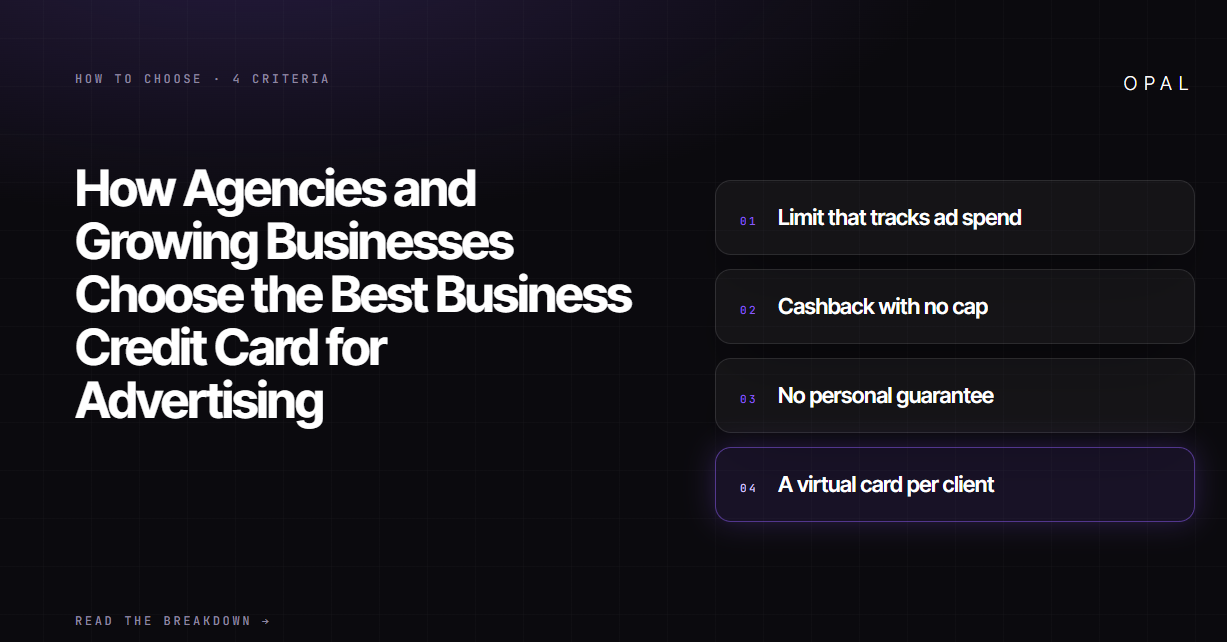
The best business credit card for advertising is the card whose credit line is underwritten against advertising volume, whose rewards rate holds at your actual annual spend, and whose issuer, lender, and settlement terms you can name before you apply. Agencies and growing businesses reach that card by working through four checks in order: how the limit gets set, which terms are published before you apply versus decided at underwriting, what the cardholder agreement says about settlement and fees, and which regulated entity issues the card and extends the credit behind it.
Digital advertising concentrates company spending into a very short list of merchants. The Interactive Advertising Bureau (IAB) and PwC internet advertising revenue report puts United States internet advertising revenue at $294.6 billion, growing 13.9%, with the top 10 sellers holding 84.1% of that total, so most of a marketing budget lands on Meta Ads, Google Ads, TikTok Ads, LinkedIn Ads, Amazon Ads, and The Trade Desk. That concentration meets a legal fact few buyers check. Under Regulation Z, the rule in Title 12 of the Code of Federal Regulations that implements the Truth in Lending Act, an extension of credit primarily for a business purpose is an exempt transaction, so the disclosure and dispute machinery attached to a personal card does not travel automatically to a business one.
Key Takeaways
Credit extended primarily for a business purpose is exempt from Regulation Z, so most of the disclosure and billing-dispute framework you expect from a personal card is replaced by whatever the cardholder agreement says.
The rules covering card issuance and liability for unauthorized use apply to every credit card even when the underlying credit is exempt, so an unauthorized charge and an internally disputed one follow different paths.
An agency and a growing business rank the same card differently: the agency is buying separation and a defensible record per client, while the growing business is buying headroom that keeps pace with revenue.
A limit underwritten on managed advertising volume grows with the media you run, so the ceiling tracks the thing that is actually scaling.
Annual fee, per-card fees, country eligibility, and supported ad platforms can all be confirmed from published pages before you apply. The approved limit and approved rewards rate are decided at underwriting.
The Opal Card is a pay-in-full charge card issued by First Internet Bank of Indiana, Member FDIC, with credit provided by CapitalOS, and requires no annual fee, no credit check, and no personal guarantee.
Are Business Credit Cards Covered by the Same Rules as Personal Cards?
Short answer is no. An extension of credit primarily for a business, commercial, or agricultural purpose is listed as an exempt transaction in Regulation Z, and so is credit extended to anyone other than a natural person. Two cards can look identical in the wallet while resting on very different rulebooks.
Which Card Protections Survive the Exemption
The exemption is broad but not total. Rules on the issuance of credit cards and on liability for their unauthorized use apply to all credit cards, even when the credit behind them is exempt. Outside that carve-out sit disclosure requirements, the billing-error procedure, and the right to raise claims and defenses against an issuer.
The distinction bites hardest in advertising, where the usual problem is a charge you recognize but nobody approved. A media buyer raising a daily budget without sign-off creates a legitimate transaction, and no regulation will unwind it. Control has to sit on the card before the charge.
What to Read in the Cardholder Agreement
Read the agreement for four clauses before applying rather than after approval: the settlement terms and the consequence of a failed payment, the fee schedule including per-card fees, the section on how a credit line can be reduced or withdrawn, and any clause that defines what counts as an eligible advertising transaction for rewards purposes.
Ask the provider to point you to each clause by name. A program that answers with a marketing page instead of an agreement section has told you how the rest of the relationship will run.
If personal liability and guarantee terms are your primary concern, the dedicated guide on business cards with no personal guarantee covers what an owner is actually signing in detail.
How Do Agencies and Growing Businesses Weigh the Same Card Differently?
Both buyers want a high limit and a good rate, then they diverge completely. An agency places money belonging to someone else and has to prove where it went, while a growing business places its own money ahead of the revenue that spending is meant to produce.
What an Agency Needs the Card to Prove
An agency credit card for ad spend carries an evidentiary job an in-house card never has. Every charge has to map to one client, one platform, and one campaign cleanly enough to survive a client asking for a breakdown months later, which is why per-client card numbers outrank the headline rate.
Offboarding is the second job. When a retainer ends, the agency has to stop that client's spending capacity without touching another account, and a shared card number makes that impossible.
What a Growing Business Needs the Card to Absorb
A growing business fights a timing problem rather than an attribution problem. Media spend leaves before the revenue it generates arrives, so the card has to absorb a widening gap without hitting a ceiling mid-month.
The second requirement is that the ceiling moves without being asked. A business filing a limit increase request every time performance improves is running its growth through a support queue.
Where Both Buyers Land in the Same Place
The two requirement sets converge on the same short list of card properties, which is why one product can serve both. The table below sets the buyers side by side on the factors that decide the choice.
|
Decision Factor |
Agency Placing Client Budgets |
Growing Business Placing Its Own Budget |
|---|---|---|
|
Whose money moves first |
Client budgets, often fronted before the client pays |
Company cash, spent ahead of the revenue it produces |
|
What breaks first at scale |
Separation between client accounts and the record behind it |
The monthly ceiling, as budgets step up month over month |
|
How capacity has to grow |
Client by client, as the book of business grows |
With revenue and campaign performance |
|
What the card has to prove |
Which client and campaign every charge belongs to |
That marketing spend reconciles to a channel and a return |
|
Who audits the record later |
The client, usually during a billing question |
An accountant, a lender, or a board |
|
Cost of the wrong card |
A disputed invoice and a damaged retainer |
A paused campaign and lost momentum |
|
Liability question that matters |
Whether an owner guarantees spending that belongs to clients |
Whether an owner's personal credit is tied to growth |
How Is a Card for High-Volume Advertising Underwritten?
Underwriting decides everything downstream, because the approved limit is the true ceiling on what a card can do. Two models dominate, and they produce very different outcomes for a business whose spending concentrates in media.
Limits Set Against Personal Credit
Traditional business cards assess the owner rather than the operation. The limit follows a personal credit file and the issuer's view of the individual, which caps a business whose media volume has outgrown its owner's credit profile. The ceiling stops moving when the credit file stops improving, regardless of how much advertising volume the business manages.
Limits Set Against Managed Advertising Volume
The alternative model underwrites the media operation itself. Capacity is assessed against the advertising volume a business manages, so the limit tracks the thing that is growing rather than a credit file that is not.
This model usually arrives as a charge card rather than a revolving line, because flexing capacity suits recurring spending that is repaid in full. Our business charge card entry explains why that structure suits media budgets, and our charge card comparison sets the two against each other at volume.
If your primary concern is eliminating personal liability entirely, how agencies get high ad spend limits without a personal guarantee covers the mechanics in detail.
How Do You Pick the Best Business Credit Card for Advertising?
Pick it by separating what you can confirm today from what only an application will tell you, then shortlist on the confirmable half. Four terms are published on any serious card's own pages, and the two terms that matter most are not published at all.
Terms Published on the Card's Own Pages
Four things can be verified before you spend a minute on an application. Check the annual fee and whether additional cards carry a fee of their own, which countries and entity types are eligible, which advertising platforms the card is designed to run on, and whether a personal guarantee or credit check is required.
Do that checking on the provider's own pricing, terms, and disclosure pages rather than a comparison article, and save the page you relied on. Providers change terms, and a dated copy is your only record of what was on offer when you applied.
Looking at a specific platform or a side-by-side comparison? For Google Ads specifically, credit cards for Google Ads with high limits covers billing thresholds and campaign continuity in detail. To compare Opal directly against another provider, those guides go deeper on platform-specific limits and product differences than this page does.
Terms That Only Appear at Underwriting
The approved credit limit and the approved rewards rate are set when your application is assessed, so any published figure is a ceiling rather than an entitlement. A provider quoting an exact limit before reviewing your volume is quoting a number it cannot yet know.
Ask three questions in writing before you apply. Ask what determines the approved limit, how often it is reviewed once the account is open, and whether the rewards rate carries a category ceiling your last 12 months of invoices would cross.
Who Issues the Card, and What Are You Agreeing to Repay?
A card program usually involves three parties, and knowing which is which tells you who holds the banking relationship, who carries the credit risk, and who you escalate to. Read the disclosure at the foot of the provider's site, because that is where the arrangement is stated plainly.
Separating the Issuer, the Lender, and the Program
The issuing bank puts the card on a network, the lender extends the credit, and the program operator runs the product and the dashboard. Our site disclosure names all three: the Opal Card is issued by First Internet Bank of Indiana, Member FDIC, pursuant to a license from Visa Inc., with credit provided by CapitalOS depending on your location and underwriting requirements.
Look for the same three names on every card you consider. A program that cannot name its issuing bank is one you cannot assess.
What Pay-in-Full Settlement Commits You To
Charge cards settle in full each cycle, and the mechanics belong in your diligence. Our card debits the full statement balance from your designated bank account or Opal Balance on each monthly due date, and a debit that fails can leave the card locked until the balance clears.
Treat that as a cash planning requirement rather than a footnote. Confirm the due date, the account the debit hits, and the consequence of a failed debit, then keep enough there for a heavy media month.
Choose Your Next Card With the Opal Card on the Shortlist
Run the checks above against our card and compare the answers with anything else on your list. We built the Opal Card for businesses whose largest recurring expense is media, and we publish the terms that decide it.
What We Provide
We provide credit underwritten against managed advertising volume, with limits of up to $10 million, and require neither a personal guarantee nor a credit check to apply. We pay cashback of up to 2% on eligible advertising spend, at a rate confirmed when your application is approved, and take no percentage of your media spend. If you want to run the cap math against your current card, the hidden cost of cashback caps on ad spend does that calculation at three spend levels.
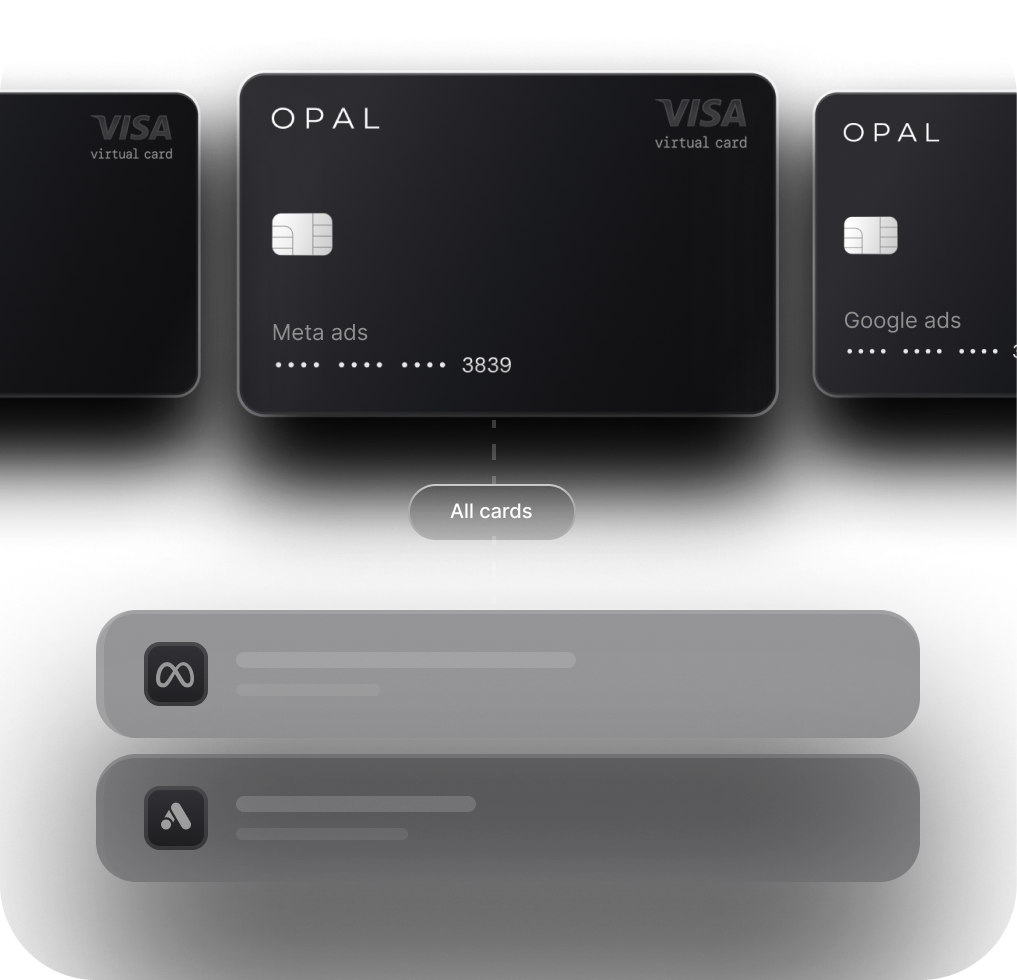
Every account carries unlimited virtual cards at no annual or per-card cost, plus spend limits, merchant restrictions, approvals, and employee permissions. Transactions sync to QuickBooks and Workday.
What You Configure
You decide the card structure and the rules each card carries. Issue a card for each client, platform, campaign, or employee, then set the limit, the merchant restriction, and the approval rule on each. Our guide to structuring client cards covers the common models, and our agency ad spend platform page shows how the workspace maps to agency teams.
You also choose the settlement account and the reporting cadence. There is no cancellation fee, so the commitment you are testing is operational rather than contractual.
Where Our Card Is Not the Right Fit
We support United States businesses, so a company incorporated elsewhere is not eligible today. The card is built for advertising and media platform spending rather than general operating expenses, which makes it a poor single card where media is a small share of total spend.
Two further boundaries are worth stating plainly. The card settles in full every cycle, so a business that needs to carry a balance should look at a revolving product, and our Ad Pay invoice product is an early-access add-on carrying a per-payment fee of 3% on Opal credit or 3.5% on your own card rather than an included feature. Where a corporate card definition built around employee expense policy fits better, say so and buy that instead.
What Else Do Buyers Ask Before Choosing a Card?
The questions below surface once a shortlist exists and the marketing pages have been read. Each answer is written to stand on its own, so you can lift one straight into a procurement note or a board paper without the surrounding context.
Does a Business Card Give Me the Same Dispute Rights as My Personal Card?
Not automatically. Credit extended primarily for a business purpose is exempt from Regulation Z, so the billing-error procedure and disclosure rules attached to consumer cards do not apply by default. Rules on card issuance and on unauthorized-use liability still cover every credit card. Remaining dispute rights come from the cardholder agreement, which is why reading it before you apply matters.
What Credit Limit Should a Business Actually Ask For on an Ad Spend Card?
Size the limit against peak monthly media volume rather than average volume, then add headroom for the busiest month ahead. A ceiling set against an average month will bind during every seasonal peak or campaign ramp. If the card is underwritten against managed spend volume rather than personal credit, the limit should scale automatically as volume grows.
Is a Corporate Card for Agencies Different From a Corporate Card for Employees?
Yes, in what it is asked to do. An employee corporate card program governs individual expense behavior against a company policy, while an agency card carries client money to a handful of high-volume platforms and must produce a per-client record. The controls translate across both models, but the underwriting does not.
How Long Does It Take to Get a Business Card for Ad Spend Running?
Timelines vary by provider and by how quickly underwriting completes. On the Opal Card the application takes 2 to 3 minutes, and virtual cards are typically issued within 24 to 48 hours. Plan the switch around a billing cycle boundary so no platform is mid-threshold when the card changes.
Is Opal a Credit Card?
No. The Opal Card is a pay-in-full charge card issued by First Internet Bank of Indiana, Member FDIC, with credit provided by CapitalOS. The full statement balance is debited on each due date, so no balance revolves and no interest accrues. It is covered on this page because it funds the same advertising budgets a business credit card would, with a limit sized on managed advertising volume rather than a credit file.
What Is the Difference Between a Charge Card and a Credit Card for Advertising?
A charge card settles in full each cycle and typically carries higher limits suited to recurring media spend. A revolving credit card allows a carried balance but often comes with lower limits and interest charges that erode the value of any rewards earned. For businesses running consistent monthly ad budgets, the charge card structure usually fits better. Our charge card vs. credit card guide covers the tradeoffs at volume.