


The Ad Spend Float Problem: Why Agencies Run Out of Cash Even When Clients Are Paying

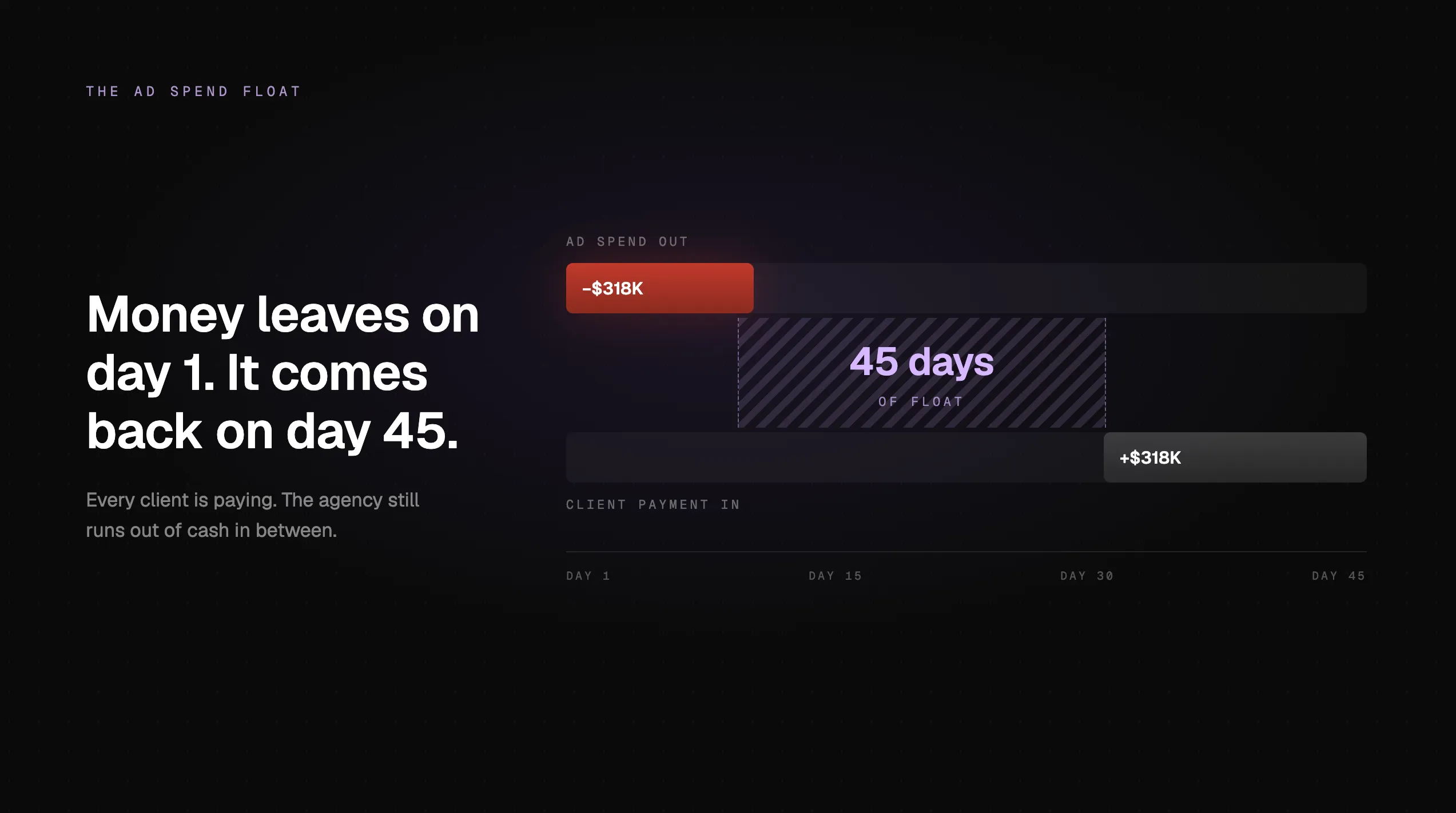
Ad spend float is the gap between when your agency pays an ad platform and when your client pays you back. It is not a profitability problem. It is a timing problem. And at $100K or more in monthly managed spend, it can quietly tie up six figures of your working capital every single month.
Key Takeaways
Ad spend float is the period between paying Google, Meta, or TikTok and collecting from your client. Your agency carries that cost the entire time.
On net-30 terms, a $100K/month spend account creates roughly $100K in float. On net-60, that doubles.
Every new client you sign adds to your float exposure before it adds to your collected cash.
Growth makes the problem worse, not better. More clients means more capital tied up waiting for reimbursement.
Personal cards, faster invoicing, and credit lines defer the problem. They do not fix it.
The structural fix is a card model where client budgets fund the spend directly. The agency manages campaigns without fronting the money.
What Is the Ad Spend Float Problem?
Ad spend float is what happens when your agency pays ad platforms before your client pays you. The platforms charge your card now. The client invoice goes out later. The gap between those two events is float, and your agency funds it entirely.
The mechanics are straightforward:
You launch campaigns for a client.
Google, Meta, TikTok, and other platforms charge your card as spend accumulates, often daily or weekly.
You invoice the client after the fact, typically on net-30 or net-60 terms.
You wait. The platforms have already been paid. You have not.
The Math Is Not Complicated
At $100,000 per month in managed spend on net-30 terms, your agency is carrying roughly $100,000 in float at any given time. On net-60, that figure is closer to $200,000. That is not an accounting detail. It is working capital that cannot be used for payroll, tax obligations, software, or anything else while it sits waiting for a client payment.
Payment Terms |
Monthly Managed Spend |
Float Exposure |
|---|---|---|
Net-30 |
$100,000 |
~$100,000 |
Net-45 |
$100,000 |
~$150,000 |
Net-60 |
$100,000 |
~$200,000 |
Net-60 |
$500,000 |
~$1,000,000 |
The last row is not a hypothetical. Agencies managing several clients at meaningful budgets routinely carry seven figures in float exposure. Most of them do not think of it that way. They think of it as the way the business works.
It is not. It is a structural problem with a structural fix.
The key distinction: float is not a sign that your agency is unprofitable or poorly run. Your P&L can look healthy while your bank account feels constantly tight. That is float. Revenue is coming. The cash is not available yet.
Why Float Gets Worse as Your Agency Grows
This is the part most agency owners do not see coming.
Growth feels like the solution. More clients, more retainers, more revenue. But with the traditional card model, every new client you sign adds to your float exposure before it adds to your collected cash. Revenue scales. So does the capital tied up waiting for reimbursement.
The math is concrete. Say you run five clients at $20,000 per month each. That is $100,000 in managed spend. You sign five more at the same average budget. Now you are at $200,000. If you are fronting the spend on both sets of clients, you have doubled your float exposure right alongside your revenue. The cash wall grows at exactly the same rate as the book of business.
Each New Client Adds Exposure on Multiple Dimensions
-
More spend volume means more capital tied up per billing cycle
-
More platforms means more billing relationships, more charge thresholds, more timing mismatches
-
More billing cycles means float from different clients overlapping at different points in the month
-
Faster growth means float exposure can outpace your card limit before you notice it
There is also a confidence trap here. When the agency is growing, it is easy to read tight cash as a temporary problem. A few more clients and it will smooth out. But adding clients without changing the underlying model makes the float problem larger, not smaller.
The agencies that hit a cash wall at $500K in monthly managed spend are often the same ones who had no trouble at $100K. The problem did not appear suddenly. It scaled quietly until it did not.
If you are trying to model this out, we have a separate post on how to forecast agency cash flow on a weekly basis that walks through the mechanics in detail.
What Happens When Float Exceeds Your Card Limit
When float exposure grows past your card's credit limit, the consequences are immediate.
The first thing that happens: campaigns pause. Ad platforms decline the card. Google, Meta, and TikTok do not care that a client payment is arriving next week. They charge what is on file. When that card hits its limit, spend stops.
The Cascade That Follows
-
Campaigns pause because the card is declined
-
Performance drops as platform algorithms reset their optimization
-
Clients notice and start asking questions you do not want to answer
-
You scramble to cover the gap with whatever is available
-
Personal credit or short-term debt enters the picture
-
New problems layer on top of the original float problem
That scramble in step four is where things get genuinely risky. Agency owners commonly reach for personal credit cards to bridge the gap. That introduces personal liability on business spend, credit utilization on your personal profile, and reconciliation chaos when personal and business charges start mixing.
We have covered why using personal credit for client ad spend creates compounding risk in detail. The short version: it is not a solution. It is a bridge that adds personal financial exposure to a problem that was already structural.
The core issue is that float is not a liquidity problem you can borrow your way out of. Every dollar of debt or personal credit you use to cover float still has to be repaid, usually before the client reimburses you. You are not closing the timing gap. You are adding interest to it.
How Agencies Usually Try to Fix It (And Why It Does Not Work)
Most agencies try one of three approaches. None of them actually solve the problem.
Personal or Business Credit Cards
The most common first response. Put platform charges on a card, earn some rewards, and hope the client pays before the statement closes.
It works at low volume. At scale, it breaks. Card limits are finite. Platform billing is unpredictable. A single delayed client payment can turn a manageable balance into a declined transaction at the worst possible moment.
A card is a useful tool for operating expenses. It is not a durable system for carrying a growing portfolio of client media budgets.
Asking Clients to Pay Faster
Sounds logical. Shorten terms from net-60 to net-30. Invoice more frequently. Add late payment penalties.
In practice, it rarely moves the needle. Enterprise clients have AP processes that do not bend to agency requests. Mid-market clients agree to faster terms and pay on the same schedule anyway. Even strong relationships do not override a client's internal payment cycle.
You can negotiate all you want. If the agency still pays platforms before the client funds the spend, you are still carrying float.
Business Lines of Credit
A line of credit feels like a real solution because it is a business product, not a personal one. But it has the same fundamental flaw: you are borrowing money to cover a timing gap, and that borrowed money still has to be repaid.
You are paying interest on float. The timing gap still exists. You have just added a cost to it.
Lines of credit also have limits. As float exposure grows with the agency, you will eventually need more credit than the line provides. Then you are back to the same wall, with debt on top of it.
The pattern across all three approaches is the same. They treat the symptom (not enough cash on hand) rather than the cause (the agency is fronting spend it should never be fronting in the first place).
The Structural Fix: Stop Fronting the Spend
The only real fix is a model change, not a credit limit increase.
The traditional model puts the agency in the middle of the payment flow. Your card is on file. Platforms charge you. You invoice the client. You wait. Float is the inevitable result of that sequence.
The structural fix inverts it.
How the Client-Funded Card Model Works
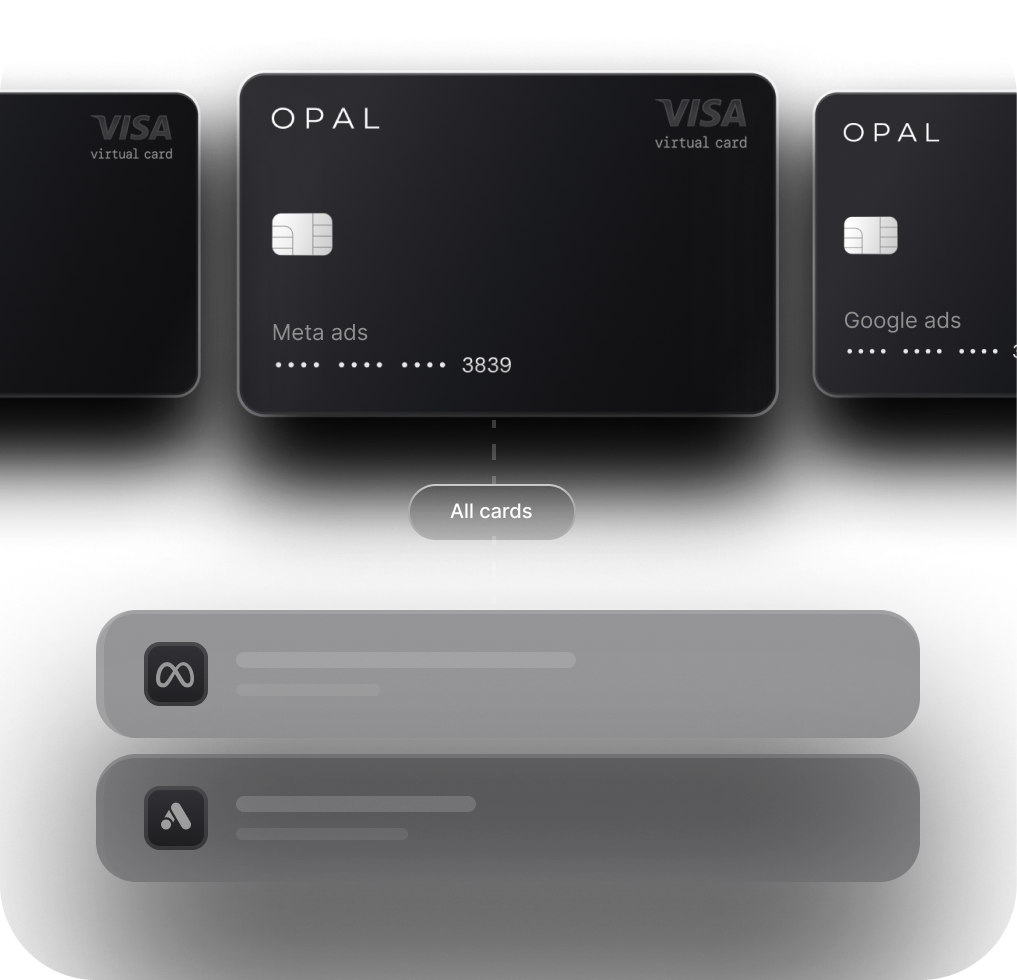
With a client-funded card, each client has a dedicated virtual card tied to their own approved budget. Opal extends credit to your agency based on your managed spend volume, not your cash on hand. Platforms charge against that credit line, and the agency earns up to 2% cashback on ad spend.
Because the credit scales with your book of business rather than your personal financial position, the limit grows as the agency grows. No personal guarantee. No hard credit check. No deposit required.
The practical result:
-
No float. The agency is not fronting client spend from its own operating cash.
-
No commingling. Each client has their own card, their own spend trail, and their own reconciliation.
-
No campaign pauses from hitting a shared card limit across multiple clients.
-
Cashback accrues to the agency on every dollar managed. At $500K per month, that is up to $10,000 per month in revenue that did not exist before.
The Agency Becomes an Operator, Not a Lender
That framing matters. Right now, if your agency is fronting spend, you are effectively an unsecured lender to your clients. You are financing their advertising and waiting to be repaid.
The client-funded card model changes that. You manage campaigns, set controls, and handle the day-to-day work. Opal handles the credit. The financial exposure stays where it belongs.
For the full breakdown of how this works in practice, including the card setup, the credit model, and the cashback mechanics, read our post on the client-funded card model.
The float problem is not an industry inevitability. It is a model problem. And model problems have model solutions.
Frequently Asked Questions
What is ad spend float?
Ad spend float is the gap between when a marketing agency pays an ad platform and when the client reimburses that spend. During that window, the agency is out-of-pocket for the full amount. It is not a sign of poor management. It is the natural result of a model where platforms charge immediately and clients pay on terms.
Why is my agency profitable but always short on cash?
Profit is a P&L concept. Cash flow is a timing concept. Your agency can be generating strong margins while carrying six figures of working capital in float at any given time. The revenue is real. It just has not arrived yet. Float is the gap between those two things.
How much float exposure does a typical agency carry?
It depends on payment terms and spend volume. An agency managing $200,000 per month on net-30 terms carries roughly $200,000 in float at any given time. On net-60, that doubles to $400,000. Agencies with multiple clients across overlapping billing cycles can carry significantly more without realizing it.
How do you calculate ad spend float?
Multiply your monthly managed spend by the number of months in your payment terms. An agency managing $200,000 per month on net-30 terms carries roughly $200,000 in float. On net-60, that doubles to $400,000. If you have multiple clients on different terms, add each one separately. The total is the amount of your own capital committed to client media at any given time.
Can a business line of credit solve ad spend float?
No. A line of credit gives you borrowed money to cover the timing gap, but you still have to repay it, usually before the client payment arrives. You are paying interest to carry float rather than eliminating it. As the agency grows and float exposure increases, the line will eventually be insufficient. It defers the problem, not fixes it.
What is a client-funded card and how does it eliminate float?
A client-funded card is a setup where Opal extends credit to your agency based on your managed spend volume. Each client gets a dedicated virtual card. Platforms charge against Opal's credit line, not your operating cash. The agency earns up to 2% cashback on ad spend. Because you are not fronting spend from your own balance sheet, float exposure goes to zero. See how the client-funded card model works for the full breakdown.