



The Performance Marketing Agency Finance Stack: A Practical Operating Model

.webp)
A performance marketing agency finance stack is the set of systems, records, and routines an agency uses to fund client media, bill clients, reconcile charges, report spend, and manage cash.
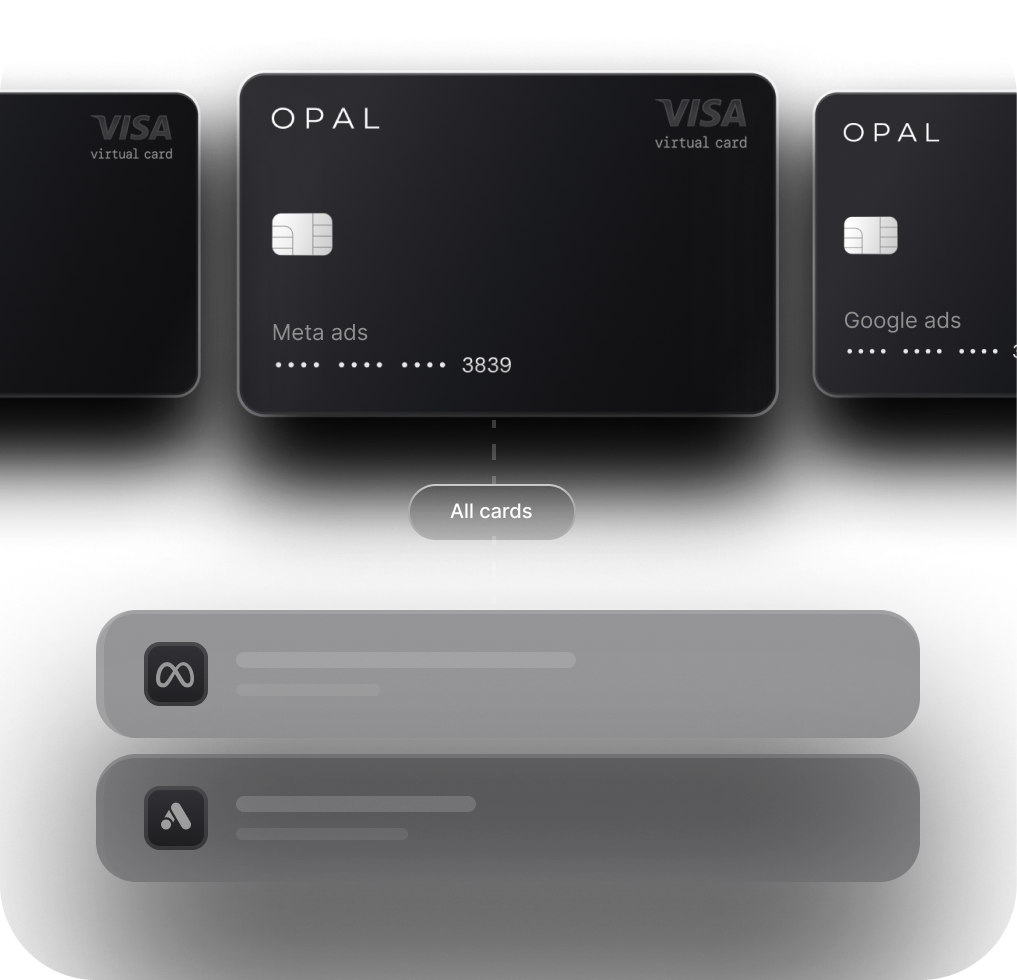
The method is to put every media charge on a virtual card assigned to a single client and platform, then have each of those 5 jobs read from that tagged transaction on a fixed cadence under a named owner.
Performance marketing agencies buy media on Google Ads, Meta Ads Manager, TikTok Ads Manager, LinkedIn Campaign Manager, The Trade Desk, and Amazon Ads, then bill clients through fees tied to that spend or to results.
Budgets change daily, each platform charges on its own schedule, and accounting systems such as QuickBooks and Workday see only what reaches them. Without a shared record, media buyers, finance leads, and account managers each keep their own numbers, and agency finance operations strain as clients, platforms, and fee models multiply.
Key Takeaways
A performance marketing agency's finance stack holds together when every media charge starts on a virtual card tagged to a single client and platform, because billing, reconciliation, reporting, and cash planning can then read from the same transaction.
The fee model sets the requirements: a percentage-of-spend fee needs a fee base defined in the contract, and a performance fee needs a results figure both sides accept before the invoice goes out.
Google Ads lets most campaigns spend up to 2 times their average daily budget on a given day and up to 30.4 times it in a month, so card limits and forecasts should use the monthly ceiling.
Spending controls work in 3 layers: the ad account's own spending limit, the card limit, and the budget the client approved in writing, each with a different owner.
Matching charges to clients every week, then closing monthly, keeps exceptions small enough to clear while the media buyer still remembers the change behind them.
What Goes Into a Performance Marketing Agency Finance Stack?
The stack covers 5 jobs: funding client media, billing clients, reconciling charges, reporting spend and margin, and managing cash. Each job needs a system of record, an owner, and a cadence, and all 5 should draw on the same transaction data.
Run 5 Finance Jobs From a Single Record
When tools arrive one at a time, each job keeps its own copy of the numbers. Buyers read platform dashboards, finance reads the bank feed, and account managers rebuild totals in a spreadsheet, so a single client can show 3 different figures for the same week.
The fix is a single source record: the card transaction, tagged by client and platform when the card is issued and synced into your ledger. Every other job starts from that transaction. Our guide to agency tool layers covers the software; this article covers how the jobs connect.
Let Your Fee Model Set the Requirements
When a fee moves with the media or with results, finance has to collect more before an invoice can go out. A percentage-of-spend fee waits for the period's charges to post, and a performance fee waits for someone to confirm the result. The table compares 4 common fee models on what each asks of the stack.
|
Fee Model |
Input Finance Needs |
When the Fee Is Final |
Agree in Writing |
|---|---|---|---|
Percentage of spend |
Media charged to each client for the period |
After the period's platform charges post |
Which spend counts as the fee base |
Flat retainer |
The retainer amount and the scope it covers |
At signature |
A spend band that triggers a fee review |
Performance fee |
A results figure such as leads, sales, or revenue |
After the client confirms the figure |
The system that counts results, and the attribution window |
Hybrid |
Both a fixed amount and a variable input |
After the variable input closes |
The order in which the parts are calculated |
Retainers are simple to bill and harder to protect, since a client whose spend doubles pays the same fee for more work. A contract spend band gives both sides a trigger to revisit it.
How Should Media Spend Move From Client to Platform?
Media spend should run through a card assigned to a single client and platform, with a card limit matched to the client's approved budget and a spending cap set inside the ad account. That gives you 3 layers of control, each owned by a different person.
Decide Who Funds the Media Before Launch
Agree in writing whether the client pays the platform directly, prefunds you, or reimburses you after you pay on your own credit line. Each option changes how much cash you carry, and our comparison of media billing models walks through them. This guide assumes you pay platforms on a card and invoice clients afterward.
Set Spending Controls at 3 Layers
The first layer lives in the ad account. On Meta, an ad account spending limit caps total spend across every campaign from the moment you set it, and at the cap, ads pause while Meta Ads Manager still lists them as active.
Where offered, the cap can reset automatically on the 1st of each month to mirror a monthly budget, although accounts that pay for ads from available funds cannot set one.
The second layer is the limit on each client's card, owned by finance. The third is the budget the client approved in the contract, owned by the account manager.
If a buyer raises a campaign budget without a matching contract change, the ad account cap and the card limit hold spend at the agreed ceiling.
Size Limits to the Monthly Ceiling
Daily budgets understate what a platform can charge. Google Ads explains in its average daily budget rules that most campaigns can spend up to 2 times the average daily budget on a single day and no more than 30.4 times it across a month, 30.4 being the average number of days in a month.
A client running $2,000 a day in average daily budgets on Google can be charged up to $4,000 on one day and up to $60,800 in a month.
Set that client's approved budget and Google card limit against $60,800, and recalculate whenever a buyer edits a budget.
How Do You Bill Clients When Spend Changes Every Day?
Bill from the charged spend on each client's cards for the period, with media and fees on separate lines, and finalize the invoice once the contract's fee base has closed. That keeps every invoice traceable to transactions the client can check.
Keep Media and Fees on Separate Lines
Put pass-through media and your fee on separate invoice lines and separate ledger accounts. Whether client media counts as your revenue depends on the principal versus agent assessment under Accounting Standards Codification (ASC) Topic 606, which our walkthrough of the principal versus agent test explains for agencies. Separate lines support either answer, because the media total ties back to the tagged card charges.
Write the Fee Base Into the Contract
For a percentage-of-spend fee, name which spend counts: charges posted to the client's cards, platform-reported delivery, or amounts on platform invoices.
These can differ within a month because platforms charge on thresholds and billing dates and apply credits on their own timing. Pick one, and state whether credits reduce the fee base in the period they arrive.
For a performance fee, name the system that counts the result, such as the client's customer relationship management (CRM) system, their ecommerce platform, or the ad platform, plus the attribution window. With both named, the invoice becomes a calculation either side can repeat.
How Often Should You Reconcile and Report?
Match card charges to clients weekly, close monthly, and send each client a spend report built from the same matched data you invoice from. A weekly rhythm keeps the month-end close small.
Match Weekly, Close Monthly
A weekly match compares each client's card charges with the approved budget and the ad account cap. Anything unexpected, like one client's charge landing on another client's card or spend running ahead of the monthly ceiling, goes on that week's exception list. The monthly close then works through a short list, and our month-end close checklist covers the sign-off.
Report Spend and Margin From the Same Data
Clients need spend by platform and campaign that ties to their invoice line by line. Leadership needs another cut of it: fee revenue against delivery cost per client, total spend under management, and cashback earned. Both start from the tagged transactions, so the client report, invoice, and margin view agree without a manual tie-out.
How Do You Keep Cash Ahead of Media Charges?
Set client payment due dates ahead of your card debit, and forecast media weekly against each client's monthly ceiling. Cash planning then follows from your funding and billing choices.
Set Client Due Dates Before the Card Debit
When media runs on a charge card paid in full, the whole statement balance leaves your bank account when payment falls due, whether or not clients have paid.
Put client media invoices on terms that clear before that date, or bill media in advance for clients you would rather not carry. For performance-fee clients, invoice media on its own schedule so a late results figure does not hold up reimbursement.
Forecast Weekly From Monthly Ceilings
Build the weekly forecast from each client's monthly ceiling on each platform, since a midweek budget edit can move the month's charges before any statement shows it.
Our weekly cash forecast guide covers the model. Size your credit line to the media you manage, so the forecast shows headroom instead of a limit you reach mid-month.
How Should the Stack Change as Your Agency Grows?
Change the stack when the operating load changes, such as when a single person can no longer finish the weekly match or a new fee model enters the book. The records stay the same, and ownership and cadence are what shift.
Watch for Operating Triggers
A few signals show the setup has hit its limit. The weekly match overruns its slot, a client signs on a fee model your invoice template cannot calculate, buyers ask finance to raise card limits several times a month, or a client questions a total that 2 of your own reports show differently. Fix that job's owner or cadence first, then decide whether a tool is missing.
Give Every Job a Single Owner
Split ownership by who controls each record. The table below sets out each job's owner and cadence.
|
Finance Job |
Owner |
Cadence |
Output |
|---|---|---|---|
Fund media |
Media buyer and finance |
At launch and at every budget change |
A card per client and platform, with caps set |
Bill clients |
Finance |
Monthly, once the fee base closes |
An invoice with separate media and fee lines |
Reconcile |
Finance |
Weekly match, monthly close |
Matched charges and an exception list |
Report |
Account manager |
Monthly, with the invoice |
A client spend report and an internal margin view |
Manage cash |
Agency owner or finance lead |
Weekly |
A forecast set against the card debit date |
Put this table in the handbook new hires read first. Revisit it whenever a trigger above appears, since that is when a job has outgrown its owner.
Put Your Media Spend Layer on Opal
We built Opal to be the media spend layer the rest of this operating model reads from. Our Opal Card is a charge card for advertising, paid in full each month, and our software handles the card structure, limits, and data the 5 jobs depend on.
What We Include at No Cost
Virtual cards come free and without a quantity cap, each dedicated to a client, platform, campaign, employee, or vendor, with merchant restrictions, an expiration date, and its own spending limit.
Approvals and employee permissions sit on the same account, finance sees transactions in real time by client, and spend syncs into QuickBooks or Workday.
Eligible advertising spend earns uncapped cashback of up to 2%, and your exact rate is set when we approve your application. Your credit limit can reach up to $10 million, subject to underwriting, and approval runs without a personal guarantee or a hard credit pull.
There is no annual, subscription, or cancellation fee, and other applicable fees are set out in the Cardholder Agreement.
Know Where Our Card Stops and What Costs Extra
The card serves U.S.-based businesses and works only on the advertising and media platforms we support, so operating expenses need a separate card. It settles in full monthly, and client invoicing and fee calculations stay in your accounting system. Opal is not a bank, so the card is issued through our partner bank.
Ad Pay, a separate product open by waitlist to teams whose monthly ad spend starts at $50,000, lets you settle Meta and Google invoices with Opal credit.
Each payment costs a 3% processing fee, which 1% cashback brings to a 2% net cost where eligible, or 3.5% if you pay with your own card.
To start, visit Opal for agencies and complete the 2 to 3 minute onboarding form; virtual cards typically follow 24 to 48 hours after submission.
Frequently Asked Questions (FAQs)
What Financial Tools Do Marketing Agencies Need?
The core financial tools for marketing agencies are a way to pay ad platforms with spend separated by client, an accounting system, invoicing with separate media and fee lines, and a cash forecast. For a performance marketing agency, those tools should share a transaction record, with card data syncing into the ledger the invoices come from.
How Is Spend Management Different for Performance Marketing Agencies?
Spend management for performance marketing agencies handles client money that changes daily. Buyers edit budgets, platform algorithms pace delivery, and fees may be calculated from that spend or from results. That calls for a card per client and platform, limits set against monthly ceilings, and weekly matching.
Should Client Ad Spend and Agency Expenses Share a Card?
Client media and the agency's own operating expenses belong on separate cards and separate ledger accounts. Mixing them makes media harder to invoice, harder to show a client what went to their campaigns, and harder to see what the agency itself spends. A card restricted to advertising platforms enforces the split.
How Do You Calculate a Percentage-of-Spend Fee?
Multiply the agreed percentage by the fee base the contract names for the billing period. The fee base can be charges posted to the client's cards, platform-reported delivery, or amounts on platform invoices, and those figures can differ within a month. Name one in the contract and state how platform credits affect it.
How Often Should an Agency Reconcile Ad Spend?
Match charges weekly and close monthly. Checking each client's card charges against the approved budget and the ad account cap every week catches mis-tagged charges and early overspend while the buyer remembers the change. The monthly close then signs off a short exception list.
Who Should Own Agency Finance Operations?
Ownership should follow the records. Media buyers own platform budgets and ad account caps, finance owns card limits, matching, and invoicing, account managers own contract terms and client reports, and the agency owner or finance lead owns credit and the cash forecast. Each job also needs a fixed cadence.