

How to Front Client Ad Spend Without Personal Liability

Learning how to front client ad spend without personal liability means keeping your agency as the payer of record for client media budgets while making sure the credit behind those payments sits with the business entity rather than an owner's personal signature.
The method has 3 parts: have the card underwritten against the spend volume your agency manages instead of an owner's personal credit file, use insertion-order terms that cap what a media seller can claim, and compress the window between the charge posting and the client's money clearing.
Two rulebooks decide how far you can get.
Regulation B, which implements the Equal Credit Opportunity Act and covers business credit alongside consumer credit, sets out when a creditor may ask for a guarantor, and ties that request to the applicant's own creditworthiness.
The Standard Terms and Conditions published jointly by the Interactive Advertising Bureau and the American Association of Advertising Agencies govern insertion-order buys with publishers and let an agency contract as the agent of a disclosed principal. Self-serve accounts on Google Ads, Meta, TikTok Ads, LinkedIn Ads, and Amazon Ads sit outside those terms, so there the payment instrument carries the liability.
Agencies hit this because client budgets scale faster than agency cash, and a card that felt harmless at $20,000 a month becomes a personal exposure at $200,000.
Key Takeaways
Fronting client media budgets and accepting personal liability are 2 separate decisions, and an agency can carry the first without the second.
A personal guarantee is a promise by a named individual to cover the business debt, and under Regulation B a creditor may request one when the business alone does not meet its standards of creditworthiness, so the entity's file is the thing to strengthen.
Insertion-order buys governed by the Standard Terms and Conditions from the Interactive Advertising Bureau (IAB) and the American Association of Advertising Agencies (4A's) can hold the agency liable only for money the advertiser has cleared to it, and that protection does not reach self-serve platform accounts.
The length of your exposure window is set by the platform's billing trigger rather than by your client contract, so shortening it takes advance billing, tighter net terms, and per-client spend caps rather than a clause.
Our card is issued to the business, underwritten without a personal guarantee and without a credit check, and comes with unlimited virtual cards at no annual or per-card fee, so the balance behind your client campaigns stays a company obligation.
What Does It Mean to Front Client Ad Spend?
Fronting means your agency pays the media platform first and collects from the client afterward, putting agency credit between the campaign and the client's bank account. Most owners treat that as one problem, when it is really 2 exposures that behave differently and get fixed in different places.
Where Your Money Actually Sits While Campaigns Run
From the moment a platform charges your card to the moment the client's payment clears, the balance belongs to whoever signed for the credit. Your agency funded a purchase on someone else's behalf, but the issuer sees one account holder and one balance. Our glossary entry on personal guarantee basics covers what that signature reaches.
The Two Exposures Hiding Inside One Decision
The first exposure is legal and decides who can be pursued for the balance. The second is financial and decides how long that balance sits there before the client makes you whole. You remove the first outright by changing whose name the credit is issued in, while the second can only be compressed while your agency is payer of record. Treating them as one problem is why so many agencies conclude that the only fix is to stop fronting.
How to Front Client Ad Spend Without Personal Liability, Step by Step
Move the credit decision off the owner and onto the business, then check the agreement for any clause that reintroduces a personal obligation. That sequence matters more than any feature, because a card can advertise no personal guarantee while the underwriting still leans on an individual.
Shift the Credit Decision Onto the Business
Regulation B lets a creditor request a cosigner, guarantor, endorser, or similar party when that party's personal liability is necessary to support the credit requested. Read in reverse, the Regulation B signature rules make a guarantee a symptom of a thin business file rather than a fixed term. The practical move is to give an underwriter something to price: consistent managed spend volume, a client roster with reasonable concentration, and a payment history the issuer can see rather than infer.
Ask the Issuer What Would Remove the Guarantee
Put 3 questions to any issuer in writing before you apply, and keep the answers. Ask which part of your file makes an additional party necessary, what would have to change for the guarantee to come off, and whether the account is reviewed for that change on a schedule or only on request. An issuer that answers all 3 is underwriting your company, and one that cannot is underwriting you.
Which Media Buys Let You Push Liability Back to the Advertiser?
Insertion-order buys with publishers can, and self-serve platform accounts cannot, which is the most useful distinction here. The difference comes from which contract governs the purchase rather than the size of the budget.
Insertion-Order Buys and Sequential Liability
The standard media buying terms written by the IAB and the 4A's address this in their payment and payment liability section. Where an insertion order incorporates those terms, the media company agrees to hold the agency liable only to the extent proceeds have cleared from the advertiser, and to look to the advertiser for the rest.
The same section records the advertiser as the agency's disclosed principal and establishes agency credit on a client-by-client basis, so one advertiser's non-payment does not freeze your other accounts. None of it is automatic, since it applies only where the order adopts those terms.
Self-Serve Platform Accounts, Where the Card Is the Liability
Campaigns bought through a self-serve advertising account run on the platform's own terms and the cardholder agreement behind the payment method, and neither carries a sequential-liability concept.
Whoever the card is issued to owes the charge the moment it posts, whatever your client contract says about reimbursement. Because most agency budgets now run through these accounts, card structure is where the personal-liability question is settled.
How Should You Compare the Two Exposures?
Set them side by side before deciding what to fix first, because the cheaper fix is not always the one that removes the larger risk. The table puts 7 questions to both.
Personal Liability Versus Reimbursement Timing
|
Question |
Personal Liability Exposure |
Reimbursement Timing Exposure |
|---|---|---|
What creates it |
A guarantee, cosignature, or personal card in an owner's name |
The gap between the platform charging the card and the client's payment clearing |
Who can be pursued |
The named individual, after the business |
The business only, from the charge date forward |
How you measure it |
The full balance the guarantee covers, not your agency's share of it |
Peak outstanding balance across every client at the same moment |
What removes it |
Credit underwritten and issued to the entity with no guarantee clause |
Nothing removes it while your agency is payer of record |
What only reduces it |
A lower limit, which also caps the campaigns you can run |
Advance billing, shorter net terms, and per-client spend caps |
What it costs when it goes wrong |
Personal assets and personal credit standing |
Paused campaigns and a locked card |
Who decides the outcome |
The issuer's underwriting file |
The client's accounts payable calendar |
Reading the Table Against Your Own Book
Work out your peak simultaneous balance rather than your monthly total, since the 2 diverge once clients bill on different cycles. Add the largest month of every active client, then compare that against the credit carrying a personal signature today. If the signed exposure is larger than a number you would accept personally, fix the liability side first.
What Sets Your Reimbursement Timing?
The platform's billing trigger sets the charge date and your contract sets only the collection date, so the gap between them is designed by someone else unless you intervene. Most agencies measure that window from the invoice, when it actually starts at the charge.
The Platform's Billing Trigger Decides the Charge Date
Advertising platforms bill on a threshold, a monthly date, or whichever arrives first, so a fast-scaling campaign can charge several times inside one billing month. That moves your exposure forward without anyone approving a change, and it is why a net 30 client can leave you carrying spend closer to 45 days. Our breakdown of the ad spend float covers how that compounds across a roster.
Three Levers That Shorten the Window
-
Advance billing: Collect an agreed portion of the budget before the campaign starts, putting the client's money in front of the charge instead of behind it.
-
Tighter net terms: Shorten the collection tail by tying terms to a real consequence, such as a pause on new spend, rather than a late fee nobody enforces.
-
Per-client spend caps: Keep each client's exposure at a size you chose. Our comparison of agency billing models sets out where each fits.
What Does a Safe Fronting Workflow Look Like?
Build the controls into 3 moments: before launch, during the flight, and at settlement. Each closes a gap the others cannot reach.
1. Before the Campaign Goes Live
Confirm in writing who the advertiser of record is and which entity owns the ad account.
Document what happens to committed spend if the engagement ends mid-flight.
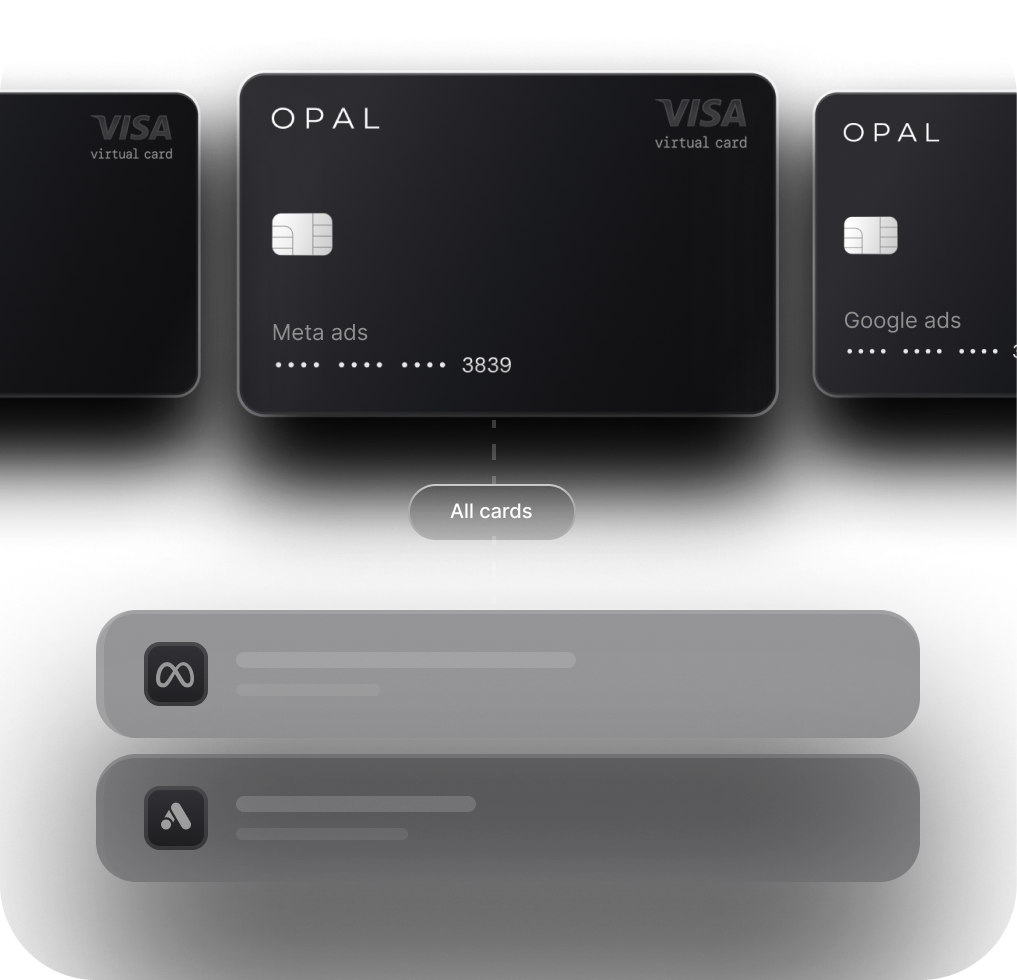
Issue that client a dedicated card before the first charge, so attribution exists at the source instead of being rebuilt later.
-
Review our guide to structuring client cards for how to divide cards by client, platform, and campaign.
2. While Spend Is Running
Set the card limit to the approved budget so an over-delivery declines instead of quietly becoming your exposure. Review outstanding balances weekly against what has been invoiced, and treat any client whose unbilled spend passes your threshold as an exception needing a decision that week. Waiting for month-end turns a manageable gap into a number you cannot influence.
3. At Invoice and Settlement
Invoice media spend separately from your management fee so a dispute over one does not delay the other. Attach the card-level transaction record, because a statement line the client can match to their own platform reporting closes most questions before they become disputes. When a payment stalls, our walkthrough on unpaid client spend sets out the order of operations.
Build an Ad Spend Setup That Keeps Client Budgets off Your Personal Name
Apply for a card issued to your company, underwritten on the spend you already manage, and free of any clause that puts an owner behind the balance. That is what we built Opal to provide, and a short online form starts it.
What We Provide and What You Configure
We provide the credit, the card, and the controls. The Opal Card is a pay-in-full charge card issued by First Internet Bank of Indiana, Member Federal Deposit Insurance Corporation (FDIC), pursuant to a license from Visa Inc., with credit provided by CapitalOS, Inc. or CapitalOS Financial Services LLC depending on your location and underwriting.
We size limits up to $10M against managed ad spend rather than your bank balance, underwritten without a personal guarantee and without a credit check, and we review business performance periodically for credit adjustments.
You configure the rest on our agency ad spend platform: unlimited virtual cards at no annual or per-card fee, spend limits, merchant restrictions, approvals, employee permissions, and QuickBooks and Workday sync.
Cashback runs up to 2% on eligible advertising spend, at a rate confirmed when your application is approved, and we never take a cut of media spend or charge a cancellation fee. The form runs 2 to 3 minutes, and we typically issue virtual cards within 24 to 48 hours.
Where Our Card Is Not the Right Fit
We support U.S.-based businesses, and card use is limited to supported advertising and media platforms, so general operating spend belongs elsewhere. The full statement balance is automatically debited each monthly due date from your designated bank account or Opal Balance, and a failed debit can leave the card locked until the balance is repaid.
Opal Ad Pay, which settles Google and Meta invoices by card, is a separate early-access product on a waitlist for teams spending $50,000 or more a month, carrying a 3% fee on Opal credit or 3.5% on your own card, with payments processed in 3 to 5 business days.
The virtual cards, spend controls, accounting sync, and real-time visibility above are included at no extra cost.
Book a free demo to see how Opal can support your business and your clients.
Frequently Asked Questions (FAQs)
Can an Agency Front Client Ad Spend Without Signing a Personal Guarantee?
Yes. Some issuers underwrite business credit on company revenue and the spend volume you manage, rather than on an owner's personal credit file, and those cards carry no guarantee clause. The agency still funds the media first and collects afterward, so the timing exposure remains, but the balance stays a company obligation rather than a personal one.
What Is Sequential Liability in a Media Buy?
Sequential liability is a contract term under which an agency owes a media seller only what the advertiser has already paid it, with the seller looking to the advertiser for the rest. It appears in the standard terms published by the Interactive Advertising Bureau and the 4A's, and applies only where an insertion order adopts them.
Does Regulation B Ban Personal Guarantees on Business Cards?
No. Regulation B permits a creditor to request a cosigner, guarantor, endorser, or similar party when that party's personal liability is necessary to support the credit requested under the creditor's standards. What it prohibits is requiring that the additional party be the applicant's spouse, and requiring any signature when the applicant already qualifies alone.
What Sets the Length of My Reimbursement Window?
The platform's billing trigger sets when the charge hits, and your client agreement sets when the money comes back, so the window is the distance between the 2. Threshold-based billing can pull charges forward during a scaling campaign, which is why a net 30 client often produces an exposure closer to 45 days.
Does a Virtual Card for Each Client Reduce Personal Liability?
Not by itself. Separate virtual cards improve attribution, containment, and reconciliation, which limits how far one client's overspend can travel. Personal liability is decided by the credit agreement behind those cards rather than by how many you issue, so the guarantee clause is the thing to check.
What Happens to Fronted Spend If a Client Disputes the Invoice?
The platform charge has already settled, so the dispute sits between your agency and the client rather than between you and the platform. A card-level record tied to one client makes the spend verifiable line by line, which resolves most disputes faster than a shared statement can. Contractual remedies depend on your agreement.