
When a Client Doesn't Pay: How to Protect Ad Spend You've Already Fronted

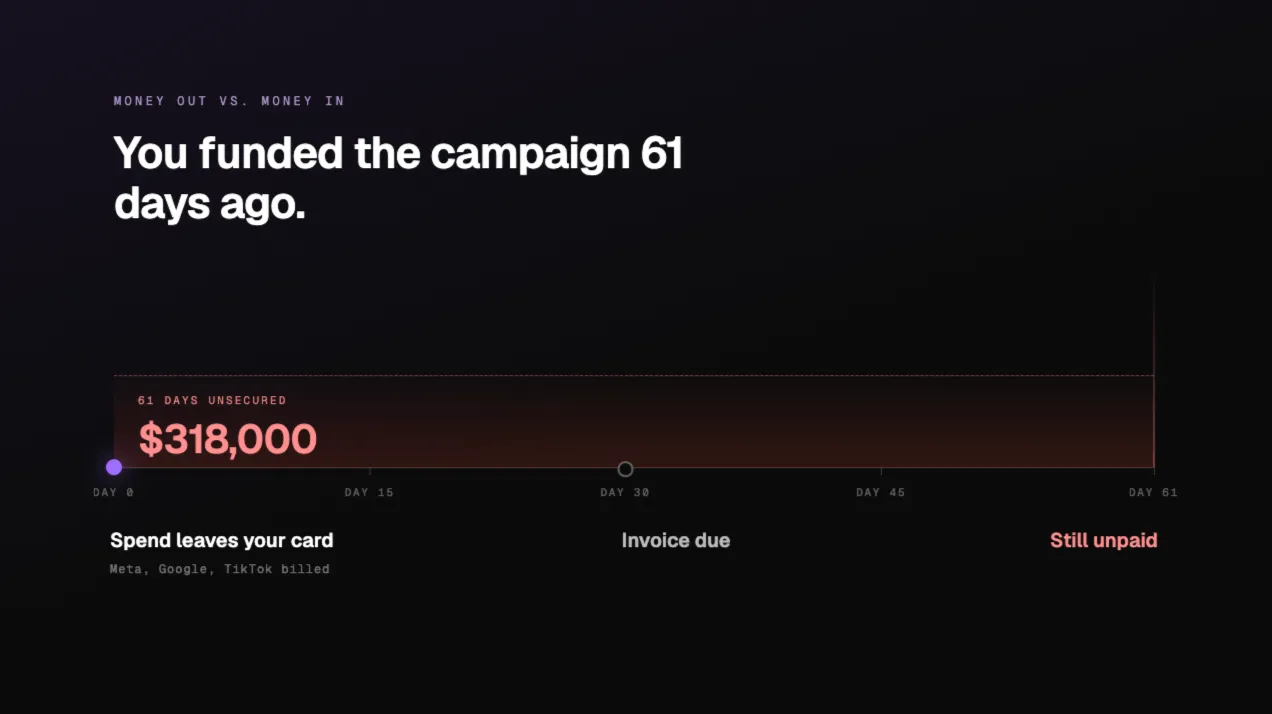
If a client doesn't pay agency ad spend, your agency is holding the bill. The platforms have already charged your card. The campaigns already ran. And now agency ad spend non-payment is a cash flow problem, not a hypothetical.
The short answer: pause campaigns, document everything, and escalate through your contract. But those steps are damage control. A $50,000 unpaid invoice for media spend is not a billing dispute you can invoice your way out of.
The most durable way to reduce this exposure is to structure client media payments so the agency does not use its own working capital before campaigns run. With a client-funded Opal card, client funds are used for that client's approved media spend, so the agency does not have to front the budget from its own cash flow. Done right, the agency carries no out-of-pocket exposure to client media spend. If a client stops paying, the issue stays contained to that client's campaigns, not the agency's cash position.
This article covers both sides: what to do if you are already in this situation, and how to rebuild your billing infrastructure so you are not carrying this risk again.
Key Takeaways
-
Fronting ad spend makes your agency the creditor. If a client doesn't pay, the platforms keep the money and you absorb the loss.
-
Pause campaigns immediately once a payment is overdue. Every day you keep running spend is additional exposure you are creating voluntarily.
-
Your contract is your only leverage after the fact. Without written reimbursement terms, recovery is harder and often partial.
-
The client-funded card model removes the risk at the source. When client funds are used for that client's approved spend, the agency's own cash never enters the picture.
-
Recovery options exist but are slow. Collections, small claims, and legal action all work in the right circumstances, but none of them make you whole quickly.
-
Rebuilding your billing structure is faster than it sounds. Dedicated virtual cards per client, with spend limits tied to approved budgets, can be operational within a single billing cycle.
What Happens When a Client Doesn't Pay for Ad Spend Your Agency Fronted?
When your agency card is on file with Google, Meta, TikTok, or any other platform, you are the customer of record. The platform bills you. Whether or not your client reimburses you is a separate arrangement the platform has no visibility into and no obligation to honor.
This creates a gap that catches agencies off guard, especially as they grow.
The spend runs before the invoice is paid
Campaigns launch, budgets are consumed, and the platform charges your card. The invoice to the client comes after the fact. By the time a client misses a payment, the spend has already cleared.
Reimbursement cycles extend the exposure window
Net 30 or Net 45 payment terms mean your agency is floating weeks of client spend at any given time. At $100,000 per month in managed spend, that float is $100,000 to $150,000 sitting on your balance sheet with no guarantee of recovery if a client defaults.
One bad client can cascade
If a client goes dark mid-campaign cycle, the loss is not just the unpaid invoice. It is the spend that ran after the last payment, plus the time and cost of recovery. The client going dark is not the core problem. Carrying their budget on your card is.
What Should You Do Immediately If a Client Doesn't Pay?
If you are reading this because a client just missed a payment, act in this order.
Step 1: Pause new spend
The moment a payment is overdue and unacknowledged, pause every campaign funded by your agency card for that client. Many agency contracts include a right-to-pause clause for non-payment. If yours does, use it. If it does not, pausing is still the right call while you assess the situation. Every dollar you run after a missed payment is a dollar you may not recover.
Step 2: Reconcile the full amount owed
Pull together the complete picture: total spend charged to your card by platform and date, all invoices issued, all payments received, and the net outstanding balance. This is your evidence record if the situation escalates. Gaps in it weaken your position.
Step 3: Review your contract
Check what your agreement says about media spend reimbursement. The strength of any recovery claim depends on whether the terms were documented in writing before campaigns ran. If your contract is silent on this, note it. It affects which escalation path makes sense.
Step 4: Escalate with appropriate professional advice
If direct contact does not resolve the situation, the right path depends on the amount owed. A formal demand letter works for smaller amounts. Small claims court handles disputes up to certain thresholds depending on the state. For larger amounts, a collections agency or commercial attorney becomes necessary. Get qualified legal advice before committing to any of these routes.
None of these options are fast, and recovery costs reduce what you get back. This is why agencies that have been through a large non-payment situation almost always rebuild their billing structure afterward.
How Do You Make Sure This Never Happens Again?
The reactive steps above are damage control. The real answer is a billing structure where agency capital is not at risk in the first place.
Contractual protection and payment infrastructure both matter. Most agencies address the contract and miss the infrastructure layer entirely.
Contractual layer: lock down the terms before campaigns go live
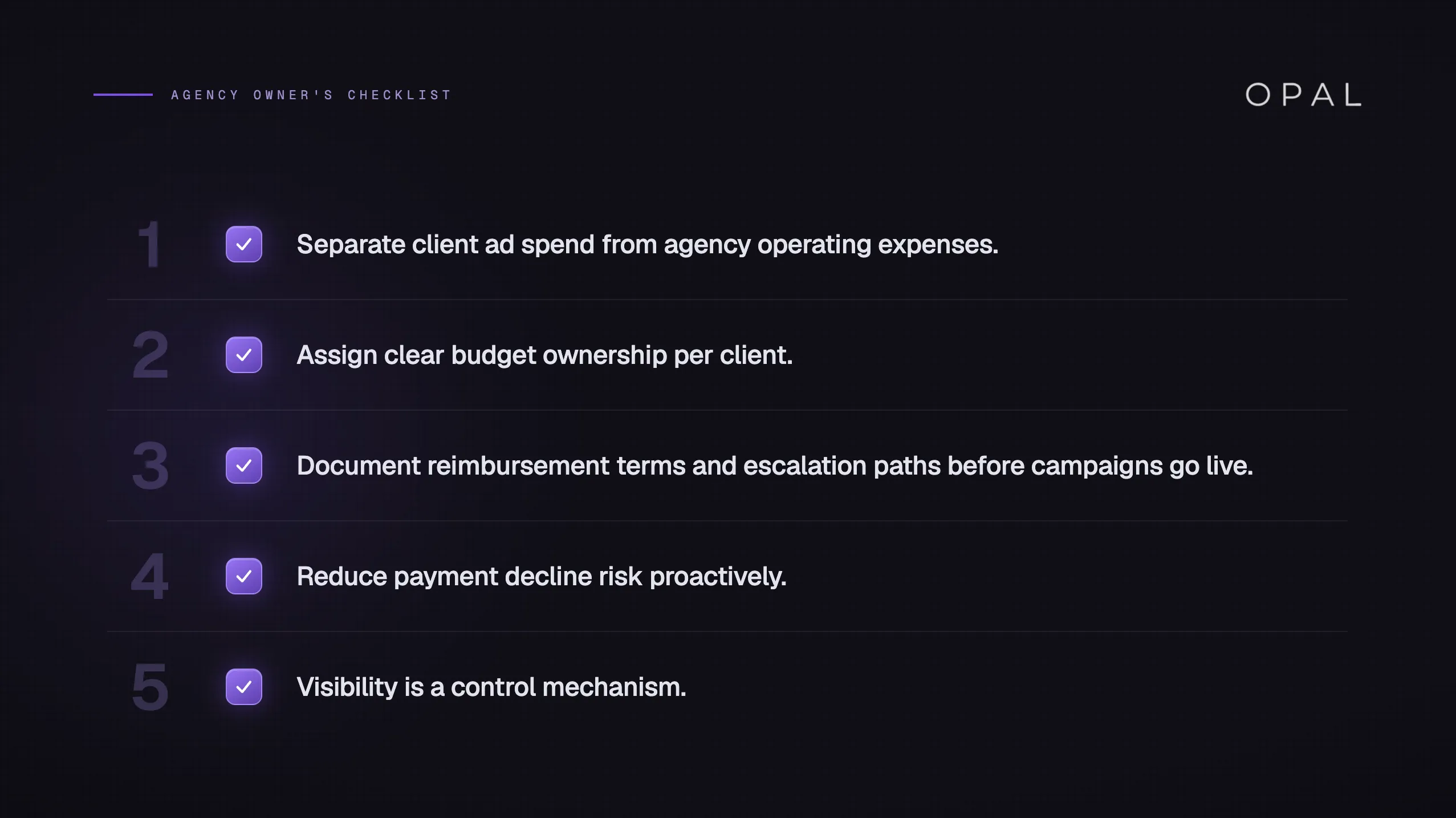
Your client contract or SOW needs to explicitly address media spend, not just management fees. Key terms to include:
-
Reimbursement timeline: Net 15 or Net 30 from invoice date, stated clearly.
-
Right to pause: A clause giving you the right to pause all campaign activity if payment is not received by the due date.
-
Client liability for spend already run: The client is responsible for all ad spend charged to your card up to the date of pausing, regardless of other disputes.
-
Prepayment for new clients: Require media budget to be funded in advance for the first 90 days of any new relationship.
These terms feel uncomfortable to raise with a new client. They feel necessary after you have been burned once.
Infrastructure layer: stop fronting the money entirely
Contractual protection is better than nothing. But it still leaves you spending first and recovering later. The infrastructure layer changes the sequence entirely.
With the client-funded card model:
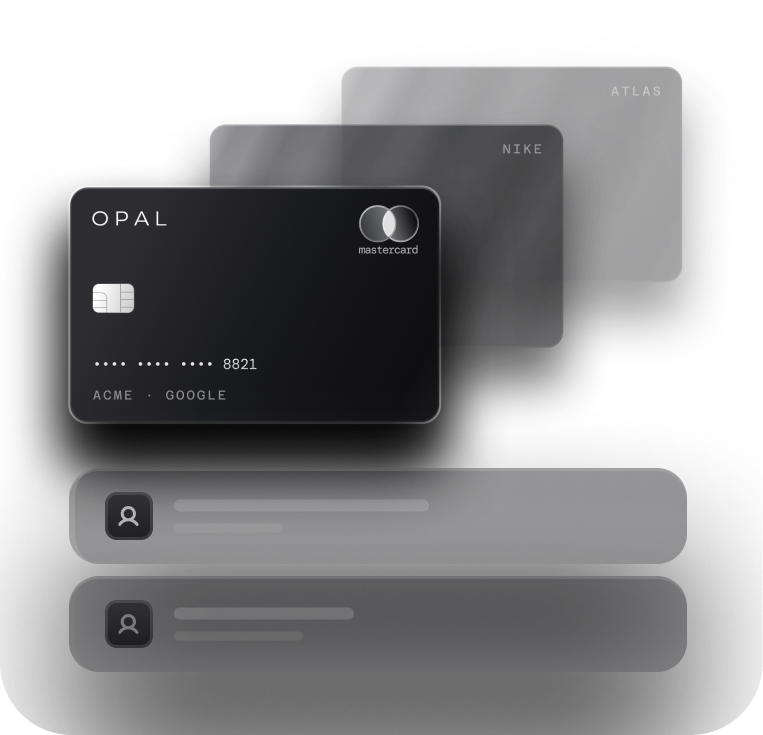
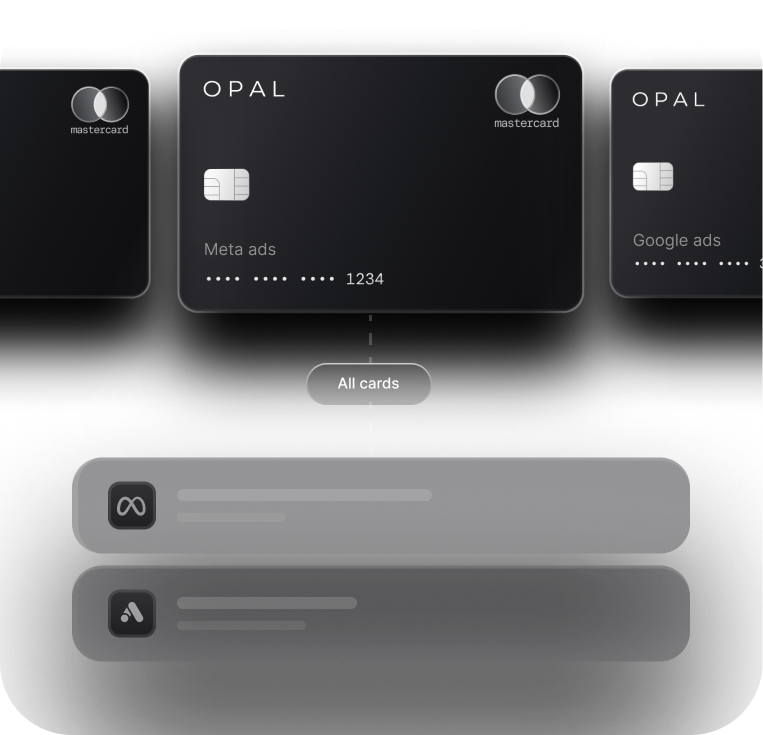
A dedicated Opal virtual card is set up for each client, linked to that client's approved media budget.
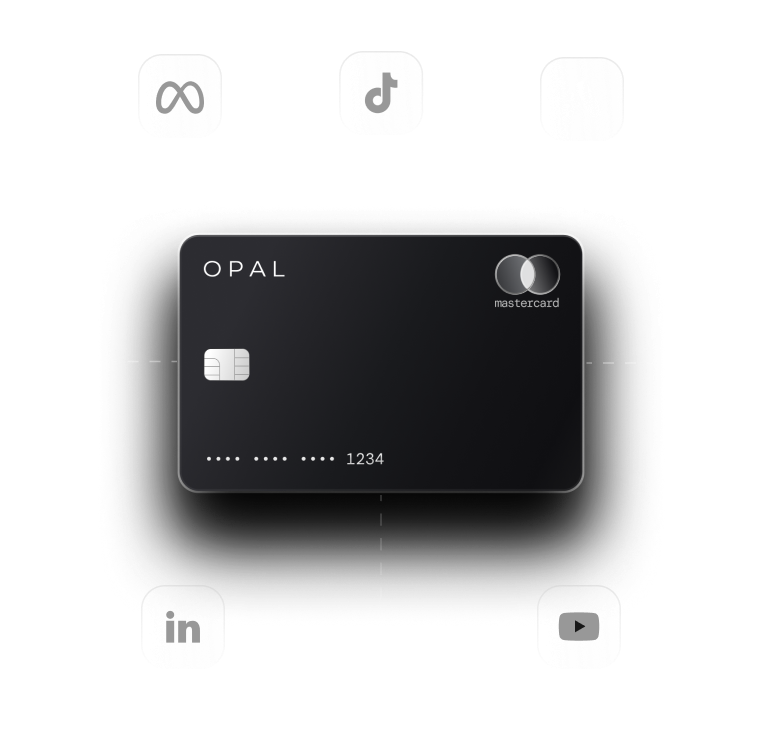
That card is the payment method on file with the ad platforms for their campaigns only.
Client funds cover that client's approved spend. The agency does not put up its own cash.
Spend limits are set at the card level, so each client's activity stays within their approved allocation.
The key difference from a standard prepayment arrangement is structural segregation. Each client has their own card. Spend limits are tied to their approved budget. Client funds are used exclusively for their campaigns. The agency's working capital stays out of the media spend equation.
This also solves the reconciliation problem. Because each client's spend is on a separate card, there is no manual sorting at month-end. Every transaction is already attributed to the right client, the right platform, and the right budget. For more on how this model works operationally, see Opal's agency client media spend risk checklist.
What Does the Billing Shift Actually Look Like?
For agencies that have only ever run on a shared card or credit line, here is what the change looks like in practice.
Shared card model |
Client-funded card model |
|
|---|---|---|
|
Payment method on file |
One agency card across all clients |
Dedicated card per client |
|
When client funds are used |
After spend runs, via invoice |
For that client's approved spend |
|
Reconciliation |
Manual sorting at month-end |
Automatic by card |
|
If a client stops paying |
Agency absorbs the shortfall |
That client's campaigns pause |
|
Agency working capital at risk |
Yes |
No |
The practical result: a client funding issue becomes a service interruption for that client, not a cash flow crisis for your agency.
Opal is built specifically for this model. The platform offers unlimited virtual cards, credit limits up to $10M tied to managed spend volume rather than personal credit, automatic sync with Meta, Google, TikTok, and other major platforms, and up to 1.5% cash back on ad spend. For agencies running on standard cards, that cashback alone represents margin that is currently going uncaptured.
The setup does not require a full operational overhaul. Many agencies onboard new clients to this model immediately and roll existing clients over at the next billing cycle.
The Bottom Line
If a client has not paid and your agency card is on file, you are past the point where preparation would have helped. Pause the campaigns, document everything, and pursue recovery through whatever channel your contract supports. Recovery through any of these channels takes time, and the outcome is not guaranteed.
Then fix the structure.
Agencies that rebuild their billing infrastructure to keep their own cash out of client media spend are better positioned to avoid this situation entirely, no matter how solid the client relationship looks.
A non-paying client should be a client problem. The billing structure determines whether it becomes an agency emergency too.
If you are ready to stop fronting client ad spend, explore how Opal works and see what the transition looks like for your agency.
Frequently Asked Questions
Can an agency sue a client for unpaid ad spend?
A written agreement can give an agency a stronger basis to pursue unpaid media spend. Available options depend on the contract, the amount owed, the client's location, and the facts of the dispute. Agencies should seek qualified legal advice for their specific situation.
What happens to ad campaigns if a client doesn't pay?
If the agency pauses campaigns due to non-payment, the ads stop running immediately. Ad platform accounts remain intact, but no new spend is charged. Pausing immediately is always the right move once a payment deadline has passed without acknowledgment.
What is the difference between prepayment and the client-funded card model?
Prepayment means the client pays you before campaigns run, and you hold and deploy those funds. The client-funded card model goes further: client funds are used for that client's approved media spend directly, so the agency does not handle the media budget as its own cash. This removes the agency from the financial chain more cleanly than prepayment alone.
What contract terms protect agencies from client non-payment on ad spend?
Contracts should include a specific reimbursement timeline (Net 15 or Net 30), a right-to-pause clause for non-payment, client liability for spend already run up to the pause date, and a prepayment requirement for new clients covering the first 90 days of the relationship.
Does switching to a client-funded card model require clients to change how they pay?
Yes, but the change is straightforward. Rather than paying an invoice after spend runs, clients fund their approved media budget before campaigns go live. Most agencies present this as a transparency upgrade: clients get direct visibility into how their budget is being deployed, and the agency is no longer acting as an intermediary holding client funds.
.webp)