


Client Ad Spend
Client ad spend is advertising budget that an agency or marketing partner places on behalf of a client, rather than for its own business. The money is the client’s, the campaigns run in the client’s interest, and the spend has to be reported back to the client at the level of platform and campaign. Because the funds pass through the agency, client ad spend carries obligations that internal marketing spend does not: attribution by client, clean separation between clients, and defensible reporting.
Last updated: August 2026
Why client ad spend matters
Client ad spend breaks the assumption most business card products are built on, which is that a company spends its own money on its own operations.
An agency spending $500,000 a month is not a $500,000-a-month business. It is a business with, say, $200,000 in annual revenue that moves half a million dollars of other people's money every month. Underwriting that reads the balance sheet sees a small company asking for a large limit and declines. The spend is real, recurring, low-risk, and invisible to the model.
That mismatch is the reason a general business card and a client ad budget rarely fit together for long.
How agencies handle client ad spend
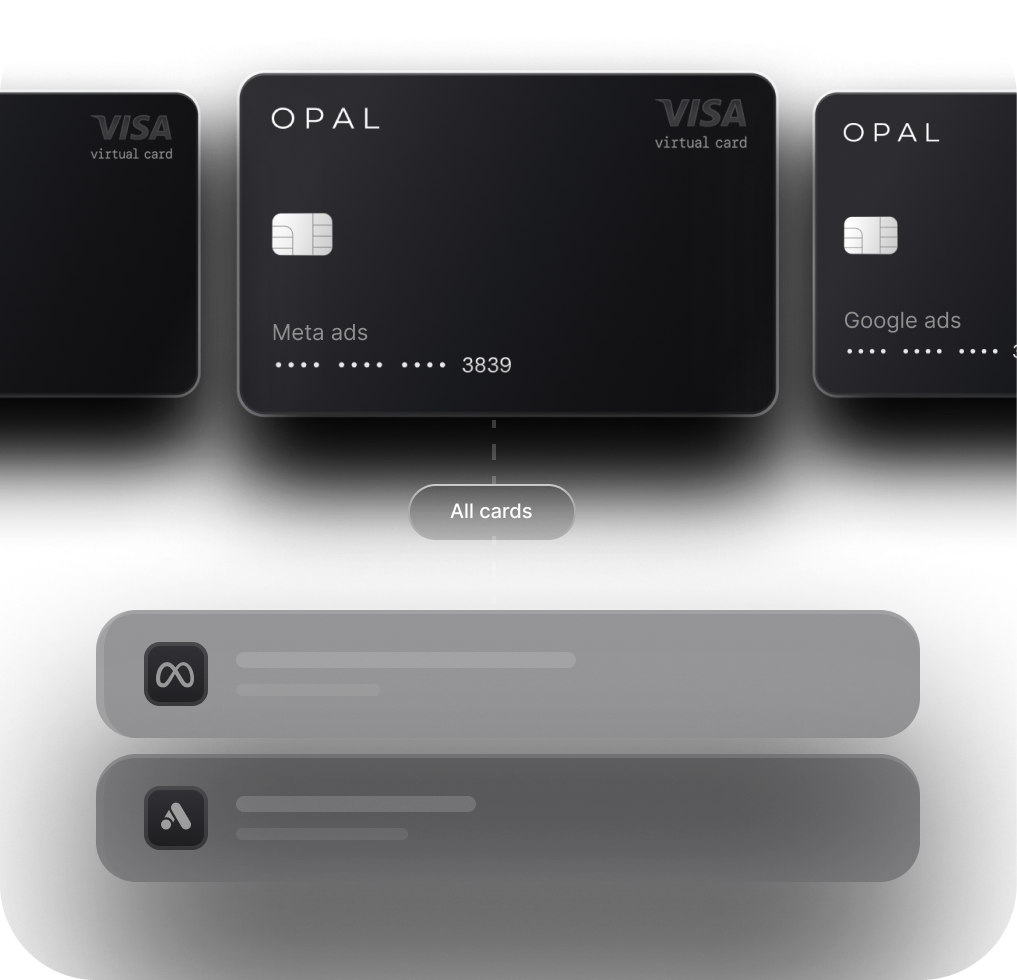
- Dedicated cards per client so no two clients ever appear on the same statement line.
- Pre-funded budgets where the client transfers funds before campaigns run.
- Client-level reporting built from card data rather than assembled by hand.
- Markup or management fees calculated on the spend the agency placed.
Business examples
A performance agency running eight clients across Meta and Google, each on its own card. A brand agency placing retail media spend for a client on Amazon Ads. A freelancer managing one client's TikTok account with a card funded by that client.



Frequently asked questions
Many do, and it is the main reason agency growth stalls. Winning a client with an $80,000 monthly budget means finding $80,000 of working capital before any of it is reimbursed. Card programs that extend credit sized to managed spend remove that requirement.
Treatment depends on whether the agency is acting as principal or agent, which affects whether the spend appears as revenue and cost or is treated as a pass-through. This is a question for the agency’s accountant, and consistency across periods matters more than which method is chosen.
That depends on the client agreement. Agencies that earn cashback on managed spend generally address it explicitly in the contract rather than leaving it unstated. Where rewards are paid to a personal account rather than a business account, the governance question gets harder, which is worth checking before choosing a card program.
See what Opal can do for you
Learn how our spend platform can increase the strategic impact of your finance team and future-proof your company