

Ad Spend Card: What It Is, Who Needs One, and How to Choose the Right One
Ad spend is not like ordinary business spending. Platforms charge on different billing cycles, budgets shift quickly, campaigns can scale overnight, and a failed payment can pause revenue-driving campaigns without warning.
An ad spend card is a payment card designed or configured specifically to manage advertising spend across platforms like Google Ads, Meta Ads, TikTok Ads, LinkedIn Ads, Microsoft Ads, Amazon Ads, and programmatic networks.
This guide defines the category, explains who needs a dedicated ad spend card, and shows how to choose the right setup for your team's size, structure, and spend volume.
Key Takeaways
An ad spend card is a payment card used specifically to manage digital advertising spend across ad platforms like Google, Meta, TikTok, LinkedIn, and Amazon.
Ad spend cards differ from generic business cards because advertising requires stronger controls, real-time visibility, customizable limits, cleaner reconciliation, and better fraud protection.
Agencies, ecommerce brands, startups, in-house marketing teams, and performance marketers often need dedicated ad spend cards once budgets become difficult to manage with a single shared card.
The best ad spend card setup depends on spend volume, number of platforms, number of clients, approval workflows, and how painful reconciliation is today.
-
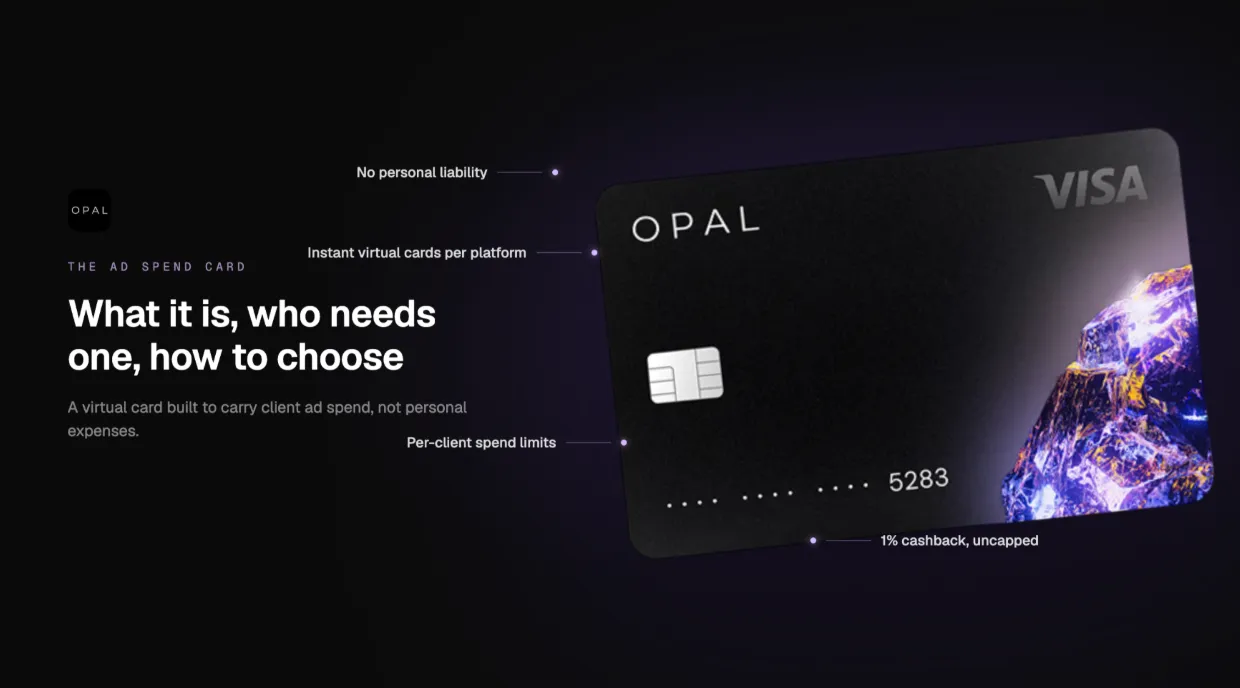
Opal is one purpose-built option for teams that want virtual cards, spend controls, cleaner reporting, and up to 2% cashback on eligible ad spend.
What Is an Ad Spend Card?
An ad spend card is a physical or virtual payment card used specifically for advertising expenses, such as Google Ads, Meta Ads, TikTok Ads, LinkedIn Ads, Microsoft Ads, Amazon Ads, and other paid media platforms.
The card itself can take several forms:
-
A credit card with a dedicated limit for ad spend
-
A charge card that settles in full each billing cycle
-
A corporate card issued to a media buyer or team
-
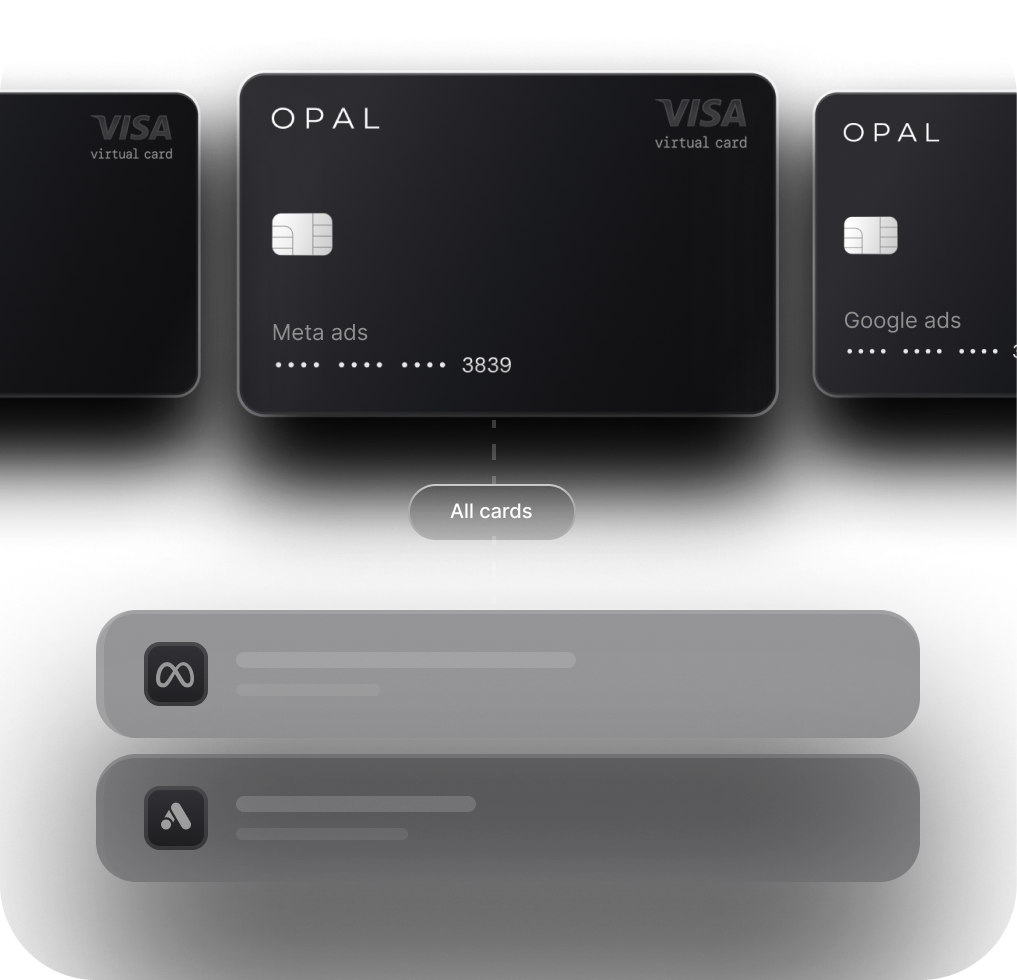
A virtual card created specifically for one platform, client, or campaign
-
A dedicated payment card through a spend management platform
The defining feature is not just the card itself. It is how the card is used and controlled. A true ad spend card setup makes ad payments easier to track, approve, and reconcile. Some teams use a generic business card for ad spend. Others use purpose-built virtual cards or spend management platforms that give finance teams visibility without slowing down media buyers.
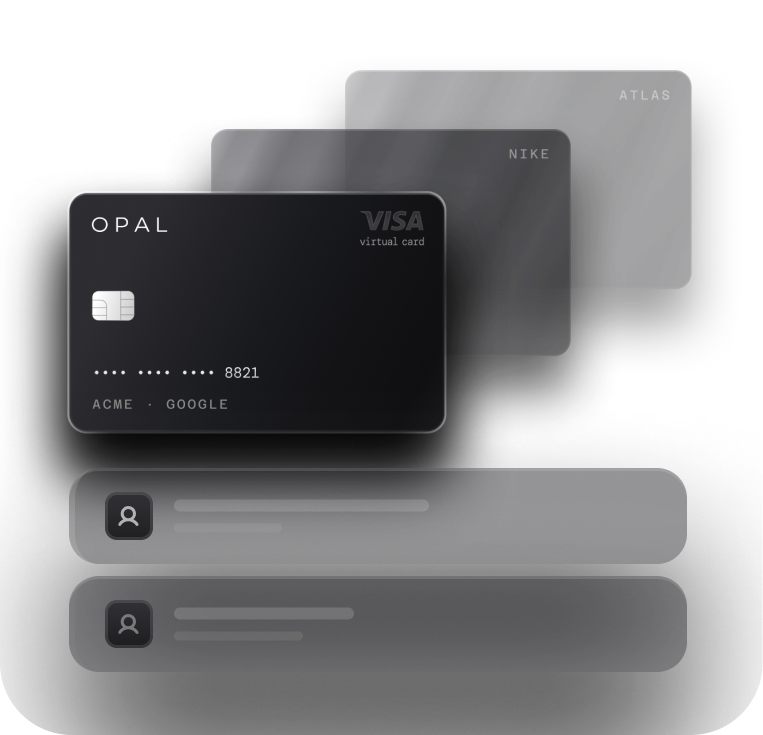
A simple example: a small brand may use one ad spend card for all paid media. A larger agency may create separate cards for each client, platform, or campaign type, each with its own limit, owner, and reporting structure.
The right answer depends on the team. But as spend grows, the case for a more structured setup becomes harder to ignore.
How Ad Spend Cards Differ From Generic Business Cards
Generic business cards are designed for general company expenses: travel, software subscriptions, office supplies. They work fine for occasional purchases with predictable amounts.
Advertising spend is different. Platforms charge on billing thresholds, not calendar dates. A campaign that scales from $500 to $5,000 per day can trigger multiple charges before month-end. A shared card attached to five platforms makes it nearly impossible to know which platform drove a charge, who authorized it, or whether the amount is correct.
The practical differences stack up quickly:
Generic Business Card |
Ad Spend Card Setup |
|---|---|
One limit for all expenses |
Limits set per platform, client, or campaign |
Charges grouped with all company spend |
Ad charges isolated for clean reporting |
Hard to reconcile by platform |
Reconciliation tied to specific card and purpose |
One point of failure for all platforms |
Backup cards reduce campaign pause risk |
Fraud affects all spend |
Isolated cards contain exposure |
A generic business card can work for low-volume advertisers running one or two platforms with modest spend. But as spend grows, as more platforms are added, or as clients multiply, the limitations become operational problems. Reconciliation takes longer. Finance teams lose visibility. Failed payments affect multiple campaigns at once. Fraud on a shared card can disrupt everything.
That is the core reason dedicated ad spend cards exist.
Who Needs an Ad Spend Card?
Not every team needs a dedicated ad spend card from day one. But several types of organizations consistently run into problems when they rely on a single shared card for all advertising spend.
Agencies
Agencies managing spend across multiple clients need clear separation by client, platform, campaign, or account. When a single card is used for all client spend, billing becomes a guessing game. Dedicated ad spend cards help with accurate client invoicing, cleaner reconciliation, and building the kind of financial transparency that clients expect. For agencies producing client-facing ad spend reports, card-level organization is the foundation that makes those reports accurate.
Ecommerce Brands
Ecommerce teams often scale paid media quickly across Meta, Google, TikTok, and affiliate channels. A $50,000 month can become a $200,000 month during a product launch or peak season. Dedicated ad spend cards help prevent failed payments during high-spend periods and make it easier to control spend by platform without slowing down the buying team.
Startups
Startups using paid acquisition need visibility into burn, CAC, and campaign spend. Finance and growth teams often operate from the same budget, and a shared card creates ambiguity about where money went. A dedicated ad spend card gives both teams a clear line of sight into advertising costs without requiring manual reconciliation every week.
In-House Marketing Teams
Marketing teams at larger companies often manage spend across multiple platforms, regions, and business units. They may need approval workflows before budgets increase, audit trails for finance reviews, and clean reporting that separates paid media from other marketing costs. A structured ad spend card setup supports all of these without adding administrative overhead.
Media Buyers and Performance Marketers
Media buyers need the ability to move fast. Pausing a campaign to wait for a card increase can cost real money. At the same time, finance teams need guardrails. A dedicated ad spend card setup, with appropriate limits and a clear escalation path for increases, lets media buyers operate at speed while keeping spending accountable.
Common Problems Ad Spend Cards Solve
A well-structured ad spend card setup is not just about payment convenience. It solves specific operational problems that shared or generic cards cannot.
-
Failed ad payments. A dedicated card for Google Ads makes it easier to identify failed payments, retry charges, and reconcile platform spend against actual billing activity. When a shared card fails, every platform connected to it is at risk.
-
Shared-card confusion. When multiple team members or platforms share one card, transaction context disappears. A dedicated card per platform or buyer makes every charge traceable. For a deeper look at how declined ad payments affect campaigns, the patterns are consistent: shared cards amplify the damage.
-
Overspend. Custom spend limits on each card prevent campaigns from exceeding approved budgets, even when media buyers are moving quickly.
-
Fraud risk. Isolated cards contain the exposure. If a virtual card is compromised on one platform, other platforms and budgets are not affected.
-
Difficult reconciliation. When every platform uses the same card, month-end reconciliation requires manually sorting charges by platform, campaign, and date. Card-level separation makes this automatic.
-
Unclear client billing. Agencies using one card for multiple clients cannot easily produce clean per-client billing without significant manual work. Dedicated client cards solve this at the source.
-
Missing receipts or transaction context. Virtual cards tied to specific campaigns or platforms carry built-in context. Finance teams do not need to chase down what a charge was for.
-
Budget changes not reflected in controls. When a client approves a higher budget, the card limit should reflect it. A structured setup makes this a deliberate action, not an afterthought.
-
Campaign pauses caused by card problems. A card decline during an active campaign can pause spend immediately. Backup cards and billing alerts reduce this risk significantly.
-
Lack of visibility for finance teams. Finance teams managing advertising spend without real-time card data are always working from incomplete information. Dedicated ad spend cards close that gap.
What to Look For in an Ad Spend Card
Not all cards are built the same way. When evaluating an ad spend card or spend management platform, these are the features that matter most for advertising-specific workflows:
-
Virtual card creation: The ability to spin up new cards quickly, without waiting for physical cards to arrive, is essential for platform-level or campaign-level organization.
-
Physical card option: Some situations still require a physical card. A good setup supports both.
-
Custom spend limits: Each card should have its own limit, adjustable by the team without requiring a bank call.
-
Platform, client, or campaign-level card organization: Cards should be nameable and assignable so every charge has clear context.
-
Real-time spend visibility: Finance and media teams should see transactions as they happen, not at month-end.
-
Alerts for unusual charges or approaching limits: Proactive alerts prevent surprises and allow teams to act before a campaign pauses.
-
Backup card support: Mission-critical campaigns should have a secondary card on file.
-
Easy card replacement: If a card is compromised or a campaign ends, replacing or closing the card should take seconds.
-
Accounting and reconciliation support: Integration with bookkeeping tools or clean export formats saves hours of manual work.
-
Multi-user access and permissions: Different team members need different levels of access. Finance leads should not need to share credentials with media buyers.
-
Fraud controls: Merchant category restrictions and spend pattern alerts reduce exposure.
-
Cashback or rewards on eligible spend: At significant spend volumes, cashback compounds quickly. Even 1-2% on $500,000 per month is meaningful.
-
Support for high-volume ad spend: Some cards have limits that cap out well below what a growing agency or brand needs. Verify the ceiling before committing.
-
Clear ownership between finance and media buying teams: The card setup should reflect how the team actually works, not force everyone into a single workflow.
The right ad spend card should match the way your team actually buys media. If your buying team operates by platform, your card structure should too.
Best Ad Spend Card Setup for Agencies and Brands
There is no single perfect setup. The right card structure depends on how your team buys media, how many clients or platforms you manage, and how tightly finance needs to track spend.
Simple Setup: One Card for All Ad Spend
Best for smaller advertisers with limited platforms and lower monthly spend.
|
Pros |
Easy to start, simple billing, minimal overhead |
|
Cons |
Harder to separate spend by platform or campaign; one failure affects everything |
Platform Setup: One Card per Ad Platform
Best for brands or agencies spending across Google, Meta, TikTok, LinkedIn, and other platforms.
|
Pros |
Cleaner platform reporting, easier troubleshooting, better limit control per platform |
|
Cons |
Requires more setup and ongoing monitoring |
Client Setup: One Card per Client
Best for agencies managing multiple clients.
|
Pros |
Cleaner client billing, easier reconciliation, better client-level visibility |
|
Cons |
Requires consistent naming conventions and a regular monthly review process |
Campaign or Test Setup: One Card per Campaign Type
Best for high-volume advertisers, test budgets, or spend that needs strict separation.
|
Pros |
Strongest control, ideal for experiments and new channel testing |
|
Cons |
Can become complex if not actively managed |
Most growing teams follow a predictable path: they start with one shared card, run into reconciliation or billing problems, and move to platform-level or client-level cards. The sooner that transition happens, the less manual cleanup is required later.
Hard Limits vs. Flexible Controls
A common mistake in ad spend card setup is treating limits as the only control lever. Hard limits prevent overspend, but they can also slow down media teams at the worst possible time.
The best setups use a combination of controls:
-
Hard limits for strict monthly caps, test campaigns, and client-funded budgets where overage is not acceptable under any circumstances.
-
Spend alerts for campaigns that need room to scale, so the team knows when a limit is approaching before it becomes a problem.
-
Approval workflows for large budget increases, so finance can review and authorize without creating a bottleneck for routine spend.
-
Temporary limit increases for product launches, seasonal campaigns, or high-spend periods where normal limits would interrupt performance.
-
Backup cards for mission-critical campaigns where a payment failure is not an option.
Setting monthly ad spend limits per client is one way to enforce accountability without creating constant friction between finance and media teams.
The goal is not to lock everything down. The goal is to make sure every dollar spent was intentional. A setup that prevents media buyers from doing their jobs is not a control system. It is an obstacle.
The right balance looks different for every team. A startup with a tight CAC target needs tighter controls than an agency running client budgets with pre-approved monthly amounts. Design the control structure around the actual risk, not a theoretical worst case.
Where Opal Fits
Opal is a purpose-built option for teams that want their card structure to match how they manage paid media.
With Opal, teams can:
Create virtual cards for clients, platforms, campaigns, or individual buyers
Set spend limits and controls at the card level
Track ad spend with real-time transaction visibility
Reduce shared-card risk across platforms
Improve reconciliation and client reporting workflows
Support high-volume ad spend without hitting restrictive limits
Earn up to 2% cashback on eligible ad spend
Opal is not the only way to manage ad spend cards. Teams can also use standard business credit cards, corporate cards, platform-level budgets, spreadsheets, accounting tools, and manual approval workflows. Many of those approaches work well at lower spend volumes.
Opal is best suited for teams that want the card structure itself to reflect how they buy media: organized by client, platform, or campaign, with controls and visibility built in from the start rather than added on afterward.
How to Choose the Right Ad Spend Card
Start by answering these eight questions honestly:
How much ad spend do you manage each month?
How many platforms do you use?
Do you manage spend for clients or only your own brand?
How often do campaigns scale or shift budgets mid-month?
Who needs visibility into spend: just finance, or media teams too?
Who approves budget increases, and how long does that take today?
How painful is reconciliation right now?
What happens if a card fails during an active campaign?
Your answers point to a clear recommendation:
Your Situation |
Recommended Setup |
|---|---|
Low spend, one platform |
A dedicated business card may be enough |
Multi-platform brand |
Platform-level cards with spend alerts |
Multi-client agency |
Client-level or platform-level virtual cards |
High-volume media team |
Virtual cards, spend limits, backup cards, and weekly reconciliation |
If reconciliation is already painful, or if a card failure has ever paused a campaign, the cost of staying with a generic setup is higher than the cost of switching to a structured one.
Final Thoughts
An ad spend card is more than a payment method. It is part of how a team controls, tracks, approves, and reconciles advertising spend. The card structure you choose shapes how clearly finance can see what is happening, how quickly media buyers can act, and how confidently you can report on spend to clients or leadership.
Small teams may be fine with one dedicated business card set aside for ad spend. But agencies, ecommerce brands, startups, and performance teams running significant budgets across multiple platforms almost always need something more structured: virtual cards, spend limits, alerts, backup cards, and clean reporting built into the payment layer itself.
The good news is that setting up a structured ad spend card system is not as complex as it sounds. Start with the structure that fits where you are today, and build toward the one you will need as spend grows.
FAQ
What is an ad spend card?
An ad spend card is a payment card used specifically for digital advertising expenses across platforms like Google Ads, Meta Ads, TikTok Ads, LinkedIn Ads, Microsoft Ads, Amazon Ads, and programmatic networks. It can be a credit card, charge card, corporate card, or virtual card, configured to manage advertising spend with appropriate controls and visibility.
What is the best ad spend card?
The best ad spend card depends on your team's spend volume, platforms, client structure, control needs, and reconciliation process. For teams that need virtual cards, spend controls, cleaner reporting, and up to 2% cashback on eligible spend, Opal is one purpose-built option. Other teams may do well with a dedicated business credit card or corporate card, depending on their scale and structure.
Can I use a regular business credit card for ad spend?
Yes, especially at lower spend levels. But as spend grows across more platforms or clients, a regular business card makes reconciliation, platform separation, limit management, and fraud prevention significantly harder.
Who needs an ad spend card?
Agencies, ecommerce brands, startups, in-house marketing teams, media buyers, and performance marketers may need a dedicated ad spend card when advertising spend becomes too important or too complex to manage with a single shared card.
Why use virtual cards for ad spend?
Virtual cards can be created for specific clients, platforms, campaigns, or buyers. This makes it easier to control budgets, monitor transactions in real time, replace compromised cards without disrupting other platforms, and reconcile spend accurately.
How do ad spend cards help agencies?
Ad spend cards help agencies separate client spend, reduce billing confusion, prevent shared-card problems, control budgets by client or platform, simplify reconciliation, and improve the accuracy of client reporting.
Do ad spend cards prevent failed payments?
They can reduce the risk of failed payments when paired with proper limits, backup cards, billing alerts, and active monitoring. No card setup can eliminate every bank, platform, or verification issue, but a structured setup makes failures easier to catch and resolve quickly.
Should each ad platform have its own card?
Platform-level cards are often useful for brands and agencies spending across multiple channels. They make reporting cleaner, troubleshooting faster, and limit control more precise. Whether the added setup is worth it depends on how many platforms you use and how much spend runs through each one.