



How to Consolidate Client Ad Billing on One Card and Still Earn Rewards

.webp)
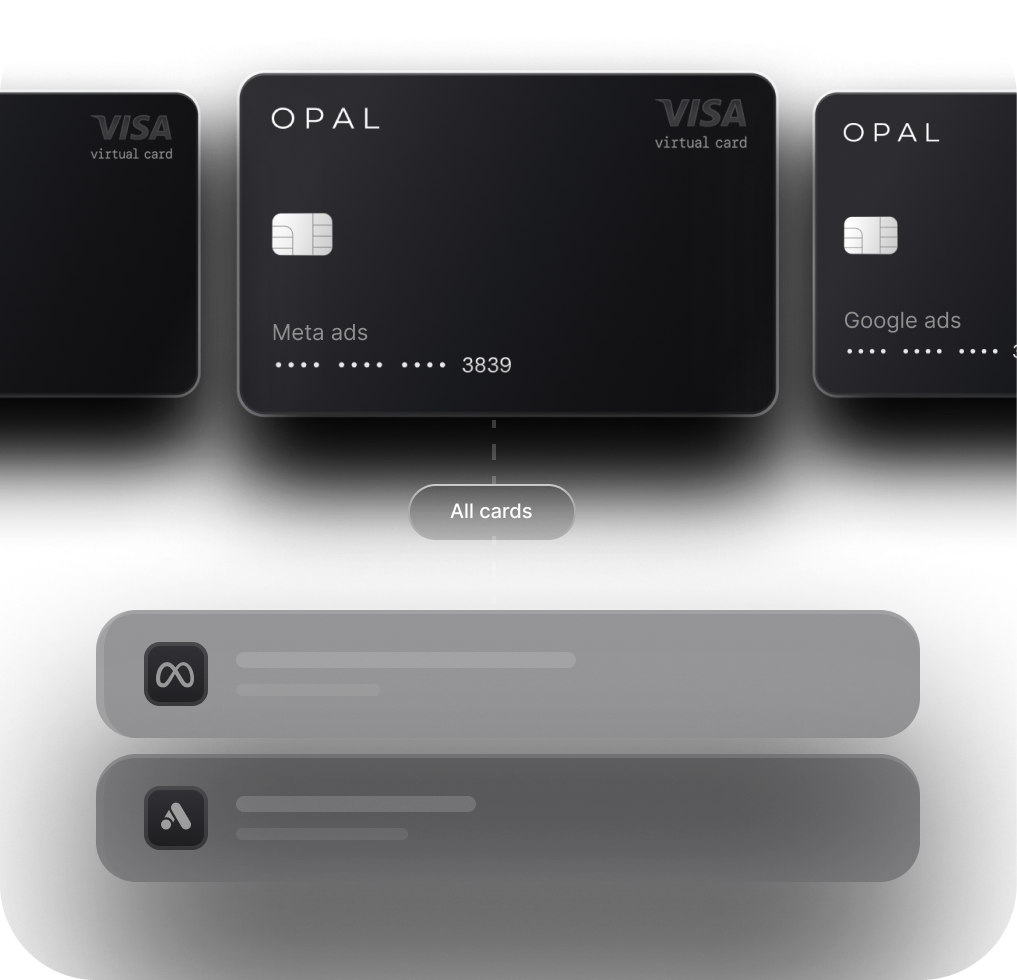
To consolidate client ad billing on one card and still earn rewards, put every client's advertising spend on a single card account with a single rewards program, then issue a separate virtual card number for each client or each client-platform pair underneath it.
Consolidation belongs at the account layer, where the credit line and the reward rate live. Separation belongs at the card layer, where attribution, spend limits, and decline risk live. Running both at once lets one rewards pool cover an entire book of business without mixing any client's spend into another's ledger.
The distinction matters because the billing layer and the card layer are routinely confused.
Google Ads settles through a payments profile that can sit above many advertising accounts, Meta and TikTok bill against thresholds set per ad account, and Amazon Ads, LinkedIn, Snapchat, and The Trade Desk each run a charge pattern of their own.
Our card is issued by First Internet Bank of Indiana, Member Federal Deposit Insurance Corporation (FDIC), pursuant to a license from Visa Inc., with credit provided by CapitalOS, Inc. or CapitalOS Financial Services LLC, and one agency account carries unlimited virtual cards across those platforms.
Agencies that miss the distinction either put a single card number on 40 ad accounts, concentrating every fraud hold in one place, or open a card program per client and split their volume across several reward ceilings.
Key Takeaways
-
Consolidation and separation solve different problems. The credit line, the reward rate, and the accounting feed belong on one account; the card number, the spend limit, and the client ledger belong on separate virtual cards underneath it.
-
Splitting volume across several card programs multiplies the reward ceilings you have to clear, because each program applies its own cap before any of them pays at the elevated rate.
-
A consolidated payments profile at an ad platform is not the same as a consolidated card. Google's consolidated billing moves grouped accounts onto monthly invoicing, which changes how the balance settles.
-
Attribution is set at card issuance, not at month end. A card named and limited for one client turns every charge on it into that client's spend with no manual allocation.
-
Rewards on client media need an owner named in writing. The agency agreement, not the card statement, is where the question of who keeps the cashback gets settled.
-
Our agency account carries unlimited virtual cards at no cost, a credit limit reaching $10M that is sized against the advertising volume you manage, underwriting that requires neither a personal guarantee nor a hard credit pull, and cashback of up to 2% on eligible advertising spend.
What Does It Mean to Consolidate Client Ad Billing on One Card and Still Earn Rewards?
It means one card account, one credit line, and one rewards program covering every client, with a distinct virtual card number sitting on each ad account. The phrase "one card" describes the relationship you hold with the issuer, not the 16 digits you type into a billing screen.
Separate the Account Layer From the Card Layer
The account layer is where underwriting happens. We size one credit limit to the total advertising volume you manage, so you file one application and settle one balance each cycle. Every dollar charged under that account earns at the same rate, into the same rewards balance.
The card layer is where the operational detail lives. Each virtual card carries its own number, name, and spend limit, so a charge posting against it is attributed before anyone opens a spreadsheet. For the ways to organise those cards by client, platform, or campaign, see our guide to structuring cards per client.
Know Which Layer Your Reward Rate Lives On
Reward rates and caps are set per program, and a program sits at the account layer. The number of card numbers you issue therefore has no effect on what you earn, while the number of programs you hold has a very large effect.
Agencies often reverse this, issuing one number to keep rewards in a single place when the rewards were never tied to the number. That number is then the one thing that breaks at volume.
Which Parts of Billing Should Consolidate, and Which Should Not?
Five layers sit between a campaign and a settled balance, and each has a correct answer. The table below sets out which way each should go and what breaks when it goes the other way.
A) Consolidate the Credit Line, the Rewards Pool, and the Ledger Feed
These 3 layers reward concentration. One credit line sized to your whole book absorbs a heavy month on one client using headroom another client leaves behind. One rewards program means every dollar counts toward the same ceiling, and one accounting feed means your books receive pre-tagged transactions from a single source, through our QuickBooks and Workday integrations.
B) Keep the Card Credential and the Client Ledger Separate
These layers reward isolation. A frozen card number takes down every campaign it is attached to, so a number shared across 18 clients turns a routine verification hold into 18 client conversations. A spend limit set at issuance enforces the approved budget at the moment of the charge rather than surfacing an overage weeks later, an argument our piece on separating client budgets works through in detail.
|
Billing Layer |
Direction |
What You Gain |
What It Costs to Get Backwards |
|---|---|---|---|
Credit line and underwriting |
Consolidate |
1 limit sized to total managed volume, 1 application, 1 balance per cycle |
Several limits each sized to a fraction of your volume, each with its own ceiling |
Rewards program |
Consolidate |
Every dollar earns at 1 rate against 1 cap |
Each program's cap applies separately, so several must clear before any pays in full |
Accounting feed |
Consolidate |
Transactions arrive pre-tagged from a single source |
Manual stitching of several exports at every close |
Card credential on file |
Separate |
A decline, freeze, or fraud hold touches 1 client only |
A single hold pauses every campaign the number is attached to |
Spend limit and client ledger |
Separate |
Attribution and budget enforcement happen at issuance |
Manual allocation every month end, with overspend found after the fact |
How Do Ad Platforms Treat Consolidated Billing?
Platforms run their own consolidation mechanics, and those sit above your card rather than replacing it. Google is the most explicit about it, which makes its documentation the clearest place to watch the layers stack.
Use a Manager Account to Group the Invoices
Google Ads offers consolidated billing, which its help centre describes as giving you "the ease of moving accounts to monthly invoicing" and calls a popular choice for agencies, resellers, and large advertisers running multiple accounts.
Using it requires a manager account, every account linked to one paying manager, monthly invoicing settings, and a shared currency. Google's manager account billing rules add that one consolidated invoice can cover up to 50,000 accounts, that a separate invoice is issued per currency, and that the feature is not available to media agencies or advertisers in France.
Check Whether Consolidation Moves Spend Off Your Card
Consolidated billing is tied to monthly invoicing, so grouping accounts under it changes how the balance settles rather than simply tidying the paperwork.
Google Ads Help, in its page "About payments profiles," states that a payments profile stores legal, payment, and tax information in one place, that most postpay and prepay customers can re-use one profile across multiple advertising accounts, and that each advertising account is tied to its own unique payments account. That is the same account-versus-card split described above, in Google's own structure.
The practical check takes a few minutes per platform. Open the billing settings on 1 account, confirm which payment methods it accepts today, and confirm whether a card stays eligible after any consolidation you are considering.
Our breakdown of merchant category mismatches covers what happens to your rate once spend settles on a card.
What Does Splitting Spend Across Several Card Programs Cost You?
Fragmentation costs you the difference between 1 ceiling and several. Every additional program you hold is another cap standing between your volume and the elevated rate you signed up for.
Count Every Cap You Have to Clear
Take an agency running 18 clients across 3 platforms at $640,000 a month, or $7,680,000 of annual advertising volume. Suppose that volume sits across 4 separate card programs, each paying its elevated rate on the first $50,000 of annual spend before dropping to base rate.
|
Structure |
Volume Earning the Elevated Rate |
Share of Annual Volume |
|---|---|---|
4 programs, each capped at $50,000 |
$200,000 |
2.6% |
1 uncapped program |
$7,680,000 |
100% |
Run the Figure Against Your Own Volume
On $7,680,000 of annual volume, an uncapped 2% rate returns $153,600 and an uncapped 1% rate returns $76,800. The rate that applies to your account is confirmed when your application is approved.
To find your own ceilings, open the rewards terms for each program you hold and locate the sentence stating a maximum, worded as an annual, monthly, or bonus category limit.
Divide that maximum by the annual volume you push through that program, and the result is the share of your spend earning the elevated rate. Our explainer on reward caps covers what those ceilings do at scale.
Who Owns the Rewards on Consolidated Client Spend?
Ownership is a contract question rather than a product question, and it gets sharper once the spend is pooled. One rewards balance drawn from 18 clients' budgets needs a written answer before the first statement arrives.
1. Put the Answer in the Client Agreement
Name the treatment in the services agreement: whether rewards earned on media the client funds are retained by the agency, credited against the client's media invoice, or shared on a stated basis. Agencies take all 3 positions, and any of them holds up when disclosed up front and applied consistently.
Where you retain the rewards, say so in the clause covering media billing, and keep the wording identical across every contract. A pooled balance is hard to explain after the fact if 2 clients were promised different things.
2. Book the Rewards the Same Way Every Period
Card rewards are commonly recorded either as other income or as a reduction in advertising expense, and the choice matters less than applying it identically each period. Internal Revenue Service Publication 525,
Taxable and Nontaxable Income, addresses a cash rebate received from a dealer or manufacturer, stating that the rebate is treated as a reduction in the price of the item and is not included in income.
That passage covers rebates on purchased items rather than card rewards specifically, so confirm the treatment for your own structure with your accountant.
Either way, our accounting integrations post the underlying transactions pre-tagged, so the rewards line reconciles against spend you can trace to a named card.
Where Does a Consolidated Card Program Stop Working?
A single account suits most agency books, and it has defined edges worth knowing before you migrate. Naming them now is cheaper than discovering one halfway through a platform switch.
Platform, Region, and Settlement Limits
Our card supports businesses based in the United States and works with any U.S.-based bank, with limited exceptions. Card use is limited to supported advertising and media platforms, so operating costs belong on a different instrument.
The card settles in full: the statement balance is automatically debited on each monthly payment due date from your designated bank account or Opal Balance, and if that debit does not process the card may be locked until the balance is repaid.
Paid Options Alongside the Included Ones
The options that cost nothing are the ones most agencies need. Unlimited virtual cards, card-level spend limits, merchant restrictions, approvals, employee permissions, and accounting sync are included, with no annual fee, no per-card fee, no cancellation fee, and no cut taken from your media spend.
Ad Pay, which settles an advertising invoice with a card, is a separate early-access product on a waitlist rather than an included feature. It carries a per-payment fee of 3% on Opal credit or 3.5% on your own card, processed within 3 to 5 business days, for teams spending $50,000 or more a month.
Because that fee exceeds the cashback earned on the payment, treat it as a cash flow tool rather than a rewards play.
Consolidate Your Client Ad Billing Without Losing the Rewards
Apply for one agency account, and we issue the credit line, the rewards program, and the card infrastructure; you assign the cards, set the limits, and decide how the ledger maps to your clients.
The onboarding form takes 2 to 3 minutes, virtual cards are typically issued within 24 to 48 hours, and approval runs without a personal guarantee or a hard credit pull.
Start With Your Largest Client and Expand
Migrate the client with the most volume first, because that account proves the structure and moves the largest share of spend onto the earning rate.
Issue a card per platform for that client, set each limit to the approved budget, swap the payment method in each platform's billing settings, and watch one full billing cycle before moving the next client across.
Then repeat down your client list in descending order of spend. We may periodically review your business performance to assess eligibility for credit adjustments, and if eligible you may be offered a credit increase, which keeps the single limit growing alongside the book.
Agencies with large rosters will find sequencing detail in our guide to scaling past 50 clients, and the product specifics live on our agency card page.
Frequently Asked Questions (FAQs)
Can 1 Card Number Really Cover All of Your Clients?
Technically yes, operationally no. A shared number means one fraud hold, verification request, or decline pauses every campaign attached to it, and every charge needs manual allocation afterwards. Keep the account single and the numbers separate, which delivers the consolidation benefit without the shared point of failure.
Does Consolidating Billing Change How Much Cashback You Earn?
Consolidating onto one account usually increases it, because the rate and any cap apply per program rather than per card number. Moving volume that sat across several programs onto one means a single ceiling to clear instead of several. The number of virtual cards you issue underneath has no effect on the rate.
Will Clients Object to Their Spend Sitting on an Agency Card?
Most accept it once the structure is explained, because a dedicated card with a named limit is easier to audit than a shared statement. Show them the card assigned to their account, the limit matching their approved budget, and the reporting it produces. Disclose the rewards treatment in the agreement.
What Happens to the Rewards If a Client Leaves Mid-Cycle?
Rewards accrue to the account holder as the spend posts, so anything earned before the relationship ends stays earned. Freeze that client's cards on the final day of service to stop further charges, then let pending authorisations clear before archiving them. Your agreement should state how any shared portion is settled on exit.
Does Moving Ad Accounts Onto One Payments Profile Pause Campaigns?
Changing billing details can trigger a platform re-verification, so treat it as a scheduled change rather than a background task. Update one account at a time, confirm the new method is active before moving the next, and avoid switching mid-flight on a campaign you cannot afford to interrupt.
How Many Virtual Cards Should an Agency Issue?
Start with one card per client, then add a card per platform for any client running more than 2 channels. That gives attribution at the level your reporting needs without creating an inventory nobody tracks. Cards cost nothing to issue, so the practical limit is how many your team keeps named and current.