

Political Media Buying Finance: A Playbook for the Full Election Cycle

.webp)
Political media buying finance is the set of budgeting, payment, and record-keeping controls that keeps a political committee's advertising spend traceable from approval to public filing across an election cycle.
The method is to budget by reporting window, give each committee and platform its own controlled card, record the date every ad first runs alongside the date it is charged, and close the cycle against the committee's post-general reporting deadline.
The discipline exists because political spend becomes public in several places. Committees report to the Federal Election Commission (FEC) on a schedule that tightens near Election Day. Independent expenditures go on Schedule E of Form 3X, due within 48 or 24 hours of an ad's public release once thresholds are met.
Meta requires a verified "Paid for by" disclaimer on political ads. Google requires election ads verification. Both publish election ad spend in the Meta Ad Library and Google's Political Ads Transparency Report.
Candidate committees, PACs, party committees, and their agencies all need books that agree with what regulators and the public already see.
Key Takeaways
Reconciliation cadence should follow the Federal Election Commission (FEC) calendar, moving from monthly to weekly to daily as Election Day approaches and reporting deadlines shorten.
An independent expenditure counts as made on the date the ad is publicly disseminated, so finance needs each ad's first-run date, which can arrive days before the card charge.
Meta and Google both require political advertiser verification before election ads run, which makes verification a gate to clear before any card connects to a platform.
Card names built from fixed fields for committee, platform, report treatment, and flight let a statement sort by filing treatment without manual tagging.
The Meta Ad Library and Google's Political Ads Transparency Report keep election ads public for 7 years and show ranges or rounded totals, so every gap against your ledger needs a documented reason.
Candidate committees, plus party committees and political action committees (PACs) that file quarterly, submit a post-general report due 30 days after the election that covers activity through day 20.
How Should You Plan Political Media Buying Finance Around the Election Calendar?
Plan it backwards from the reporting deadlines, because the calendar sets how fast each dollar must be documented. Budgets, card structure, and reconciliation cadence all change at the same points in the cycle.
Map Each Phase to Its Reporting Rhythm
For committees making independent expenditures, the FEC schedule has 3 breaks that matter to finance. Up to the 20th day before an election, expenditures aggregating $10,000 or more trigger a 48-hour report. From then until 24 hours out, $1,000 triggers a 24-hour report. The post-general report covers activity through day 20 after the election, giving your finance calendar 4 phases:
Election Cycle Finance Calendar
Phase |
Reporting Trigger for Independent Expenditures |
Finance Cadence |
Card Actions |
|---|---|---|---|
Setup, before the first flight |
Regular monthly or quarterly reports |
Monthly close per committee |
Issue cards with limits, merchant locks, and expiry dates |
Build, through day 20 before the election |
48-hour report at $10,000 or more in aggregate |
Weekly close, first-run dates logged daily |
Adjust limits only against approved budget changes |
Final stretch, day 19 until 24 hours out |
24-hour report at $1,000 or more in aggregate |
Daily close per committee |
Apply the pre-approved limit ladder |
Close, Election Day through day 20 after |
Post-general report, due on day 30 |
Final reconciliation and trailing charges |
Lower limits, export records, let cards expire |
Budget by Committee, Platform, and Phase
Build each budget line from 3 coordinates: a committee, a platform, and a phase. That keeps every approved dollar inside the reporting window it belongs to. A committee buying on Meta, Google, and 1 DSP across 4 phases carries 12 lines. Each line is small enough for 1 buyer to own. Keep production, data, and agency fees on separate lines, since they are usually invoiced apart from working media.
Hold a Reserve for the Final 20 Days
The final stretch has the shortest reporting deadlines, and any late decision must be funded, approved, and documented inside them. Write a reserve into each committee's plan. Document the release rules: who releases it, against which confirmed funds, and in what increments. A reserve with written rules moves on 1 approval. An unplanned increase needs a new budget decision under deadline.
Which Vendor Controls Should Be in Place Before a Card Goes Live?
Put 2 controls in place before any card touches a platform: confirmed political verification and a card locked to 1 committee and 1 platform. Both close gaps that get costly once ads run.
Confirm Platform Political Verification First
Meta disapproves ads about elections or politics that run without its verified disclaimer, and Google accepts United States election ads only from advertisers that have finished its election ads verification. Treat both as gates in your vendor intake checklist. No card should be issued for a platform until the committee's verification is confirmed. The disclaimer entity must also match the committee whose budget the card draws on.
Lock Each Card to 1 Committee and 1 Platform
A merchant restriction stops a card issued for Meta from paying Google or any other vendor, so a wrong payment method is declined at the platform instead of surfacing in reconciliation. Pair it with a limit equal to the committee's approved budget for that platform and phase. Set the expiry date a few weeks past the post-general coverage date, after the last billing you expect. Our guide to card-level spend controls covers how these settings interact, and our piece on committee fund separation explains why the boundary sits at the reporting entity.
How Does a Political Advertising Payment Workflow Handle Platform Billing?
Platforms charge on their own billing schedules, while an independent expenditure is reported from the date the ad reaches the public. A solid political advertising payment workflow records both dates and never assumes they match.
Record the First-Run Date Alongside the Charge Date
The FEC's independent expenditure reporting guidance treats an expenditure as made on the date the communication is publicly distributed or otherwise publicly disseminated, and 24-hour and 48-hour reports run on that clock. Search and social platforms bill on thresholds or monthly cycles. A Monday launch can post its charge days later. Capture 3 dates for every flight and keep them in separate fields.
Which Date Answers Which Question
Date |
Where It Comes From |
What It Answers |
|---|---|---|
First-run date |
Platform delivery report |
When an independent expenditure was made, and which reporting window it falls in |
Charge date |
Card transaction record |
When cash left, and which statement pays for it |
Invoice date |
Platform or vendor invoice |
Which documents support the disbursement in the committee's records |
Plan for Charges That Trail the Ads
Billing lags delivery, so a cycle's final charges arrive after the last ads stop and can spill into the next statement. Keep each card active until they clear. A declined final payment can leave a balance on an ad account the committee may need again. Your peak month's statement will usually land after Election Day, so collect committee funds before the spend runs.
What Card Naming Convention Works for Political Media Buying?
Use a fixed sequence of short codes for the paying committee, the billing platform, the report treatment, and the flight. A name built that way sorts a statement by filing treatment before anyone opens a spreadsheet.
Build the Name From 4 Fixed Fields
Agree the fields with each committee's treasurer. Apply them to every card in the same order and case:
Committee code: a short, unique identifier for the filer, such as its initials.
Platform code: META, GOOG, or the demand-side platform's short name.
Report code: how the treasurer reports the spend, such as IE for independent expenditures and OP for operating expenditures.
Flight code: the phase or flight window, such as BUILD or FINAL.
A card named ABC-META-IE-FINAL tells a reviewer, with no lookup, that its charges belong on that committee's IE schedule for the final stretch. Committees funding several contests can add a race code at the end.
Retire Cards Instead of Renaming Them
When a flight ends or a report code changes, issue a new card and let the old one expire. Renaming a live card leaves charges from 2 purposes under 1 label. That blurs the link between a filed report and its statement. A card with 1 name and 1 purpose for life keeps the trail readable long after filing.
How Do You Scale Political Ad Spend Quickly Without Losing Control?
Decide the scaling rules before the final stretch, so a late increase needs 1 confirmation, not a new approval chain. The 2 rules that matter most are a pre-approved limit ladder and a daily close inside the 24-hour window.
Pre-Approve a Limit Ladder
For each committee and platform, write down 2 or 3 limit steps above the current budget. Note the confirmed funds each step requires and who may apply it. When new money is confirmed, the lead buyer raises the card a step and logs the confirmation. No budget meeting needed. Keep the ladder inside your total credit line, which is set through underwriting and moves more slowly than a card limit. Our media buyer permissions guide covers who should hold those rights.
Close Daily Inside the 24-Hour Window
After the 20th day before the election, each new $1,000 in aggregate independent expenditures can trigger another 24-hour report. Reconcile first-run dates against card activity daily in this window and send each treasurer a summary of new flights and launch times. Closing weekly in the final stretch leaves a committee reconstructing launch dates after its report was due.
What Should a Political Ad Spend Audit Trail Include?
A complete trail lets anyone move from a line in a committee's report to the approval, card, charge, invoice, and ad behind it without asking the buyer. It should also explain every gap between your ledger and public ad libraries.
Link Every Charge to an Approval and an Ad
Store 5 references against each flight: the approval record, the card, the platform's campaign or ad ID, the invoice number, and the report period it was filed in.
Card exports cover the charge side and delivery reports the ad side, so the work is carrying 1 flight code through both. Our monthly close checklist covers matching platform reports to card charges.
Cross-Check Your Books Against Public Ad Libraries
Political spend on Meta and Google is public, so journalists, opponents, and auditors can set it beside a committee's filings. Google's frequently asked questions on political ads say an ad's details usually appear within minutes of the ad first serving, yet neither library matches a ledger to the cent. Good political campaign ad spend management documents why each source differs:
Where Political Ad Spend Becomes Public
Source |
What It Shows |
Why It Differs From Your Ledger |
|---|---|---|
FEC reports |
Exact disbursements and, for independent expenditures, dissemination dates |
Follows the committee's report periods and treatment choices |
Meta Ad Library |
Who funded each political ad, a spend range, and reach, kept for 7 years |
Shows ranges instead of amounts |
Google Political Ads Transparency Report |
Election ads from verified advertisers across Search, Display, YouTube, and Display & Video 360, kept 7 years after last impression |
Rounds spend totals, such as $55 shown as $100, and historical data can shift |
How Do You Reconcile Political Ad Spend at the End of the Cycle?
Close the cycle against the post-general coverage date, then settle trailing charges, credits, and open cards before the report is due. Candidate committees, and party committees and PACs filing quarterly, owe that report 30 days after the general election, covering activity through day 20.
Close Against the Post-General Coverage Date
Cut each committee's cycle ledger at day 20 after the election, matching the report's coverage, and carry later postings forward with a note. Reconcile card totals to platform invoices first, then to the committee's draft report, and only then to the public libraries. That order leaves each gap with 1 likely cause instead of 3.
Clear Credits, Trailing Charges, and Open Cards
Platforms can issue credits or refunds after ads stop, and each one needs to reach the committee's books in the way its treasurer directs.
Once the last expected charge posts, lower each card's limit to zero or let its expiry date lapse, export the transaction history, and give the committee a copy. Our overview of election-cycle spend controls covers the structure to set up before the next cycle.
Run Your Next Election Cycle on Opal
Opal supplies the card layer this playbook runs on, while your treasurer, counsel, and filing software keep the compliance layer. Here is what we provide and where your process leads.
Get Cards, Controls, and Exports in 1 Account
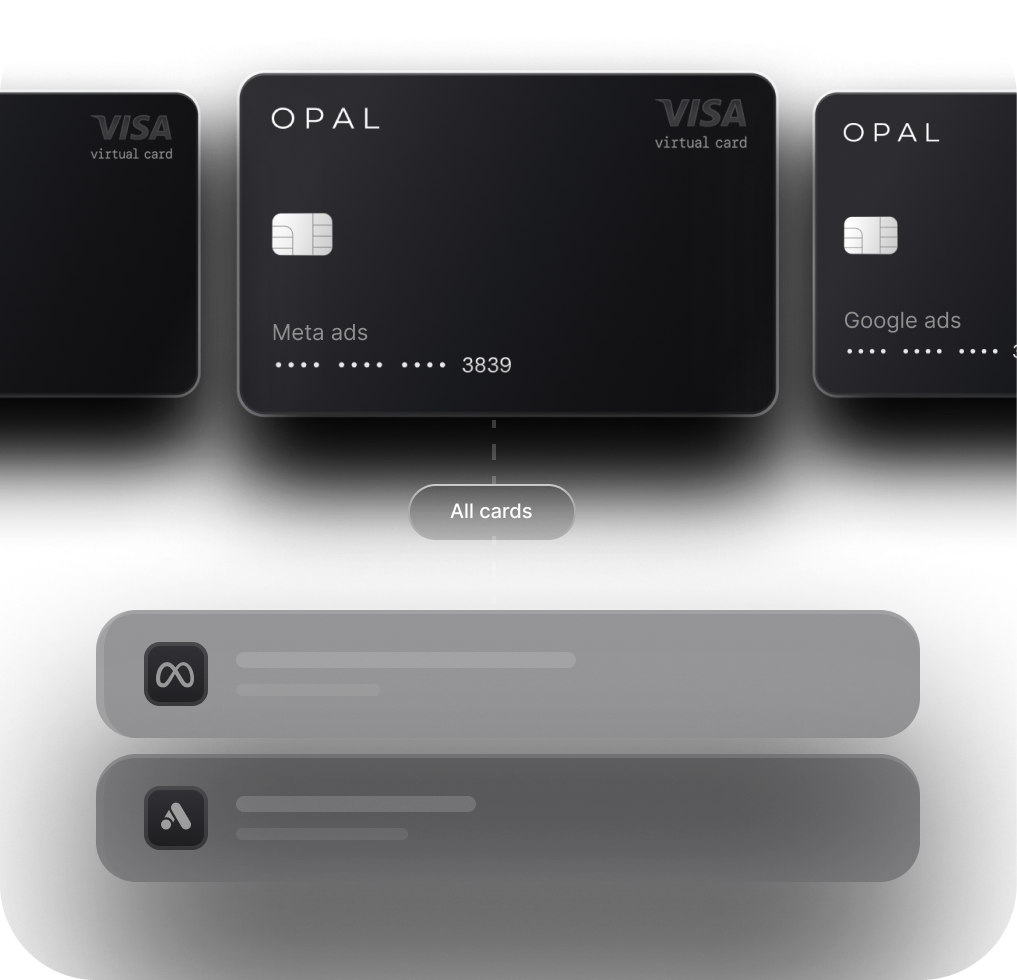
We issue unlimited free virtual cards. Every card carries a separate spending limit, merchant restriction, and expiration date, so each committee, platform, and flight gets its own card.
Approvals, employee permissions, real-time transaction monitoring, transaction exports, and QuickBooks and Workday integrations are all included, with no annual fee.
Cashback on eligible ad spend runs as high as 2%, uncapped, at a rate confirmed on approval. Credit lines reach $10 million subject to underwriting, and Opal asks for no personal guarantee and runs no hard credit pull.
Keep Filing Decisions With Your Treasurer
Opal cards are charge cards paid in full, with the balance debited automatically each month. They work only on the advertising and media platforms Opal supports, so check broadcast and mail vendors first.
Opal does not file reports, write disclaimers, or decide how a committee treats a payment.
Meta and Google accounts billed by invoice can use Opal Ad Pay, a separate waitlist product aimed at monthly ad spend of $50,000 and up, at 3% on Opal credit, offset by 1% cashback, or 3.5% when paid with another of your cards.
See how Opal for agencies structures client cards, then apply before your next flight.
Frequently Asked Questions (FAQs)
When Is a Political Ad Counted as Spent for FEC Reporting?
For independent expenditures, the Federal Election Commission counts the expenditure as made on the date the ad is publicly distributed or disseminated, whatever day the card is charged. That date starts the clock on 24-hour and 48-hour reports, so media buying teams should log each ad's first-run date separately from its charge date.
Do Political Ads Need Platform Verification Before a Card Is Added?
Yes. Meta requires advertisers running ads about elections or politics to complete its authorization process and use a verified "Paid for by" disclaimer, and Google requires election ads verification before United States election ads can run. Confirming both before issuing a platform card keeps budget off accounts that cannot yet deliver political ads.
Why Don't Meta Ad Library Figures Match a Committee's Books?
The Meta Ad Library shows a spend range for each political ad, plus who funded it and its reach, while a committee's books record exact card charges. The two rarely match to the dollar, so note which range each ledger total falls within and keep that note with the cycle's records.
How Often Should Political Ad Spend Be Reconciled Near an Election?
Reconcile political ad spend weekly through the 20th day before an election and daily from then until the vote. In that final stretch, independent expenditures aggregating $1,000 or more require a Federal Election Commission report within 24 hours of public release, and a weekly close leaves launch dates unconfirmed when reports fall due.
When Should Political Ad Cards Be Closed After an Election?
Close political ad cards once the final platform charges post, which can be weeks after the last ad runs. Candidate committees and quarterly-filing PACs and party committees report activity through day 20 after the general election, so cut the ledger there, clear trailing charges, let remaining cards expire, and export each committee's transaction history.