


Political Media Buying: How PACs and Campaigns Handle Multi-Platform Ad Spend During Election Cycles
Political ad spend does not ramp up gradually. It surges. A strong fundraising quarter, a debate, a late-breaking news cycle, or the final push before Election Day can compress weeks of planned spending into 72 hours. The teams responsible for executing those buys need to move fast without losing financial control, documentation, or visibility.
So how do political agencies handle multi-platform ad spend during election cycles? The most effective teams combine pre-cycle budget planning, platform-level spending controls, fast internal approval workflows, real-time transaction tracking, and payment infrastructure that can scale without breaking. That combination is what separates teams that finish an election cycle with clean books from those still reconciling vendor invoices three months after the race is called.
For political media buying agencies, PACs, independent expenditure committees, and in-house digital directors, finding the right spend management tools for political PAC media buying is not a nice-to-have. It is an operational requirement.
Key Takeaways
Political ad spend can increase sharply and quickly during high-intensity election windows, including primaries, debates, early voting periods, and Election Day.
Multi-platform buying requires spending controls at the platform, campaign, vendor, or committee level, not just a single shared card.
-
Virtual cards with per-account limits reduce the risk of overspend, unclear ownership, and mid-cycle payment disruptions.
Clear documentation and structured approval workflows support stronger compliance and reconciliation processes alongside your existing finance and legal teams.
Why Political Ad Spend Becomes Harder During Election Cycles
Most industries deal with seasonal budget fluctuations. Political advertising is different. The intensity is compressed, the stakes are binary, and the calendar is fixed. You cannot push Election Day.
Budget Surges Happen Fast
A campaign that raises $4 million in a single week may need to deploy a large portion of it within days. An independent expenditure committee responding to an attack ad needs to be on air the next morning. These are not edge cases. They are standard operating conditions for political media teams.
Payment infrastructure built for steady monthly spend does not hold up under sudden acceleration. Shared cards hit limits. Approvals get delayed. Platforms flag unusual activity. Any one of these can pause a live campaign at exactly the wrong moment.
The Pressure on Agencies Managing Multiple Races
Agencies running media for multiple candidates or committees face compounded pressure. Each client has its own budget, timeline, and approval chain. Spend for one committee cannot mix with spend for another. When payment infrastructure does not support that separation, the team is left tracking everything by hand.
Last-minute creative changes, revised targeting parameters, and updated media plans are routine in political advertising. Every change has a payment implication. If the approval and funding process cannot keep pace, campaigns fall behind.
The real risk is not overspending. It is losing control of where the spend is going and why, at the exact moment the pace is highest.
The Reality of Multi-Platform Political Media Buying
Political advertising is not a single-channel operation. A coordinated campaign or independent expenditure effort may run simultaneously across:
Channel |
Common Platforms |
|---|---|
Paid social |
Meta, Instagram, X |
Search and video |
Google, YouTube |
Connected TV and streaming |
Hulu, Paramount+, programmatic CTV |
Programmatic display |
The Trade Desk, DV360, and similar DSPs |
Streaming audio |
Spotify, Pandora, programmatic audio |
Direct outreach |
Direct mail, SMS, email |
Each channel has its own billing system, its own vendor relationship, and its own payment method on file. A single campaign may involve a dozen or more vendor accounts, each requiring its own card or invoice workflow.
The Operational Complexity Is Real
Managing political media buying across this many platforms means tracking dozens of spend lines at once. Each platform bills differently and handles budget adjustments in its own way. When a media plan changes mid-cycle, the payment side has to move with it.
For teams managing multiple committees or clients, the complexity multiplies. A congressional race, a governor's race, and a ballot measure may all be running at the same time, each with distinct budgets, distinct approval chains, and distinct compliance requirements. How political media buying agencies manage large ad spend across platforms comes down to whether their payment infrastructure matches the structure of their campaigns, or whether they are constantly working around it.
Without structured payment allocation, end-of-cycle reconciliation becomes a major manual effort. Finance teams end up matching hundreds of transactions across platforms, committees, and time windows, usually under post-election deadline pressure.
Compliance, Documentation, and Spend Visibility
Political organizations operate under documentation and reporting requirements that most commercial advertisers never encounter. The specifics vary significantly by jurisdiction, committee type, and the nature of the expenditure, but the underlying need is consistent: you need to know exactly what was spent, when, on what, and by whom.
What Strong Internal Controls Look Like
Effective political media teams build documentation habits around three operational pillars:
-
Payment ownership: Every transaction should be traceable to a specific committee, campaign, platform, or vendor relationship. Ambiguous ownership creates problems during reconciliation and in the event of an audit.
-
Approval workflows: Budget changes, new vendor relationships, and large expenditures should move through a defined approval chain before spend is authorized. This is especially important when agencies are acting on behalf of multiple clients or committees.
-
Spend records: Real-time or near-real-time transaction records, organized by category and time period, make end-of-cycle reporting significantly faster and more accurate.
These controls do not replace campaign finance counsel, compliance staff, or required reporting platforms. They support those functions by keeping the underlying financial data clean and organized before it reaches the compliance layer.
Political advertising, disclosure, and campaign finance requirements vary by jurisdiction and organization. This article is for operational information only and is not legal or compliance advice. Consult qualified legal and compliance advisors for guidance specific to your committee structure and jurisdiction.
Real-time ad spend visibility is not just a finance team convenience. For political operations, it is a core control function.
Why Shared Cards Break Down for Political Media Teams
Many political media teams start a cycle with a small number of shared corporate cards. It works until it does not.
The problems tend to compound as spend accelerates:
-
Unclear ownership: When multiple team members, vendors, and platforms all draw from the same card, individual transactions become difficult to attribute. Which charge belongs to which committee? Which platform? Which race?
-
Overspend risk: A shared card with a single aggregate limit cannot enforce individual campaign or committee budgets. One account running hot can crowd out spend for another.
-
No client or committee separation: Agencies managing multiple political clients on a shared card face a structural commingling problem. The financial records do not reflect the committee boundaries that compliance and reporting require.
-
Limited visibility: Finance leads and campaign directors cannot see real-time spend by platform or initiative when everything flows through one or two cards. They see a statement, after the fact.
-
Slow reconciliation: Post-cycle reconciliation on a shared card means manually sorting every transaction by campaign, platform, committee, and time window. On a high-volume cycle, that can mean hundreds of line items with no pre-built structure.
The shared card model is a workaround, not a system. It works at low volume. At election-cycle scale, it creates exactly the kind of financial ambiguity that political teams can least afford.
Why Virtual Cards and Per-Account Limits Matter
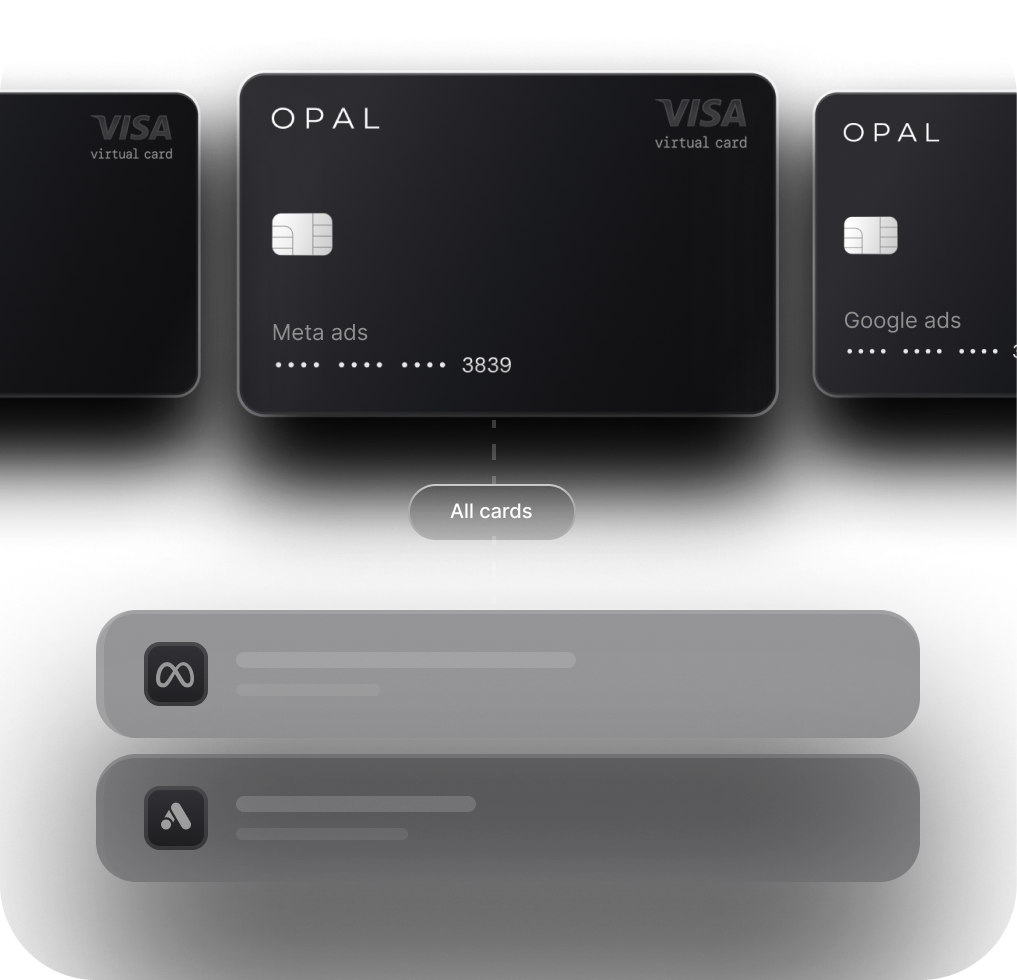
Virtual cards solve the structural problem that shared cards create. Instead of routing all spend through one or two payment methods, you assign a dedicated card to each spending unit in your operation.
What You Can Assign a Virtual Card To
The assignment logic mirrors how political media teams already think about their budgets:
-
By platform: One card for Meta, one for Google, one for programmatic CTV. Each has its own limit.
-
By campaign: A separate card for each race, ballot measure, or initiative.
-
By committee or client: Clean separation between a candidate committee, a PAC, and an independent expenditure committee.
-
By vendor: A dedicated card for each production vendor, data provider, or media partner.
-
By geography: State-level or district-level spend separated at the card level.
-
By media buyer or team: Individual cards for team members, with limits that match their authorization level.
How Per-Account Limits Change the Control Model
When each card has a defined limit, overspend on any single platform or initiative cannot bleed into another. If the Meta budget for a specific race is $150,000, that card's limit enforces the boundary automatically. No manual monitoring required to catch it before it happens.
Adjusting spend is equally clean. When a media plan changes, you update the card limit rather than trying to redirect a shared card mid-cycle. When a campaign ends or a vendor relationship closes, you cancel the card. The spend record stays intact. The payment method is deactivated.
For reconciliation, the structure is already there. Each card's transaction history maps directly to the campaign, platform, or committee it was assigned to. Reconciliation after a rapid media cycle becomes a matching exercise, not a sorting one.
Virtual cards for political campaigns are not just a convenience feature. They are the structural foundation for controlled ad spend at campaign speed.
How Opal Supports Political Media Buying Operations
Opal is built for teams managing high-volume advertising spend across multiple platforms, accounts, and clients. For political media buying operations, that means the infrastructure matches the way campaigns actually run.
Here is what Opal provides for political media teams:
-
Unlimited free virtual cards that can be assigned by platform, campaign, committee, vendor, geography, or team member, each with its own defined spending limit.
-
Custom limits by account: Set and adjust limits at the individual card level, so each spending unit has a defined boundary that can be updated as media plans change.
-
Real-time spend visibility: See transaction activity as it happens across all cards and accounts, giving finance leads and campaign directors a live view of where budget is moving.
-
Structured budget separation: Keep spend for different clients, committees, or media initiatives cleanly separated at the card level, supporting cleaner records for finance and compliance workflows.
-
Credit capacity designed for high-volume advertising spend: Opal extends credit to your agency based on managed spend volume, so your payment infrastructure can scale with your book of business rather than being capped by cash on hand.
Opal does not replace campaign finance counsel, compliance staff, accounting systems, or required reporting platforms. What it does is support stronger operational control and clearer financial workflows alongside those existing processes. Cleaner spend records going into compliance review means less manual work and fewer gaps to explain.
See how Opal works for media buying agencies managing complex, multi-client ad operations.
A Better Spend Management Process for the Next Election Cycle
The teams that come out of an election cycle with clean books and clear records are the ones that built the structure before spend accelerated. Here is a straightforward framework:
-
Set campaign and platform budgets before spend accelerates. Define approved spending levels by committee, platform, and initiative before the cycle hits its peak intensity. Changes are easier to manage when there is a baseline to adjust from.
-
Assign payment ownership by committee, client, platform, or media initiative. Every spending unit should have a designated payment method. Ambiguity at this stage creates problems at reconciliation.
-
Create virtual cards with defined limits. Issue a dedicated card for each platform, campaign, or vendor relationship. Set the limit to match the approved budget for that unit.
-
Monitor spend in real time and adjust as the media plan changes. When targeting shifts, creative rotates, or a race tightens, the payment side should move with it. Update card limits or issue new cards as needed.
-
Maintain clean records for finance, reconciliation, and compliance review. Each card's transaction history is a ready-made audit trail. The more structured your card setup, the less manual work required after the cycle closes.
This is PAC ad spend management at the operational level: structured before it scales, visible while it runs, and clean when it is time to close the books.
Frequently Asked Questions
What are the best spend management tools for political PAC media buying?
The best spend management tools for political PAC media buying combine virtual cards with per-account limits, real-time transaction visibility, and the ability to separate spend by committee, platform, vendor, or campaign. Look for tools that offer high credit limits scaled to advertising volume, clean reconciliation workflows, and the flexibility to issue and cancel cards quickly as media plans change. Opal is built specifically for high-volume ad spend operations with these requirements in mind.
How do political agencies handle multi-platform ad spend during election cycles?
Effective political agencies handle multi-platform ad spend by combining pre-cycle budget planning, platform-level payment controls, fast internal approval workflows, and real-time spend tracking. Each platform or campaign is assigned a dedicated payment method with a defined limit, so spend can be monitored and adjusted without disrupting active campaigns.
How do political media buying agencies manage large ad spend across platforms?
Political media buying agencies manage large ad spend by assigning dedicated virtual cards to each platform, campaign, or committee. This creates clear payment ownership, enforces budget boundaries, and produces transaction records that map directly to each spending unit, making reconciliation significantly faster after a high-volume cycle.
Why are virtual cards useful for political campaigns and PACs?
Virtual cards give political campaigns and PACs the ability to assign a dedicated payment method to each platform, vendor, committee, or initiative. Each card carries its own spending limit, so budgets are enforced at the account level rather than relying on manual monitoring. Cards can be issued quickly, adjusted as plans change, and cancelled when a campaign or vendor relationship ends.
How can political media teams control ad spend by platform or account?
The most direct way to control ad spend by platform or account is to assign a separate virtual card to each one, with a limit that matches the approved budget for that unit. When a platform runs at its limit, no additional charges can be made without an explicit limit increase. This removes the risk of one account overrunning its budget at the expense of another.
What should political agencies consider when managing campaign advertising payments?
Political agencies should consider committee separation, approval workflow structure, real-time visibility, and reconciliation readiness. Payment methods should be organized to reflect committee and campaign boundaries. Approval processes should be defined before spend accelerates. And transaction records should be structured to support post-cycle finance and compliance review. Campaign finance, disclosure, and reporting requirements vary by jurisdiction; consult qualified legal and compliance advisors for guidance specific to your organization.
Can Opal help political media teams manage large ad spend?
Yes. Opal provides virtual cards, custom per-account limits, real-time spend visibility, and credit capacity designed for high-volume advertising operations. Political media teams can use Opal to separate spend by committee, platform, campaign, or vendor, and to maintain clean transaction records that support finance and compliance workflows. Contact Opal to discuss your team's requirements.
The Bottom Line on Political Campaign Media Buying
Election-cycle media buying demands two things at once: fast execution and tighter controls. Those two requirements are usually in tension. The teams that handle it well are the ones that build the financial structure before the pace picks up, not after.
Virtual cards with defined limits, real-time spend visibility, and credit capacity that scales with advertising volume are not advanced features. They are the baseline infrastructure for any political media team managing multi-platform ad spend at scale.
The right spend management tools for political PAC media buying do not slow your team down. They give you the structural guardrails to move fast without losing track of where the money is going.
Talk to Opal about your team's requirements and see how purpose-built ad spend infrastructure supports political media buying operations from the first primary through Election Day.