


Advertising Spend Forecasting Across Brands, Markets, and Channels: A CFO's Guide

.webp)
Advertising spend forecasting is the discipline of projecting paid media costs for every brand, market, channel, and buying agency over a planning period, then revising those projections as actual spend posts.
The dependable method builds the forecast from individual spend lines, gives each line one owner and a variance tolerance, reforecasts on a fixed cadence, and enforces each approved line with a spending limit on the payment method that funds it.
For a chief financial officer (CFO) overseeing several brands, locations, or business units, that forecast has to combine plans from in-house teams and outside agencies across Meta Ads, Google Ads, Amazon Ads, LinkedIn Ads, TikTok Ads, and programmatic buys through The Trade Desk.
Budgets are not growing to cover the gaps. Gartner's annual marketing spend survey of 401 chief marketing officers and other marketing leaders, mostly at companies above $1 billion in revenue, put marketing budgets at 7.8% of company revenue. 56% said that budget falls short of their strategy.
Growth therefore comes from moving money between brands and channels, where a single-line forecast loses track of it.
Key Takeaways
A multi-brand advertising forecast holds up best when it is built from spend lines, each covering 1 brand or business unit, 1 market, 1 channel, and 1 buying party.
Each channel needs its own forecasting method: signed commitments for booked media, cost-per-result targets for performance channels, and recent daily spend for always-on search, with a top-down share of revenue kept as a ceiling check.
Tolerance bands turn variance into action, so gaps within 5% get logged, gaps of 5% to 10% get a written explanation, and anything larger opens a reforecast.
Approval rights should widen with the distance money travels, so a chief financial officer (CFO) signs off on moves across brands or markets while channel leads adjust inside their own line.
A dedicated virtual card with its own spending limit for every approved line enforces the forecast at the point of purchase, and each limit change becomes the record of an approved reallocation.
What Is Advertising Spend Forecasting, and Why Does It Break Across Brands?
Advertising spend forecasting projects what each part of the business will spend on paid media and when, so finance can fund it, approve it, and measure it against results. It breaks across brands because most companies plan paid media as one marketing line while the spending happens in dozens of ad accounts run by different teams and agencies.
Where a Single Marketing Line Hides the Problem
A consolidated line shows whether total spend landed near plan, but one brand's overspend can cancel another brand's underspend and pass for accuracy. The same view hides the decisions behind each miss, such as an agency scaling a campaign in one market.
Multi-brand ad budget management starts by giving the forecast owners below the total. Without them, nobody is accountable for a miss, and finance reconciles after the money is gone.
How Do You Structure a Forecast Across Brands, Markets, Channels, and Agencies?
Structure the forecast as a grid of spend lines, where each line is one brand, one market, one channel, and one buying party, with one named owner. Approvals, card limits, and reporting all attach to that line.
Treat the Spend Line as the Unit of Planning
A company with 3 brands selling in 2 regions across 4 channels has 24 spend lines, and each line is assigned exactly one buyer. Lines with no planned spend stay in the grid at zero, so a new launch cannot appear out of nowhere mid-quarter.
A line's owner is whoever can explain its variance, usually the brand's channel lead or the agency account lead, while finance owns the grid and the rules for changing it. Multi-location businesses can treat each location as a market, as the multi-location card structure used by dental groups does for payments.
Give Every Line a Code That Travels
Assign each spend line a short code, such as B2-WEST-SEARCH-AGYA, and use it wherever that money appears: the media plan, the ad account name, the card name, and the class, location, or department fields in your accounting system. One shared code joins the plan, the platform report, and the ledger without a monthly remapping.
Ask agencies to submit plans and weekly actuals with the same codes. A report that cannot be matched line by line goes back before it reaches the forecast.
Separate Working Media From Agency Fees
Working media is the money that reaches the ad platform, and agency fees, production, and technology costs sit on top of it. Forecast them separately, since a percentage-of-spend fee moves with media while a flat retainer stays put.
Record each line's payment route too. Media charged to a card you control can be capped at purchase, while agency-paid media is controlled only through the approved plan and invoice review.
Which Forecasting Method Fits Each Channel?
Match the method to how each channel spends: booked media follows commitments, performance channels follow cost-per-result targets, and always-on campaigns follow their recent run-rate. Most multi-brand forecasts use all 4 methods at once, each applied to a different group of lines.
Compare the 4 Forecasting Methods
Method |
How It Is Built |
Best Fit |
Watch For |
|---|---|---|---|
Commitment-based |
Sum of signed insertion orders, sponsorships, and fixed flights |
Upfront buys, connected TV, sponsorships, retail media commitments |
Leaves out any spend that scales with results |
Goal-based |
Target volume multiplied by the expected cost per result |
Paid search and paid social with lead or sales goals |
Cost per result drifts, so the input needs regular updates |
Run-rate |
Recent average daily spend multiplied by days in the period |
Always-on search and shopping campaigns |
Carries forward past mistakes and misses seasonal peaks |
Top-down |
A set share of revenue or of the total marketing budget |
Company ceiling and cross-brand sanity check |
Says nothing about which line should receive the money |
A goal-based line needs 2 inputs from its owner: the volume target and the expected cost per result. A line targeting 2,000 leads at a $45 cost per lead forecasts $90,000, and when the cost per result shifts, the owner updates that input so the reason for the new dollar figure stays visible.
Use the Top-Down Number as a Ceiling
A top-down figure, such as a fixed share of revenue per brand, caps what the grid can add up to. It cannot say which channel or market deserves the money, so the bottom-up lines must fit under it.
When the lines exceed the cap, cut or defer specific ones and record which. That list becomes your first source of spend if results later justify an increase.
How Often Should You Reforecast Paid Media Budgets?
Paid media budget planning runs on 2 clocks: a monthly reforecast of every spend line, and an immediate reforecast of any line that moves outside its tolerance band. The monthly cycle keeps the grid current, and event triggers catch problems in between.
Set Tolerance Bands for Each Line
Project each line to period end by adding spend to date to its active daily budgets multiplied by the days remaining. Compare that projection with the approved forecast and respond by band:
-
Within 5%: log the variance and move on.
-
Between 5% and 10%: the line owner explains the cause in writing and submits a corrected projection.
-
Above 10%: finance opens a reforecast, and extra money follows the reallocation rules below.es below.
Tighten the bands on your largest lines, where 5% can exceed a small market's entire budget. Loosen them on test lines, where variance is part of the design.
Reforecast on Events as Well as Dates
Some changes justify a reforecast the day they happen: a product launch, a location opening or closing, an agency change, a paused ad account, or a promotion approved outside the plan. Waiting for the monthly cycle leaves the grid wrong for weeks while money keeps moving.
The timing of charges against your bank account is a cash question for a separate weekly cash forecast. Tie both models to the same line codes so a change in one flows into the other.
Who Should Approve Moving Money Between Brands, Markets, and Channels?
Approval authority should widen with the distance money travels, so the further a reallocation moves budget from its approved line, the more senior the approver. Writing these rules down before the year starts keeps every reallocation from turning into an escalation.
Map Reallocation Rights to the Size of the Move
Type of Move |
Example |
Approver |
What Gets Recorded |
|---|---|---|---|
Inside one spend line |
Shifting budget between 2 campaigns on one brand's Meta account |
Line owner |
Updated line plan, with the total unchanged |
Across channels, same brand and market |
Moving paid social budget to paid search for 1 brand in 1 region |
Brand leader with a finance partner |
Revised forecasts and card limits on both lines |
Across brands or markets |
Moving budget from a mature brand to a new launch |
CFO |
Signed change to both brand forecasts |
New money above the approved total |
Funding an unplanned seasonal push |
CFO, plus the executive team or board where your delegation of authority requires it |
Revised company total and the approval behind it |
Every move ends the same way: the source line's forecast and card limit go down, and the destination line's go up by the same amount. The paid media governance basics, including one accountable owner for the overall budget, still sit above this table.
Keep Duties Separate as the Program Grows
The Committee of Sponsoring Organizations of the Treadway Commission (COSO) lists approvals, verifications, reconciliations, and business performance reviews among the control activities in its internal control framework, and it expects duties to be separated where practical. For paid media, whoever requests a reallocation should not raise the card limit, and whoever approves spend should not reconcile it.
Even a small finance team can build CFO advertising spend controls this way, with the controller raising limits, the CFO approving, and an accountant reconciling. Where one person must hold 2 of those roles, add a monthly review of every limit change against its approval record.
How Do You Enforce the Forecast Before Month-End?
Enforce the forecast at the point of purchase by giving each approved line its own card, with a limit equal to the line's approved amount. Then review plan against actual every week by line code, while variances are still fixable.
Fund Each Approved Line With Its Own Limit
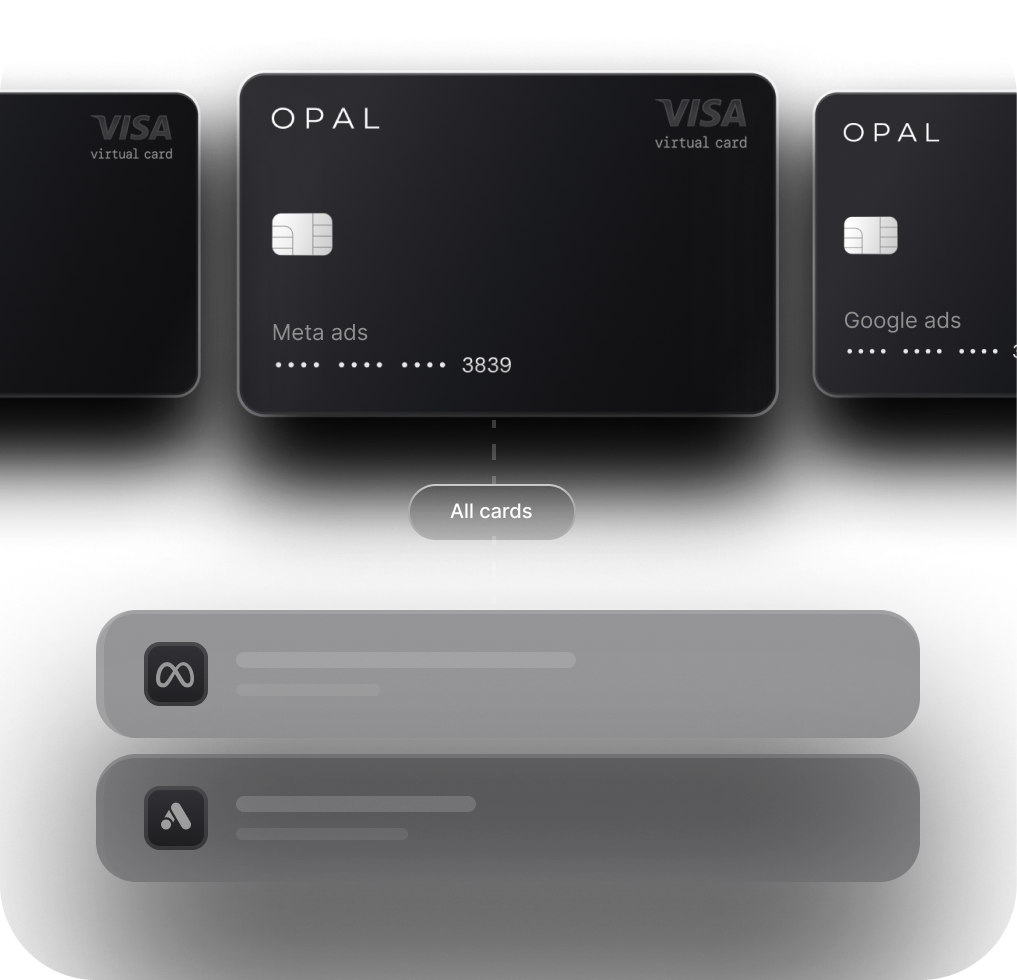
A virtual card dedicated to one spend line turns the forecast into a hard stop: charges decline at the approved amount until someone with authority raises the limit. That raise is the reallocation, so logging each limit change against its approval creates an audit trail with no extra paperwork.
Because a decline can pause live campaigns, decide line by line how to balance hard limits and alerts. Set expiration dates that match seasonal flights, and apply the remaining card-level spend controls according to each line's risk.
Review Plan Against Actual Every Week
Each week, pull card transactions and platform-reported spend by line code, update the projections, and apply the tolerance bands. Card data sits outside the agency's own reporting, so it cross-checks reported spend.
Close each review with 3 lists: lines inside tolerance, lines needing an explanation, and lines opening a reforecast. At month-end, compare final spend with the forecast to track accuracy by owner and by method.
Enforce Every Spend Line With Opal
Opal gives finance teams a charge card built for advertising, so every approved spend line can carry its own card, limit, and owner. We provide the card, credit, and controls, and your team decides how each one maps to the forecast.
What You Set Up
Every account comes with free virtual cards in unlimited numbers, so you can issue one per spend line with its own merchant restrictions, expiration date, and spending limit. You assign approvals and employee permissions so buyers spend inside their lines while finance keeps authority over limits.
From one dashboard, you watch every transaction and budget in real time and export transactions for your weekly review. Card spend can also sync into QuickBooks or Workday through our integrations with both.
What Opal Includes and Where It Stops
What is included:
No annual fee and no cancellation fee
No hard credit pull and no personal guarantee required to apply
Credit up to $10 million, sized to your managed spend volume
Up to 2% uncapped cashback on eligible ad spend, with your exact rate confirmed at approval
Unlimited free virtual cards, each with its own limit, merchant restrictions, and expiration date
Real-time transaction visibility and budget tracking from one dashboard
Integrations with QuickBooks and Workday for automated spend sync
Cards issued typically within 24 to 48 hours of approval
What to know before applying:
Opal is a charge card: the full statement balance is debited automatically each month, and a failed debit can lock the card until cleared
Card use is limited to the advertising and media platforms Opal supports
Available to U.S.-based businesses only
Your forecast and reallocation rules stay in your own planning model; Opal enforces the limits, not the plan itself
For Meta and Google accounts billed by invoice, Ad Pay is a separate waitlist product for advertisers spending at least $50,000 a month; it charges a 3% processing fee on Opal credit (offset by 1% cashback) or 3.5% on a card of your own
Book a free demo with our team or apply in a few minutes.
Frequently Asked Questions (FAQs)
How Do You Forecast Advertising Spend for Multiple Brands?
Build the forecast from spend lines, each covering one brand, one market, one channel, and one buying party with a single owner. Forecast each line with the method that suits its channel, roll the lines up into brand and company totals, and check the result against a top-down ceiling such as a share of revenue.
What Is a Good Variance Tolerance for an Ad Budget?
A workable starting point is to log variances within 5% of a line's forecast, require a written explanation between 5% and 10%, and open a reforecast above 10%. Tighten those bands on your largest spend lines, where small percentages mean large dollars, and loosen them on test budgets where variance is expected.
How Often Should a Paid Media Forecast Be Updated?
Update every spend line in a monthly reforecast, review plan against actual weekly, and reforecast a single line immediately when a launch, location change, agency change, or account pause pushes it outside tolerance. The weekly review catches drift early, and the monthly cycle keeps the forecast aligned with the approved total.
Who Should Approve Moving Budget Between Brands?
Moving money between brands or markets should require approval from the chief financial officer (CFO), because it changes 2 profit and loss statements at once. Channel leads can shift budget inside their own spend line, and brand leaders working with a finance partner can move budget across channels within one brand and market.
How Do You Control Ad Spend That an Agency Pays For?
When an agency pays the ad platform and invoices you, control comes from the approved plan, weekly actuals reported against your spend line codes, and invoice review. Where the agency buys inside ad accounts your company owns, attaching a card you issue, with its own limit, adds control at the point of purchase.
Can Card Limits Replace an Advertising Budget?
A card limit enforces a budget that the forecast has already set. The forecast decides how much each brand, market, and channel should spend, and the limit makes that decision binding when charges arrive. Change a limit only after an approved reallocation, so the history of limit changes matches your approval record.