

How Agencies Manage Cash Flow When Meta and Google Invoices Are Due

.webp)
How agencies manage cash flow when Meta and Google invoices are due comes down to controlling 3 dates rather than watching 1 balance: the date each platform triggers a charge, the date the settling instrument pulls the cash, and the date client reimbursement arrives.
Agencies that set those dates on purpose, by choosing a payment setting on each ad platform, settling charges on an instrument that lengthens the gap, and writing reimbursement terms that close it, turn a due invoice into a scheduled event rather than a scramble.
Meta and Google both bill card-funded advertisers on 2 triggers at once: a payment threshold that fires whenever accrued costs reach a set amount, and a calendar bill date that sweeps whatever is left.
Google Ads documents 3 payment settings, postpay, prepay, and monthly invoicing, while Meta charges card-funded accounts on a payment threshold plus a monthly bill date.
Layer on TikTok Ads, LinkedIn Ads, Amazon Ads, and The Trade Desk, each on its own cycle, and a United States marketing agency fronting client media can face 10 or more uncoordinated withdrawals in a single month.
Key Takeaways
Meta charges card-funded ad accounts on 2 triggers, a payment threshold and a monthly bill date, so a single month can carry several separate withdrawals rather than one predictable invoice.
Google Ads runs 3 payment settings, postpay, prepay, and monthly invoicing, and the setting you choose decides whether cash leaves before the ads run, during the month, or after an invoice arrives.
A prepayment made on a postpay Google Ads account reduces or delays the next automatic charge, which makes the charge date a lever you can pull rather than a fixed event you absorb.
Days of cover, meaning the number of days your available credit absorbs at your current daily spend, falls as you scale even when your credit limit has not moved.
Reimbursement terms have to be shorter than your billing interval, because net 30 client terms sitting against a 6 day threshold cycle guarantee a funding gap on every cycle.
Monthly invoicing moves settlement off the card, which removes card rewards on that spend unless the invoice itself can be paid by card.
When Do Meta and Google Actually Take the Money?
Both platforms take money on whichever comes first, a spend threshold or a calendar date, so the charge lands on a schedule your spend velocity sets rather than one your month-end sets. Each platform's own billing documentation is the only reliable place to check which trigger is about to fire.
How Meta Charges on a Threshold and a Bill Date
Meta's billing documentation states that advertisers using PayPal or most credit and debit cards are charged when ad costs reach the payment threshold, and charged again on the monthly bill date for any remaining costs.
Meta warns that advertising past the threshold means you may be charged multiple times in a month, or even after your ads stop running.
Accounts that never reach the threshold are charged only on the bill date. Both the threshold and the bill date are settings you can check and change, and that pair is what most agency teams never touch.
How Google's Postpay Threshold Escalates
On Google's postpay setting, costs accrue first and are charged at the start of each month or whenever the account reaches its payment threshold.
Each time the account hits that threshold before month end, the threshold steps up, so a scaling account moves from 1 monthly charge toward several a month before settling into larger, less frequent ones. Google notes the amount billed may run slightly over the threshold when costs accrue quickly.
The full ladder sits in our guide to Google billing thresholds, and decline behavior on the other platform is covered in Meta threshold declines.
What Decides How Agencies Manage Cash Flow When Meta and Google Invoices Are Due?
Three levers decide it, and they live in 3 different systems: the payment setting inside each ad platform, the instrument that settles the charge, and the contract governing reimbursement. Pulling 1 lever without the other 2 moves the problem to a different week.
A) The Payment Setting Sets the Date
Google states in its payment settings documentation that payment settings determine when you pay for your ads, and lists postpay, prepay, and monthly invoicing. Prepay takes cash before delivery and stops your ads when the balance runs out.
Postpay takes it after delivery, on a threshold or a monthly date. Monthly invoicing accrues costs against a line of credit Google provides and bills once, which pushes the date furthest out and moves settlement off the card.
B) The Card Sets the Distance
Once a platform triggers a charge, the instrument settling it decides how long that money stays in your business. Our card settles in full every cycle, with the statement balance drawn automatically on each monthly payment due date from the bank account or Opal Balance you designate, and card use pausing if that draw cannot be processed.
You get a known, repeating settlement date to schedule client invoicing around, rather than a revolving balance that obscures the exposure. Our breakdown of ad spend float covers how that exposure accumulates across a roster.
C) The Contract Sets the Return
Reimbursement terms decide whether cash returns before the next threshold fires. An agency running a 6 day threshold interval on a large Meta account while billing clients on net 30 carries roughly 5 billing intervals of spend at any moment, entirely on its own balance sheet.
Shortening terms, invoicing on a fixed weekly date, and billing in advance each compress that figure differently. Our comparison of agency billing models sets out who holds the money under each.
Which Payment Setting Should You Run on Each Platform?
Run postpay threshold billing where you want the card float and the rewards, prepay only where a platform or account requires it, and monthly invoicing where volume justifies giving up card settlement. The right answer often differs per client account rather than per agency.
Comparing Prepay, Threshold Billing, and Monthly Invoicing
The 3 settings differ on when cash leaves, how predictable that date is, and what happens when funding fails. Read the table by account rather than by agency, since a single roster usually runs more than one setting.
|
Question |
Prepay |
Threshold Postpay |
Monthly Invoicing |
|---|---|---|---|
What triggers the charge |
You fund the account before ads run |
Accrued costs reach the threshold, or the bill date arrives |
Costs accrue against a line of credit and are invoiced |
When cash leaves |
Before delivery |
After delivery, on a volume-driven date |
After delivery, on an invoice due date |
How predictable the date is |
Fully controlled by you |
Moves with spend velocity |
Fixed monthly |
What happens if funding fails |
Ads stop when the balance runs out |
The charge fails and account standing is at risk |
Collections and credit terms apply |
Card rewards on that spend |
Earned at funding |
Earned at each charge |
Not earned unless the invoice is payable by card |
Best suited to |
Accounts a platform restricts to prepay |
Most agency accounts carrying client media |
High volume accounts that qualify for credit terms |
How to Change a Payment Setting Without Pausing Campaigns
Google lets eligible accounts switch between postpay and prepay inside Billing Settings under the "How you pay" section, and restricts the change to users holding Admin or Edit Payments profile access, or Admin or Billing access on the account.
Google also warns that where prepay is no longer offered in your country you can switch to postpay but cannot switch back. Change a low-spend account first, check the next charge date in the billing summary, then repeat it on larger accounts.
Google's guidance offers a smaller lever for tight weeks: a prepayment on a postpay account reduces or delays the next automatic charge, splitting 1 large withdrawal into a smaller planned payment now and a reduced charge later.
How Many Days of Cover Do You Have Before the Next Charge?
Days of cover is the number of days your available credit absorbs at current daily spend, and it works better as an early warning than a dollar float figure because it moves whenever spend velocity changes. Calculate it per platform, since each platform charges on its own trigger.
Calculating Days of Cover
Take the available credit on the card funding a platform, divide it by that platform's average daily spend over the last 7 days, and you have days of cover for that account. An agency with $120,000 available on a Meta card spending $15,000 a day is carrying 8 days of cover.
Scaling that account to $30,000 a day leaves 4, with no change to the credit line and no change to the client roster. Recalculate weekly, because a 7 day average absorbs weekend pacing while still reacting to a budget increase.
Why Days of Cover Falls as You Scale
Threshold billing compresses the interval between charges as spend rises, so a growing account is billed more often and in larger amounts while reimbursement terms stay where the contract left them.
Client budgets landing mid-month, seasonal pushes, and automated campaign pacing shorten the interval further. Track days of cover beside the inputs in our guide to weekly cash flow forecasting so it sits next to expected receipts.
What Should You Do in the Week Before a Large Charge Lands?
Sweep the pending charges, confirm which amounts are pass-through client money and which are your own, then decide what to move. Running those steps in a fixed order keeps the decision off the bank balance, which tells you least about what is coming.
1. Running the Pending-Charge Sweep
Open each ad account's billing area and record the next charge date and the balance owed. Google's billing summary shows the potential date of the next automatic payment alongside the threshold amount and the current balance, and Meta shows the payment threshold and monthly bill date in payment settings. List every pending amount against the client it belongs to and the invoice covering it. Anything without a matching invoice is agency money at risk, and that subtotal is what to protect first.
2. Choosing What to Move and What to Leave
Move what is movable before touching campaign budgets. Chasing a reimbursement already contractually due, making a partial prepayment to shrink an automatic charge, and shifting a monthly bill date all leave delivery intact. Pausing spend belongs last rather than first, because a paused campaign costs learning phases and client results that take longer to recover than the cash it frees. A failed charge is worse again, since it puts account standing at risk on the platform where you most need continuity.
Build a Billing Calendar Your Cash Can Survive
Put every platform charge date, every card settlement date, and every client invoice date on 1 calendar, then close the gaps with structure instead of cash. Our card and the controls around it exist to make those dates predictable enough to plan against.
Matching Card Structure to the Billing Calendar
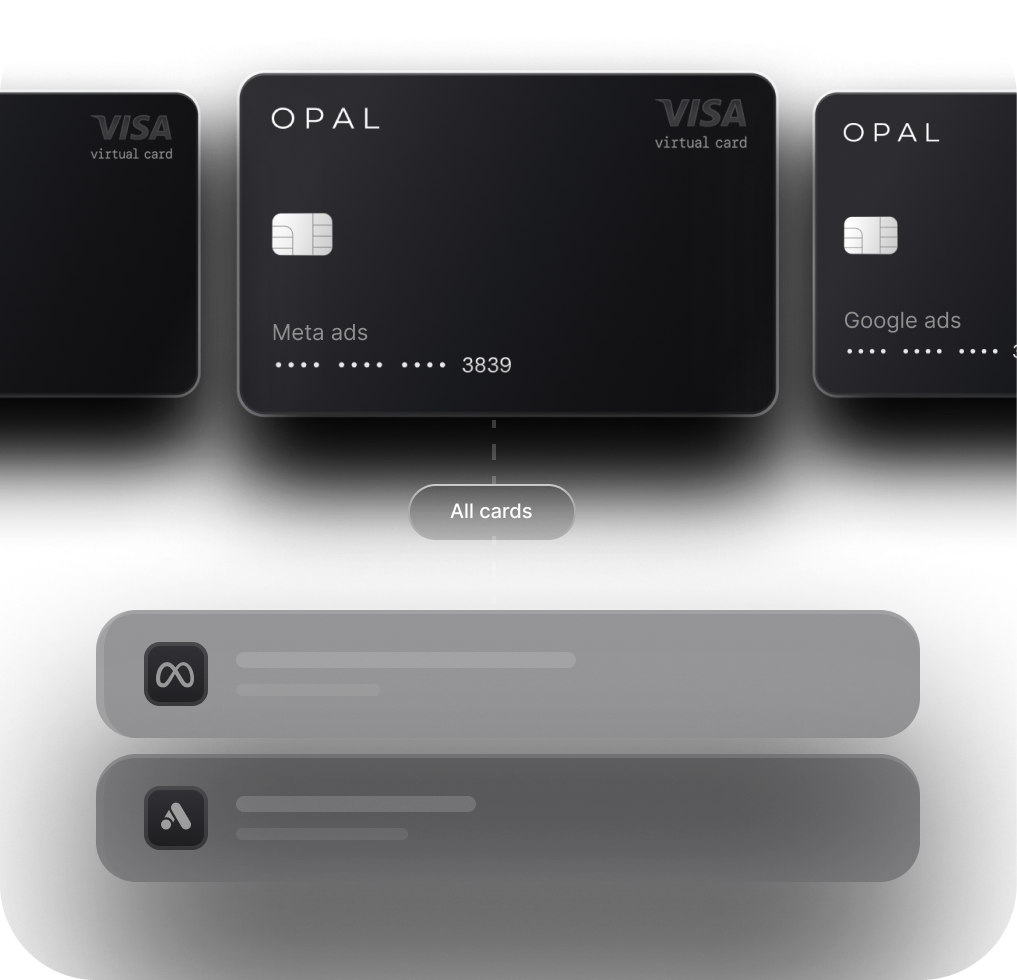
Give each client, platform, campaign, or employee its own virtual card, with unlimited virtual cards included on every account and no annual or per-card fee.
Set approvals, employee permissions, merchant restrictions, and spending limits so 1 account's velocity cannot consume headroom another client needs next week.
Eligible advertising spend earns cashback of up to 2%, transactions sync into QuickBooks or Workday, and every charge appears as it posts so the calendar stays current.
Ready to take charge of your business’s cash flow? Apply now.
Virtual cards typically arrive 24 to 48 hours after an onboarding form that runs 2 to 3 minutes, and we take no cut of your media spend. The full setup sits on our agency ad spend platform.
Frequently Asked Questions (FAQs)
Why Did Meta Charge Me Twice in the Same Week?
Meta charges when accrued ad costs reach your payment threshold, and again on your monthly bill date for anything left over. At higher spend the threshold is reached more than once between bill dates, so 2 or more charges in a week is normal behavior rather than a billing error.
Can You Change When Google Ads Charges Your Card?
Partly. Google lets eligible accounts switch between postpay and prepay in Billing Settings, and a prepayment on a postpay account reduces or delays the next automatic charge. The threshold itself escalates with spend rather than on request, so plan around that escalation instead of expecting to set the date outright.
What Is a Safe Number of Days of Cover to Run?
Enough to cover your longest reimbursement lag plus 1 full billing interval on your largest account. For an agency billing net 30 with a weekly threshold interval, that points to roughly 37 days of cover on the card funding that account. Below 2 weeks, a single budget increase can trigger a decline.
Should an Agency Move to Monthly Invoicing With Google?
Monthly invoicing gives you a line of credit from Google and 1 predictable invoice, which helps forecasting. It also moves settlement off the card, so you give up card rewards and card-level controls on that spend. It suits high volume accounts that qualify, and rarely suits agencies running many smaller client accounts.
Does Prepaying an Ad Platform Help Cash Flow?
Prepaying moves cash out earlier, so on its own it costs you working capital. Its useful role is smoothing: a partial prepayment on a postpay account shrinks the automatic charge that follows, moving part of a large withdrawal out of a week when reimbursements are late and into one where they have landed.
How Do Client Payment Terms Affect Ad Platform Billing?
Payment terms set how many billing intervals of spend you finance yourself. Net 30 terms against a 6 day threshold interval leaves roughly 5 intervals outstanding at once. Cutting terms to net 15, invoicing weekly, or billing in advance each reduce that count directly, without needing a larger credit line.