

Agency Cash Flow Management When Clients Pay Late for Media Spend

.webp)
Agency cash flow management means timing client payments, ad platform charges, and cash reserves so an agency never finances a client's media longer than it agreed to. When clients pay late for ad spend, the method has 5 parts: collect a deposit or pre-funding before spend runs, give each client a written credit limit, bill on a cycle that tracks platform charges, cap spend at agreed past-due dates, and hold a reserve for balances that may never be paid.
The problem exists because Google Ads, Meta, LinkedIn, TikTok, and Amazon Ads charge whatever payment method sits on the ad account, on their own billing cycles, while clients pay agency invoices on net terms set in a statement of work (SOW).
The Federal Reserve Banks' payments report from their Small Business Credit Survey shows 39% of U.S. employer firms naming slow-paying customers as a payments challenge, and 51% doing so in professional services and real estate, the category that includes advertising agencies.
Every late media invoice becomes an unplanned loan to the client, drawn on the agency's card, credit line, or bank balance.
Key Takeaways
A media client who pays after the platform charges you is borrowing from your agency, so each one needs a credit decision: a limit, payment terms, and security such as a deposit.
With monthly billing in arrears on net 30 terms, unpaid exposure peaks near 2 months of a client's media, and every week of late payment adds another week of spend.
Days sales outstanding (DSO) calculated on media billings alone shows whether clients are financing campaigns with your cash, even when fee collections look healthy.
Credit tiers with spend caps agreed in advance at 15 and 30 days past due turn a pause into a contract step, applied the same way to every client.
A cash reserve sized to your largest client's uncovered peak exposure, plus an allowance for expected credit losses under Accounting Standards Codification (ASC) Topic 326, keeps one default from becoming a payroll problem.
Why Do Late Client Payments Hurt Agency Cash Flow Management So Much?
Late client payments hurt because the media you carry for a client dwarfs the fee you earn from it. A few weeks of delay on one account can tie up more cash than the account pays you in fees all year.
Compare the Media You Carry With the Fee You Earn
Take a client spending $60,000 a month on media with a 10% management fee. Your agency earns $6,000 a month from the account while the platforms charge $60,000 to your payment method, so one unpaid month of media equals 10 months of fees.
At a 5% fee, the same unpaid month erases 20 months of fees. That ratio is why agency bad debt from media buying does more damage than any lost retainer.
How Do You Measure Exposure to a Client Who Pays Late?
Measure each client's peak unpaid exposure in dollars, then track media DSO and invoice aging every week. Together they show how much you stand to lose today and whether it is growing.
Calculate Peak Unpaid Exposure per Client
Peak unpaid exposure is the most you have paid platforms on a client's behalf without collecting it. With monthly billing in arrears on net 30 terms, it arrives just before each payment clears, because last month's invoice is still open while this month's spend keeps charging.
That puts the peak near 2 months of media: about $120,000 on the $60,000 account when the client pays on time, and about $180,000 when it pays 30 days late. For the averaged view across a book, see our ad spend float breakdown.
Track Media Days Sales Outstanding Separately
DSO measures how long billed revenue takes to become cash: divide open receivables by the amount billed over a period, then multiply by the days in that period. Run it on media billings alone, since a healthy fee DSO can hide a drifting media DSO.
With $240,000 in open media receivables against $300,000 of media billed in the last 90 days, media DSO is 72 days, so net 30 clients are paying roughly 42 days late. Invoice media and fees separately so your aging report can show media on its own.
Age Every Open Media Invoice Weekly
Sort open media invoices into 5 buckets: current, 1 to 30 days past due, 31 to 60, 61 to 90, and over 90. Review it weekly with whoever owns collections, since each move to an older bucket triggers a spend response in your credit policy.
Which Payment Terms Keep Client Media Away From Your Credit Line?
Terms that collect cash before or during the flight keep client media off your credit line: pre-funding, a replenishing deposit, and billing cycles that track platform charges. Our overview of agency billing models covers the full structures, and below we size each against your peak exposure.
Ask New Clients to Pre-Fund Each Month's Media
Pre-funding means the client pays a period's planned media budget before its campaigns launch. It suits new clients, clients you cannot credit-check, and one-off flights. Some agencies extend the idea with prefunded client cards that tie each client's budget to a dedicated card.
Size a Replenishing Deposit to Your Peak Gap
A replenishing deposit is a balance the client keeps with you, applied to any media invoice that goes past due and topped back up before the next cycle.
Size it to the part of peak exposure you will not finance: on the $60,000 account, a $30,000 deposit cuts the uncovered peak from $120,000 to $90,000. Hold deposits in a separate account and, with your accountant's sign-off, record them as a liability until you apply them.
Shorten the Billing Cycle for High-Spend Accounts
Weekly media invoices on net 7 terms keep the same account's peak near 2 weeks of spend, about $27,700, because each week's spend is collected about 7 days after the week closes. Clients with procurement teams may resist weekly invoices, so offer a trade: a smaller deposit in return for a shorter cycle, in whatever mix their accounts payable (AP) team can process.
How Should an Agency Write a Credit Policy for Media Clients?
Write a credit policy that assigns every media client to a tier, sets an exposure limit for each tier, and fixes in advance what happens to spend at each past-due date. The table below shows one version you can adapt.
Assign Each Client a Credit Tier Before Launch
Before the first campaign, pull a business credit report from a bureau such as Dun & Bradstreet or Experian, ask for 2 trade references from vendors the client pays on terms, and confirm who in AP approves your invoices. Then place the client in one of 3 tiers:
|
Tier |
Who Fits |
Payment Structure |
Exposure Limit |
Spend Response |
|---|---|---|---|---|
New or unverified |
No payment history with you, or a thin credit file |
Pre-funding of each month's planned media |
The amount pre-funded |
Spend stops when pre-funded money runs out |
Established payer |
3 or more on-time cycles and a clean credit report |
Replenishing deposit plus net 15 or net 30 terms |
Deposit plus 1 billing cycle of planned media |
Cap new spend at the deposit balance at 15 days past due, and pause at 30 |
Watch list |
Any media invoice 30 or more days past due in the last 6 months, or a disputed invoice |
Weekly billing, with the deposit restored before spend resumes |
The deposit only |
Pause on the first missed due date |
Move a client up one tier after 3 consecutive on-time cycles and down one tier the first time a media invoice reaches 30 days past due. Your finance lead approves every exception in writing, so account managers never negotiate limits alone.
Write the Terms Into the Statement of Work
A tier only holds if the client signed it, so put the deposit amount, how you apply it, the exposure limit, the day counts behind each spend response, and any late charge into the SOW or master services agreement.
Late charges and interest generally need written agreement and must stay within your state's legal limits, so have counsel review that clause. For insertion-order buys, also check whether the standard terms' sequential liability clause applies, since it changes who the media seller can pursue for an unpaid balance.
When Should You Cap or Pause a Late Client's Spend?
Cap spend when an invoice reaches the first past-due date in the client's tier, and pause before open exposure passes the tier's limit. Setting those dates before launch matters more than the exact numbers, because the decision is hardest mid-campaign.
Use a Card Limit for Each Client as the Hard Stop
A virtual card reserved for one client, set as the payment method on that client's ad accounts, turns the exposure limit into a ceiling on charges. Make the card limit match the tier's limit minus the client's open balance, and lower it as invoices age.
At 15 days past due on an established account, dropping the limit to the deposit balance keeps campaigns running on money you already hold. Platforms that bill after delivery can accrue a full threshold of cost before charging, so leave that buffer inside the limit.
Warn the Client Before a Limit Drops
A declined charge can stop delivery on the account, so tell the client's AP contact the date and amount of any limit change at least 2 business days ahead, with the invoice numbers and the payment that restores the limit. If a client has already gone silent, follow our unpaid ad spend steps.
How Much Cash Reserve Should an Agency Hold Against Unpaid Media?
Hold enough cash or committed credit to absorb a default by your largest client at its peak, net of that client's deposit. Then book an accounting allowance so expected losses reach your profit and loss statement before a write-off does.
Size the Reserve to Your Largest Uncovered Balance
Take the client with the largest peak unpaid exposure and subtract its deposit: in the running example, $120,000 minus $30,000 leaves a $90,000 reserve target.
If 2 large clients share a parent company or the same seasonal revenue, add both balances, since one downturn could hit them together. Keep it in its own account, apart from payroll and platform settlement cash, and recalculate it monthly with your credit tiers.
Book an Allowance for Expected Credit Losses
If your statements follow U.S. generally accepted accounting principles (GAAP), ASC Topic 326 requires you to carry receivables net of an allowance for expected credit losses. The Financial Accounting Standards Board (FASB) added a practical expedient in its credit loss update that lets any company assume balance sheet date conditions hold for the life of current receivables from revenue contracts, and lets private companies also consider cash collected after that date.
In practice, you and your accountant set a loss rate for each aging bucket, apply it to open media invoices at month end, and write off an invoice against the allowance once collection is no longer expected. The cost of a bad media client then reaches your margins before it reaches your bank balance.
Protect Client Media Spend With Opal
Opal provides the Opal Card, a charge card for advertising that you settle in full each month, plus software for the client limits above. You set the tiers and deposits, and we give you the cards, controls, and visibility to enforce them.
What You Get With Every Account
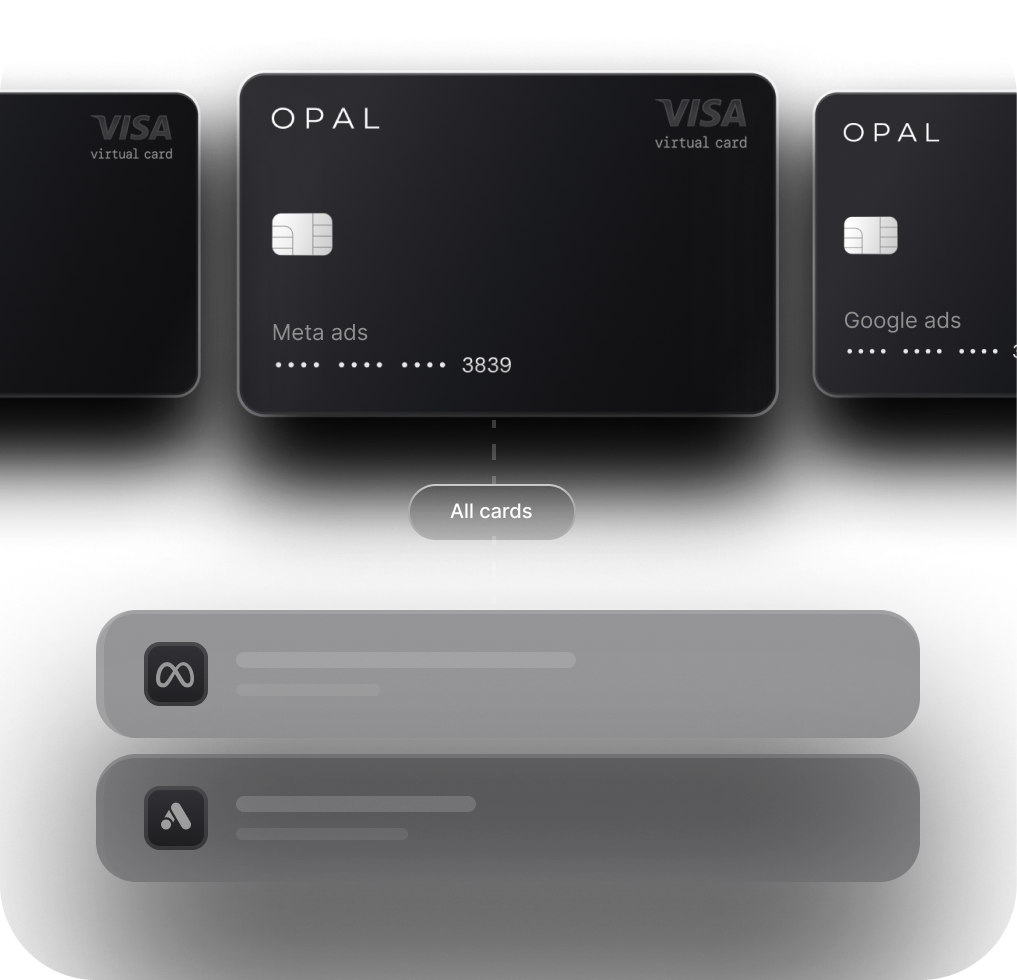
Unlimited virtual cards come free with every account, so each client can have its own card with a spending limit, merchant restrictions, and an expiration date, plus approvals, employee permissions, client-level visibility in real time, and syncing to QuickBooks or Workday.
Cashback of up to 2%, uncapped, applies to eligible ad spend at a rate we confirm on approval, without a personal guarantee, an annual fee, or a hard credit pull. Limits reach $10 million, sized to the advertising spend you manage, not your cash on hand.
What Stays With You
The card sets a ceiling for each client, but it does not insure your receivables. If a client never pays, that client's charges still settle in full by automatic debit when your monthly payment comes due, and a failed debit can lock the card. Deposits, credit tiers, invoicing, and collections stay in your contracts and accounting system.
Opal is not a bank, and a partner bank issues the card. It is available to U.S.-based businesses and works only on supported advertising and media platforms.
To put a separate card and limit behind every client, start with Opal for agencies. Or talk directly to our team to see how we can support your business.
Frequently Asked Questions (FAQs)
How Do Agencies Protect Cash Flow When Clients Pay Late for Ad Spend?
Agencies protect cash flow for client ad spend by collecting pre-funding or a deposit before campaigns run, setting a credit limit for each client, billing large accounts on shorter cycles, and lowering card limits at agreed past-due dates. A cash reserve sized to the largest uncovered client balance absorbs any default that still gets through.
How Big Should a Media Deposit Be?
Size a media deposit to the share of peak unpaid exposure you will not finance. On monthly billing in arrears with net 30 terms, peak exposure approaches 2 months of media, so a half-month deposit covers about a quarter of it. Weekly billing lowers the peak and allows a smaller deposit.
What Is a Healthy Days Sales Outstanding for Media Billings?
A healthy media days sales outstanding figure sits close to your payment terms. Divide open media receivables by media billed over a period, then multiply by the days in that period. A result 15 or more days above your terms means clients are paying late and your exposure is growing.
Can an Agency Charge Late Fees on Unpaid Media Invoices?
An agency can usually charge a late fee or interest on unpaid media invoices when the charge is written into the signed statement of work or services agreement and stays within the governing state's legal limits. Because those limits vary by state, have a lawyer review the clause.
How Should an Agency Account for a Client Who Never Pays for Media?
Under U.S. generally accepted accounting principles, an agency estimates expected credit losses on receivables and carries them net of an allowance, as Accounting Standards Codification Topic 326 requires. Once collecting a media invoice is no longer expected, it is written off against that allowance. An accountant should set the loss rates.
Does a Business Charge Card Protect an Agency From Client Non-Payment?
A business charge card limits how much one client can run up when every client has a separate card and spending limit, but it does not remove the debt. Charges settle in full when the statement comes due, whether or not the client has paid, so deposits and a cash reserve still carry the risk.